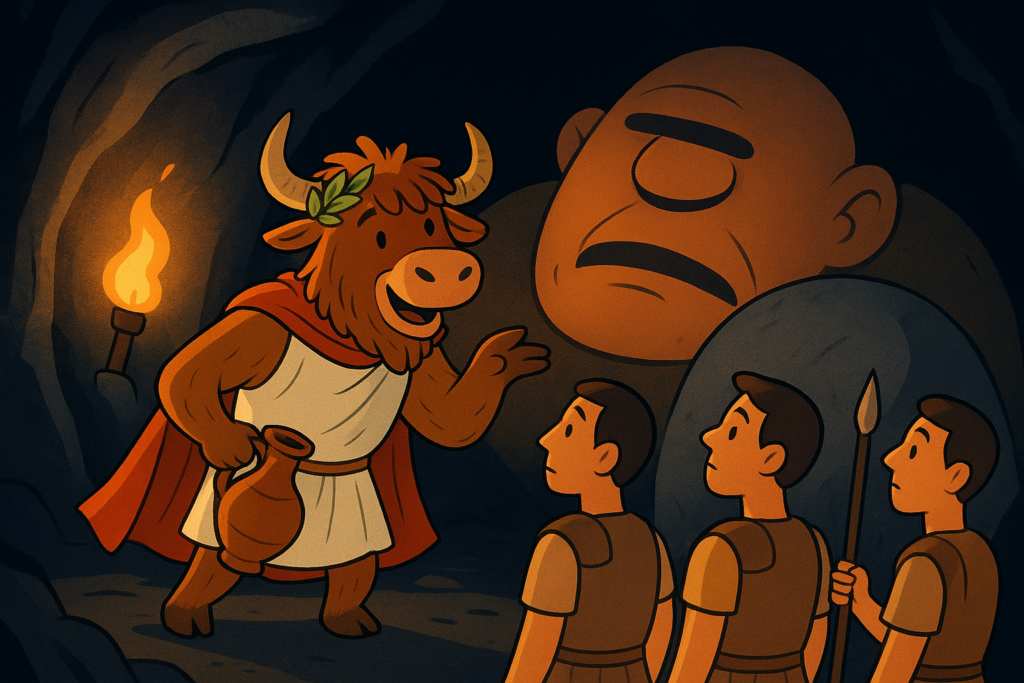
Set sail on an epic adventure with Ulysses, the clever Greek hero from Homer's ancient tale. After the Trojan War, Ulysses just wants to go home to his wife Penelope and son Telemachus on the island of Ithaca. But the gods have other plans! His journey is filled with incredible dangers, like the one-eyed Cyclops, the tempting song of the Sirens, and the six-headed monster Scylla. In this retelling, we've simplified the language to a comfortable B1 Intermediate level, so you can enjoy the story without getting lost.
Every page of this Yak Yacker graded reader comes with a free audio version, so you can read and listen at the same time – a great way to improve your English naturally. Got stuck on a word? No problem! Just tap on any difficult vocabulary, and you'll get an instant explanation. Plus, we've packed the article with handy lesson notes that focus on useful phrases and grammar from the story. All of this is online and completely free for you.
Whether you're studying English for travel, work, or just for fun, following Ulysses' struggles and clever tricks is a memorable way to build your reading and listening skills. Ready to begin? Let's step into the world of gods and heroes!
Ulysses was the clever king of Ithaca, a small rocky island in Greece. He had fought in the long Trojan War, and now, after ten years, he wanted nothing more than to sail home to his wife Penelope and his son Telemachus.
But the journey was far from easy. With twelve ships and many brave men, Ulysses set out across the wild sea. and
One day, they landed on an island of one-eyed giants called Cyclopes. Ulysses and his men explored a huge dark cave full of cheese and sheep. The giant Polyphemus returned and blocked the entrance with a .
"Who are you, little men?" roared the giant. Ulysses answered carefully, "We are only sailors, lost at sea. Please show us kindness." But the giant laughed and two of the men.
Ulysses . That night, he offered the giant some strong wine. Polyphemus drank it all and shouted, "What is your name, stranger?"
"My name is Nobody," said Ulysses with a . Soon, the giant fell into a deep sleep. Ulysses and his men took a large wooden stake and the giant's single eye.
Polyphemus screamed in pain. The other giants rushed to the cave. "Who is hurting you?" they asked. The giant cried, "Nobody is hurting me!" So the others went away, thinking he was mad.
Next morning, the blind giant opened the cave to let his sheep out. Ulysses his men under the animals' bellies. They escaped safely to their ships, but Ulysses shouted back, "My real name is Ulysses, king of Ithaca!"
After many more adventures, the sailors reached the island of the beautiful witch Circe. She turned some of Ulysses' men into pigs with a . But Ulysses was protected by a special herb given by the god Hermes.
"Please, great Circe, turn my men back," begged Ulysses. Circe was by his courage. She returned the men to their human forms and even gave them advice for the dangerous journey ahead.
The next challenge was the Sirens, mysterious creatures whose songs made sailors crash their ships on the rocks. Ulysses had a plan. He put wax in his men's ears so they could not hear. But he wanted to hear the song himself.
"Tie me tightly to the mast," he ordered. "No matter how much I beg, do not untie me." As they sailed past, the Sirens sang with sweet, deadly voices. Ulysses the ropes, but his men held firm until they were safe.
Then came the most terrifying part of the journey: a narrow strait between two monsters. On one side was Scylla, a terrible beast with six long necks and sharp teeth. On the other side was Charybdis, a great that swallowed the sea three times a day.
Sailing through, Ulysses lost some brave men to Scylla's hungry mouths. But he the ship forward with all his strength, and they escaped the whirlpool's pull.
Finally, after twenty years away, Ulysses reached Ithaca alone. His palace was full of rude men who wanted to marry Penelope. But she had remained , waiting for her husband.
With the help of his son Telemachus, Ulysses made a plan. He as an old beggar and entered the palace. Penelope had set a test: whoever could string Ulysses' great bow and shoot an arrow through twelve axes would win her hand.
None of the other men could even bend the bow. Then the old beggar took it. He strung it easily and shot the arrow perfectly. He threw off his disguise and stood before them. "I am Ulysses, king of Ithaca!" he declared. The family was finally reunited, and peace returned to the island.
Ulysses' story is full of exciting words to express clever ideas and dangerous moments. Learning these will help you talk about trickery, hidden identities, and the power of the sea.
- Cunning (adj.): clever and tricky. Ulysses gave a cunning smile when he said his name was Nobody.
- Disguise (n. / v.): a way to change your appearance to hide who you are. Ulysses used a disguise to enter his palace as an old beggar.
- Whirlpool (n.): a powerful, spinning current of water that can pull things under. Charybdis was a deadly whirlpool that swallowed the sea.
- Mast (n.): a tall pole on a ship that holds the sails. Ulysses was tied to the mast so he could hear the Sirens safely.
When we tell a story, the past simple carries the main actions. It moves the plot forward like a camera following one event after another. Nearly every sentence in Ulysses' adventure uses the past simple to show what happened next.
- He offered the giant some strong wine.
- They escaped safely to their ships.
- Ulysses struggled against the ropes, but his men held firm.
Sometimes we need a 'flashback'-an action that happened even earlier than the main events. The past perfect (had + past participle) sets the background. It explains why things are the way they are, or what someone had already done before a new moment.
Look how the past perfect adds depth to Ulysses' tale. These earlier actions make the later choices clearer.
- Before Ulysses offered the wine, the giant had eaten two men.
- Because Ulysses had put wax in his men's ears, they didn't hear the Sirens' song.
- Penelope had waited for twenty years, so the reunion was full of emotion.
Great storytellers mix past simple and past perfect to create a smooth, exciting flow. Now why not try it yourself? Pick a moment from Ulysses' journey and retell it in your own words-use past simple for the main events and past perfect for the backstory.
You could also write about a real-life situation where you had to be clever or make a quick escape. Your stories are just beginning-go on your own adventure with tenses!
- Example: "Ulysses had blinded the giant the night before, so the next morning, they hid under the sheep to escape."
- Challenge: tell how you prepared for a difficult moment-what had you done beforehand?
The Adventures of Ulysses comes from the Irish / James Joyce tradition and is best known as a modernist novel. This Yak Yacker article is an original learner retelling based on James Joyce, 1922; public domain in U.S., so the wording here is simplified for modern learners rather than copied from one old edition.
Older printings, translations, and retellings of this story can vary quite a bit. The original audience was usually adult, but this version is adapted for B1 Intermediate learners studying English. Very difficult source; adapt as simplified episode summaries only.
If you want to look into the source tradition, start with Project Gutenberg.
If you want to keep going, browse more in our English section and review the B1 English Vocabulary List. After that, try 1,200 English Phrases and Expressions for another useful next step.