Meet Tom Sawyer, a clever boy with a big imagination-and a big problem. When his Aunt Polly punishes him by making him whitewash the fence on a sunny Saturday, Tom turns the boring chore into an enviable privilege. Soon, other boys are paying him for the chance to paint too! This classic tale by Mark Twain is full of humor and smart tricks.
In this free Yak Yacker interactive reader, you can read and listen to the story at an A2 English level. Click any tricky word to see a simple English definition. The story audio, together with the lesson notes, will help you learn new vocabulary and grammar easily.
It was a Saturday morning. The sun was and the birds were . But Tom Sawyer was not happy. He had to the big fence in front of his Aunt Polly's house.
Tom looked at the . He felt very . He started to , but soon he heard . His friends were playing in the river. Tom wanted to play too, but he had to work.
Suddenly, Tom had a . He stopped painting and smiled. He took his brush and began to paint again-but this time he looked very . He painted , like an artist.
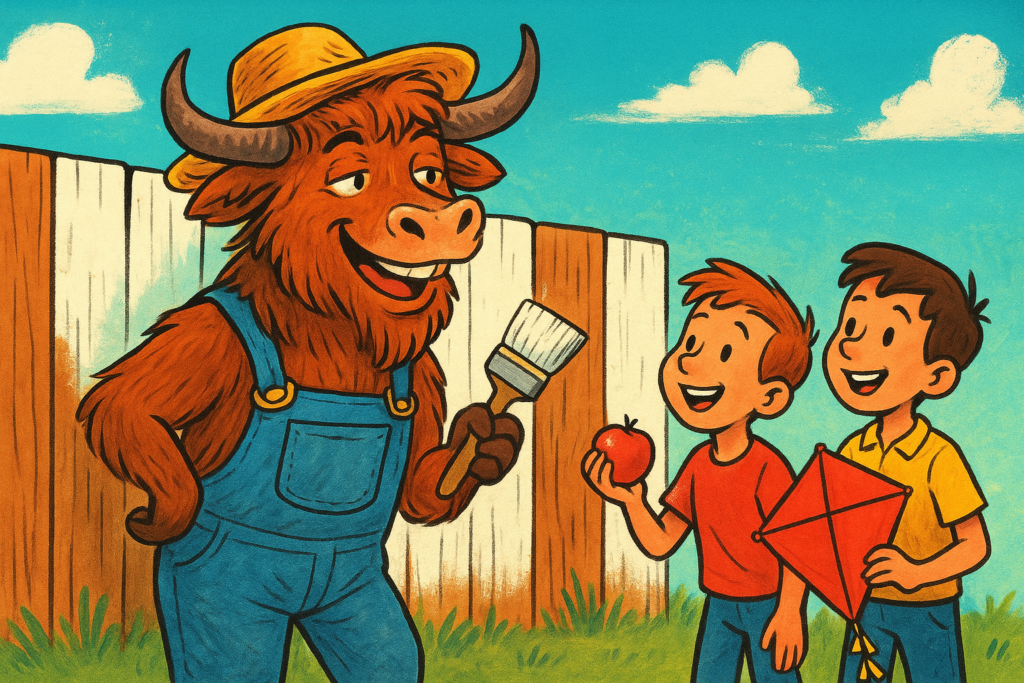
Ben Rogers came . He was eating a big red apple. 'Ha! You have to , Tom!' Ben laughed. Tom did not look at him. He just painted and to admire his work.
Ben watched. He was . 'Tom, are you saying this isn't work?' asked Ben. 'Work? This is ! Not every boy gets to paint a fence,' said Tom. He kept painting with a smile.
Ben wanted to try. 'Please, Tom, let me paint a little!' he said. Tom pretended to . 'Well, I don't know. Aunt Polly is very about this fence.' But Ben offered his apple, and Tom finally .
Soon, more boys came. They saw Tom's happy face and felt . 'Can we try?' they asked. Tom for many things: a kite, a dead rat on a string, twelve marbles, and even a blue bottle. By the afternoon, the fence had three of whitewash!
Tom sat under a tree with his . He smiled. He learned a : if you make work look like play, people will want to do it. That was a summer day.
Tom Sawyer used some clever words and actions. Let's look at new words from the story. They can help you talk about work, feelings, and persuasion.
- whitewash: a white paint for walls and fences. "Tom had to whitewash the fence."
- admire: to look at something you think is good. "He stepped back to admire his work."
- particular: wanting something exactly right. "Aunt Polly is very particular about this fence."
- offer: to give something in exchange. "Ben offered his apple."
- jealous: wanting what someone else has. "The boys saw Tom's happy face and felt jealous."
- treasure: something very special. "Tom sat under a tree with his treasures."
Tom didn't force his friends. He made them want to paint! This is persuasion. He used short phrases to make the work look special and fun.
To do the same, you can say things like: "This is fun!" even when it's a chore. Or make it seem rare: "Not every boy gets to do this." You can also show how important it is: "Aunt Polly is very particular."
- "This isn't work, it's fun!" - Change how you see the task.
- "Not every boy gets to paint a fence." - Make it seem special.
- "Aunt Polly is very particular." - Show that it's important and not easy.
- To ask, say: "Please, let me try!" and maybe offer something in return.
Now you know Tom's secret! Think of a boring job you have to do. How can you make it sound like play? Try using Tom's phrases with a friend or family member.
You can also rewrite the story. What if Tom had to clean the kitchen? Use the same words and tricks. The more you practice, the better you'll get at persuading people!
Tom Sawyer Whitewashes the Fence comes from the American / Mark Twain tradition and is best known as a novel episode. This Yak Yacker article is an original learner retelling based on Mark Twain, 1876; public domain, so the wording here is simplified for modern learners rather than copied from one old edition.
Older printings, translations, and retellings of this story can vary quite a bit. The original audience was usually kids/general, but this version is adapted for A2 Elementary learners studying English. Use as episode, not full novel.
If you want to look into the source tradition, start with Project Gutenberg.
If you want to keep going, browse more in our English section and review the A2 English Vocabulary List. After that, try English Question Words for another useful next step.