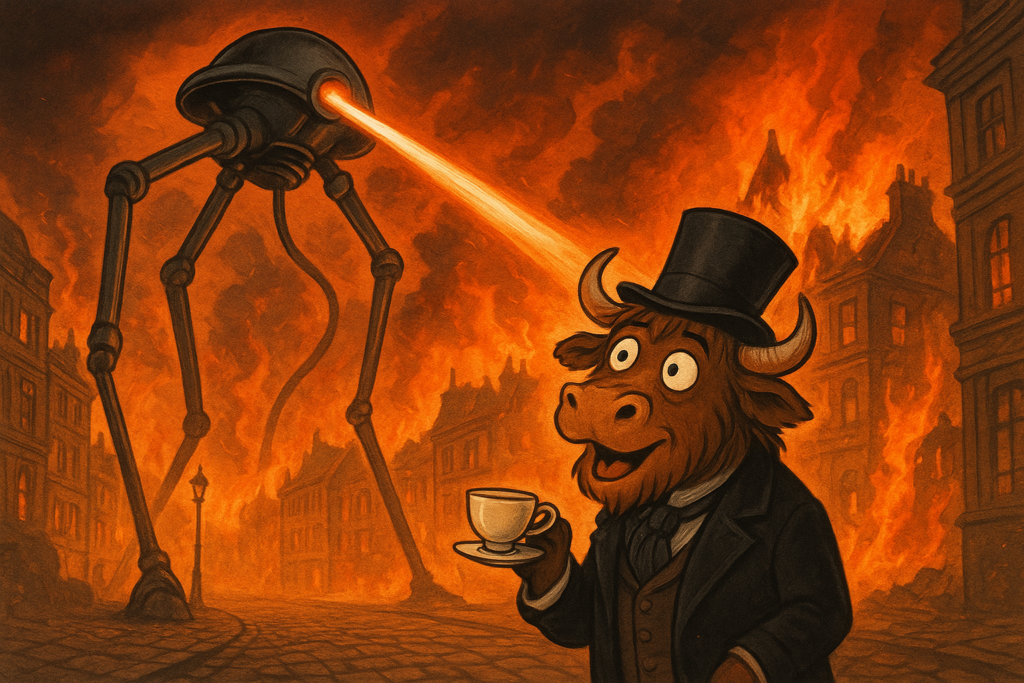
Welcome to an alien invasion that shook the world! In this B1 intermediate retelling of H.G. Wells' classic, you'll follow one man's terrifying journey as gigantic Martian tripods stride across the English countryside, unleashing heat-rays and black smoke. Our story keeps the suspense and wonder of the original, but with clear language perfect for English learners.
As you read, tap any tricky word to see its meaning instantly – no dictionary needed. You can also listen to the full story audio to improve your pronunciation and rhythm. Along the way, we've added friendly lesson notes to explain key grammar and vocabulary, so you learn English naturally while enjoying a masterpiece of science fiction.
Ready to face the Martians? Just scroll down and start reading for free. No sign-up, no stress – just a great story and friendly learning tools.
In the last years of the nineteenth century, nobody thought about from space. People in England went to work, drank tea, and read newspapers. They believed they were .
But across space, on the planet Mars, something was . The Martians were preparing to Earth. I, Tom, lived in a small town near London. One night, I saw a strange in the sky.
A few days later, I was walking on Horsell Common when I saw a huge . It had fallen from the sky and was half buried in the sand. A crowd gathered. A man asked, 'What is it?'
'It's a ,' someone said. But then the top of the cylinder began to . 'Look! Something is !' I shouted. The crowd fell silent.
Suddenly, an with huge eyes came out. It moved slowly. Then a shot from a machine. It was a terrible . People screamed and fell.
'Run!' I yelled. I ran as fast as I could. The heat-ray trees and people behind me. I didn't stop until I reached home. My wife Sarah opened the door.
'Tom! What happened?' she cried. 'They're ,' I said, . 'We have to leave!' We packed quickly and joined the people running away from London.
On the road, we saw tall metal machines walking on three legs. ',' a man whispered in fear. They moved than a man could run. Their heat-rays destroyed everything.
'We're not here,' Sarah said, her voice . We hid behind a broken house. 'Don't make a sound,' I whispered. A tripod passed us, its metal feet shaking the ground.
Later, we met a soldier. He looked and dirty. 'They're ,' he said. 'We tried to fight, but our guns are .' I felt hopeless. Was this the end?
We had to keep moving. Suddenly, in a crowd of people, Sarah was pushed away from me. 'Sarah!' I shouted, but I couldn't find her. I was alone, hiding in empty houses, with no of her.
Days passed. I saw a strange red growing everywhere, covering the land. The tripods people and drank their blood. I thought I would never see Sarah again.
Then one morning, I saw a tripod that didn't move. Another one was . 'They're dying!' someone cried. The Martians were falling to the ground, dead.
We soon understood: the Martians had no against Earth's tiny . The smallest living things on our planet had killed the invaders. I rushed home, hoping for a miracle.
When I reached my house, Sarah was there. She ran to me. 'Tom! I thought you were dead!' We held each other, crying with . We had survived.
Life slowly returned to normal, but we never forgot the . From that time, we knew that we are not alone in the universe, and that even tiny things can .
At the end of the 1800s, no one worried about space threats. English people worked, drank tea, and read papers, feeling safe.
But on Mars, Martians were watching and planning to attack Earth. I, Tom, lived near London. One night I saw a strange green light.
Days later, on Horsell Common, I found a large metal cylinder fallen from the sky, half-buried. A crowd came, and someone wondered what it was.
One person thought it was a meteor, but the top started turning. I yelled that it was opening, and everyone went quiet.
An octopus-like creature with big eyes emerged. Then a machine fired a blinding heat-ray, and people screamed and died.
I shouted for everyone to run. I sprinted home while the heat-ray burned things behind me. My wife Sarah let me in.
Sarah asked what happened. I told her they were coming and we had to flee. We packed and fled London with others.
We saw tall three-legged metal machines, called Tripods, moving fast and destroying everything with heat-rays.
Sarah said we weren't safe. We hid behind a broken house. I told her to be quiet as a Tripod stomped past, shaking the ground.
We met a soldier who said the Martians couldn't be stopped and guns were useless. I felt hopeless, thinking it might be the end.
We kept moving, but in a crowd, Sarah got separated. I couldn't find her and was alone, hiding with no news of her.
Days later, red weed spread. Tripods captured people and drank blood. I lost hope of seeing Sarah again.
Then one day, I saw still Tripods. Someone shouted they were dying. The Martians fell dead.
We realized Earth's bacteria killed the Martians. I hurried home, hoping for a miracle.
At home, Sarah was there. She thought I was dead. We embraced, crying with joy-we survived.
Life went back to normal, but we never forgot the horror. We learned we're not alone and tiny things can save us.
This adaptation of The War of the Worlds is full of words to describe an invasion from space. Getting comfortable with these terms will help you read and talk about science fiction, danger, and the unknown.
Pay attention to how the narrator uses specific nouns like cylinder, tripod, and heat-ray to paint a clear picture of the Martian technology. Adjectives like octopus-like and unstoppable make the threat feel real and frightening.
- cylinder - a long round metal object that fell from the sky
- tripods - tall walking machines with three legs
- heat-ray - a blinding light that burns and destroys
- bacteria - microscopic life that became Earth's unexpected defence
The story uses a mix of past simple and past continuous to make events feel sudden and urgent. The past continuous sets the scene (I was walking…), and the past simple delivers the shock (…when I saw a huge metal cylinder). This contrast keeps you on the edge of your seat.
Strong verbs and quick speech also push the action forward. Words like yelled, screamed, whispered, and gasped show emotion and pace without needing long descriptions. Notice how short sentences like 'Run!' or 'Don't make a sound' increase the feeling of panic.
- Past continuous for background: 'A tripod was passing us, its metal feet shaking the ground.'
- Past simple for main events: 'Suddenly, a blinding light shot from a machine.'
- Powerful reporting verbs: 'I yelled', 'someone screamed', 'he whispered in fear'
- Short exclamations: 'We have to leave!', 'They're dying!'
Stories told with 'I' put you inside the narrator's mind. You see the world through Tom's eyes, so his emotions and observations are your guide. When he describes something as 'terrible' or 'strange', you know to expect danger.
To follow the plot smoothly, look for time markers (One night, A few days later, Suddenly, Then one morning) and reporting verbs that introduce speech or thoughts. The panic is not always spelled out directly - you often have to infer the danger from the characters' reactions and the chaos around them.
- Watch for time words: 'One night', 'Later', 'Days passed'
- Notice how characters speak: 'Tom! What happened?' shows worry and confusion
- Infer threat from description: 'The heat-ray burned trees and people behind me' tells you it's a weapon
- Track the narrator's feelings: 'I felt hopeless' signals a low point in the survival journey
Now that you've seen how vocabulary, grammar, and narrative choices work together, try re-reading the story with these tools in mind. Notice how the author keeps you close to Tom's experience, and how small things - like the twist with bacteria - carry huge meaning.
Why not try telling a survival story of your own? You could describe a dangerous situation you read about or imagine, using first-person narration, strong action verbs, and some of the alien-threat vocabulary you've just learned. Every time you tell a story, you make these patterns stick.
The War of the Worlds comes from an older public-domain story tradition and is best known as a public_domain_story_retelling. This Yak Yacker article is an original learner retelling based on public-domain source material, so the wording here is simplified for modern learners rather than copied from one old edition.
Older printings, translations, and retellings of this story can vary quite a bit. This version is adapted for B1 Intermediate learners studying English.
If you want to keep going, browse more in our English section and review the B1 English Vocabulary List. After that, try 1,200 English Phrases and Expressions for another useful next step.