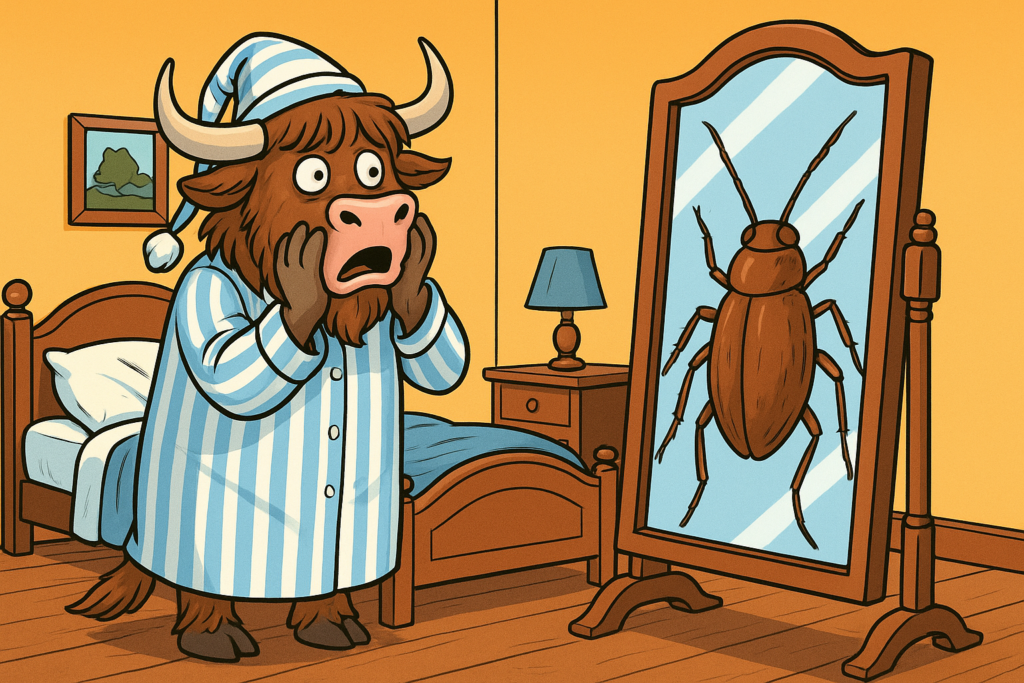
This B1 Intermediate retelling of The Metamorphosis keeps the plot clear for learners while still giving the story some atmosphere and momentum. One morning, Gregor Samsa woke from uneasy dreams. He found himself changed into a giant insect.
This version is written for English-speaking learners and includes clickable word help inside the story, full story audio, and lesson notes after the reading. It is free to use on Yak Yacker and is designed to feel natural, readable, and manageable in English.
One morning, Gregor Samsa woke from . He found himself a giant insect. He looked at his moving in the air and felt confused. 'What has happened to me?' he thought.
He tried to get out of bed, but his new body was hard to control. He until he finally . The noise made his family . 'Gregor, are you all right?' his mother asked. 'Is something wrong?' his father added. Gregor tried to answer, but only a came out.
His sister Grete whispered, 'He sounds sick. Maybe we should .' Then the office manager . 'Mr. Samsa!' he shouted through the door. 'You are late for work! What is your ?' Gregor panicked. He needed his job to .
Gregor managed to with his mouth. When he opened it, everyone . The manager and ran down the stairs. His mother fainted. His father picked up a and pushed Gregor back into his room. 'Go back, you monster!' he cried.
From that day, Gregor lived in his room. His sister Grete brought him food. At first, she brought milk and bread, but Gregor no longer liked fresh food. He preferred old vegetables and cheese. He when she came in, so he would not .
Grete noticed the room was too full of furniture for him to move easily. She and her mother decided to some things. But Gregor did not want to the picture on the wall. He the wall and covered it with his body. When his mother saw him there, she screamed and fainted again.
As weeks passed, the family had . Gregor used to them, but now they had to work. They took in three to earn extra money. Gregor stayed hidden in his room, feeling more and more alone.
One evening, the lodgers heard Grete playing the violin. They asked her to play for them. Gregor, , the living room. 'I just want to hear my sister play,' he thought. But when the lodgers saw him, they shouted, 'Disgusting! We are leaving immediately!'
After the lodgers left, the family gathered in the living room. 'We must that thing,' Grete said. 'It is not Gregor anymore. It is just an insect that .' Gregor heard her words and felt a deep sadness. 'She is right,' he thought. 'They will be better off without me.'
Gregor crawled back to his room, . The door was locked behind him. That night, he . In the morning, the cleaning woman found him and said, 'Come look! It's dead.'
The family stood over the . 'Thank God,' said Mr. Samsa. Mrs. Samsa smiled through her tears. Grete looked at the body and then at the . 'Let's go out,' she said. 'It's a beautiful day.'
They took a tram to the countryside. For the first time in months, they felt . 'We have jobs now, and we are healthy,' said Mr. Samsa. 'Maybe we can find a . And Grete, you have grown into a .' Grete stretched her arms and smiled. At the end of their walk, they talked about the future with .
One morning, Gregor woke up to find he'd turned into a huge bug. He saw his many legs wiggling and was confused. He thought, "What happened to me?"
He struggled to get up because his body was awkward. He rocked until he fell, making noise. His family called out, asking if he was okay. When Gregor tried to respond, only odd squeaks came out.
His sister whispered he sounded ill and should see a doctor. Then his boss came yelling that he was late. Gregor panicked because he needed the job to care for his family.
Gregor unlocked the door with his mouth. Seeing him, everyone screamed. The manager fled, his mother passed out, and his father forced him back, shouting, "Go back, monster!"
Gregor stayed in his room. Grete brought him food, but he now preferred rotten food. He hid under the sofa to avoid scaring her.
Grete noticed the furniture made it hard for him to move, so they planned to remove some. But Gregor clung to a picture on the wall. His mother saw him there, screamed, and fainted again.
Weeks later, money was tight. Gregor had supported them before, but now they worked and took in lodgers for extra cash. Gregor felt lonelier, hidden away.
One evening, Grete played violin for the lodgers. Gregor loved her music and crawled out to listen. The lodgers saw him, screamed in disgust, and left.
After the lodgers left, the family agreed to get rid of the insect. Grete said it wasn't Gregor anymore. Gregor heard, felt sad, and thought they'd be better off without him.
Gregor, weak and hurting, crawled back. The door was locked. That night, he died. The next morning, the cleaner found him dead and called out.
The family saw the small, dried-up body. Mr. Samsa said, "Thank God." Mrs. Samsa smiled tearfully. Grete looked at the sunshine and said, "Let's go out. It's a beautiful day."
They took a tram to the countryside, feeling light for the first time in months. Mr. Samsa noted they had jobs and health, and Grete had grown strong. They talked hopefully about the future.
Let's revisit some words and phrases that paint Gregor's strange new world. Understanding these will help you describe unusual situations and emotions.
- uneasy (adjective): feeling worried or uncomfortable. 'He woke from uneasy dreams.'
- panicked (verb, past): acted out of sudden, strong fear. 'Gregor panicked when the manager arrived.'
- fainted (verb, past): became unconscious for a short time. 'His mother fainted when she saw him.'
- lodgers (noun, plural): people who pay to live in someone else's home. 'The family took in three lodgers.'
- better off (phrase): in a more favourable situation. 'They will be better off without me.'
- get rid of (phrase): to remove or throw away something unwanted. 'We must get rid of that thing.'
This story shows two handy structures for talking about the past: 'used to' for old habits or states, and 'managed to' for achieving something difficult.
Notice how they work: 'used to' implies the situation has changed, while 'managed to' focuses on success despite challenges.
- Gregor used to provide for his family. (He does not do that now.)
- She used to bring milk and bread, but he no longer liked fresh food. (The habit stopped.)
- Gregor managed to unlock the door with his mouth. (It was very hard, but he succeeded.)
- Try making your own: 'I used to live in the city, but now I live in the countryside.' and 'I managed to catch the tram just in time!'
The writer uses many expressions to show how characters feel and how their state changes. You can learn from these patterns to make your own English more vivid.
- Use 'felt + adjective' for emotions: 'He felt confused.', 'They felt light.', 'He felt a deep sadness.' (Note: 'a deep sadness' is a noun, which works too.)
- Use 'became / found himself + changed' for transformations: 'He found himself changed into a giant insect.'
- Use 'stopped + -ing' for something that ended: 'He stopped breathing.'
- Add 'immediately' or 'finally' to show sudden or eventual actions: 'The lodgers said, "We are leaving immediately!"' 'He finally fell onto the floor.'
You've just met some powerful words and structures. Why not imagine Gregor's diary entry for that first morning, using 'used to' and 'managed to'?
Keep an eye out for these patterns when you read or listen to stories in English - each one you notice makes you a stronger reader and speaker.
The Metamorphosis comes from the Czech / Franz Kafka tradition and is best known as a absurdist novella. This Yak Yacker article is an original learner retelling based on Franz Kafka, 1915; public domain in U.S., so the wording here is simplified for modern learners rather than copied from one old edition.
Older printings, translations, and retellings of this story can vary quite a bit. The original audience was usually adult/general, but this version is adapted for B1 Intermediate learners studying English. Use public-domain translations or own retelling.
If you want to look into the source tradition, start with Project Gutenberg.
If you want to keep going, browse more in our English section and review the B1 English Vocabulary List. After that, try 1,200 English Phrases and Expressions for another useful next step.