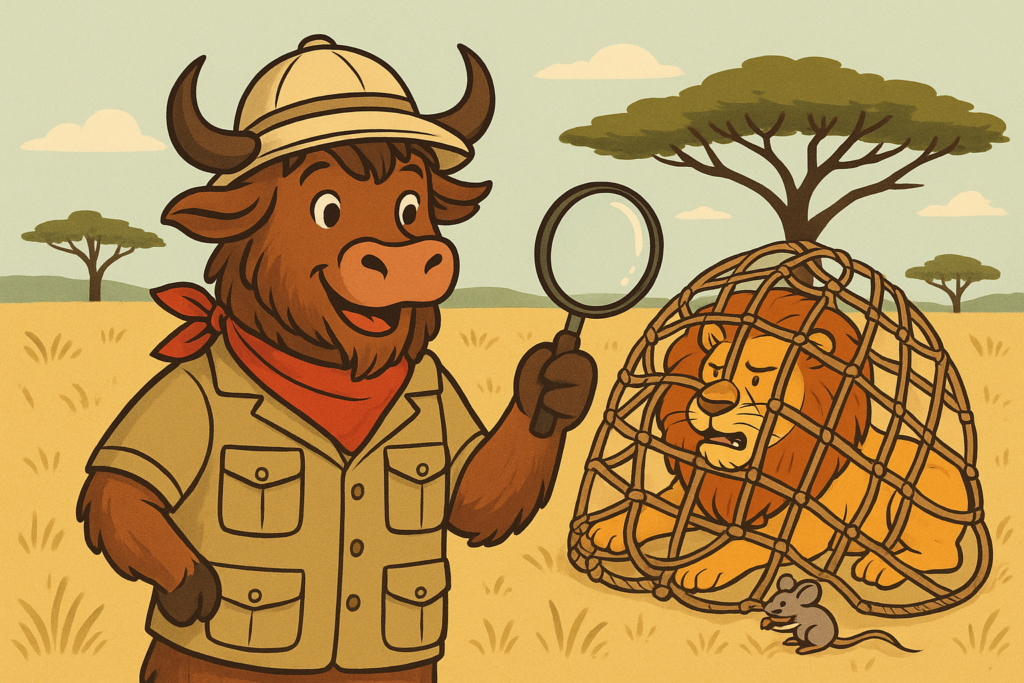
Welcome to the classic tale of The Lion and the Mouse, retold in easy English for beginners (CEFR level A1). One day, a mighty lion catches a tiny mouse who promises to help him someday. Later, the lion is caught in a hunter's net, and the mouse gnaws through the ropes to set him free. This simple story shows that even little friends can be a great help, and kindness is never wasted.
Read or listen to the story with our free interactive reader. Click on any hard word to see its meaning, play the story audio to hear natural pronunciation, and check the lesson notes for sentence patterns and new words. It's a fun way to learn English, one little story at a time.
A big lion slept under a tree. A little mouse ran over his paw.
The lion . He the little mouse in his big paw.
"Please let me go!" said the mouse. "One day I can you."
The lion . "You are so little! How can you me?" But he let the mouse go.
Some days later, the lion a trap. He was in a big .
The little mouse the lion. She came and the net with her teeth. She the lion get free.
The lion said, "Thank you, little mouse!" is good. A friend can be .
A big lion slept under a tree. A little mouse ran over his foot.
The lion woke up and caught the little mouse with his big paw.
"Don't hurt me!" said the mouse. "I might help you one day."
The lion laughed. "You're too small to help me!" But he set the mouse free.
A few days later, the lion got caught in a trap-a big net.
The little mouse heard the lion. She chewed the net with her teeth and freed him.
The lion said, "Thank you, little mouse!" Kindness is good. A friend doesn't have to be big.
Let's meet the characters and things in the story. A lion is a big cat. A mouse is a small animal. The lion's paw is his foot. A tree is tall with leaves. A net is like a big spider web. And a trap can catch animals.
We also have some describing words: big and little. Big means large, like an elephant. Little means small, like a mouse.
- lion: a big, wild cat
- mouse: a very small animal
- paw: the foot of an animal
- net: a thing made of ropes, for catching
The story is in the past. We use the simple past to talk about finished actions. Many verbs add -ed: helped, walked. Some verbs are irregular: run → ran, wake up → woke up.
In the story, both kinds appear. Look: The lion slept. The mouse ran. The lion caught the mouse. The mouse gnawed the net.
- Regular: help → helped, laugh → laughed
- Irregular: run → ran, say → said
- Irregular: sleep → slept, catch → caught
This story teaches us about kindness. The lion is big, and the mouse is little. But the mouse helps the lion. Kindness is not about size.
We learn that friends can be different. A friend can be big or little. It's good to help others, even if they are small.
- "Let me go!" - ask someone to free you
- "Thank you!" - show you are grateful
- A friend can be big or little - size doesn't matter
You learned new words and the simple past. Try to tell the story to a friend. Use the past tense verbs!
Can you tell a story about helping someone? What happened? Use words like 'helped', 'said', and 'thank you'.
The Lion and the Mouse - An English Story for Beginners comes from an older public-domain story tradition and is best known as a public_domain_fable_retelling. This Yak Yacker article is an original learner retelling based on public-domain source material, so the wording here is simplified for modern learners rather than copied from one old edition.
Older printings, translations, and retellings of this story can vary quite a bit. This version is adapted for A1 Beginner learners studying English.
If you want to keep going, browse more in our English section and review the A1 English Vocabulary List. After that, try English Question Words for another useful next step.