In this A2 elementary English story, a young goat (a kid) is left alone at home. A hungry wolf comes knocking, but the clever kid has a plan to stay safe. It's a lively retelling of a classic fable, with simple sentences and useful everyday words.
When the wolf pretends to be the kid's mother, the kid listens carefully. She asks for a password, and the wolf cannot give it. The kid bravely tells the wolf to go away, and soon her mother returns. This timeless tale teaches children to be cautious and trust their instincts.
Read along with our story audio, click on any word for an instant definition, and check the lesson notes for extra practice. It's a free, fun way to improve your English reading and listening skills.
Once there was a little kid. He lived with his mother in a near the .
One day, Mother Goat needed to go to the . She said, "I am . Do not open the door for anyone. Only open it for me." Then she him and left.
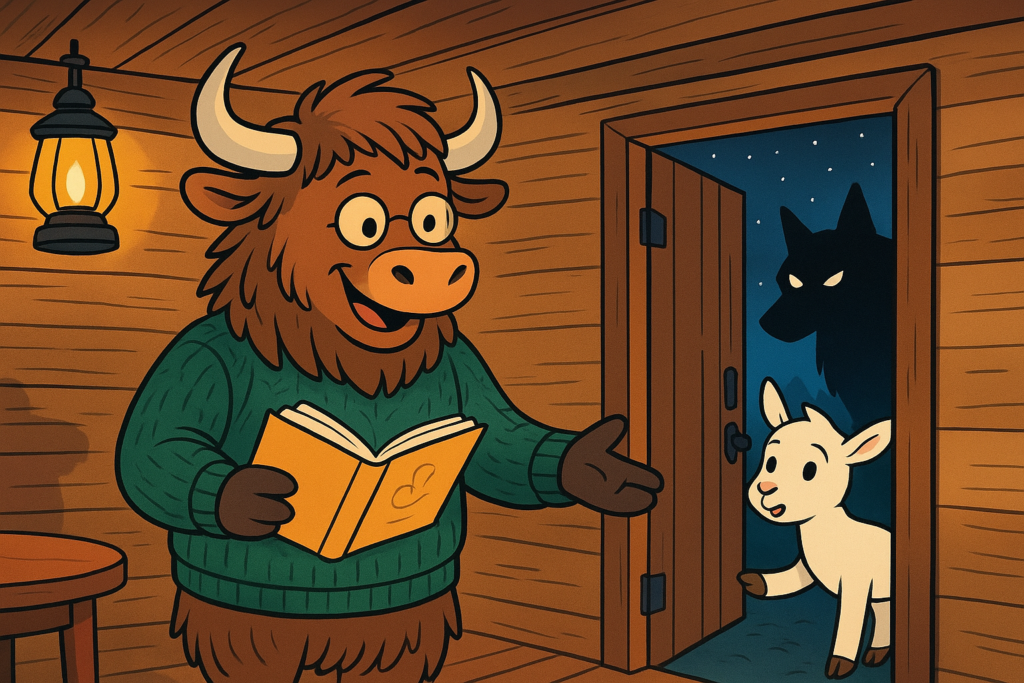
Soon, there was a at the door. Knock! Knock! It was a wolf! The wolf said in a , "Open the door, my little kid. It is your mother." But the kid was . He did not open the door. He said, "My mother has a sweet voice. Your voice is . You are not my mother."
The wolf tried again. He some honey to make his voice sweet. Then he came back. Knock! Knock! "Open the door, my dear kid. It is your mother." Now his voice was . But the kid was . He said, "My mother has white feet. Show me your white foot!"
The wolf to the kitchen. He put his foot in a . Now his foot was white! He went back to the door. "Look! Here is my white foot," he said, it under the door.
The kid saw the white foot. But he heard the wolf's voice again. It was sweet, but something was wrong. The kid said, "You have a white foot, but you are not my mother. I will not open the door! !"
The wolf was . He and went away into the .
Later, Mother Goat came home. She knocked and called, "Open the door, my little kid. It is your mother." The kid saw her white feet and heard her sweet voice. He . He told her about the wolf.
Mother Goat him. "You were very and ," she said. "You kept yourself safe." And they had a warm dinner together.
A young goat lived with his mom in a small house near the forest.
One day, the mom had to go shopping. She told her kid, "Don't open the door for anyone but me." She kissed him and left.
Soon a wolf knocked. He said softly, "Open the door, I'm your mother." But the kid was smart. He didn't open it and said, "My mom's voice is sweet, yours is rough. You're not my mom."
The wolf drank honey to sweeten his voice. He knocked again and said, "Open up, kid, it's your mom." His voice was soft, but the kid said, "My mom has white feet. Show me your foot!"
The wolf ran to the kitchen and dipped his foot in flour to make it white. He went back and showed his white foot under the door.
The kid saw the white foot but still didn't trust the wolf's voice. He said, "You have a white foot, but you're not my mom. I won't open the door! Go away!"
The wolf got mad. He growled and left into the forest.
Later, the mom came home. She knocked and called. The kid saw her white feet and heard her sweet voice, so he opened the door and told her about the wolf.
The mom hugged him and said, "You were brave and clever. You kept yourself safe." Then they had a nice dinner.
This classic tale is full of useful words for A2 learners. Let's explore some key nouns and adjectives that you can use every day.
- kid: a young goat or a child (here, a young goat)
- knock: the sound when you hit a door
- rough voice: a voice that sounds hard and not gentle (opposite: sweet voice)
- flour: white powder used for baking bread or cookies
- clever: smart and able to think quickly
- brave: not afraid to face danger
In the story, Mother Goat and the wolf use commands to tell the kid what to do. In English, commands (also called imperatives) are easy: just start with the verb! To tell someone NOT to do something, use 'Do not' + verb.
- "Open the door." (command)
- "Do not open the door for anyone." (negative command)
- "Show me your white foot!" (command with an object)
- "Go away!" (short command)
- Tip: Add 'please' to sound more polite: "Please open the door."
The story is told in the past tense. You'll see many verbs changed to talk about things that already happened. Regular verbs add -ed (like 'knocked'), while irregular verbs change completely (like 'say' → 'said').
- Regular past: knock → knocked, open → opened, kiss → kissed, live → lived (just add -d if the verb ends in -e).
- Irregular past: say → said, come → came, run → ran, go → went, drink → drank, put → put (no change), see → saw, hear → heard, tell → told, have → had.
- Example: "He drank some honey." "She went to the market." "The wolf said, 'Open the door.'"
- Practice tip: Read the story aloud to remember regular and irregular forms together.
You've learned some key words, how to give commands, and how to use past tense. Why not try retelling the story yourself? It's a fun way to practise speaking and writing.
- Imagine you are the kid: tell your friend to "Close the door!" and "Don't let anyone in!"
- Tell the story to a family member using past tense: "Once there was a little kid..."
- Can you add a new twist? What if the wolf tried again? What would you say?
The Kid comes from the American / public-domain screen or print culture tradition and is best known as a silent feature film. This Yak Yacker article is an original learner retelling based on 1921 film; public domain in U.S., so the wording here is simplified for modern learners rather than copied from one old edition.
Older printings, translations, and retellings of this story can vary quite a bit. The original audience was usually kids/general, but this version is adapted for A2 Elementary learners studying English. Chaplin character/trademark-like likeness caution; retell plot generically.
If you want to look into the source tradition, start with Project Gutenberg.
If you want to keep going, browse more in our English section and review the A2 English Vocabulary List. After that, try English Question Words for another useful next step.