Welcome to our B1 intermediate retelling of Edgar Allan Poe's classic story, 'The Cask of Amontillado.' This dark tale follows Montresor, a man who feels deeply insulted by his friend Fortunato. Seeking revenge, he lures Fortunato into the eerie catacombs beneath his palazzo with the promise of a rare wine called Amontillado.
As they descend into the damp, bone-lined tunnels, the tension builds. You'll follow the cunning plan and discover the chilling outcome. This free graded reader includes story audio, so you can listen as you read, plus clickable word help for tricky vocabulary.
At the end, you'll find helpful lesson notes to reinforce your learning. Whether you're practicing English on your own or in class, this story offers a gripping way to improve your reading and listening skills.
I had a problem with a man called . He many times with . I was very angry, but I never showed it.
One evening during the , I saw him. He was wearing a and looked very .
I and said, 'Fortunato! I am so happy to see you.'
He looked at me with . 'Montresor,' he , 'what brings you here?'
'I have a large of Amontillado wine,' I told him. 'But I am not sure if it is the real thing. What bad luck to meet you, since everyone says you are the best wine . But I will ask someone else.'
His face became . 'Amontillado? You must let me it. Take me there !'
'But my friend,' I said, 'look at you. You are . The air in my underground is cold and . I do not want you to get sick.'
He waved his hand. 'A little cold means nothing! The wine is much more important. Let us go.'
I pretended to worry. 'You are right. Come, then. I will take you to my palazzo.'
We walked through the to my home. It was empty because all the servants had gone to the carnival. I had planned this .
We went down some steps into the , stone . I lit two and gave one to Fortunato. The air smelled of old earth and wine.
'Where is the Amontillado?' he coughed. 'It is further in,' I said. 'Rest a moment. Here, some of this wine.' I handed him a bottle.
He . 'Good wine,' he said, 'but I want the Amontillado.' We walked deeper into the .
At the end of a narrow passage, I stopped. 'The cask is inside that little room,' I said, pointing to a small in the wall.
Fortunato stepped inside. Before he could turn around, I quickly a chain around his waist. He was now to the stone wall.
He , thinking it was a joke. 'Montresor, let me go. This is very funny, but the Amontillado?'
I did not answer. Instead, I started to with stones and that I had hidden there.
Fortunato's laugh stopped. 'What are you doing? Montresor! Your friend! Let me out!'
I worked . 'Yes, my friend,' I said .
He began to . The sound was terrible, but I kept building. Soon the screams stopped.
When the wall was almost finished, I looked through a small hole. All was quiet. I dropped a inside. It landed on the floor and stayed lit. I saw nothing else.
I pushed the last stone into place. The wall was . That was fifty years ago. No one has ever found Fortunato's body. May he rest in peace.
A man named Fortunato often insulted me. I was very angry but hid my feelings.
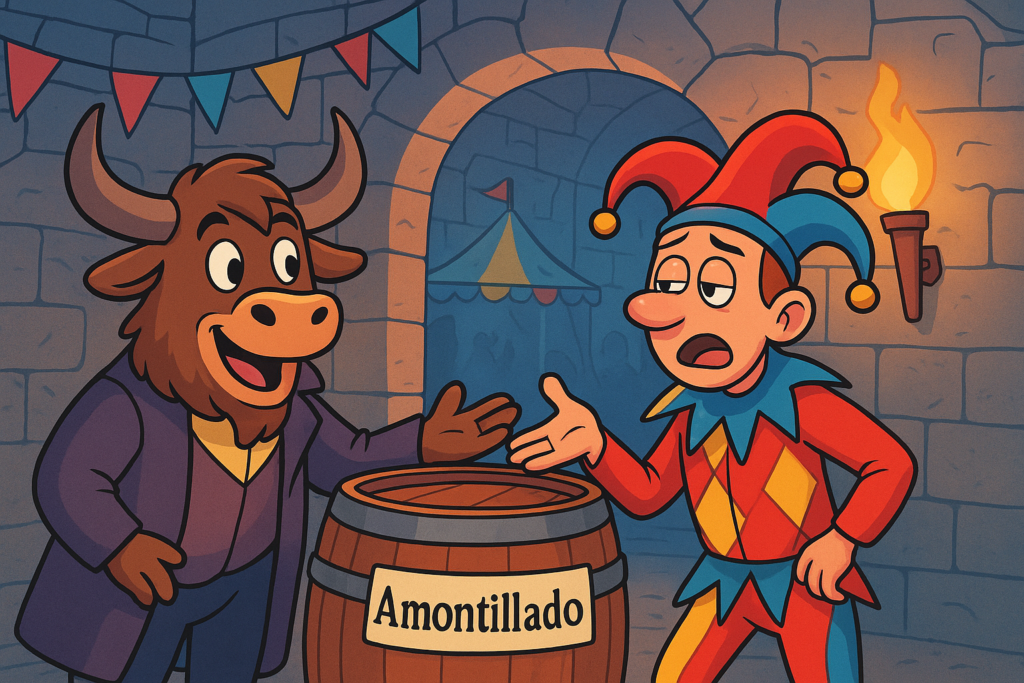
During the carnival, I met him dressed as a jester and drunk.
I smiled and greeted him warmly.
He asked me what I was doing there.
I said I had a big barrel of Amontillado wine but wasn't sure it was real. I pretended it was bad luck to meet him because he's an expert, and I'd ask someone else.
He proudly insisted on tasting it and told me to take him there right away.
I pointed out his cough and warned him the vaults were cold and damp, saying I didn't want him to get sick.
He said a little cold didn't matter and the wine was more important, so we should go.
I pretended to worry, agreed, and said I'd take him to my house.
We walked through dark streets to my empty home; I had planned for the servants to be at the carnival.
We went down steps into damp stone vaults. I lit two torches, gave him one, and the air smelled of old earth and wine.
He coughed and asked where the wine was. I said it was further in, offered him a drink, and gave him a bottle.
He drank deeply, said it was good but wanted the Amontillado, so we went deeper.
At the end of a narrow passage, I stopped and pointed to a small niche, saying the cask was inside.
He stepped in, and before he could turn, I quickly chained him to the wall.
He laughed, thinking it was a joke, and asked to be let go while reminding about the wine.
I didn't answer and started building a wall with hidden stones and mortar.
He stopped laughing and pleaded, calling me his friend.
I worked slowly and coldly replied, 'Yes, my friend.'
He screamed terribly, but I kept building until the screams stopped.
When the wall was nearly done, I looked through a gap. All was quiet. I dropped a burning torch inside; it stayed lit but I saw nothing else.
I placed the last stone. Fifty years have passed, and no one has found his body. May he rest in peace.
This story builds suspense by letting the reader know more than Fortunato does. Montresor keeps smiling, speaking politely, and pretending to be concerned, while the real danger is hidden underneath his calm words.
That gap between appearance and reality is what makes the scene tense. In suspense stories, small details matter: a cough, a dark passage, a locked chain, a wall of stones. Each one quietly raises the pressure.
- Suspense grows when the reader can sense danger before the character does.
- Polite words can hide cruel intentions.
- Small descriptive details help create a creepy mood.
The story mainly uses the past simple to show completed actions: "I saw him," "He looked at me," "We walked." This tense is perfect for moving a story forward step by step.
It also uses the past continuous to show background actions or ongoing situations: "He was wearing a silly jester's costume" and "I was very angry." That mix helps the reader see what was happening in the moment.
- Past simple = finished actions in the story.
- Past continuous = actions or states in progress.
- Use both together to make scenes feel alive and clear.
A few words in this story do a lot of work. "Glassy eyes" suggests someone is drunk or unfocused. "Coughing," "cold," and "damp" create an uncomfortable underground setting. "Vaults" means underground rooms used for storage, and "niche" is a small hollow space in a wall.
The story also uses words for emotion and attitude: "proud," "coldly," "screamed," and "quiet." These help show how the characters feel without needing long explanations.
- "Glassy eyes" = eyes that look unfocused or dull.
- "Damp" = slightly wet in an unpleasant way.
- "Vaults" = underground storage rooms.
- "Coldly" = in an unfriendly, unemotional way.
One of the most interesting things in the story is the contrast between polite language and violent action. Montresor says things like "my friend" and "I am so happy to see you," but his meaning is the opposite. This kind of irony makes the story sharper and more unsettling.
For learners, this is a useful reminder: in English, tone matters as much as vocabulary. A sentence can sound friendly on the surface while the context tells a very different story.
- Irony happens when words and meaning do not match.
- Tone can change the feeling of a sentence completely.
- Context helps you understand the real message.
The Cask of Amontillado - A Graded Reader comes from the American / Edgar Allan Poe tradition and is best known as a horror short story. This Yak Yacker article is an original learner retelling based on Edgar Allan Poe, 1846; public domain, so the wording here is simplified for modern learners rather than copied from one old edition.
Older printings, translations, and retellings of this story can vary quite a bit. The original audience was usually adult/general, but this version is adapted for B1 Intermediate learners studying English. Dark revenge; good suspense.
If you want to look into the source tradition, start with Project Gutenberg.
If you want to keep going, browse more in our English section and review the B1 English Vocabulary List. After that, try 1,200 English Phrases and Expressions for another useful next step.