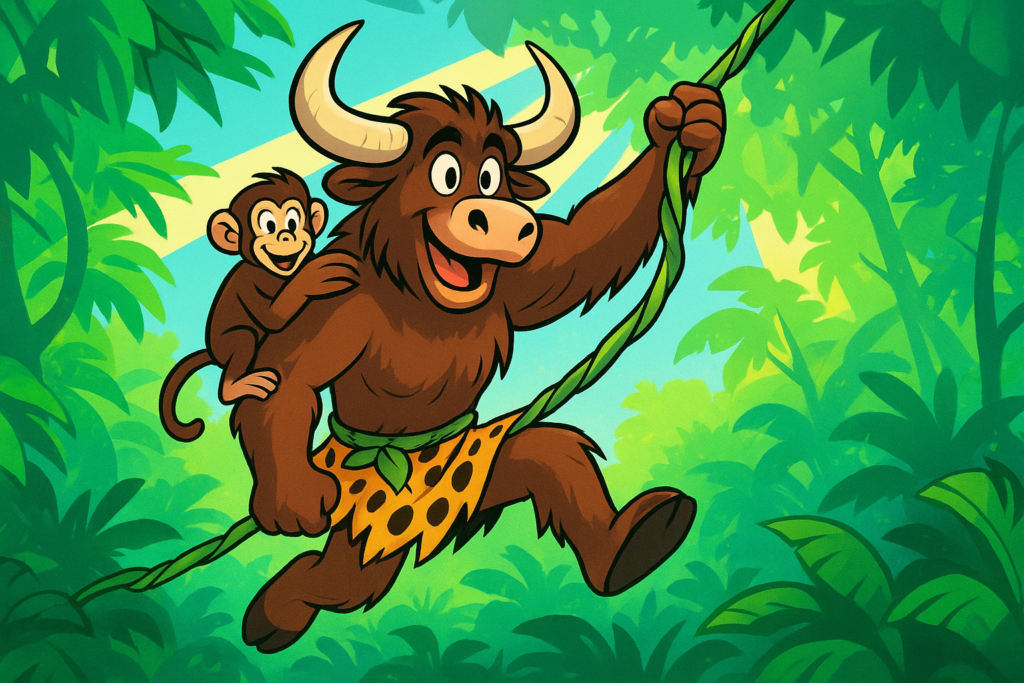
Welcome to Yak Yacker! Today, we bring you the exciting story of Tarzan, a boy who grows up in the African jungle among apes. He learns to survive, swing through the trees, and talk to animals. But everything changes when other humans arrive-including the kind and curious Jane Porter. Will Tarzan find his place in the human world? Our B1 intermediate retelling makes the classic adventure easier to enjoy.
As you read, you can click on any word to see its meaning. You can also listen to the full story audio to improve your listening and pronunciation. And don't miss our free lesson notes with grammar and vocabulary tips. This is a complete learning experience-fun, free, and ready when you are!
The deep jungle was hot and green. The sounds of birds and wild animals filled the air. In a small open place, a baby boy lay alone. He cried softly. His human parents were dead.
A large, gentle ape named heard the cries. She came through the leaves and looked down at the tiny human. Her own baby had just died, and her heart was full of . She picked up the little boy and held him close.
"I will call you ," she said softly. "You are my son now." She carried him back to the ape family. The other apes did not like the creature, but Kala protected him.
Tarzan grew up among the apes. He learned to trees quickly. He swung from , high above the ground. His hands became strong, and his body moved like a wild animal.
One day, while , Tarzan found a strange little house. It was his father's old cabin. Inside, he saw books with pictures of people who looked like him. He touched the pages and said, "I am a human."
He began to teach himself to . He learned about human things: houses, clothes, . But he still lived with the apes in the jungle. He was wild and free, yet something was missing.
One morning, Tarzan was sitting high in a tree when he saw a on the water. A group of humans arrived on the beach. Among them was a young woman named Jane. She had light hair and a kind smile. Tarzan watched her from the trees. His heart beat fast.
While Jane was walking in the jungle, a attacked her. She screamed. Tarzan heard the scream and flew through the trees. He jumped down and fought the leopard with his bare hands. He saved Jane's life.
Jane looked up at the strong, wild man. "Who are you?" she asked with wide eyes.
"I am Tarzan," he said simply. He was breathing hard, but his eyes were gentle.
Jane stayed with the group on the beach. Every day, Tarzan was waiting for her by the big tree. They walked together, and he showed her the jungle. He pointed at the flowers and the birds. She taught him more human words.
One evening, as the sun set, Tarzan took Jane's hand. "You are the most beautiful thing I have ever seen," he said. "I do not want you to leave."
Jane's face became soft. "Tarzan, I cannot stay in the forever. My home is in the city."
Tarzan's heart felt heavy. He looked at the jungle, then at Jane. "I am wild like the apes, but I am also human. Which world is mine?"
The next day, Jane's group prepared to leave. Tarzan stood at the edge of the jungle. He watched Jane walking to the boat. Suddenly, she turned and ran back to him.
"I cannot leave you!" she cried. "The jungle is wild, but my heart is here with you." Tarzan smiled a big smile. He picked her up gently and carried her into the trees.
Together, they built a new life. Tarzan showed Jane how to swing on vines and talk to the apes. Jane showed Tarzan more about human love. They were happy, half-wild and half-human, in the deep green jungle.
The jungle was hot and green with bird and animal sounds. A baby boy lay alone in a small clearing, crying softly, because his human parents were dead.
A big, kind ape named Kala heard him. She had lost her own baby and was very sad. She found the human baby and held him close.
She named him Tarzan and took him as her son. The other apes didn't like him, but Kala kept him safe.
Tarzan grew up with the apes. He learned to climb and swing on vines. He became strong and moved like a wild animal.
Tarzan found his father's cabin. He saw books with pictures of humans and realized he was one too.
He taught himself to read and learned about human life. But he still lived in the jungle, feeling something was missing.
Tarzan saw a boat with humans arrive. A young woman named Jane caught his eye, and his heart raced.
A leopard attacked Jane. Tarzan heard her scream, rushed over, and fought the leopard with his hands to save her.
Jane asked the wild man who he was with surprise.
He said simply, 'I am Tarzan.' He was out of breath but kind.
Jane stayed on the beach. Each day, Tarzan met her, showed her the jungle, and she taught him more words.
At sunset, Tarzan held Jane's hand and said she was the most beautiful thing he'd ever seen, and he didn't want her to go.
Jane said gently that she couldn't live in the wild forever; her home was the city.
Tarzan felt sad and wondered if he belonged to the jungle or the human world.
As Jane was about to leave on the boat, she turned and ran back to Tarzan.
She cried that she couldn't leave him; her heart was there. Tarzan smiled, picked her up, and carried her into the jungle.
They built a life together. He taught her jungle ways, she taught him more about love. They were happy, both wild and human.
The story is filled with words that bring the jungle to life. Let's look at some key vocabulary you'll want to remember.
Notice how these words help you picture the setting, the characters, and the action.
- vine - a long, thin plant that hangs from trees (Tarzan swung from vine to vine).
- leopard - a large wild cat with spots (a leopard attacked Jane).
- cabin - a small wooden house in a wild place (his father's old cabin).
- creature - any living thing, often an animal (the other apes did not like the hairless creature).
The story uses two main past tenses: the simple past and the past continuous. The simple past (climbed, heard, saw) tells us about completed actions. The past continuous (was walking, was sitting) describes actions in progress at a certain moment.
By combining them, we can show what was happening when something else occurred. For example: 'While Jane was walking in the jungle, a leopard attacked her.'
- Simple past: 'He jumped down and fought the leopard.' (finished actions)
- Past continuous: 'Tarzan was sitting high in a tree.' (ongoing background action)
- Common pattern: When + simple past, while + past continuous
- Tip: Look for time words like 'one day', 'one morning', 'while', and 'when' to help you choose the correct tense.
Good descriptions make you feel as if you are inside the story. The writer uses strong adjectives and adverbs to paint a clear picture.
Pay attention to words that appeal to your senses: what you see, hear, and feel. For instance, 'hot and green' makes you imagine the jungle heat and color, and 'her heart was full of sadness' shows emotion rather than just stating it.
- Adjectives: deep jungle, gentle ape, hairless creature, wild and free, kind smile, heavy heart
- Adverbs: softly, quickly, gently, simply
- Sensory details: 'the sounds of birds and wild animals filled the air' (hearing), 'the sun set' (sight), 'he held her close' (touch)
- Try it: pick a scene and replace one adjective or adverb - how does the mood change?
Now it's your turn to use what you've learned. Imagine you are Tarzan meeting Jane for the first time - or create your own jungle explorer. Write a short paragraph using past tenses and descriptive words to bring the scene to life.
You might re-read the story and highlight all the past tense verbs. Notice how the writer mixes simple and continuous past to keep the narrative flowing. Keep exploring, and soon these patterns will feel natural.
Tarzan of the Apes comes from the Mixed / needs review tradition and is best known as a adventure novel. This Yak Yacker article is an original learner retelling based on Edgar Rice Burroughs, 1912; public domain, so the wording here is simplified for modern learners rather than copied from one old edition.
Older printings, translations, and retellings of this story can vary quite a bit. The original audience was usually general/adult, but this version is adapted for B1 Intermediate learners studying English. Trademark and dated racial/colonial material caution.
If you want to look into the source tradition, start with Project Gutenberg.
If you want to keep going, browse more in our English section and review the B1 English Vocabulary List. After that, try English Question Words for another useful next step.