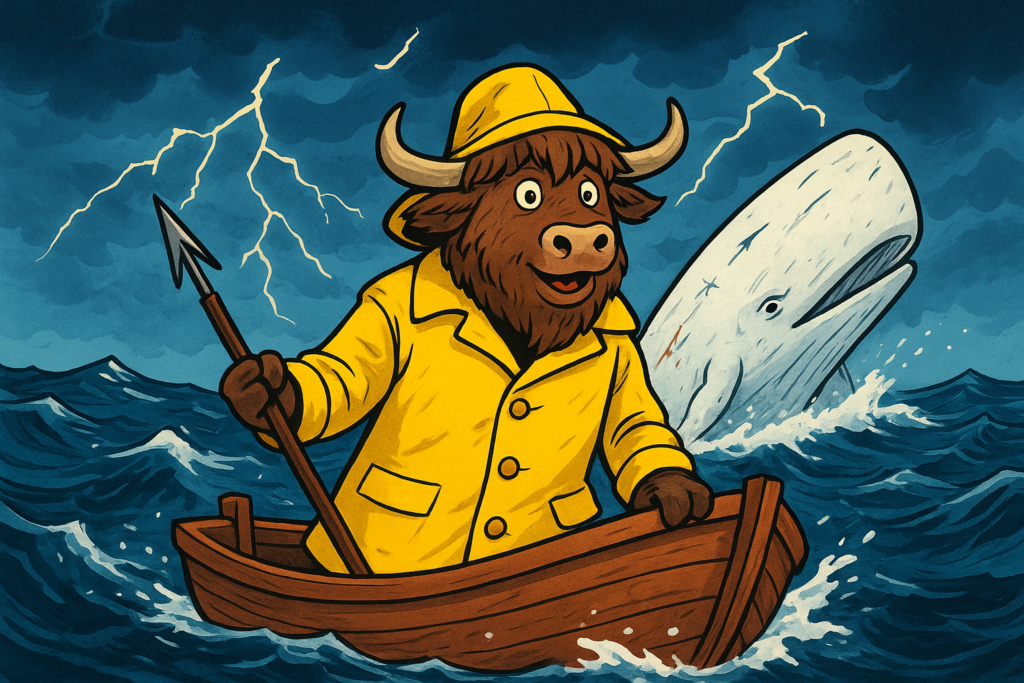
Welcome to our free B1 English story based on Herman Melville's classic novel, Moby-Dick. This retelling follows the young sailor Ishmael as he joins the whaling ship Pequod, where Captain Ahab is obsessed with hunting a giant white whale that took his leg.
You'll sail through adventure and danger, meeting colorful characters like the harpooner Queequeg and watching Ahab's madness grow. Our version uses plain English at an intermediate level (CEFR B1), so you can enjoy the tale without getting lost.
As you read, tap any word for instant help. You can also listen to the story audio to practice listening. At the end, you'll find simple lesson notes to review key language. Start your journey on the sea today!
I was tired of life on land. I needed . So I decided to become a on a whaling ship.
I arrived in New Bedford, a busy whaling town. At the inn, I had to with a .
I opened the door and saw a : a tall, man from the South Seas. He was holding a small, dark .
He did not speak at first. We were both .
The man's name was Queequeg. He was a and a .
We and soon became friends. He even gave me half of his .
'We must be friends, Ishmael,' he said. 'We are going to sea together.'
We decided to . We chose the Pequod, a whaling ship. The captain was not there, but the mate said he would come .
One morning, Captain Ahab finally came on . He stood tall, with a white scar running down his face. One leg was made of .
'Have you seen a white whale?' he asked the sailors. His voice was and full of .
Suddenly, Ahab a gold coin. He to the main mast.
'This gold is for the man who sees !' he shouted. 'That white whale took my leg, and I will !'
The sailors cheered, but I felt a inside.
Days and nights passed. We sperm whales. Queequeg's harpoon flew fast and true. We filled barrels with oil. But Ahab was not interested. He was always for his white whale.
One stormy day, the shouted, 'Whale! White whale!' Ahab's eyes .
We the boats. The white whale appeared, huge and shining like a ghost. His was covered with harpoons and scars.
Ahab stood in his boat, ready to . 'There he blows!' he cried.
But Moby-Dick was fast and clever. He the boat with his great tail. We were thrown into the cold water. We lost that battle, but Ahab would not stop.
For many months we sailed, always the white whale. Ahab became more and more . He did not sleep. His eyes burned with hate.
'Do not try to stop me, Starbuck,' he said to the first mate. 'My is tied to that whale.'
At last, we saw him again. The sea was , but the sky was dark. Moby-Dick was there, .
'This is the day!' Ahab shouted. He all boats down. This time, he would finish the hunt.
The battle lasted three days. On the first day, the whale a boat. On the second day, Ahab's fake leg broke. On the third day, Moby-Dick turned and the Pequod itself.
The ship shook and began to sink. 'From hell's heart I !' Ahab screamed, throwing his harpoon one last time.
But the harpoon line Ahab around the neck and pulled him into the sea. He was gone in an instant. The great white whale swam away, and the Pequod sank under the waves.
I was the only one left. I held onto a wooden that had been built for Queequeg when he was sick. It saved my life. A ship found me floating on the .
And so I tell you this story of Captain Ahab and his for the white whale.
In the story of Moby-Dick, you meet many words connected to the sea, ships, and whaling. Let's look at some key vocabulary that Ishmael uses to describe his adventure.
Learning these words will help you talk about sea journeys and understand other stories set on the ocean.
- sailor - a person who works on a ship
- harpooner - a sailor who throws a long spear (a harpoon) to catch whales
- mast - a tall pole on a ship that holds the sails
- lookout - a sailor who watches for land, danger, or whales from a high point
Good storytellers use adjectives to create pictures in the reader's mind. Ishmael chooses his words carefully to show what the characters look like and how they feel.
For example, he describes Queequeg as a "tall, tattooed man" and the white whale as "huge and shining like a ghost." These adjectives paint a clear image and set the mood.
- tall, tattooed - gives a strong physical description of Queequeg
- cold and full of fire - shows Captain Ahab's angry, intense voice
- white, huge, shining - makes Moby-Dick appear mysterious and powerful
- mad hunt - tells us the search is not just determined, but crazy with emotion
Ishmael uses the simple past to tell the main events of his journey ('I arrived', 'We chose the Pequod'). The past continuous is used for background scenes and actions in progress ('He was holding a small, dark idol').
Using these two tenses together makes the story come alive. The simple past moves the action forward, while the past continuous gives us the atmosphere.
- Simple past: "I opened the door and saw a strange sight." - a sequence of completed actions.
- Past continuous: "He was always watching the sea…" - an ongoing habit in the past.
- Combined: "One stormy day, the lookout shouted, … The white whale appeared, huge and shining…" - background (stormy day) + sudden main event (shouted, appeared).
Now it's your turn! Try retelling a part of the story in your own words, or imagine you are a sailor on the Pequod. Use the vocabulary and past tenses you've just practiced.
You could describe a character, like Captain Ahab, using a strong adjective, or write a few sentences about a stormy day at sea. The ocean is full of stories-just like the one Ishmael told.
- Describe Queequeg using three adjectives from the lesson.
- Write three sentences about a day on a whaling ship, using both simple past and past continuous.
- Imagine Ahab's first sight of Moby-Dick-what did he see and how did he feel?
Moby-Dick: The White Whale comes from the American / Herman Melville tradition and is best known as a adventure/philosophical novel. This Yak Yacker article is an original learner retelling based on Herman Melville, 1851; public domain, so the wording here is simplified for modern learners rather than copied from one old edition.
Older printings, translations, and retellings of this story can vary quite a bit. The original audience was usually adult/general, but this version is adapted for B1 Intermediate learners studying English. Use adventure episodes; original is hard.
If you want to look into the source tradition, start with Project Gutenberg.
If you want to keep going, browse more in our English section and review the B1 English Vocabulary List. After that, try 1,200 English Phrases and Expressions for another useful next step.