This A1 Beginner retelling of Mary and Her Little Lamb keeps the plot clear for learners while still giving the story some atmosphere and momentum. Its fleece is white as snow. Everywhere Mary goes, the lamb goes too.
This version is written for English-speaking learners and includes clickable word help inside the story, full story audio, and lesson notes after the reading. It is free to use on Yak Yacker and is designed to feel natural, readable, and manageable in English.
Mary has a little lamb. Its is . Everywhere Mary goes, the lamb goes too.
One day, Mary goes to school. The lamb her. It the school.
The children see the lamb and . they say.
Mary says, ", little lamb!" But the lamb .
The teacher comes. she asks. "It is my lamb," says Mary. "It me."
The teacher says, "The lamb outside." Mary takes it outside. "," she says.
The lamb waits all day. At , Mary comes out. The lamb is happy. They go home .
Mary has a small lamb. Its wool is very white. The lamb follows Mary everywhere.
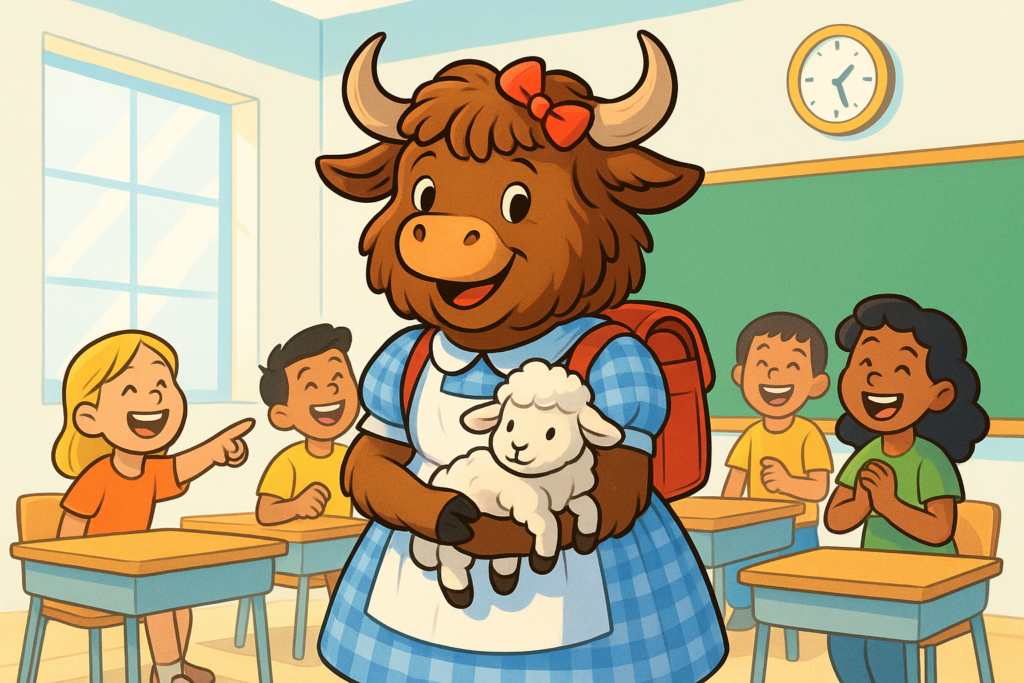
One day, Mary goes to school. The lamb follows her and goes inside.
The kids see the lamb and laugh. They say, "Look, a lamb!"
Mary says, "Go home, lamb!" But the lamb does not go.
The teacher comes and asks, "What is this?" Mary says, "It's my lamb. It loves me."
The teacher says, "The lamb must wait outside." Mary takes it out and says, "Wait here."
The lamb waits all day. When school ends, Mary comes out. The lamb is happy. They go home together.
Let's meet the special words in Mary's adventure. A lamb is a baby sheep, and its soft wool is called fleece. The story takes Mary to school, where a teacher and children see the little lamb.
Here are some words to know:
- a lamb - a young sheep
- fleece - the wool on a sheep
- snow - white, cold flakes from the sky
- a teacher - the person at school who helps you learn
- children - boys and girls, like you!
In English, we often use the present simple to talk about habits and things that always happen. Notice how the story uses 'goes', 'follows', and 'laughs' - these words end in -s because they talk about one person or one thing.
When the teacher says 'The lamb must wait outside,' she uses an instruction. 'Must' shows that it is necessary. And Mary says 'Wait here,' which is a friendly command.
- Mary goes, the lamb follows - add -s for he / she / it.
- They say, the children laugh - no -s for I / you / we / they.
- 'Wait here!' - a short way to tell someone to stay.
The lamb follows Mary everywhere. 'Follow' means go after a person. The lamb also waits for Mary all day. 'Wait' means stay in a place until something happens.
These words are useful when you go places with friends or when you ask someone to be patient. Try using them in your day!
- follow - go after: The ducklings follow their mother.
- wait - stay: Please wait for me at the door.
- together - with each other: They go home together.
You met Mary and her loyal lamb. Can you tell a friend about a pet or a toy that follows you everywhere? Use the words and actions from the story. Maybe your pet waits for you, too!
Every time you retell a little tale, your English grows stronger. Keep playing, and you'll soon have many stories to share.
Mary and Her Little Lamb comes from the American / Sarah Josepha Hale tradition tradition and is best known as a nursery rhyme/song text. This Yak Yacker article is an original learner retelling based on 19th-century poem; public domain, so the wording here is simplified for modern learners rather than copied from one old edition.
Older printings, translations, and retellings of this story can vary quite a bit. The original audience was usually kids, but this version is adapted for A1 Beginner learners studying English. Good for animal/school words.
If you want to look into the source tradition, start with Wikisource.
If you want to keep going, browse more in our English section and review the A1 English Vocabulary List. After that, try English Root Words and Prefixes for another useful next step.