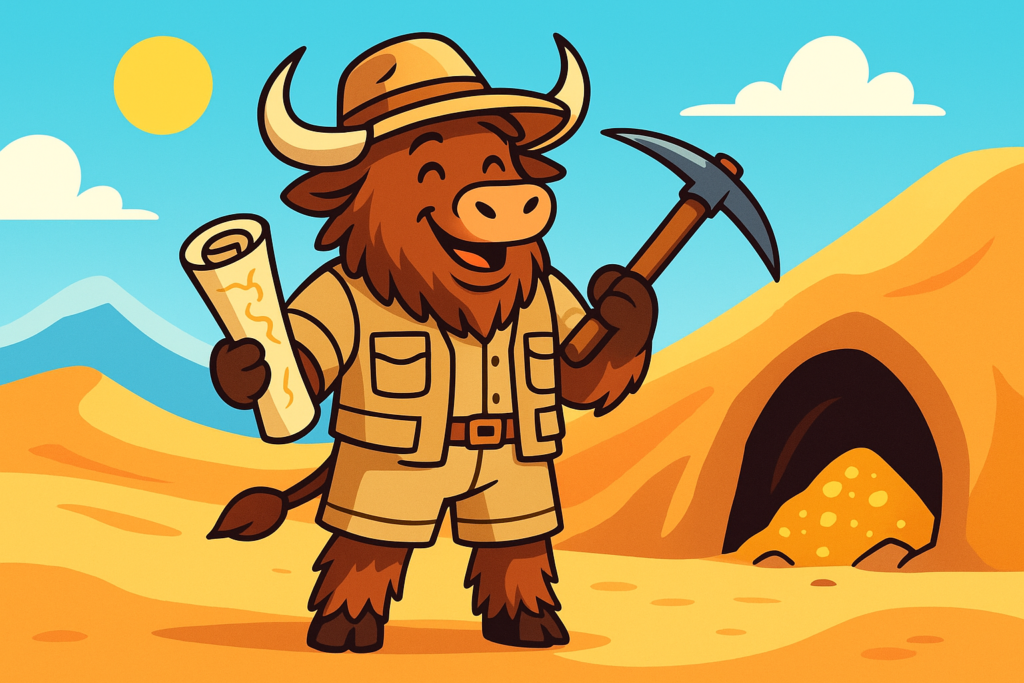
This B1 Intermediate retelling of King Solomon's Mines keeps the plot clear for learners while still giving the story some atmosphere and momentum. I am a hunter in South Africa, and I am not a rich man. But one day, two men changed my life.
This version is written for English-speaking learners and includes clickable word help inside the story, full story audio, and lesson notes after the reading. It is free to use on Yak Yacker and is designed to feel natural, readable, and manageable in English.
My name is Allan Quatermain. I am a in South Africa, and I am not a . But one day, two men .
They were Sir Henry Curtis and Captain John Good. Sir Henry was . Captain Good was a who always looked very clean. They them find Sir Henry's brother. He had gone into the to find King Solomon's Mines and never came back.
I had a to the mines. A gave it to me long ago. The map showed a across a terrible desert and over high mountains. 'There is great there,' I said. 'But many people to reach it.'
Sir Henry with his fist. 'I must ! Will you help us? I will .' I liked Sir Henry. And to be honest, I wanted treasure too. So I agreed.
We started our with some helpers. One of them was a tall Zulu man named Umbopa. He was but very proud. We rivers, saw many wild animals, and walked under the hot sun for many days.
Then we reached the desert. There was no water and the sun . Our water bags were almost empty. We were very . 'We will die here,' said Captain Good .
But Umbopa . 'Look! There is a green place.' It was an . We drank and . We had survived the desert.
Beyond the oasis were high mountains. The map showed a cave that the other side. It was inside. After many hours, we saw light. We came out into a . It was Kukuanaland.
The people of Kukuanaland were strong and . They took us to their king, a named Twala. With him was an old witch called Gagool. She had and laughed like a hyena.
Umbopa suddenly spoke: 'I am Ignosi, the of this land! Twala killed my father and .' The people were shocked. A fight was coming.
There was a great battle. Sir Henry fought Twala and, with his axe, the false king. The people shouted, 'Hail, Ignosi! Hail, the true king!' Umbopa, now King Ignosi, was .
King Ignosi said, 'You have helped me, so I will show you the of King Solomon.' But the old witch Gagool laughed. 'Only I know the . Follow me if you dare!'
Gagool led us into a . There were and strange carvings. 'The treasure is beyond this door,' she said and pushed a stone. The door moved. Inside, gold and diamonds .
But Gagool had a plan. She pushed a and the stone door began to close. 'You will die here!' she screamed. Captain Good quickly with his body. We barely escaped. Gagool was trapped inside forever.
We took as much treasure as we could carry. It was but our hearts were . We said goodbye to King Ignosi and his people. 'You are always welcome here,' he said with a smile.
After a long journey, we returned home. We were rich but also very . Sir Henry never found his brother. But he made . We had found friendship, adventure, and the truth about King Solomon's Mines.
Great job reading the story! Now let's learn some vocabulary that often appears in adventure tales. These words help you talk about exploration, danger, and discovery.
Understanding these key words not only helps you follow the story better but also builds your vocabulary for describing real or imagined journeys.
- treasure (n.) - a collection of valuable things like gold or jewels: "There is great treasure there."
- desert (n.) - a very dry area of land with little water and few plants: "a map showed a route across a terrible desert."
- oasis (n.) - a place in a desert where water is found and plants grow: "It was an oasis. We drank and rested."
- warrior (n.) - a brave and experienced soldier or fighter: "The people of Kukuanaland were strong and warriors."
Did you notice how the story uses different past tenses? Narrative text often combines past simple and past perfect to show the order of events clearly.
Past simple describes the main actions that happen one after another. Past perfect is used for something that happened even earlier, before the main story time.
- Past simple: "I agreed." / "We reached the desert."
- Past perfect: "He had gone into the desert." (his going happened before the main story begins)
- Try making two sentences: one about a past action, and one about something that happened before that.
The story feels alive because of the adjectives. Words like "big and strong," "cruel," "piercing," "dark and cold" help us imagine the people and places.
When you write or speak, adding a few well-chosen adjectives can make your description much more interesting. But remember, a little goes a long way - too many adjectives can sound unnatural.
- Describing a person: "the old witch Gagool had piercing eyes and laughed like a hyena."
- Describing a place: "Inside, gold and diamonds shone like stars."
- Practice: choose a character from the story and list two or three adjectives that fit them.
You've finished the story! Adventure stories like this one are full of useful language. Why not try retelling the story to a friend, or writing a short summary using some of the new words?
If you enjoyed the adventure, consider reading the full (simplified) book or exploring other classic tales like 'Treasure Island' or 'Journey to the Center of the Earth.' The world of stories is your next treasure!
King Solomon's Mines comes from the English / H. Rider Haggard tradition and is best known as a adventure novel. This Yak Yacker article is an original learner retelling based on H. Rider Haggard, 1885; public domain, so the wording here is simplified for modern learners rather than copied from one old edition.
Older printings, translations, and retellings of this story can vary quite a bit. The original audience was usually general/adult, but this version is adapted for B1 Intermediate learners studying English. Colonial-era material; adapt carefully.
If you want to look into the source tradition, start with Project Gutenberg.
If you want to keep going, browse more in our English section and review the B1 English Vocabulary List. After that, try English Adjectives and Adverbs for another useful next step.