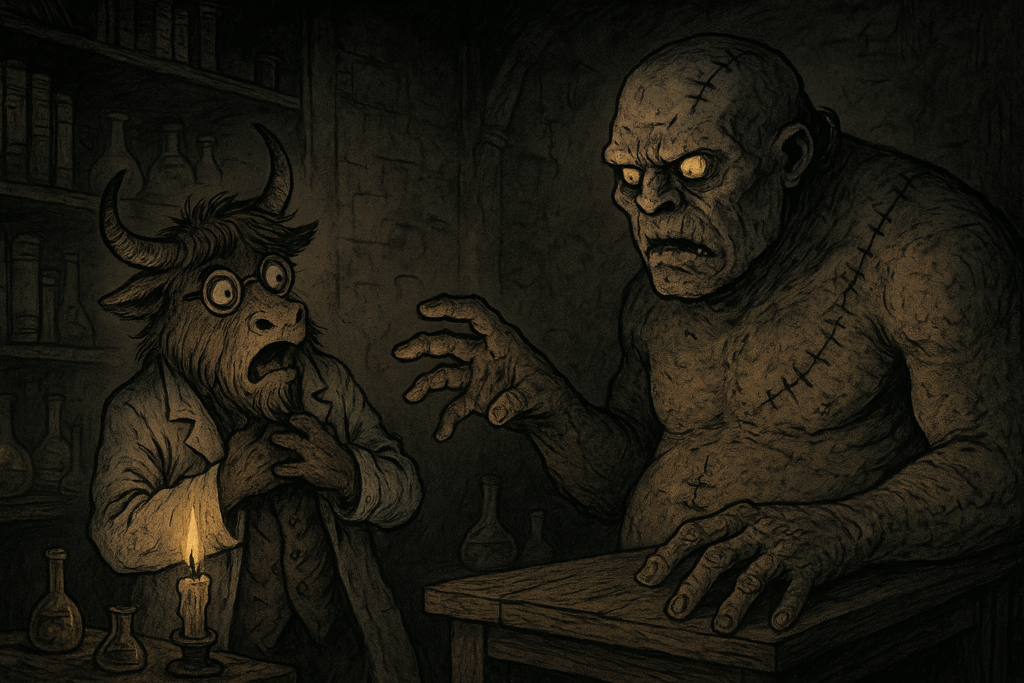
Deep in a dark laboratory, a young scientist named Victor Frankenstein works day and night on a secret project. His goal is amazing but terrifying: to create a living being from dead body parts. When the creature finally opens its eyes, Victor is horrified and runs away. But the lonely monster wants love and friendship, and Victor's rejection starts a tragic journey across Europe – ending in the icy wilderness of the Arctic. This classic tale of ambition, guilt, and revenge has fascinated readers for over 200 years.
Now you can enjoy our B1-level retelling of Frankenstein, specially created for intermediate English learners. This story comes with built-in word help: just click any word you're not sure about to see its meaning instantly. You'll also find full audio narration to help with listening practice, plus clear lesson notes after the text. It's a complete learning experience – and it's completely free.
Victor Frankenstein was a young scientist from Geneva. He was very and wanted to the secret of life.
For many months, Victor worked in his small . He bones and body parts, and studied chemistry and electricity. He was exhausted, but he could not stop.
One stormy night, Victor finally . A huge, ugly opened its yellow eyes and began to breathe.
Victor was . "What have I done?" he cried, and ran out into the street. The enormous, lonely creature followed him with its eyes.
Victor fell very ill. His friend Henry Clerval found him and took care of him. For weeks, Victor said nothing about the .
When Victor felt better, he received a terrible letter. His little brother William was dead, in the woods near their home.
Victor back to Geneva. Near the city, he saw the creature in the forest. In that moment, he knew: the monster had killed his brother.
But the police arrested a kind girl named Justine. Victor said nothing, and Justine was . Victor felt guilty and deeply sad.
Victor went to the mountains to find some peace. There, the creature . "You are my creator," it said. "You must listen to my story."
The creature spoke softly: "When I ran away, everyone was of me. I hid in a small hut and watched a gentle family, the De Laceys. I learned to speak by to them."
"I am a good being, but my face is terrible. I tried to the blind old man, but his son beat me. I am completely ."
"You must make me a female companion," the creature . "Promise me, or I will destroy everything you love."
Victor was filled with and . He agreed to create a second creature. But when he was nearly finished, he looked at the ugly thing and destroyed it with his own hands.
The creature watched from the window. "You have broken your promise," it said. "I will be with you on your wedding night!"
That night, the creature killed Victor's best friend Henry. Later, on Victor's wedding night, it took the of his sweet wife Elizabeth.
Now Victor had nothing left. He followed the monster across the Arctic, desperate for . He was cold, sick, and dying.
A ship captain named Walton found him and heard his amazing, sad story. Victor's last words were: "Do not be like me. Find peace in simple things."
After Victor died, the creature came onto the ship. It cried over its creator's body. "I am so sorry," it whispered, and then it into the white, icy world.
Victor Frankenstein was a young scientist from Geneva who wanted to find the secret of life.
Victor worked for months in his lab, collecting body parts and studying science. He was very tired but couldn't stop.
On a stormy night, Victor succeeded. A big, ugly creature with yellow eyes came to life.
Victor was scared. He shouted, "What have I done?" and ran outside. The huge, lonely creature watched him go.
Victor got very sick. His friend Henry took care of him. For weeks, Victor didn't talk about the monster.
When Victor got better, he got a bad letter. His little brother William was killed in the woods near home.
Victor rushed back to Geneva. He saw the creature in the forest and knew it killed his brother.
The police arrested a kind girl, Justine. Victor stayed quiet, and Justine was killed. He felt very guilty and sad.
Victor went to the mountains for peace. The creature came and said, "You made me. You must hear my story."
The creature said, "When I ran away, people were scared. I hid in a hut and watched a kind family. I learned to talk by listening to them."
"I am good, but I look terrible. I tried to make friends with a blind old man, but his son hit me. I am all alone."
"You must make me a female friend," the creature said. "Promise, or I will destroy all you love."
Victor felt fear and pity. He agreed to make another creature. But when almost done, he saw the ugly thing and destroyed it.
The creature saw from the window. "You broke your promise," it said. "I'll be there on your wedding night."
That night, the creature killed Victor's best friend Henry. Later, on his wedding night, it killed his wife Elizabeth.
Victor had nothing left. He chased the monster across the icy Arctic for revenge. He was cold, sick, and dying.
A captain named Walton found him and heard his sad story. Victor's last words: "Don't be like me. Find peace in simple things."
After Victor died, the creature came on the ship. It cried over Victor's body, said "I'm so sorry," and disappeared into the ice.
Mary Shelley's Frankenstein is full of strong emotions. In this story, you met words like 'ambitious', 'terrified', and 'guilty'. These adjectives help us understand how characters feel. They also appear in everyday English, so it's useful to know them well.
Let's look at four key words from the story and practice using them. Try to make your own sentences after each one.
- ambitious - wanting very much to be successful or powerful. Victor was ambitious, which made him work day and night.
- terrified - very, very scared. Victor was terrified when the creature opened its eyes.
- guilty - feeling bad because you did something wrong. Victor felt guilty about Justine's death.
- companion - a person or being to share your life with. The creature asked Victor for a female companion.
When we tell a story, we often repeat the characters' exact words. For example, Victor cried, 'What have I done?' This is direct speech. But when we retell the story later, we might use **reported speech**.
In reported speech, we change the tense and pronouns. 'I am a good being' becomes 'He said he was a good being.' Notice how 'am' changes to 'was'. Let's practice with a few lines from the story.
- Direct: 'You must listen to my story,' said the creature. → Reported: The creature said that Victor had to listen to its story.
- Direct: 'I will be with you on your wedding night!' → Reported: The creature said it would be with Victor on his wedding night.
- Remember: when the reporting verb is past (said, cried, whispered), we usually move the tense back. 'Will' → 'would', 'must' → 'had to'.
Good writers don't always say 'he was sad'. They show us through actions. Look at these examples from the story: 'Victor fell very ill' and 'he cried'. These small details make us feel the character's pain more deeply.
Next time you write in English, try to replace simple adjectives with actions. Instead of 'he was scared', you could say 'his hands trembled'. This makes your storytelling more powerful.
- "Victor was exhausted, but he could not stop." → This shows his ambition better than 'he was ambitious'.
- "The enormous, lonely creature followed him with its eyes." → 'Followed with its eyes' is a descriptive way to show attention or sadness.
- Practice: Think of a time you felt guilty. What did you do? Write a sentence that shows your guilt without using the word 'guilty'.
Victor Frankenstein's story warns us that ambition without care can destroy everything. When he refused to take responsibility for his creation, terrible things happened. The theme of responsibility is a classic one, and it appears in many great stories.
As you continue learning English, notice how stories like this use language to explore big ideas. Try to use the vocabulary and grammar from this lesson when you discuss books or even tell your own stories. See you next time!
Frankenstein comes from an older public-domain story tradition and is best known as a public_domain_story_retelling. This Yak Yacker article is an original learner retelling based on public-domain source material, so the wording here is simplified for modern learners rather than copied from one old edition.
Older printings, translations, and retellings of this story can vary quite a bit. This version is adapted for B1 Intermediate learners studying English.
If you want to keep going, browse more in our English section and review the B1 English Vocabulary List. After that, try 1,200 English Phrases and Expressions for another useful next step.