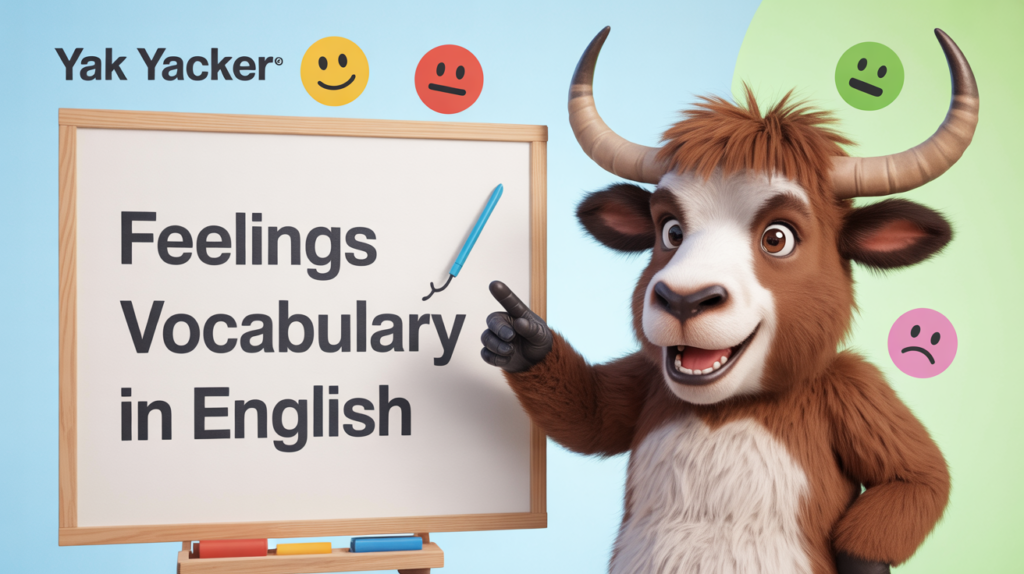
Feelings Vocabulary in English: 16 Real-Life Emotions
Stop answering “I’m fine.” Your feelings deserve better words. (Also your friends deserve better answers.)
Feelings in English can be subtle. “Angry” and “annoyed” are not the same. “Excited” and “nervous” can weirdly show up together. This list gives you useful words you can actually say out loud without sounding like a dramatic movie narrator.
Tap Hear to practice. Then steal the example sentence. Language learning is basically legal theft.
🦬 Yak Snark
If your only emotional vocabulary is “good,” “bad,” and “tired,” congratulations: you’re a phone battery. Let’s upgrade you to “actual person.”
Section 1: The feelings you’ll use all the time
These eight show up everywhere: work chats, family texts, awkward dates, and “how are you?” lies.
Happy
HAP-ee
Feeling good or pleased about something.
For example: I’m really happy you came today.
Sad
SAD
Feeling unhappy or down.
For example: I felt sad after the movie ended.
Excited
ik-SY-tid
Feeling very happy and energized about something coming.
For example: I’m excited for the trip next week.
Nervous
NER-vus
Worried or shaky before something important.
For example: I get nervous before job interviews.
Angry
ANG-gree
Feeling strong annoyance or frustration.
For example: I’m angry about how they treated her.
Annoyed
uh-NOYD
A smaller, everyday kind of angry.
For example: I’m annoyed that the train is late again.
Proud
PROWD
Feeling pleased about your own or someone else’s achievement.
For example: I’m proud of you for finishing that project.
Relieved
ri-LEEVD
Feeling better because a worry is gone.
For example: I’m relieved the results were normal.
Section 2: More feelings to sound specific
These help you describe what’s really going on (without writing a 12-paragraph diary entry in the group chat).
| Word | Meaning | Example | Hear |
|---|---|---|---|
| Confused | Not understanding something clearly. | For example: I’m confused—can you explain that again? | |
| Embarrassed | Feeling awkward or ashamed in front of others. | For example: I was embarrassed when I forgot her name. | |
| Grateful | Feeling thankful. | For example: I’m grateful for your help today. | |
| Lonely | Feeling sad because you feel alone or disconnected. | For example: I felt lonely after moving to a new city. | |
| Overwhelmed | Feeling like there’s too much to handle. | For example: I’m overwhelmed with emails right now. | |
| Calm | Peaceful and not stressed. | For example: The beach makes me feel calm. | |
| Stressed | Feeling pressure or worry (often about time or responsibilities). | For example: I’m stressed about the deadline. | |
| Bored | Not interested; nothing feels engaging. | For example: I’m bored—let’s do something. |
Section 3: Quick upgrades (same vibe, better accuracy)
When one word feels too basic, try these nearby options. Same emotional neighborhood. Different house.
| Instead of… | Try… | When to use it | Hear |
|---|---|---|---|
| Angry | Frustrated | When something isn’t working and it’s driving you crazy. | |
| Sad | Disappointed | When you expected better, and… nope. | |
| Nervous | Anxious | When worry sticks around and won’t stop buzzing in your brain. | |
| Happy | Thrilled | When you’re very excited (big news, big win, big snacks). |
Mini practice: say one sentence with a “basic” word, then swap it with a stronger one. For example: “I’m angry” → “I’m frustrated.” Same truth, better aim.
🦬 Yak Snark
The next time someone asks “How are you?” you’re allowed to say something other than “fine.” Try “relieved,” “overwhelmed,” or “grateful.” You’ll sound emotionally literate. Scandalous.