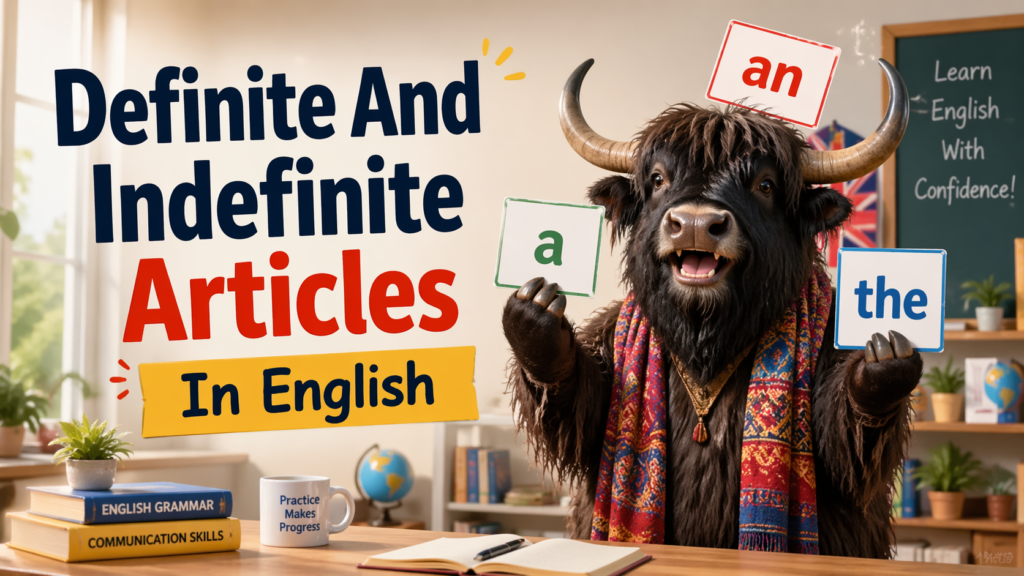
English articles are tiny words, but they do a lot of work. The words a, an, and the tell your listener whether you mean something general, something new, or something specific.
By the end of this guide, you will know the main rules, the common exceptions, and the article patterns native speakers use in everyday American English.
Use this quick idea first:
- A / an = one general thing, usually mentioned for the first time.
- The = one specific thing that both people can identify.
- No article = general plural nouns, general uncountable nouns, many names, meals, sports, and some common expressions.
That is not every rule, but it is the steering wheel. Please do not drive English without it.
What Are Articles in English?
An article is a small word that comes before a noun. It helps show whether the noun is general or specific.
| Article | Meaning | Example 1 | Example 2 | Example 3 |
|---|---|---|---|---|
| a | One general thing before a consonant sound | I bought a notebook. | She is a doctor. | We need a plan. |
| an | One general thing before a vowel sound | He ate an apple. | That was an easy test. | She has an idea. |
| the | One specific thing, or something already known | Close the door. | I liked the movie. | Where is the coach? |
| no article | No a, an, or the before the noun | Dogs need exercise. | I drink water. | She plays basketball. |
The Big Difference: General Vs. Specific
The biggest article rule is not about spelling. It is about meaning.
Use A Or An For General
Meaning: one of many possible things.
Example: I need a pen.
You do not mean one special pen. Any normal pen is fine. No need to summon the royal pen.
Use The For Specific
Meaning: a certain thing both people can identify.
Example: I need the pen on your desk.
Now the listener knows exactly which pen you mean. Fancy? No. Clear? Yes.
Rule One: Use A Before A Consonant Sound
Use a before a word that begins with a consonant sound. The sound matters more than the letter.
| Phrase | Meaning | Example 1 | Example 2 | Example 3 |
|---|---|---|---|---|
| a book | one general book | I bought a book. | She is reading a book. | He needs a book for class. |
| a car | one general car | They rented a car. | I want a car with good gas mileage. | She drives a car to work. |
| a teacher | one teacher; a person whose job is teaching | My brother is a teacher. | We need a teacher for the class. | She became a teacher last year. |
| a university | one university; starts with a “you” sound | He goes to a university in Boston. | That is a university, not a high school. | She visited a university yesterday. |
| a one-time offer | one special offer; starts with a “w” sound | This is a one-time offer. | They gave us a one-time offer. | It was a one-time offer, so I said yes. |
Rule Two: Use An Before A Vowel Sound
Use an before a word that begins with a vowel sound: usually sounds like a, e, i, o, or u. Again, sound wins. Spelling can sit down.
| Phrase | Meaning | Example 1 | Example 2 | Example 3 |
|---|---|---|---|---|
| an apple | one general apple | I ate an apple. | She packed an apple for lunch. | He gave me an apple. |
| an email | one email message | I sent an email. | Did you get an email from Sarah? | She wrote an email to her boss. |
| an idea | one thought or plan | I have an idea. | That is an idea worth trying. | He shared an idea during the meeting. |
| an hour | sixty minutes; starts with a silent h | Wait an hour. | The drive takes an hour. | She studied for an hour. |
| an honest answer | a truthful answer; starts with a silent h | I need an honest answer. | He gave me an honest answer. | That was an honest answer, finally. |
| an NBA player | one basketball player in the NBA; starts with “en” sound | He met an NBA player. | She interviewed an NBA player. | My cousin wants to be an NBA player. |
Rule Three: Use A Or An For First Mention
When you mention a singular countable noun for the first time, use a or an. After that, use the because the listener now knows which thing you mean.
I saw a dog outside. The dog was wearing a tiny sweater. Very stylish. Slightly judgmental.
| First Mention | Second Mention | Meaning |
|---|---|---|
| I bought a laptop. | The laptop is fast. | Now we know which laptop. |
| She found an apartment. | The apartment is near her office. | Now it is a specific apartment. |
| We watched a game. | The game went into overtime. | Now it is a specific game. |
| He made a mistake. | The mistake cost the team points. | Now it is a specific mistake. |
Rule Four: Use The When Both People Know Which One
Use the when the noun is clear from the situation. You may not have said the noun before, but both people understand it.
| Phrase | Meaning | Example 1 | Example 2 | Example 3 |
|---|---|---|---|---|
| the door | the specific door near us | Please close the door. | Can you lock the door? | The door is open. |
| the kitchen | the kitchen in this home or place | Mom is in the kitchen. | I left my phone in the kitchen. | The kitchen smells amazing. |
| the game | the game we are watching or discussing | The game starts at seven. | Did you watch the game? | The game was close. |
| the office | the office connected to the situation | She is at the office. | I left my bag at the office. | The office is closed today. |
Rule Five: Use The With Unique Things
Use the when there is only one in the normal situation, or when you mean a unique thing in the world, city, room, or conversation.
| Phrase | Meaning | Example 1 | Example 2 | Example 3 |
|---|---|---|---|---|
| the sun | the star our planet goes around | The sun is bright today. | Don’t stare at the sun. | The sun rises in the east. |
| the moon | Earth’s moon | The moon looks huge tonight. | We watched the moon over the lake. | The moon was full. |
| the president | the specific president being discussed | The president gave a speech. | They met the president. | The president answered questions. |
| the internet | the global online network | I found it on the internet. | The internet is slow today. | She learned English on the internet. |
| the world | the planet or all people generally | He wants to travel the world. | The world is changing fast. | Sports bring the world together. |
Rule Six: Use The With Superlatives And Ranking Words
Use the before superlatives because they usually point to one specific top thing in a group.
| Phrase | Meaning | Example 1 | Example 2 | Example 3 |
|---|---|---|---|---|
| the best | better than all others | She is the best player on the team. | That was the best meal I had this week. | This is the best answer. |
| the worst | worse than all others | That was the worst call of the game. | Monday traffic is the worst. | This is the worst coffee. Brave, but terrible. |
| the first | number one in order | She scored the first goal. | This is the first lesson. | He was the first person to arrive. |
| the last | final in order | We missed the last train. | He took the last cookie. | This is the last question. |
| the only | one and no others | She is the only doctor here. | This is the only way in. | He was the only player who scored. |
Rule Seven: Use A Or An For Jobs And Roles
Use a or an when you say someone’s job, role, or type of person. This is because the person is one member of a larger group.
| Phrase | Meaning | Example 1 | Example 2 | Example 3 |
|---|---|---|---|---|
| a doctor | one person whose job is medicine | She is a doctor. | My uncle is a doctor. | We need a doctor right away. |
| a coach | one person who trains a team or person | He is a coach. | They hired a coach. | A coach helps players improve. |
| an engineer | one person who designs or builds systems | She is an engineer. | My friend became an engineer. | We talked to an engineer. |
| an athlete | one person who plays sports | He is an athlete. | She trains like an athlete. | An athlete needs rest, too. |
| a student | one person who studies | I am a student. | She is a student at UCLA. | A student asked a question. |
Rule Eight: Do Not Use A Or An With Plural Nouns
A and an mean one, so they do not go with plural nouns. Use no article for general plural nouns, or use the for specific plural nouns.
| Meaning | Correct | Incorrect |
|---|---|---|
| General plural animals | Dogs are friendly. | A dogs are friendly. |
| Specific plural animals | The dogs next door are loud. | A dogs next door are loud. |
| General plural people | Teachers work hard. | A teachers work hard. |
| Specific plural people | The teachers at my school are kind. | An teachers at my school are kind. |
| General plural sports items | Basketballs are round. | A basketballs are round. |
Rule Nine: Do Not Use A Or An With Uncountable Nouns
Uncountable nouns are things we usually do not count one by one. Use no article for general meaning, or use the for a specific amount or situation.
| Uncountable Noun | Meaning | General Example | Specific Example | Useful Countable Form |
|---|---|---|---|---|
| water | liquid people drink | Water is important. | Please pass the water. | a glass of water |
| coffee | a drink made from coffee beans | I like coffee. | The coffee in this cup is cold. | a cup of coffee |
| advice | helpful suggestions | She gave me advice. | The advice helped me. | a piece of advice |
| information | facts or details | We need information. | The information was useful. | a piece of information |
| equipment | tools or gear | The team needs equipment. | The equipment is in the locker room. | a piece of equipment |
| money | cash or funds | Money can cause stress. | Where is the money for tickets? | a dollar, a bill, a payment |
Rule Ten: Use No Article For General Ideas
When you speak about something in general, use no article with plural nouns and uncountable nouns.
General Plural Nouns
- Children need sleep.
- Cars are expensive.
- Fans love close games.
- Dogs like walks.
General Uncountable Nouns
- Milk is in the fridge.
- Music helps me study.
- Practice improves skill.
- Happiness matters.
Rule Eleven: Use The For Specific Plural Or Uncountable Nouns
Use the when a plural noun or uncountable noun is not general. It points to a specific group or amount.
| General | Specific | Meaning Of The Specific Sentence |
|---|---|---|
| Books are useful. | The books on my desk are useful. | Only those books on my desk. |
| Players need practice. | The players on our team need practice. | Only our team’s players. |
| Water is healthy. | The water in this bottle is cold. | Only this bottle’s water. |
| Traffic is annoying. | The traffic on Main Street is terrible. | Only traffic on Main Street. |
| Advice helps. | The advice from my coach helped. | Only my coach’s advice. |
Rule Twelve: Use No Article With Most Names
Most people, cities, countries, streets, languages, and companies do not need an article.
| Category | Use No Article | Example 1 | Example 2 | Example 3 |
|---|---|---|---|---|
| People | Maria, David, LeBron James | Maria called me. | David is late. | LeBron James played well. |
| Cities | Chicago, Tokyo, Taipei | I live in Chicago. | She flew to Tokyo. | He moved to Taipei. |
| Most countries | Canada, Japan, Mexico | She is from Canada. | I visited Japan. | They live in Mexico. |
| Languages | English, Spanish, Korean | I study English. | He speaks Spanish. | She is learning Korean. |
| Streets | Main Street, Fifth Avenue | The store is on Main Street. | We walked down Fifth Avenue. | Turn left on Oak Road. |
Rule Thirteen: Use The With Some Place Names
Some place names take the, especially names with plural words, political words, oceans, rivers, deserts, mountain ranges, and famous buildings.
| Place Phrase | Meaning | Example 1 | Example 2 | Example 3 |
|---|---|---|---|---|
| the United States | a country name with a plural political word | She lives in the United States. | I traveled across the United States. | The United States has fifty states. |
| the Philippines | a country name that is plural in form | He is from the Philippines. | We visited the Philippines. | The Philippines has many islands. |
| the Pacific Ocean | a specific ocean | They crossed the Pacific Ocean. | The Pacific Ocean is huge. | Hawaii is in the Pacific Ocean. |
| the Mississippi River | a specific river | We saw the Mississippi River. | The Mississippi River is famous. | They live near the Mississippi River. |
| the Rocky Mountains | a mountain range | They hiked in the Rocky Mountains. | The Rocky Mountains are beautiful. | Snow covered the Rocky Mountains. |
| the White House | a famous building | They toured the White House. | The White House is in Washington, D.C. | Reporters waited outside the White House. |
Rule Fourteen: Use No Article With Meals In General
Use no article with meal names when you speak generally. Use a or the when the meal is described as a specific event.
| Phrase | Meaning | Example 1 | Example 2 | Example 3 |
|---|---|---|---|---|
| breakfast | the morning meal in general | I eat breakfast at seven. | She skipped breakfast. | Breakfast is ready. |
| lunch | the midday meal in general | Let’s have lunch. | He brought lunch from home. | We talked during lunch. |
| dinner | the evening meal in general | What’s for dinner? | They eat dinner late. | She made dinner. |
| a big breakfast | one breakfast described by an adjective | We had a big breakfast. | He cooked a big breakfast. | I need a big breakfast before the game. |
| the dinner | a specific dinner already known | The dinner last night was great. | Who paid for the dinner? | The dinner after the game was fun. |
Rule Fifteen: Use No Article With Sports And Games In General
In American English, we usually use no article when we talk about playing sports or games in general.
| Sports Phrase | Meaning | Example 1 | Example 2 | Example 3 |
|---|---|---|---|---|
| play basketball | do the sport of basketball | She plays basketball. | We play basketball after school. | He wants to play basketball in college. |
| play soccer | do the sport of soccer | My sister plays soccer. | They play soccer on Sundays. | Do you play soccer? |
| play tennis | do the sport of tennis | He plays tennis. | We play tennis twice a week. | She learned to play tennis. |
| watch football | watch the sport in general | I like to watch football. | They watch football every weekend. | He understands football well. |
| go swimming | do the activity of swimming | Let’s go swimming. | She goes swimming every morning. | We went swimming after work. |
| do yoga | practice yoga | He does yoga. | They do yoga at the gym. | I do yoga to relax. |
But use the when you mean a specific game, match, court, field, team, or score.
| Specific Sports Phrase | Meaning | Example 1 | Example 2 | Example 3 |
|---|---|---|---|---|
| the game | one specific sports event | Did you watch the game? | The game starts at eight. | We won the game. |
| the match | one specific contest, often tennis or soccer | The match was exciting. | Who won the match? | She missed the match. |
| the court | the specific playing area for basketball or tennis | The players ran onto the court. | I left my bag near the court. | The court was slippery. |
| the field | the specific playing area for soccer, football, or baseball | The team walked onto the field. | The field was wet. | Fans cheered from beside the field. |
| the score | the specific number of points in a game | What is the score? | The score is tied. | He checked the score on his phone. |
| the coach | the specific coach we mean | The coach called a timeout. | Ask the coach. | The coach looked worried. |
Useful Article Phrases For Everyday English
These common phrases show how articles work in real sentences. Each phrase includes a meaning and examples so you can see the pattern, not just stare at it like it owes you money.
| Phrase | Meaning | Example 1 | Example 2 | Example 3 |
|---|---|---|---|---|
| a little | a small amount | I need a little help. | She speaks a little English. | Add a little salt. |
| a few | a small number | I have a few questions. | He invited a few friends. | We need a few minutes. |
| a lot of | many or much | She has a lot of homework. | We saw a lot of people. | They need a lot of practice. |
| a couple of | two or a small number | I’ll be there in a couple of minutes. | He bought a couple of tickets. | We watched a couple of games. |
| an example of | one thing that shows an idea | This is an example of good teamwork. | That is an example of polite English. | She gave an example of the rule. |
| an important part of | one key piece of something | Sleep is an important part of health. | Practice is an important part of learning. | Defense is an important part of basketball. |
| the same | not different | We have the same teacher. | They made the same mistake. | The two teams had the same score. |
| the other | the second one of two | One shoe is here, but where is the other one? | She held one ticket and gave me the other. | One team was tired; the other team looked fresh. |
| the next | the one after this one | Take the next bus. | See you the next time. | They won the next game. |
| the whole | all of something | He ate the whole pizza. | We watched the whole movie. | The fans stood for the whole game. |
| at the moment | right now | I’m busy at the moment. | She is not here at the moment. | The team is winning at the moment. |
| in the morning | during the morning | I run in the morning. | Call me in the morning. | Practice starts in the morning. |
| in the afternoon | during the afternoon | We meet in the afternoon. | She studies in the afternoon. | The game is in the afternoon. |
| in the evening | during the evening | They watch TV in the evening. | I exercise in the evening. | The match starts in the evening. |
| at night | during nighttime; no article | I work better at night. | It gets cold at night. | The stadium lights shine at night. |
| by car | using a car as transportation | We went by car. | She travels by car. | The team arrived by car. |
| on foot | walking | He came on foot. | We went there on foot. | Fans walked to the stadium on foot. |
| on the bus | inside a specific bus or using the bus system | I saw her on the bus. | He left his bag on the bus. | The players talked on the bus. |
| go to school | attend school as a student | My kids go to school. | She goes to school downtown. | He didn’t go to school today. |
| go to the school | visit the school building | I went to the school for a meeting. | The coach went to the school. | Parents waited outside the school. |
Sports Vocabulary With A, An, The, And No Article
Sports English is full of article patterns. Here are useful sports words and phrases with meanings and examples.
| Vocabulary | Meaning | Example 1 | Example 2 | Example 3 |
|---|---|---|---|---|
| a fan | one person who supports a team or player | She is a fan of the Lakers. | I met a fan outside the stadium. | A fan asked for an autograph. |
| the fans | the specific group of supporters | The fans were loud. | The fans cheered after the goal. | The coach thanked the fans. |
| a player | one person on a team or in a game | He is a player on our team. | A player got injured. | She is a player to watch. |
| the players | the specific athletes in a game or team | The players warmed up. | The coach talked to the players. | The players shook hands. |
| a coach | one person who trains players | They need a coach. | She became a coach. | A coach gives instructions. |
| the coach | the specific coach in the situation | The coach looked angry. | Ask the coach first. | The coach called practice. |
| a referee | one official who controls a game | A referee stopped the play. | We need a referee. | He trained to become a referee. |
| the referee | the specific official in the game | The referee made a call. | The crowd booed the referee. | The referee checked the replay. |
| a goal | one score in soccer or hockey | She scored a goal. | We need a goal to tie the game. | He celebrated a goal. |
| the goal | the specific score or target area | The goal was amazing. | The ball went into the goal. | The goal changed the game. |
| a point | one unit of score | They won by a point. | She scored a point. | One mistake cost us a point. |
| the score | the specific points in a game | What’s the score? | The score is 3–2. | He checked the score. |
| a timeout | one short break during a game | The coach called a timeout. | They needed a timeout. | A timeout helped the team calm down. |
| the final | the last and most important game or round | They reached the final. | The final is tomorrow. | She played well in the final. |
| practice | training; no article when general | We have practice today. | He missed practice. | Practice starts at six. |
| the practice | a specific practice session | The practice was hard. | Did you attend the practice yesterday? | The practice before the final was short. |
| a championship | one competition to decide the winner | They won a championship. | She dreams of winning a championship. | A championship takes discipline. |
| the championship | the specific championship being discussed | The championship starts next week. | They lost the championship game. | The championship was exciting. |
| win a game | be the winner of one game | They want to win a game. | We finally won a game. | It feels good to win a game. |
| win the game | win the specific game | They scored late to win the game. | One shot could win the game. | She helped us win the game. |
A, An, The, Or No Article: Fast Choice Guide
When you are not sure which article to use, ask these questions in order.
- Is the noun singular and countable? If yes, it usually needs a, an, the, or another determiner.
- Is it general and new? Use a or an.
- Does the next word begin with a vowel sound? Use an. If not, use a.
- Is it specific or already known? Use the.
- Is it plural or uncountable and general? Use no article.
- Is it a name, language, meal, sport, or common expression? Check if no article is normal.
Common Mistakes And Easy Fixes
| Mistake | Correct | Why |
|---|---|---|
| I bought an book. | I bought a book. | Book begins with a consonant sound. |
| She is a honest person. | She is an honest person. | Honest starts with a vowel sound because h is silent. |
| I like the music. | I like music. | Use no article for music in general. |
| He plays the basketball. | He plays basketball. | Use no article for sports in general. |
| She is teacher. | She is a teacher. | A singular countable job needs an article. |
| I need an advice. | I need advice. | Advice is uncountable. |
| They went to the Canada. | They went to Canada. | Most country names do not use the. |
| We watched a Olympics. | We watched the Olympics. | Some special event names use the. |
| She has a equipment. | She has equipment. | Equipment is uncountable. |
| Can you pass a salt? | Can you pass the salt? | At the table, both people know the specific salt. |
Tiny Words, Big Meaning Changes
Changing the article can change the meaning of the whole sentence. English is dramatic like that.
| Sentence | Meaning | Example Use |
|---|---|---|
| I saw a coach. | I saw one coach, not a specific one you know. | I saw a coach at the gym. |
| I saw the coach. | I saw the specific coach we both know. | I saw the coach after practice. |
| She wants a car. | She wants one car, any suitable car. | She wants a car for commuting. |
| She wants the car. | She wants a specific car. | She wants the car in the showroom window. |
| I love dogs. | I love dogs in general. | I love dogs, but my apartment says no. Rude. |
| I love the dogs. | I love a specific group of dogs. | I love the dogs at that shelter. |
| We need help. | We need help in general. | We need help with the project. |
| We need the help. | We need the specific help mentioned before. | We need the help you promised. |
Article Patterns With Time Expressions
Some time expressions use the, some use a, and some use no article. Learn these as chunks.
| Time Phrase | Meaning | Example 1 | Example 2 | Example 3 |
|---|---|---|---|---|
| a day | one day | Take this medicine twice a day. | She practices once a day. | Drink eight glasses of water a day. |
| a week | one week | We meet twice a week. | He trains five days a week. | I call my parents once a week. |
| the weekend | Saturday and Sunday as a specific period | See you on the weekend. | What did you do over the weekend? | The game is on the weekend. |
| the past | time before now | Don’t live in the past. | He learned from the past. | The team forgot the past and focused. |
| the future | time after now | Think about the future. | She is planning for the future. | The coach believes in the future of the team. |
| last night | the night before today; no article | I slept well last night. | They won last night. | We watched a movie last night. |
| next week | the week after this week; no article | I start next week. | The final is next week. | Call me next week. |
| every morning | each morning; no article | She runs every morning. | I drink coffee every morning. | The team practices every morning. |
Article Patterns With Places And Institutions
Some place words change meaning depending on whether you use the. This is one of those English things that feels suspiciously like a trap, because it is.
| Phrase | Meaning | Example 1 | Example 2 | Example 3 |
|---|---|---|---|---|
| go to school | attend as a student | Children go to school. | She goes to school in Texas. | He didn’t go to school today. |
| go to the school | visit the school building | Parents went to the school. | I drove to the school. | The coach arrived at the school. |
| go to work | go to your job | I go to work at eight. | She went to work early. | He didn’t go to work today. |
| go to the office | go to a specific office | I went to the office. | Meet me at the office. | She left her laptop at the office. |
| go to bed | go to sleep | I’m tired, so I’m going to bed. | The kids went to bed. | Go to bed before the game turns into a life choice. |
| sit on the bed | sit on a specific bed | She sat on the bed. | The cat slept on the bed. | I put my bag on the bed. |
| go to church | attend a religious service | They go to church on Sundays. | She went to church with her family. | He sings at church. |
| go to the church | visit the church building | We went to the church to see the old windows. | The tourists visited the church. | Meet me outside the church. |
Mini Practice: Choose A, An, The, Or No Article
Try these before checking the answers. No panic. The articles are small; they cannot physically fight you.
- I saw ___ dog in the park. ___ dog was chasing a ball.
- She is ___ engineer.
- He plays ___ soccer every Saturday.
- Can you pass me ___ water?
- ___ children need a lot of sleep.
- We visited ___ United States last year.
- My brother is ___ university student.
- ___ moon looks beautiful tonight.
- I need ___ advice.
- They won ___ game in overtime.
Show Answers
- I saw a dog in the park. The dog was chasing a ball.
- She is an engineer.
- He plays soccer every Saturday.
- Can you pass me the water?
- Children need a lot of sleep.
- We visited the United States last year.
- My brother is a university student.
- The moon looks beautiful tonight.
- I need advice.
- They won the game in overtime.
Mini Practice: Fix The Article Mistakes
Rewrite each sentence with the correct article pattern.
- She gave me an information.
- He is engineer.
- I watched basketball game last night.
- The love is important.
- We went to the Japan.
- She bought an one-bedroom apartment.
- I need the new phone, any phone is okay.
- They play the tennis after work.
Show Suggested Fixes
- She gave me information. / She gave me a piece of information.
- He is an engineer.
- I watched a basketball game last night.
- Love is important.
- We went to Japan.
- She bought a one-bedroom apartment.
- I need a new phone; any phone is okay.
- They play tennis after work.
Quick Reference: When To Use A, An, The, Or No Article
| Use | Best For | Pattern | Example 1 | Example 2 |
|---|---|---|---|---|
| a | One general singular countable noun before a consonant sound | a + noun | a book | a coach |
| an | One general singular countable noun before a vowel sound | an + noun | an apple | an athlete |
| the | Specific nouns, known nouns, unique things, superlatives | the + noun | the game | the best player |
| no article | General plural nouns, general uncountable nouns, most names, meals, sports | noun only | players need practice | she plays soccer |
| a piece of | One countable unit of an uncountable noun | a piece of + uncountable noun | a piece of advice | a piece of equipment |
| a cup of | One serving of a drink | a cup of + drink | a cup of coffee | a cup of tea |
| a pair of | Two matching items used together | a pair of + plural noun | a pair of shoes | a pair of gloves |
Frequently Asked Questions About English Articles
Is It A Historic Or An Historic?
In standard American English, a historic is more common because the h is usually pronounced. Example: It was a historic win for the team.
Why Do We Say An Hour But A House?
Hour starts with a vowel sound because the h is silent. House starts with an h sound. Example: We waited an hour outside a house.
Can The Be Used With Plural Nouns?
Yes. Use the with plural nouns when the group is specific. Example: The players on our team are tired.
Can The Be Used With Uncountable Nouns?
Yes. Use the when the uncountable noun is specific. Example: The coffee in this cup is cold.
Why Is It A University, Not An University?
University begins with a “you” sound, which acts like a consonant sound. Example: She studies at a university in California.
Why Do We Say Play Basketball But Watch The Game?
Basketball is the sport in general, so it uses no article. The game is one specific event. Example: I play basketball, and I watched the game last night.
Final Yak
Articles are not random. They only look random when English is wearing its little chaos hat.
Remember the simple core: use a or an for one general thing, the for one specific thing, and no article for general plural nouns, general uncountable nouns, most names, meals, and sports.
When in doubt, ask: “Is this new and general, or specific and known?” That one question fixes a shocking number of article mistakes. Tiny word. Big win.