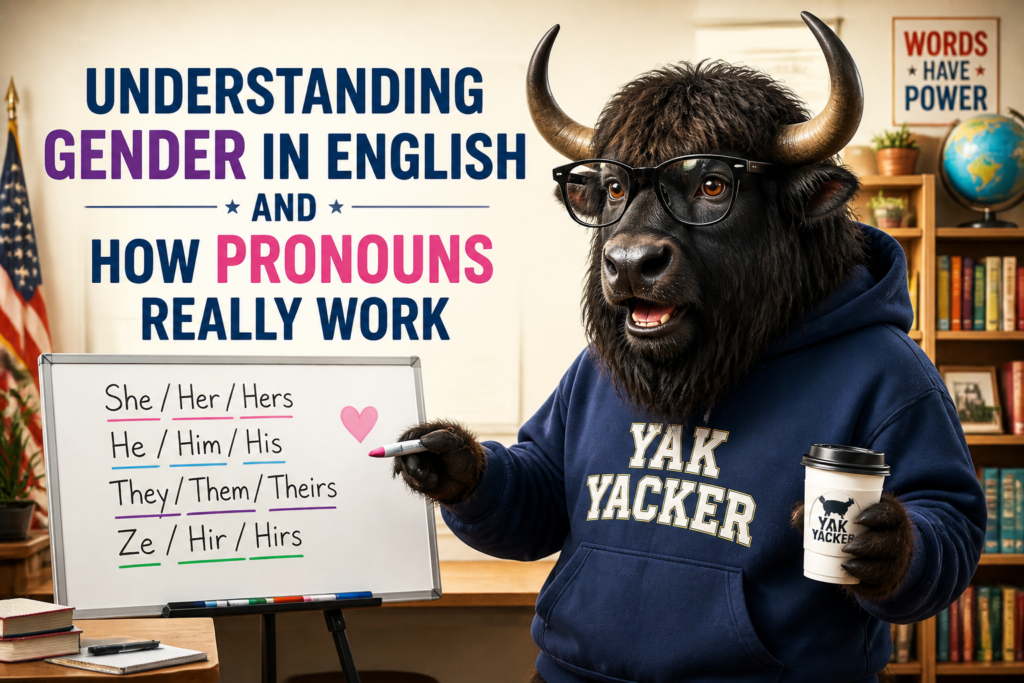
Pronouns can feel tiny, but they carry a lot of social weight. In English, gender is much simpler than in many other languages, but it also comes with a few modern rules that learners need to know so they can sound natural, respectful, and clear.
Good news: English grammar does not make every noun wear a little gender badge. Bad news: people still use gendered words all the time, especially when talking about people. So yes, the language is simple, but humans, being humans, made it interesting anyway.
By the end of this article, you will understand how English handles gender, when to use pronouns like he, she, they, and it, and how to avoid common mistakes. You will also see how to speak more naturally and respectfully in real life.
1. Gender In English: The Big Idea
English is not a heavily gendered language. That means most nouns do not have grammatical gender like masculine, feminine, or neuter. For example, table, chair, and book do not change form because of gender.
Instead, English gender usually appears in these places:
- Words for people: man, woman, boy, girl
- Pronouns: he, she, they, it
- Possessive forms: his, her, their, its
- Some job titles or old-fashioned words: fireman, policeman, chairman
Modern English often prefers gender-neutral words like firefighter, police officer, and chairperson. That way, the word focuses on the job, not the person’s gender. Revolutionary stuff, apparently.
2. The Main Pronouns You Need To Know
English personal pronouns are the tiny words that replace nouns. They help us avoid repeating names over and over. Nobody wants to read: “Maria went to Maria’s car because Maria forgot Maria’s keys.”
| Pronoun | Pronunciation | Meaning | Example | Learner Note |
|---|---|---|---|---|
| he | hee | used for one male person | He is my brother. | Subject pronoun. |
| him | him | used for one male person as an object | I saw him at school. | Object pronoun. |
| his | hiz | shows that something belongs to him | That is his bag. | Possessive form. |
| she | shee | used for one female person | She works here. | Subject pronoun. |
| her | hur | used for one female person as an object or possessive | I called her. | Can mean “to her” or “hers.” |
| they | thay | used for more than one person, or sometimes one person | They are my friends. | Very common and very important. |
| them | them | object form of they | We invited them. | Use after verbs or prepositions. |
| their | thair | shows something belongs to them | That is their car. | Possessive adjective. |
| it | it | used for things, animals when gender is unknown, ideas, or facts | The phone is new. It works well. | Do not use for people unless a person wants it. |
| its | its | shows something belongs to it | The dog wagged its tail. | No apostrophe. |
If you want a more detailed look at pronouns, Cambridge Dictionary’s grammar guide on pronouns is a solid, boring, useful place to start. Exactly the kind of source that tells the truth without making a big speech about it.
3. He, She, It, And They: How To Choose
The first question is simple: Who or what are you talking about? The answer usually tells you which pronoun to use.
| Pattern | Meaning | Example | Learner Note |
|---|---|---|---|
| he / him / his | for a man or boy | He said his name was Ben. | Use for male people. |
| she / her / hers | for a woman or girl | She forgot her phone. | Use for female people. |
| it / its | for things, animals, ideas, or weather | The car is fast. It is also expensive. | Usually not for people. |
| they / them / their | for more than one person, or for one person if that is their pronoun | They are waiting. I called them. That is their bag. | Also a respectful singular pronoun in modern English. |
Important note: in modern English, they can be used for one person when that is the person’s chosen pronoun. This is now common in everyday English, workplaces, schools, and online writing.
One person, one name, one pronoun choice. English finally found a way to be polite without making grammar explode.
4. Singular They: Yes, It Is Real English
Many learners first meet they as a plural pronoun: They are my friends. But English also uses they for one person in several common situations:
- When a person uses they/them pronouns
- When gender is unknown or not important
- When speaking generally about an imaginary or unspecified person
Examples:
- Alex said they would call later.
- If a student is late, they should check in at the office.
- Someone left their umbrella.
Notice the grammar. Even when they refers to one person, the verb still looks plural: they are, they have, they do. This can feel odd at first, but it is normal English.
Learner note: if you do not know a person’s pronouns, they is often the safest choice in modern English. It is usually better than guessing and accidentally becoming the star of an awkward moment.
5. Pronoun Forms: Subject, Object, Possessive
English pronouns change form depending on their job in the sentence. That sounds dramatic, but it is just grammar doing paperwork.
| Subject | Object | Possessive Adjective | Possessive Pronoun | Example |
|---|---|---|---|---|
| he | him | his | his | He helped him with his bag. The bag is his. |
| she | her | her | hers | She gave her friend her book. The book is hers. |
| they | them | their | theirs | They brought their lunch. The lunch is theirs. |
| it | it | its | its | The dog found its toy. The toy is its. |
Very common mistake: many learners say “between you and I” or mix up he and him. A quick trick: if the pronoun is doing the action, use the subject form. If the pronoun receives the action, use the object form.
Rule → Example
- Subject: the pronoun does the action. She called me.
- Object: the pronoun receives the action. I called her.
6. Gender-Neutral Language In English
English often prefers gender-neutral language when gender is unknown or not relevant. This is especially common in professional writing, customer service, and general communication.
| Gendered | Gender-Neutral | Example | Learner Note |
|---|---|---|---|
| fireman | firefighter | The firefighter arrived quickly. | Neutral and modern. |
| policeman | police officer | A police officer helped us. | Common in U.S. English. |
| chairman | chairperson / chair | The chair opened the meeting. | Chair is very common in business and academic English. |
| mailman | mail carrier / postal worker | The mail carrier delivered the package. | Neutral and polite. |
When you do not know a person’s gender, you can also use a job title or phrase that avoids gender entirely:
- the doctor
- the teacher
- the person at the front desk
- the student
This is not about being overly careful. It is just clear, modern English. Efficient, respectful, and less likely to make people raise an eyebrow.
7. Titles And Gendered Forms
Some English titles show gender, but many are now neutral or changing over time.
| Word | Pronunciation | Meaning | Example | Learner Note |
|---|---|---|---|---|
| Mr. | MISTER | title for a man | Mr. Brown is here. | Common in formal writing. |
| Mrs. | MISS-iz | title for a married woman | Mrs. Lee called today. | Can sound old-fashioned in some contexts. |
| Ms. | miz | title for a woman, without showing marital status | Ms. Garcia is my teacher. | Very common and polite. |
| Miss | mis | title for an unmarried woman or girl | Miss Carter helped us. | Less common in business English. |
| Mx. | mix / maks | gender-neutral title | Mx. Taylor emailed the office. | Used by some people and institutions. |
In everyday American English, Ms. is often the safest default for adult women if you do not know their preference. For people who use Mx., use that exact title if they ask for it. Grammar is not the boss here; respect is.
8. Common Gender And Pronoun Phrases
Here are practical phrases you will hear in real English conversations, emails, forms, and introductions.
| English | Pronunciation | Meaning | Example Sentence | Learner Note |
|---|---|---|---|---|
| What are your pronouns? | wut are yor PROH-nouns | polite question about how someone wants to be referred to | What are your pronouns? I use she/her. | Common in introductions and safe to ask politely. |
| I use he/him. | eye yooz hee-him | the speaker’s pronouns | I use he/him. | Often used after a name introduction. |
| I use they/them. | eye yooz thay-them | the speaker’s pronouns | I use they/them. | Use the exact pronouns the person gives. |
| My pronouns are… | my PROH-nouns are | introduces pronouns | My pronouns are she/her. | Natural in forms and introductions. |
| I’m not sure. | aim not sure | you do not know | I’m not sure what pronouns to use. | Better than guessing. |
| Could you repeat that? | kood yoo rih-PEET that | ask someone to say it again | Could you repeat that? I want to use the right pronoun. | Useful when you miss a pronoun. |
| Preferred pronouns | prih-FERD PROH-nouns | the pronouns a person wants others to use | Please write your preferred pronouns on the form. | Common in forms and workplace language. |
| Gender-neutral | JEN-der NOO-trul | not showing male or female gender | Use gender-neutral language when possible. | Common in modern English. |
| Chosen name | CHOH-zun naym | the name a person wants to be called | Use my chosen name, please. | Important in respectful communication. |
| Identity | eye-DEN-tih-tee | who a person is | Language should respect a person’s identity. | General word; use carefully and respectfully. |
9. Quick Pronunciation Notes
English pronouns are short, but learners still mix them up because the spelling and sound can be sneaky.
- he sounds like hee, not “hay.”
- she rhymes with me.
- her sounds like hur.
- they sounds like thay.
- their sounds like thair.
- them has a short e sound: them.
- its is not the same as it’s.
Important spelling note: its means “belonging to it.” It’s means it is or it has. The apostrophe matters. English loves tiny traps.
10. Common Mistakes And Fixes
| Mistake | Correct | Why |
|---|---|---|
| Her is my friend. | She is my friend. | Her is usually an object, not a subject. |
| I saw he yesterday. | I saw him yesterday. | Use him after the verb saw. |
| They is here. | They are here. | They takes are, even for one person in singular they. |
| Its raining. | It’s raining. | You need the contraction it is. |
| Its my book. | It’s my book. / That is its cover. | Its is possessive. It’s is a contraction. |
| He said that her will come. | He said that she will come. | She is the subject form. |
| I called their. | I called them. | Their shows possession. Them is the object form. |
Small pronoun errors are common, especially when your first language handles gender differently. The fix is simple: learn the form, then practice it in real sentences, not just isolated word lists. Word lists alone are cute. Real sentences do the actual work.
11. Practice: Choose The Right Pronoun
Try these quick exercises. Say the answers out loud. Your brain remembers sound better than it remembers “I read the rule once and felt brave.”
- 1. Maria is late. _____ will arrive soon.
- 2. That is my brother. I called _____ yesterday.
- 3. The teacher is kind. _____ helps everyone.
- 4. I met Sam. _____ said hello.
- 5. The keys are on the table. _____ are new.
- 6. This is Anna’s phone. It is _____.
- 7. Someone left _____ bag here.
- 8. Ben and Leo are students. _____ study English every day.
Answers: 1. she 2. him 3. she 4. they or he/she, depending on context 5. They 6. hers 7. their 8. They
12. Friendly Real-Life Examples
Here are some natural sentences you can use or adapt:
- What are your pronouns?
- My pronouns are she/her.
- He works in marketing.
- I spoke with them this morning.
- That is their seat.
- It is on the desk.
- My manager said they will join the meeting later.
- Please use Ms. Khan in the email.
Notice how natural they sounds in modern English, even when we do not want to talk about gender. That is why it matters: it lets you be clear without over-explaining or guessing.
13. American And British Notes
In both American and British English, the pronoun system is basically the same. The biggest differences are in style and preferred wording.
- American English often uses Ms., firefighter, and police officer in neutral language.
- British English also uses neutral language, and they as a singular pronoun is common and accepted.
- Some older forms like chairman may appear more often in older writing, but neutral alternatives are usually better now.
If you are ever unsure, neutral English is the safe route. It is simple, respectful, and widely understood on both sides of the Atlantic. A rare moment of peace in the English language.
14. Quick Reference Summary
| What To Use | When | Example |
|---|---|---|
| he / him / his | for a male person | He said it was his idea. |
| she / her / hers | for a female person | She said the book was hers. |
| they / them / their / theirs | for more than one person, or one person using they/them pronouns | They brought their lunch. |
| it / its | for things, animals, ideas, and some unknown cases | The dog found its toy. |
| Ms. | polite, neutral title for a woman | Ms. Brown is my teacher. |
| Mx. | gender-neutral title for some people | Mx. Taylor works here. |
If you want to keep practicing English grammar and everyday usage, check out Yak Yacker’s English learning hub. You can also test your level with the English placement test by CEFR or review your skills with the English vocabulary test.
Yak takeaway: English gender is usually simple in grammar, but pronouns still matter a lot in real conversation. Use he, she, it, and they carefully, and when in doubt, choose the respectful, neutral option. Grammar survives. So do good relationships.