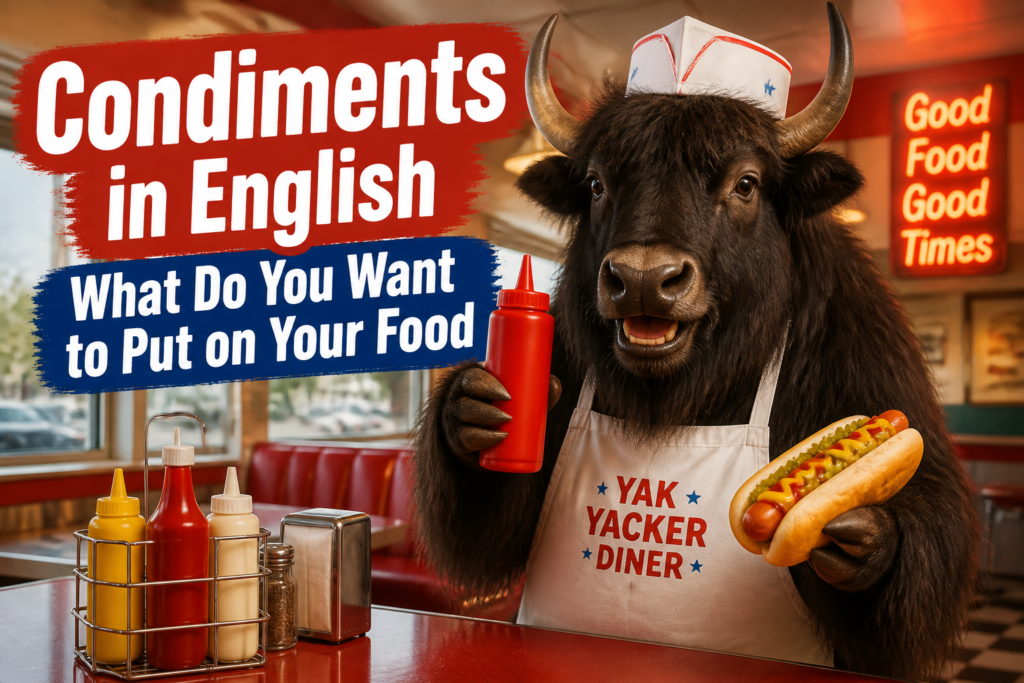
Ever stared at a burger, fries, or sandwich and thought, “Okay… what do I even call all this stuff in English?” Welcome to the delicious little world of condiments. English speakers use these words all the time, usually while making a very serious decision about ketchup versus mustard like it is international diplomacy.
For the broader learning path, visit our parent guide.
In everyday English, condiments are the sauces, spreads, seasonings, and toppings people add to food for extra flavor. Some are sweet, some are salty, some are spicy, and some are the reason your lunch suddenly becomes much better. By the end of this lesson, you’ll know common condiment words, how to ask for them, and how to use them naturally in real life.
If you want more English practice after this, you can also try the English vocabulary test or the English placement test CEFR.
Small note: in American English, people often say condiments for things like ketchup, mustard, and mayo. In British English, you may also hear accompaniments in formal writing, but condiments is still very common and natural.
What Are Condiments?
Condiments are extra ingredients you add to food to change the taste, texture, or flavor. They are usually not the main food. They sit on the side, on top, or inside the meal and do their quiet little flavor job.
For a simple dictionary-style definition, see Cambridge Dictionary’s definition of “condiment”.
Yak tip: A condiment is usually something you add. A topping is often something you put on top. Sometimes the words overlap, because English enjoys being a little messy.
Common Condiments In Everyday English
Here are the most useful condiment words you will hear in restaurants, homes, and casual conversation.
| English | Pronunciation | Meaning | Example Sentence | Learner Note |
|---|---|---|---|---|
| ketchup | KEH-chup | A sweet tomato sauce, often used with fries, burgers, and hot dogs. | I want ketchup with my fries. | Very common in American English. In British English, people also say tomato sauce. |
| mustard | MUSS-terd | A yellow or brown spicy sauce made from mustard seeds. | Do you want mustard on your sandwich? | Common on burgers, sandwiches, and hot dogs. |
| mayonnaise / mayo | may-uh-NAYZ / MAY-oh | A thick, creamy sauce made from oil, egg, and vinegar or lemon juice. | She always puts mayo on her turkey sandwich. | Mayo is casual and very common in speech. |
| relish | REH-lish | A chopped, pickled vegetable condiment, often sweet or tangy. | Hot dogs taste good with relish. | In the U.S., relish often means green pickle relish. |
| hot sauce | HAHT saws | Spicy sauce made with chili peppers. | I put hot sauce on eggs. | Very common in casual speech; can mean many different sauces. |
| soy sauce | SOY saws | A salty dark sauce used in Asian cooking. | Please pass the soy sauce. | Common with rice, noodles, and stir-fry. |
| barbecue sauce / BBQ sauce | BAR-bee-kyoo saws | A sweet, tangy sauce often used on grilled meat. | We ate chicken with barbecue sauce. | BBQ is informal but very common. |
| salad dressing | SA-lud DREH-sing | Sauce added to salad, such as ranch, vinaigrette, or Caesar dressing. | What dressing do you want on your salad? | Dressing can mean a sauce for salad, not clothing here. |
| vinegar | VIN-ih-ger | A sour liquid often used in dressings, pickles, and sauces. | The dressing has vinegar in it. | Useful for cooking and recipes. |
| salt | sawlt | A basic seasoning that adds salty flavor. | Can you pass the salt? | Usually called a seasoning, but people often lump it in with condiments in daily speech. |
| pepper | PEH-per | A common seasoning that adds a sharp flavor. | I like a little pepper on my eggs. | Like salt, this is often treated as part of the condiment set. |
Useful Phrases For Asking For Condiments
These phrases are the kind people actually use at restaurants, at home, or during a picnic where everyone suddenly becomes very picky.
| English Phrase | Pronunciation | Meaning | Example Sentence | Learner Note |
|---|---|---|---|---|
| Can I get some ketchup? | kan eye get sum KEH-chup | A polite, casual way to ask for ketchup. | Can I get some ketchup for my fries? | Very common in American English. |
| Do you have mustard? | doo yoo hav MUS-terd | Asking whether mustard is available. | Do you have mustard for the sandwiches? | Simple and natural. |
| Could I have some mayo? | kood eye hav sum MAY-oh | A polite request for mayonnaise. | Could I have some mayo on the side? | Slightly more polite than “Can I get…?” |
| Please pass the salt. | pleez pass thuh sawlt | A polite request to hand over salt at the table. | Please pass the salt, thanks. | Very common with table seasoning. |
| Can I have extra sauce? | kan eye hav EK-stru saws | You want more sauce than usual. | Can I have extra sauce with my wings? | Extra is useful in restaurants. |
| On the side | on thuh syde | Served separately, not on the food. | I want the dressing on the side. | Very useful if you want control. Very adult. Very powerful. |
| Hold the onions, please. | hohld thee UHN-yunz pleez | Do not include onions. Often used for toppings, but common in food requests. | Hold the onions, please, and add mustard. | Hold the means “leave it off.” |
| Can I get barbecue sauce? | kan eye get BAR-bee-kyoo saws | Requesting barbecue sauce. | Can I get barbecue sauce for the chicken? | Common in fast food and casual dining. |
| What sauces do you have? | wut SAW-siz doo yoo hav | Asking for a list of available sauces. | What sauces do you have for the nuggets? | Good at restaurants. |
| I’ll take ranch. | eye’ll tayk ranch | Choosing ranch dressing or sauce. | I’ll take ranch with my salad. | I’ll take is casual and natural. |
| Can I have a little more? | kan eye hav uh LIH-tul mor | Asking for a small extra amount. | Can I have a little more mustard? | Polite and simple. |
Popular Condiment Words You Will Hear A Lot
| English | Pronunciation | Meaning | Example Sentence | Learner Note |
|---|---|---|---|---|
| ranch | RANCH | A creamy salad dressing and dip, very popular in the U.S. | He likes ranch with chicken wings. | Very American. In many countries, this is less common. |
| vinaigrette | vih-nuh-GRET | A light dressing made with oil and vinegar. | I prefer vinaigrette on my salad. | More common in restaurants and healthier food conversations. |
| honey mustard | HUH-nee MUS-terd | A sweet mustard sauce. | She ordered honey mustard for the chicken tenders. | Sweet and tangy. |
| soy-ginger sauce | SOY JIN-jer saws | A sauce with soy sauce and ginger flavor. | The dumplings came with soy-ginger sauce. | Common in Asian-style restaurants. |
| tartar sauce | TAR-ter saws | A creamy sauce often served with fish. | Fish and chips usually come with tartar sauce. | More common with seafood. |
| salsa | SAHL-suh | A tomato-based sauce, often spicy or fresh. | We ate chips with salsa. | Often treated as a dip, not only a sauce. |
| gravy | GRAY-vee | A sauce made from meat juices, often served with mashed potatoes or meat. | She poured gravy over the potatoes. | Common in comfort food and holiday meals. |
| pickles | PIK-ulz | Cucumbers preserved in vinegar or brine. | I love pickles on burgers. | Not exactly a sauce, but a very common food add-on. |
| chutney | CHUT-nee | A sweet or spicy fruit or vegetable condiment. | They served chutney with the meal. | Common in South Asian and global food contexts. |
| mustard sauce | MUSS-terd saws | A sauce made with mustard, sometimes creamy or sweet. | This sandwich comes with mustard sauce. | Different from plain mustard. |
Condiment Verbs And Everyday Food Phrases
English learners often know the food word but forget the action verb. That is where the real English living happens.
| Verb / Phrase | Pronunciation | Meaning | Example Sentence | Learner Note |
|---|---|---|---|---|
| add | ad | Put something into or onto food. | Add some ketchup to the burger. | The most general verb. |
| put on | put on | Place something on the food. | I put mustard on my hot dog. | Very common with condiments and toppings. |
| spread | spred | Cover bread or similar food with a soft layer. | Spread mayo on both slices of bread. | Often used with mayo, butter, cream cheese, and jam. |
| pour | por | Move a liquid onto food. | Pour gravy over the potatoes. | Use for liquids or sauce-like condiments. |
| drizzle | DRIZ-uhl | Pour a small amount of liquid in a thin stream. | Drizzle dressing over the salad. | Common in recipes and food descriptions. |
| dip | dip | Put food into sauce before eating. | I dip my fries in ketchup. | Also used as a noun: a dip can be a sauce. |
| season | SEE-zun | Add salt, pepper, or spices for flavor. | Season the chicken with salt and pepper. | Often used in cooking. |
| top with | top with | Add something on top of the food. | Top the tacos with salsa. | Very useful in recipes. |
| serve with | surv with | Provide one food together with another food or sauce. | The meal is served with honey mustard. | Common in menus and recipes. |
| mix in | miks in | Combine a condiment into the food. | Mix some hot sauce in the rice. | Useful for cooking and meal prep. |
American English Vs British English
Most condiment words are shared, but a few differences can trip people up. English loves a small surprise just when you think food vocabulary is easy.
| American English | British English | Meaning | Note |
|---|---|---|---|
| ketchup | tomato sauce | Sweet red sauce for fries, burgers, and more. | In the U.S., tomato sauce usually means a cooked sauce for pasta, so context matters. |
| fries | chips | Fried potato sticks. | You may hear “ketchup with chips” in the U.K., but “fries” is American. |
| cookies and cream dip | biscuits and cream dip | Food terms vary by region. | This is not a standard condiment example, but it shows how food words change by variety. |
| french fries with mayo | chips with mayonnaise | A common casual food habit. | Not every country loves this, but the phrase is real. |
One useful rule: if you are in a restaurant and want the sauce on the side, “on the side” is safe in American English and widely understood elsewhere too.
Common Mistakes Learners Make
| Wrong | Better | Why |
|---|---|---|
| I want a ketchup. | I want ketchup. | Ketchup is usually uncountable when you mean the sauce in general. |
| Pass me the salt, please for one salt. | Pass me the salt, please. | Use the salt when asking for the table item. Do not add “one.” |
| I spread mustard on my burger. | I put mustard on my burger. | Spread is possible, but it works best with soft condiments like mayo, butter, or jam. Mustard is usually put on. |
| Can I get extra saucees? | Can I get extra sauce? | Sauce is often uncountable in this meaning. |
| I want sauce in side. | I want sauce on the side. | The fixed phrase is on the side. |
| Give me mustard. | Could I have some mustard, please? | Give me can sound rude unless the setting is very informal. |
Mini Practice
Try these quick exercises. Simple, useful, and far less painful than memorizing random vocabulary lists that nobody uses.
- Complete the sentence: “Can I have some ______ with my fries?”
- Complete the sentence: “Please pass the ______.”
- Choose the better verb: “I ______ mustard on my sandwich.”
- Choose the better phrase: “I want the dressing ______ ______.”
- Fill in the blank: “Do you have ______ sauce?”
Answer key: ketchup, salt, put, on the side, soy or another sauce depending on the food.
Quick Reference Summary
- Condiments are extra foods or sauces added to meals for flavor.
- Common condiments include ketchup, mustard, mayo, relish, hot sauce, soy sauce, and salad dressing.
- Useful requests: Can I get some…?, Could I have…?, On the side, and Pass the…
- Common verbs: put on, spread, pour, drizzle, dip.
- Ketchup is the American word; tomato sauce may be used in British English for the same thing.
If you remember just one thing, remember this: English speakers do not only ask for food. They also ask for the thing that makes the food less boring. That thing is often a condiment.
Yak takeaway: When someone asks what you want on your food, now you have the words. No more silent panic at the condiment station.