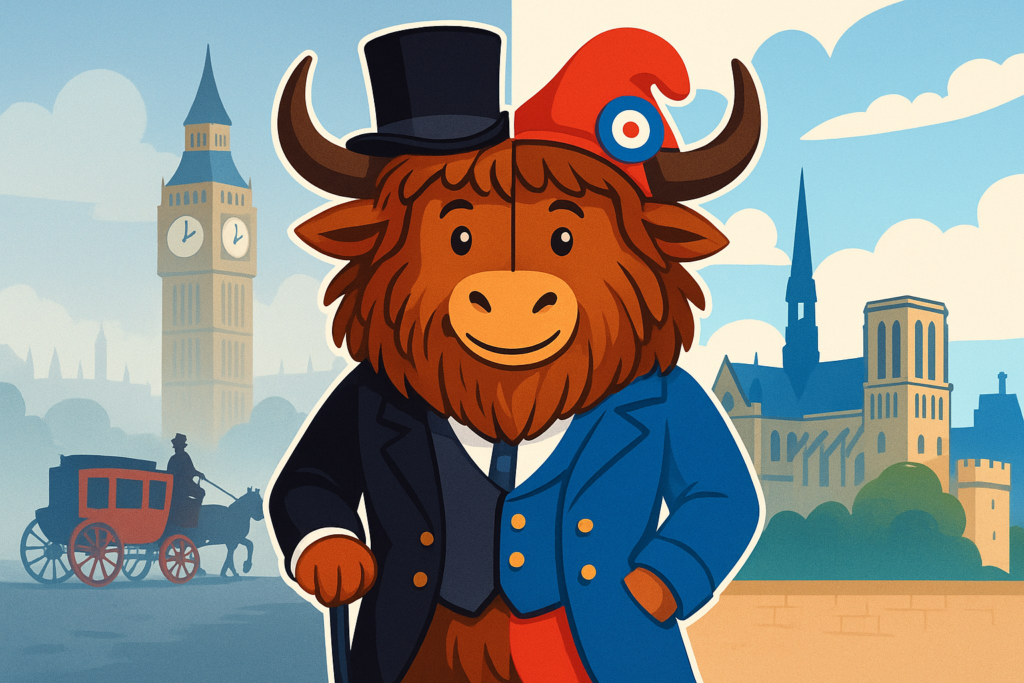
This B1 Intermediate retelling of A Tale of Two Cities keeps the plot clear for learners while still giving the story some atmosphere and momentum. In London and Paris, life was hard for most people. The rich had everything, and the poor had nothing.
This version is written for English-speaking learners and includes clickable word help inside the story, full story audio, and lesson notes after the reading. It is free to use on Yak Yacker and is designed to feel natural, readable, and manageable in English.
The year was . In , life was for most people. The had everything, and the had nothing. People whispered about . 'Something must soon,' they said.
One cold night, a mail coach toward London. Inside was Mr. Jarvis Lorry, a kind banker. A rider brought him a : 'Wait at Dover for a young lady.' Mr. Lorry read the words aloud: '.'
'What a !' he thought. 'Who is ?' But he knew part of the secret. He was going to meet Miss Lucie Manette.
Lucie was a young woman with . Mr. Lorry told her, 'Your father is alive. He was a in the Bastille in Paris for eighteen years. Now he is free.' Lucie's eyes filled with . 'My father-alive? I thought he was dead.'
Together they to Paris. They found Dr. Manette in a small, dark room above a wine shop. His white hair was long, and his eyes looked far away. He sat at a , making .
'Father, I am your daughter Lucie,' she said . He held her hand and looked into her face. , like a man waking from a long dream, he remembered. 'My child,' he whispered.
They took Dr. Manette back to London. In the clean, quiet house, he grew . Lucie took care of him. One day, a young man named Charles Darnay came to visit. He was from France, but he did not like the way the rich the poor. Lucie liked his kind eyes.
Later, in a London court, Darnay was in . He was accused of . 'He is a !' the crowd shouted. But a clever lawyer, Mr. Stryver, him. 'Look at my assistant, Sydney Carton,' Mr. Stryver said. Everyone saw that Carton and Darnay looked almost the same. The court freed Darnay.
Carton was a sad, man. He drank too much and had no . But when he met Lucie, his heart changed. One evening, he said to her, 'I know I am not good enough for you. But remember this: I would do for you or for someone you love.'
Lucie's heart chose Darnay. They and had a little daughter, also named Lucie. Dr. Manette was happy. But in France, the world was . The poor people started a . They attacked the rich, and the streets ran red.
Darnay received a letter from an old servant in Paris. The servant was in prison and asked for help. Darnay went back to France to him. But as soon as he arrived, the revolutionaries him. 'Aristocrat!' they shouted. 'He must die!'
Dr. Manette, Lucie, and little Lucie rushed to Paris to save him. The doctor's long in the Bastille made the people listen. Darnay was set free-but only for one day.
The next day, a terrible secret came out. Many years ago, Dr. Manette had written a paper about Darnay's family. The revolutionaries read it. 'He is an of the people!' they cried. Darnay was to death. He would die on the the next morning.
All hope was lost. But Sydney Carton arrived in Paris. He had a . He looked like Darnay. That night, he visited Darnay in prison. 'Change clothes with me,' he said. 'I will take your .' Darnay refused. 'No! I cannot let you do this.' Carton smiled. 'This is my choice. For Lucie.'
Carton wrote a letter and then . Darnay, dressed like Carton, left the prison with Lucie and her father. They got into a and escaped from Paris.
In the morning, Carton stood in a , riding toward the guillotine. A young girl next to him held his hand. The crowd did not know his real name. He thought of Lucie and the little girl. 'It is a far, far better thing I do now than I have ever done,' he said to himself. And Sydney Carton found .
A Tale of Two Cities begins with a tense world. London and Paris are both full of inequality, fear, and quiet anger. When people say, "Something must break soon," they are warning that a big change is coming.
This kind of opening helps set the mood fast. In stories, a city can feel like a character too: crowded, cold, hopeful, or dangerous. Here, the two cities mirror each other, even though they are in different countries.
- Look for words that create mood: hard, whispered, cold, strange.
- "Something must break soon" means trouble is about to happen.
- Cities in literature often reflect the people living in them.
This story uses strong, memorable words. Some are everyday words with extra emotional weight, like alive, free, and hope. Others belong to the historical setting, such as Bastille, revolution, and guillotine.
Try noticing how the story repeats important ideas. "Recalled to life" is not just about surviving; it suggests being brought back into hope, family, and the world.
- recalled to life = brought back from a dead or hopeless state
- prisoner = a person kept in prison
- traitor = someone believed to have betrayed their country or group
- sacrifice = giving up something valuable for someone else
Most of the story is told in the past tense, which is normal for narratives. You see simple past forms like was, had, said, went, and thought. These keep the action moving clearly from one event to the next.
The story also uses reporting verbs like whispered, told, asked, and cried. These verbs do more than show speech. They help you hear the emotion behind the words, which makes the scenes feel alive.
- Simple past is the main tense for finished events in stories.
- Reporting verbs can show tone: whispered, shouted, murmured, cried.
- Short sentences often add drama: "All hope was lost."
This tale is not only about history. It is about love, loyalty, and the cost of choosing another person's life above your own. Sydney Carton begins as a broken man, but he ends with purpose. That change is one of the story's deepest lessons.
When you read or listen again, pay attention to who changes and who stays steady. Lucie's kindness, Dr. Manette's recovery, and Carton's final choice all show different kinds of strength. That is a very Dickens-like trick: big feelings, clear contrasts, and one unforgettable ending.
- Ask: who is rescued, and who does the rescuing?
- Notice contrasts: London/Paris, rich/poor, despair/hope.
- Re-reading for character change makes the story easier to remember.
A Tale of Two Cities comes from the English / Charles Dickens tradition and is best known as a historical novel. This Yak Yacker article is an original learner retelling based on Charles Dickens, 1859; public domain, so the wording here is simplified for modern learners rather than copied from one old edition.
Older printings, translations, and retellings of this story can vary quite a bit. The original audience was usually adult/general, but this version is adapted for B1 Intermediate learners studying English. French Revolution context; B1+ if not simplified.
If you want to look into the source tradition, start with Project Gutenberg.
If you want to keep going, browse more in our English section and review the B1 English Vocabulary List. After that, try 1,200 English Phrases and Expressions for another useful next step.