



I’ve got a soft spot for people who learn a language alone in a small town, because that was me for about a year. Me, an app, a spreadsheet of verbs I was avoiding, and the nagging feeling that I was getting very good at Spanish that only existed inside my headphones.
You can drill conjugations until your thumbs hurt, but if nobody is sitting across from you waiting for an answer, you never find out what you sound like when you have to yack for real.
So I decided to fix it. I live in small-town Ontario, and I wanted to see what happens when you go find a real, in-the-flesh Spanish tutor in a place where the language tutoring options are, generously, thin.
Not Toronto. Not a language school with a front desk.
A town where the closest thing to a Spanish academy is one guy who used to teach at a community college and a noticeboard at the library.
I ended up doing three or four paid hours over roughly two weeks with a local tutor I found through, of all things, a Facebook group. First session in a cafe on the main street.
Later sessions in a bookable study room at the library, because espresso machines are loud and my ego is fragile. This is the write-up of what actually happened, what I’d do again, and the mistakes I’d spare you.
This is one piece of a bigger picture. If you’re building a whole approach, start with how to learn a language and come back here when you’re ready to add a human.
If there’s nobody local for your language, my guide to working with an online tutor is the other half of this story.
One more thing before we start: this is not a review of my tutor. He was fine.
This is a how-to. No score, no verdict on a specific human, just what I learned paying for hours in a town where the tutor pool is maybe four people deep and one of them only does French.
What an in-person tutor actually is
Let’s clear up terms, because people mix these up constantly and it changes what you should pay.
A tutor is someone you pay, one on one, whose job is to run the hour. They prepare, they correct you, they steer.
A conversation partner is someone you talk with, maybe paid, maybe traded, who mostly keeps the conversation going and fixes things when you stall. A school class is a group, a curriculum, and a teacher who has eleven other people to worry about.
The tutor is the middle option. You’re the only student, so the hour bends around you, but unlike a partner session, the tutor is expected to show up with a plan.
When I booked my guy, I was clear I wanted a tutor, not a chat. That distinction is also where a lot of pricing arguments come from, and I’ll get into the money later.
What a tutor is not is a substitute for you doing the work. He said something in our first hour that stuck with me: “I can’t learn Spanish for you.”
He was right, and it’s worth hearing before you spend a dollar. You pay for the speaking, the correction, the repair when a sentence falls apart, and a reason to show up.
Grammar study, reading, flashcards, listening, all of that happens off the clock. If you’re imagining someone pouring Spanish into your head for an hour a week and it sticking, you’re buying the wrong product.
I think of the in-person hour as the sharp end of the stick. Everything else I did, the apps, the Yak Cards we make here at Yak Yacker, the podcasts, built the stick.
The tutor hour is where it gets pointed.
When in-person beats online (and when it doesn't)
I’ve done both. The online version is on this site too, including my full guide to working with an online tutor.
The question is when the in-person version earns its extra hassle.
In-person wins on:
- Mouth shape. My tutor could literally point at my mouth and say “your lips, more like this” for the Spanish R. Over video, that’s guesswork. He watched me physically and fixed things in seconds that had been wrong for months.
- Pointing at real objects. “La taza” while lifting the actual cup beats a flashcard. There’s a whole class of vocabulary that just lands better when the object is on the table between you.
- Pressure that’s the good kind. I freeze less across a table than on a call. When the person is physically there, my brain stops hunting for the mute button as an escape hatch.
- Zoom fatigue. After a workday of calls, another video call feels like homework. A cafe hour feels like getting out.
- The language as it exists in your town. My tutor knew which local people spoke Spanish and what dialects were floating around. Online tutors abroad don’t know that, and don’t need to.
Online wins on:
- No local tutor for your language. This is the big one, and in a small town it’s most languages. If you want Portuguese in rural Ontario, good luck. The roundup of the best online tutors exists for exactly this.
- Weather. It’s Ontario. February exists. I’ll come back to this.
- Trial-shopping. If you want to compare three tutors in a week, online is trivially easy. In person, the pool is small and the drive is real.
- Price. An hour with a tutor in a cheaper country, online, often costs less than the local rate. Your budget goes further, sometimes much further.
The honest answer for me: I’d use both. Local hour for the physical stuff, pronunciation and nerve, online hours for volume and convenience when life gets busy.
They’re not competitors as much as people claim.
How we found one in a small town
Small-town Ontario has no tutor directory. There’s no academy storefront.
There’s a community college campus with a front desk, a library, and a rumour mill.
What actually produced a tutor, in order:
The local Facebook group. This is where it happened. Someone had posted “looking for Spanish help” eight months earlier and a name had surfaced in the comments.
I messaged that name. He was still tutoring.
Total time from post to reply: about a day. Marketplace showed a couple of tutoring ads too, mostly for math, but worth a scroll.
The library bulletin board. I checked it expecting nothing and found one laminated card for “Spanish, all levels” with a phone number and little pull tabs. It looked five years old but I called it.
Number was dead, which tells you something about bulletin boards, but the library itself is worth asking, because the desk staff knew the name of the ex-college tutor before I even finished the question.
The community college continuing-ed desk. They had no current Spanish course, but the person at the desk knew who used to teach one and suggested contacting him. In a big city that’s a dead end.
In a small town, the ex-academy and ex-college tutors are often still around and still taking private students.
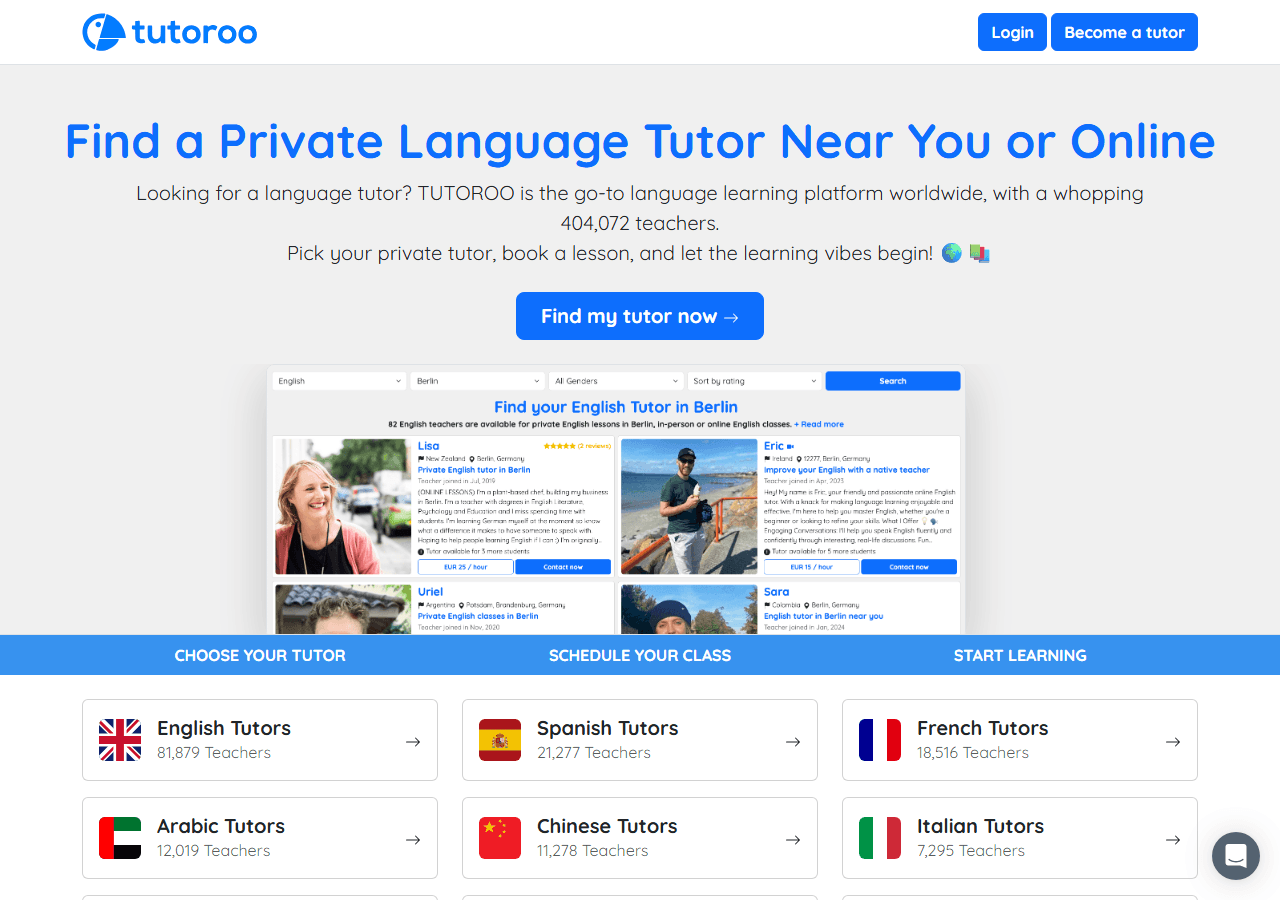
Platforms with local matching. We tested the platforms that surface when you search for local tutors. TUTOROO has a “nearby” matching setup that found one profile within driving distance, which surprised me.
Preply lists tutors by city and does show Canada, though most profiles are online-first. Care.com came up too, and we saw a listed average rate of about $26 USD an hour in the search snippet, which gives you a ballpark, though treat it as a listed rate, not a quote anyone owes you.
If you’re in a bigger centre, add language academies to the list. Academies exist in cities, and so do tutors who left academies to go private, and they’re usually the most professional option you’ll find.
In my town, it was Facebook or nothing, and Facebook delivered.
Two weeks, four paid hours, and most of the effort was finding the guy, not the lessons themselves. That ratio is normal for a small town.
Don’t let it spook you.
The first meeting
Rule one, and I’d tattoo it somewhere semi-permanent: the first meeting is in public. A cafe is what people actually book.

Mine was the cafe on the main street, the one where the wifi password is taped to the register and half the town files through for a medium double-double.
I said hi. We ordered.
I paid for my own coffee, which feels like it shouldn’t need saying, but it does. And then we did forty-five minutes of me being bad at Spanish in front of a stranger while a milk steamer screamed behind him.
A few things I’d tell my past self:
Confirm the rate before you sit down. In the messages, not at the table. You don’t want to negotiate price over a first lesson you’ve already had.
It’s an audition both ways. I was deciding if he could teach; he was checking if I was serious. First sessions are cheap dates compared to a semester, and you’re allowed to walk away after one.
Have something to say. I brought a short, honest speech: I can read okay, I panic when speaking, here’s where I want to be in six months. That gave him more to work with in ten minutes than a resume would have.
Expect it to be awkward. Mine was. There’s a stretch at the start of any first session where you’re two strangers with a transaction between you.
It passed by minute ten. If it doesn’t pass at all, that’s data.
Tell a friend where you’re going. Even in a town of a few thousand people. It’s a two-second text and it costs nothing.
More on safety near the end, but the short version: first meetings are public, always.
After the first session went well, the second and third moved to a library study room, which we booked ourselves and which I’ll compare properly in a minute. The point is the progression: cafe to prove the person, library once there was a reason to want quiet.
Not their apartment, not week one, not ever unless something big changes.
Cafes vs classrooms vs the library
Where you meet shapes the hour more than you’d think. This is from someone who did two of the three.
The cafe. Safe, socially normal, and what most people actually book. The downsides are real: it’s noisy, you’re buying drinks every hour, there’s no whiteboard, and your mistakes have an audience of espresso machines and the retired guy who’s always in the corner chair.
I said “estoy embarazada” meaning embarrassed, which means pregnant, in front of an entire latte line. My tutor laughed.
The corner guy laughed. I will never make that mistake again, so, effective?
The library study room. This is where we ended up. Our library has rooms you can book for free, it’s quiet, and it’s still public-ish, which keeps everything comfortable on that front.
You get a table, a door, and focus. What you don’t get is a whiteboard or permission to get loud with pronunciation drills.
It’s the best default once you trust the person.
A classroom or tutoring centre. Some tutors have access to a real space, community rooms, a college room, a rented office. You get a whiteboard and it feels like school, which cuts both ways.
More structure, more “we’re doing grammar now,” less conversation-in-the-wild. If your goal is exam-style progress, this is your spot.
Their home or yours. Skip it until you trust them, which is to say, after many hours and a track record. There’s no reason to make the trade early.
Public exists for exactly this, and I say that as someone who liked my tutor fine.
My arc was cafe once, library twice. If I kept going, library indefinitely.
The noise tax on a cafe hour is real when you’re straining to hear a soft-spoken person conjugate verbs.
Cash, Interac, and apps

The money conversation in Canada has three flavours.
Cash still happens. My tutor’s listed preference was cash, and for a small-town arrangement that’s not unusual. If you go cash, keep a paper trail anyway.
A note on your phone after each session, or better, a quick email or text saying “thanks for today, that’s X hours paid at $Y.” It feels paranoid for about one second and then it just feels organized.
Interac e-Transfer is the Canadian default. This is how I actually paid after the first session. It’s instant, it’s free with most bank accounts, and it automatically builds a record of every payment with dates and amounts.
If your tutor resists e-Transfer, ask why, gently. Most people over forty in Ontario have it set up already.
App booking, if they only work through a platform. If you found your tutor on Preply or TUTOROO, they may be required to run payments through the platform, and going around it can get them booted. Respect that.
It also means the platform handles receipts and cancellation rules for you, which isn’t nothing.
Whatever the method, agree the rate before you sit down. In the messages.
Written down. “One hour, $X, cash or e-Transfer okay?” takes ten seconds to type and saves the worst possible version of the end-of-session conversation.
Cancellation is a two-way street. Set the window before it matters. The usual setup: if you flake inside the window, you pay for the hour.
Fair. And it should run both ways.
If they cancel inside the window on you, you don’t eat it, or you get a reschedule with priority. I put this in writing in a friendly way after session one, and it was never an issue.
And the Ontario-specific clause I actually used: winter parking. When the plows come through or the freezing rain starts, nobody is driving across town for a language lesson, and they shouldn’t.
Put weather in the cancellation policy. “If the roads are bad, we reschedule, no charge” is a sentence that will save you money and goodwill in January.
Scheduling and actually showing up
Consistency beats intensity, and consistency is a scheduling problem, not a motivation problem.
Our tutor had two modes when we started. Mode one was “text me when you want to meet,” which sounds flexible and is actually chaos.
We met twice in one week, then nothing for ten days, because life. Mode two was the fix: one hour, same day, same time, every week.
Wednesday at 4:30. Suddenly it stopped being a decision.
It was just a thing that happened, like garbage day.
One weekly hour beat random texts by a mile. It’s not that the random sessions were bad.
It’s that without a standing slot, every session required a fresh negotiation, and negotiations are where enthusiasm goes to die. Put it in the calendar as a recurring event and let the calendar do the nagging for you.
Winter here is a legitimate scheduling factor. We didn’t get a storm in those two weeks, but we still wrote the weather clause because this is Ontario.
If the parking lot is a skating rink, you text the moment you know, not an hour before, and nobody eats a no-show fee. That sentence will matter in January even if you start in September.
Write your cancellation policy down, even in a text message you can scroll back to. The standard shape: if you flake inside the cancellation window (24 hours is common), you pay for the hour.
If they cancel inside it, they owe you a make-up session or a free hour next time. It has to cut both ways, or you’ll quietly start resenting them, or they’ll quietly start double-booking you.
And show up on time. Obvious, but I watched a guy at the next table keep his tutor waiting fifteen minutes and then spend the first ten of his paid hour apologizing.
You’re buying an hour. Every minute of lateness is a dollar you lit on fire.
What to bring
Short list. Every item earned its spot.
A notebook. Paper. The tutor corrected my word order three times in one session and it only stuck when I wrote it down by hand.
Phone notes are fine too, and our tutor preferred them because I could type faster than he could talk. But bring something to capture with.
Three to five real situations. Not “chapter four of the textbook.” Actual things from your week: ordering food when the server asks a follow-up question, small talk at the grocery store, writing a work email that isn’t stiff.
If you can walk in with a real situation you failed at this week, the hour has a spine before anyone says a word.
One stuck point. A sentence you couldn’t finish, a verb that keeps betraying you, a word you keep avoiding. Bring one.
They can’t fix what you don’t show them.
Payment, already sorted. Know how you’re paying before you sit down.
Water. You’re going to talk more than you think.
One thing to ask about first: recording. I asked before our second session and he was fine with it, but some tutors aren’t, and recording someone without asking is a great way to lose a good tutor.
Ask.
Also, don’t assume a whiteboard. If you’re in a cafe, the “whiteboard” is a napkin.
Plan accordingly, which mostly means bringing your own paper.
How we ran the hour

The best money was the first ten minutes and the middle twenty.
The first ten minutes we did something I’d resisted at first because it felt like a waste of paid time: small talk. Pure, pointless-seeming small talk.
How was your week, did you shovel, did you see the game. And it turned out this was the highest-value part of the hour, because it was the closest thing to how Spanish actually gets used.
Nobody, in real life, opens a conversation with a grammar drill.
The middle chunk we spent on the situations I’d brought. This is where a real tutor earns their rate: repair work.
When I froze, he didn’t supply the word and move on. He’d back me up a sentence, rebuild it with me, make me say it again in full.
That repair loop, someone catching your specific mistake and walking you through the fix out loud, is the thing an app cannot do. It’s also the thing a conversation partner often won’t do, because correcting a friend constantly is socially weird and correcting a paying client is the job.
We spent maybe ten minutes on explicit grammar. Ten.
Not because he didn’t know grammar, but because grammar study is cheap on your own time and expensive on his. Reading, textbook work, drills, all of that happened off the clock.
If you’re paying by the hour, pay for the hours that require another human: speaking, correction, and the mild social pressure of someone waiting for you to finish a sentence.
The last five minutes we’d set the plan for next week. Not a syllabus, just: “bring the email you’re stuck on.”
It gave me homework without it feeling like homework.
Some sessions were gold. One was a dud.
The dud was my fault, mostly. I showed up with nothing prepared and we drifted.
The tutor wasn’t inconsistent. The hour is what you make of the forty minutes before it.
Bring material and the hour runs itself.
Homework between sessions
One hour a week with a tutor is a spine, not a body. If that’s your entire contact with Spanish, you’ll crawl.
The rule we landed on: the tutor handles speaking and repair. Everything else happens between sessions, on your own time, for free or nearly.
That means input: podcasts, shows, music, whatever you’ll actually consume. It means grammar study at your own pace, because a book costs $25 once and a tutor costs $25 an hour forever.
And it means vocabulary, where Yak Cards come in. They’re our spaced-repetition deck system, built exactly for this gap: the words you meet in a session, drilled on the days you’re not paying anyone.
The stack that actually worked for us was one or two local hours a week, plus daily app and card time, plus passive input whenever the phone was in hand anyway. The tutor sessions got better the more I did between them, because I’d arrive with new mistakes instead of the same old ones.
That’s the whole game: new mistakes every week.
If you want the full method around this, we lay it out in how to learn a language.
And a specific note: if the language you’re working on is English, we’ve got 139 full lessons. Start with Lesson 1 of 139 and see how it fits alongside a local tutor hour.
The lessons intro page has the map.
Safety and professionalism
Now the unglamorous but necessary part.
First meeting is public. Always.
A cafe, a library, a Tim Hortons, it doesn’t matter, it matters that other humans are around. Our first session was in a busy cafe and later sessions moved to a bookable library study room once we knew each other.
That’s the normal arc. What’s not normal is “come to my apartment” in week one, and you should decline that without apology.
Tell a friend where you’re going. One text: “Meeting a tutor at the Second Cup on Main, 4 to 5.”
Takes four seconds, and it’s not paranoia, it’s just what adults do about any meeting arranged through Facebook Marketplace.
This is paid work, not a date, and it should feel like paid work: amicable and professional. If it starts feeling otherwise, that’s your cue to leave.
You can fire a tutor after one awkward hour. No explanation owed beyond “I don’t think this is the right fit, thanks for your time.”
The awkward hour costs you one hour’s rate; a bad fit you tolerate for two months costs you two months.
On qualifications: certificates can be fake. A framed diploma proves nothing about someone’s ability to teach you, personally.
What actually matters in week one is chemistry and whether they slow down when you visibly drown. A patient non-native speaker who remembers what it’s like to be a beginner often beats a “native speaker only” purist who’s never had to explain anything to anyone.
And a tutor with decent English as a spare tyre is useful early on: you’re not paying to play charades, and a quick English bridge gets you unstuck fast.
Beginner-friendly beats pedigree. In week one, anyway.
Later you can get picky.
What I liked, and what wore me down
What I liked
The good part: I froze less. Something about a human across a table, waiting, with a face, made me produce Spanish I didn’t know I had.
Zoom has a way of letting you go quiet, camera off, brain off. A table doesn’t.
The repair work was worth every dollar. Having someone catch that I was saying “estoy cansado” when I meant “estoy aburrido” and fix it on the spot, that’s not something I’d have caught from an app for months.
And there’s a local angle I didn’t expect: the language being actually spoken in my town. My tutor knew which grocery store had Spanish-speaking staff, when the local Spanish conversation circle met, all the real-world stuff no app surfaces.
In a small town, that local knowledge is worth as much as the teaching.
What wore me down
What wore me down. The logistics, full stop.
Driving twenty minutes each way for a one-hour session means the hour costs three hours of my life. In a snow week that would feel like a lot.
Coffee money adds up too: five dollars a week for a drink you’re drinking out of obligation. Small, but real.
The thin pool is the other drag. In Toronto you can trial three tutors and pick.
Here, if the one available tutor isn’t a fit, your option is online, full stop. That’s not a failure of in-person tutoring, it’s just geography.
Which brings us to the next section.
Who this is for, and who should skip
In-person is for you if.
Pronunciation and mouth shape matter for your goals (some sounds need someone to literally show you where your tongue goes).
You learn better with a body in the room.
You’ve got a local tutor for your language within a sane drive.
You freeze less in person than on camera.
You want the local connections.
Skip in-person and go online if: there’s no local tutor for your language, which in a small town is the most likely scenario for anything beyond Spanish and French. Or if you want to trial-shop three tutors this week, which apps make trivial and small towns make impossible.
Or if the price of local hours is silly compared to a great tutor abroad. Or if you just hate winter driving, which, fair.
We compare the two setups properly in how to work with an online tutor, and if you’re leaning that way, our roundup of the best online language tutors covers who’s actually good right now.
The best answer for most people is both: a local hour when you can get it for the speaking and the accountability, online hours for everything your town can’t supply. They’re not rivals.
They cover each other’s gaps.
What we'd use with it
The stack, concretely:
- One or two in-person hours a week, if the local pool allows it.
- Daily Yak Cards for vocabulary, because words from sessions are the words you most need to keep.
- Free or cheap input on your own time: shows, podcasts, whatever you’ll actually finish.
- An online hour or two if your local tutor can’t cover everything, following the same session logic from our online tutor guide.
Everything you need for the method itself lives under how to learn a language.
What others are saying
Dr Popkins at How to Get Fluent has a good piece on setting realistic expectations with a tutor before you start, which lines up with our “agree on everything before you sit down” approach.
Cantonese After Hours has advice on extracting maximum value from tutoring sessions that holds up across languages.
FAQ
Prices, plan names, and features below are as of September 2026.
Do I need a native speaker as my tutor?
No. A “native speaker” means someone grew up speaking the language, not that they can teach it. A fluent non-native who learned as an adult often explains things better, because they remember the struggle.
Native speakers who’ve never taught can be excellent or useless, same as anyone. Judge by whether they slow down when you drown.
How much should I pay an in-person tutor in Ontario?
It varies a lot by town and language. We saw Care.com listing an average around $26 USD an hour, and local rates ran roughly in that neighbourhood, sometimes higher for less common languages.
Agree on the number before the first session, always.
How often should I meet?
One hour a week is the floor that works. Two is better if you can afford it.
Zero scheduled and “whenever we text” is where arrangements go to die.
Where should we meet?
First meeting: public cafe. After a few sessions, a bookable library study room is the natural upgrade.
Skip their home and yours until you trust them, and maybe skip it forever. Plenty of tutor relationships run for years entirely in cafes.
Can I record the sessions?
Ask first. Most tutors will say yes, especially if it’s just audio for your own review.
Recording without asking is a trust violation and word travels, even in a small town.
What if the tutor isn't a good fit?
Leave after one session. Pay for the hour, thank them, don’t rebook.
You’re not signing a lease. The awkward exit costs one hour’s rate and saves you months of mediocre sessions.
In-person or online?
Depends on your town, your language, and your winter. Full comparison in how to work with an online tutor.
For most people in a small town: local for what exists, online for what doesn’t.
After two weeks
Three or four paid hours won’t make you fluent, and anyone selling you that timeline is selling something. What it did do was expose the shape of my Spanish: the words I avoid, the verbs that betray me, the exact moment my brain goes quiet.
A tutor is a mirror that talks back.
The thing I keep coming back to is the first ten minutes. The small talk.
It felt like wasted money the first time and it turned out to be the most useful Spanish practice I’ve had in years, because it’s the only part of the hour that resembles the actual activity of speaking a language to another human. Everything else, the drills, the flashcards, the grammar tables, is rehearsal.
The small talk is the show.
Last thing I’d pass to anyone booking their first hour: the tutor cannot learn Spanish for you. I knew that going in, sort of, but sitting in that cafe I finally understood it.
You’re not paying for the language. You’re paying for the hour: someone across the table, waiting, patient, correcting you in real time, and a reason to show up on a Wednesday when the couch is right there.
The language itself you build alone, between sessions, with your cards and your podcasts and your notebook.
Buy the hour. Do the rest yourself.