German Possessive Adjectives: Mein, Dein, Sein and How to Decline Them
Learn how to say my, your, and his in German without staring at declension charts like they personally offended you.
German possessive adjectives show who something belongs to. The big three beginners meet first are mein (my), dein (your, informal singular), and sein (his / its).
The annoying part is that they change their endings. The less annoying part is this: they decline a lot like ein-words. Once you see the pattern, the chaos gets much less dramatic.
Yak Box: The Core Idea
- mein = my
- dein = your
- sein = his / its
- They must match the gender, number, and case of the noun.
- They use endings similar to ein: -e, -en, -em, -er, -es, and sometimes no ending at all.
What Are Possessive Adjectives In German?
These words come before a noun and tell you who owns it.
| German | English Meaning | Example Sentence |
|---|---|---|
| mein | my | Mein Bruder wohnt in Berlin. = My brother lives in Berlin. |
| dein | your | Dein Kaffee ist hier. = Your coffee is here. |
| sein | his / its | Sein Auto ist neu. = His car is new. |
You can also learn the rest of the family later: ihr (her), unser (our), euer (your plural), and ihr/Ihr (their / your formal). The same declension logic still applies. German loves patterns almost as much as it loves making beginners doubt themselves.
The Base Forms: Mein, Dein, Sein
mein
English: my
Example: Mein Hund schläft.
My dog is sleeping.
dein
English: your
Example: Dein Zimmer ist groß.
Your room is big.
sein
English: his / its
Example: Sein Laptop ist alt.
His laptop is old.
Why Do They Change?
Because German nouns need signals. The possessive adjective helps show whether the noun is masculine, feminine, neuter, or plural and what role it plays in the sentence: subject, direct object, indirect object, and so on.
So you do not just learn mein. You also learn forms like meine, meinen, meinem, meiner, and meines.
The Main Declension Pattern
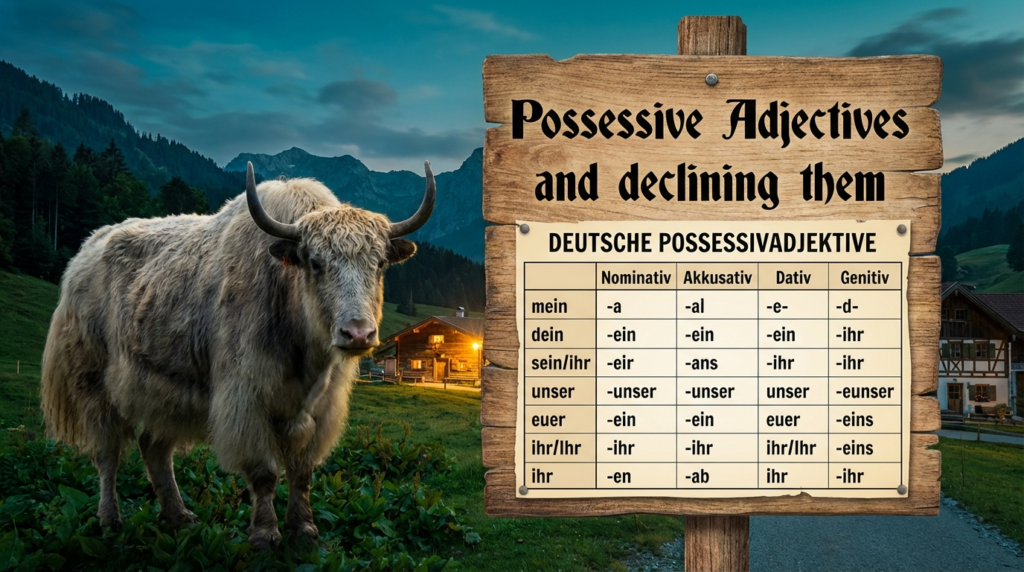
Here is the full pattern using mein-. The endings are the important part. The same endings also work for dein- and sein-.
| Case | Masculine | Feminine | Neuter | Plural |
|---|---|---|---|---|
| Nominative | mein | meine | mein | meine |
| Accusative | meinen | meine | mein | meine |
| Dative | meinem | meiner | meinem | meinen |
| Genitive | meines | meiner | meines | meiner |
The same pattern works here:
- dein, deine, deinen, deinem, deiner, deines
- sein, seine, seinen, seinem, seiner, seines
Rule By Rule: The Endings That Matter Most
Nominative Masculine And Neuter Usually Have No Extra Ending
This is why you get mein Bruder, dein Hund, and sein Auto, not some random extra vowel parade.
- Mein Bruder ist Lehrer. = My brother is a teacher.
- Dein Hund bellt laut. = Your dog barks loudly.
- Sein Auto ist schnell. = His car is fast.
Feminine And Plural Often Take -e
- Meine Schwester kommt heute. = My sister is coming today.
- Deine Tasche ist schön. = Your bag is nice.
- Seine Bücher liegen hier. = His books are lying here.
Accusative Masculine Takes -en
This one matters a lot because it shows up constantly with direct objects.
- Ich sehe meinen Bruder. = I see my brother.
- Ich finde deinen Schlüssel. = I find your key.
- Er besucht seinen Vater. = He is visiting his father.
Dative Often Uses -em, -er, And -en
- Ich helfe meinem Freund. = I help my friend.
- Ich antworte deiner Mutter. = I reply to your mother.
- Er spielt mit seinem Kind. = He plays with his child.
- Wir sprechen mit meinen Freunden. = We are talking with my friends.
Genitive Exists, Even If Spoken German Avoids It Sometimes
- Wegen meines Jobs bin ich müde. = Because of my job, I am tired.
- Trotz deiner Angst gehst du rein. = Despite your fear, you go in.
- Während seines Urlaubs liest er viel. = During his vacation, he reads a lot.
Mini Pattern Table: Endings Only
| Case | Masculine | Feminine | Neuter | Plural |
|---|---|---|---|---|
| Nominative | — | -e | — | -e |
| Accusative | -en | -e | — | -e |
| Dative | -em | -er | -em | -en |
| Genitive | -es | -er | -es | -er |
The dash means no extra ending. So mein Bruder is just the stem, while meine Schwester adds -e.
Real-Life Sentences With Mein, Dein, And Sein
| German | English Meaning |
|---|---|
| Mein Name ist Lara. | My name is Lara. |
| Meine Freundin wohnt in Wien. | My girlfriend / female friend lives in Vienna. |
| Ich habe meinen Pass. | I have my passport. |
| Wir fahren mit meinem Auto. | We are driving with my car. |
| Dein Deutsch ist schon gut. | Your German is already good. |
| Deine Jacke ist auf dem Stuhl. | Your jacket is on the chair. |
| Ich brauche deinen Rat. | I need your advice. |
| Ich rede mit deiner Lehrerin. | I am speaking with your teacher. |
| Sein Handy ist aus. | His phone is off. |
| Seine Schwester studiert Medizin. | His sister studies medicine. |
| Ich kenne seinen Chef. | I know his boss. |
| Er hilft seinem Nachbarn. | He helps his neighbor. |
A Very Important Warning: Sein Can Mean His Or Its
sein can refer to a masculine noun or a neuter noun owner.
- Tom sucht seinen Schlüssel. = Tom is looking for his key.
- Das Kind sucht sein Spielzeug. = The child is looking for its toy.
The ending still depends on the noun that comes after the possessive adjective, not on the owner. German is picky like that.
How To Build The Correct Form Step By Step
- Start with the base: mein-, dein-, or sein-.
- Look at the noun after it. Is it masculine, feminine, neuter, or plural?
- Find the case: nominative, accusative, dative, or genitive.
- Add the correct ending.
Example: I see my dog
- dog = Hund = masculine
- it is the direct object after see = accusative
- accusative masculine ending = -en
- Ich sehe meinen Hund.
Example: My bag is here
- bag = Tasche = feminine
- it is the subject = nominative
- nominative feminine ending = -e
- Meine Tasche ist hier.
Common Mistakes And Fast Fixes
Mistake 1
Mein Schwester
Fix: Meine Schwester
Schwester is feminine, so nominative feminine needs -e.
Mistake 2
Ich sehe mein Bruder
Fix: Ich sehe meinen Bruder
Bruder is masculine and a direct object, so accusative masculine needs -en.
Mistake 3
Ich helfe meine Mutter
Fix: Ich helfe meiner Mutter
helfen takes dative, so feminine dative needs -er.
Quick Comparison: Mein, Dein, Sein
| Base Form | English Meaning | Feminine Example | Masculine Accusative Example |
|---|---|---|---|
| mein | my | meine Katze = my cat | meinen Bruder = my brother |
| dein | your | deine Katze = your cat | deinen Bruder = your brother |
| sein | his / its | seine Katze = his cat | seinen Bruder = his brother |
Practice Section
Try these before peeking at the answers. Mild suffering builds character. Or at least grammar memory.
Fill In The Correct Form
- _____ Freundin kommt aus Köln. (my)
- Ich sehe _____ Vater. (your)
- Er hilft _____ Schwester. (his)
- _____ Auto ist kaputt. (my)
- Wir sprechen mit _____ Freunden. (your)
Answers
- Meine Freundin kommt aus Köln.
- Ich sehe deinen Vater.
- Er hilft seiner Schwester.
- Mein Auto ist kaputt.
- Wir sprechen mit deinen Freunden.
Swap The Owner
Change the possessive adjective, but keep the ending pattern.
- mein Bruder → dein Bruder → sein Bruder
- meine Tasche → deine Tasche → seine Tasche
- meinen Lehrer → deinen Lehrer → seinen Lehrer
- meinem Kind → deinem Kind → seinem Kind
Spot The Difference
- Mein Vater ist hier. = My father is here.
- Ich sehe meinen Vater. = I see my father.
Only the case changed. Nominative masculine uses mein; accusative masculine uses meinen. Tiny ending, big job.
Quick Reference Summary
- mein, dein, and sein mean my, your, and his / its.
- They come before nouns and must match the noun’s gender, number, and case.
- Nominative masculine and neuter often use the bare form: mein Bruder, sein Auto.
- Feminine and plural often use -e: meine Schwester, deine Bücher.
- Accusative masculine uses -en: meinen Bruder.
- Dative uses -em, -er, or -en: meinem Freund, deiner Mutter, seinen Freunden.
- Genitive uses -es or -er: meines Hauses, seiner Idee.
Final Yak
Do not try to memorize fifty charts at once. Start with the forms you will use every day: mein Bruder, meine Schwester, meinen Freund, meinem Lehrer. Once those feel normal, German possessive adjectives stop looking scary and start looking weirdly logical. Which, for German, is basically a love letter.