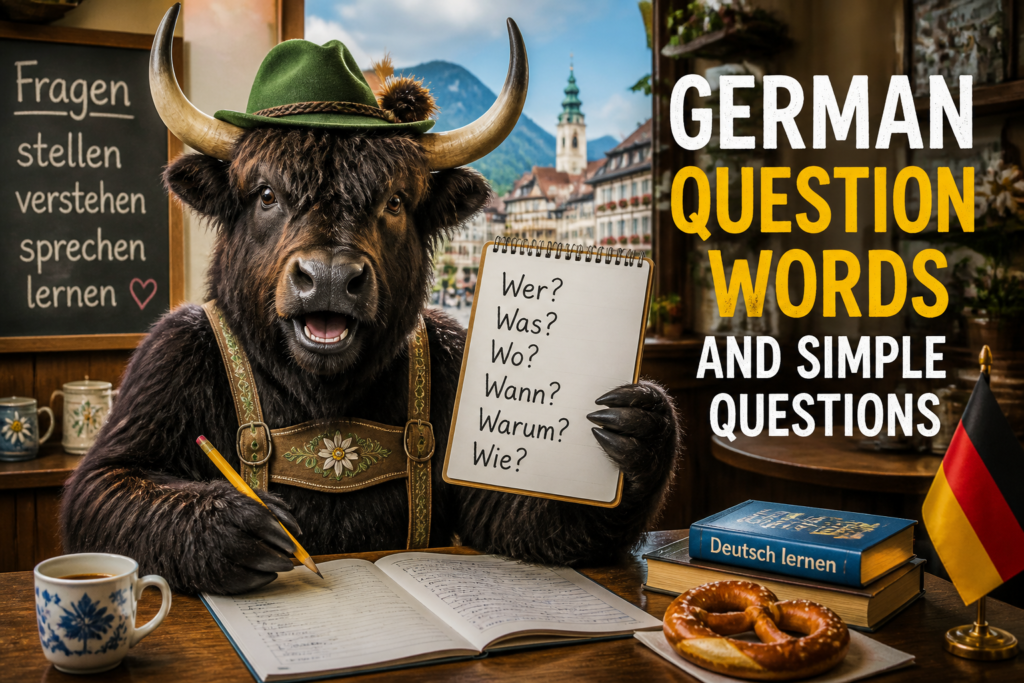
If you can ask simple questions in German, you can suddenly do a lot more than just stare politely at a train timetable. You can ask where things are, what something means, who someone is, and whether the café has oat milk or the good kind of croissant, the kind that disappears before you sit down.
For the broader learning path, visit our parent guide.
This guide keeps things practical. You’ll learn the most useful German question words, how simple questions are built, and how to answer them without sounding like a robot that learned German from a freezer label.
By the end, you’ll understand how to ask clear everyday questions with wer, was, wann, wo, wohin, woher, warum, wie, wie viel, and more.
For a bigger vocabulary base, you can also look at Essential German Words And Phrases, and if you want to understand why German sentence parts behave the way they do, German Cases Explained is the next sensible stop.
The Big Idea: German Questions Are Often Very Simple
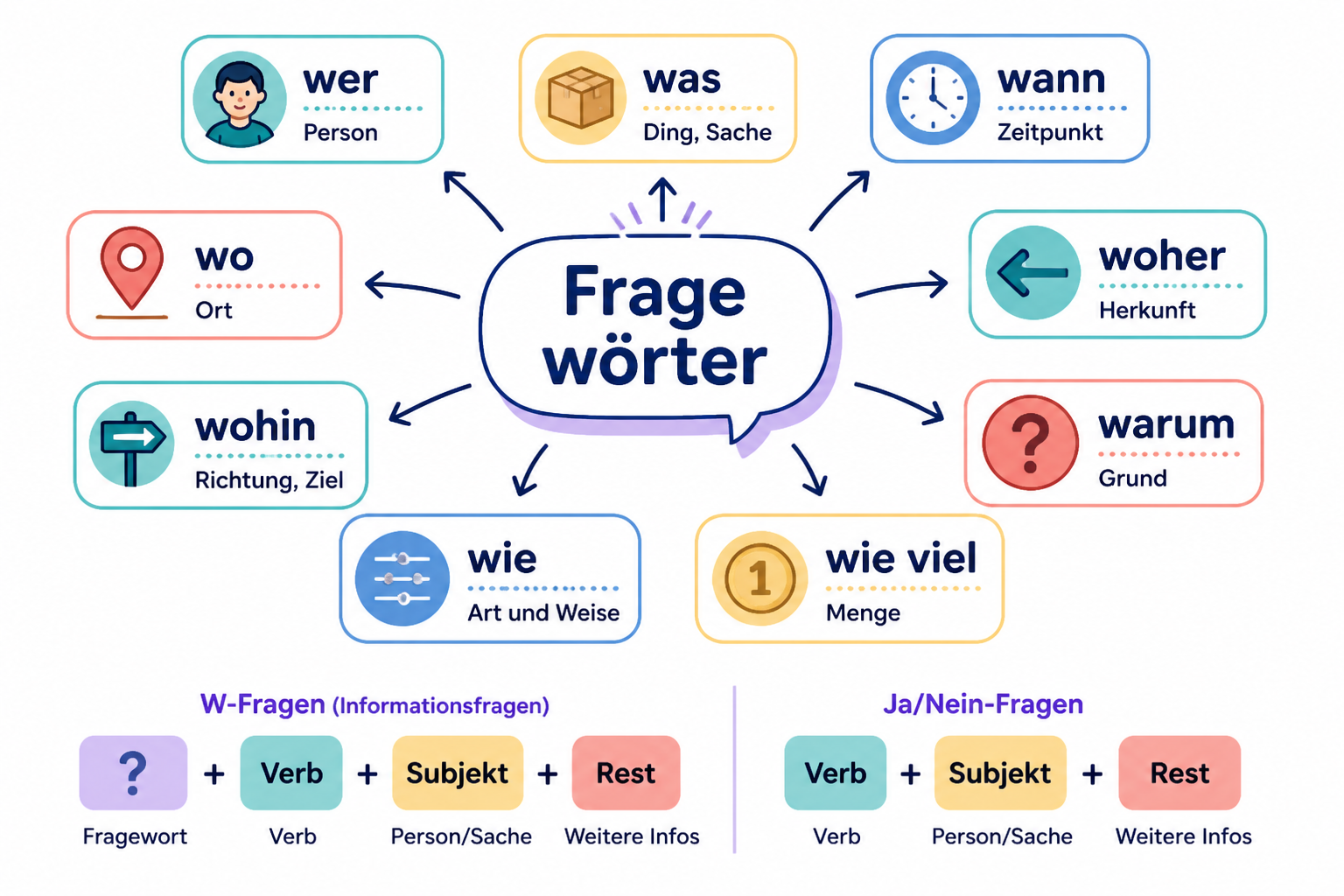
German questions usually come in two main types:
- Question word questions — you use a question word like was or wo.
- Yes/no questions — you ask with no question word, and the verb comes first.
The good news: the pattern is usually neat and logical. The slightly annoying news: German still likes to shuffle the verb around just enough to keep learners humble.
Rule: In most German questions, the verb is the second important idea in a statement, but the first idea in a yes/no question.
| Pattern | Meaning | German Example | English Translation | Learner Note |
|---|---|---|---|---|
| Question word + verb + subject + rest | Open question | Wo wohnst du? | Where do you live? | Normal question word structure. |
| Verb + subject + rest | Yes/no question | Wohnst du hier? | Do you live here? | No question word needed. |
That’s the core pattern. Everything else is mostly details, vocabulary, and the occasional German preposition trying to make your life more interesting.
Essential German Question Words
Here are the most useful question words for everyday German. These are the ones you’ll actually hear in shops, cafés, classes, travel situations, and very normal human conversations.
| German | Pronunciation | Meaning | Example Sentence | Translation | Learner Note |
|---|---|---|---|---|---|
| wer | vair | who | Wer ist das? | Who is that? | Used for people. |
| was | vahs | what | Was machst du? | What are you doing? | Very common and versatile. |
| wann | vahn | when | Wann beginnt der Kurs? | When does the course start? | Ask about time. |
| wo | voh | where | Wo ist der Bahnhof? | Where is the train station? | For a location. |
| wohin | voh-HIN | where to | Wohin gehst du? | Where are you going? | Movement toward a place. |
| woher | voh-HAIR | where from | Woher kommst du? | Where are you from? | Movement or origin. |
| warum | vah-ROOM | why | Warum lernst du Deutsch? | Why are you learning German? | Very common in daily life. |
| weshalb | ves-HAHLP | why / for what reason | Weshalb bist du spät? | Why are you late? | More formal than warum. |
| wieso | vee-ZOH | why / how come | Wieso ist das so? | How come that is so? | Natural and common in conversation. |
| wie | vee | how | Wie geht es dir? | How are you? | Also used for “what is … like?” |
| wie viel | vee feel | how much | Wie viel kostet das? | How much does that cost? | For uncountable nouns or price. |
| wie viele | vee FEE-luh | how many | Wie viele Brüder hast du? | How many brothers do you have? | For countable things. |
| welcher / welche / welches | VEL-cher / VEL-che / VEL-chess | which | Welches Buch willst du? | Which book do you want? | Changes like an adjective. |
| was für ein | vahs fur ine | what kind of / what sort of | Was für ein Film ist das? | What kind of film is that? | Very common in spoken German. |
Quick tip: wer asks about a person, was asks about a thing or idea, and welcher helps you choose between options. German loves precision when it feels cooperative.
Simple Question Patterns You’ll Use All The Time
Let’s make the structure feel less mysterious and more useful.
| Pattern | Meaning | German Example | English Translation | Learner Note |
|---|---|---|---|---|
| Question word + verb + subject | Open question | Wo wohnst du? | Where do you live? | Question word comes first. |
| Verb + subject + rest | Yes/no question | Wohnst du in Berlin? | Do you live in Berlin? | No question word, verb first. |
| Question word + subject + verb | Incorrect in most cases | Wo du wohnst? | Where you live? | This sounds wrong in standard German. |
German question word questions usually follow this formula:
- Question word
- Conjugated verb
- Subject
- Other information
For example:
Warum lernst du Deutsch? = Why are you learning German?
Here, warum comes first, then the verb lernst, then the subject du.
Another one:
Wann kommt der Zug? = When does the train come?
Yes, that simple. German does enjoy being sensible sometimes.
Useful Question Phrases For Real Life
These are the phrases you’ll actually use in daily situations. Ask them in a shop, on the street, in class, or while pretending you know what platform your train uses.
| German | Pronunciation | Meaning | Example Sentence | Translation | Learner Note |
|---|---|---|---|---|---|
| Wie heißt du? | vee heist doo | What is your name? / What are you called? | Wie heißt du? | What is your name? | Informal, uses du. |
| Wie heißen Sie? | vee HI-sen zee | What is your name? | Wie heißen Sie? | What is your name? | Formal, uses Sie. |
| Woher kommst du? | voh-HAIR komst doo | Where are you from? | Woher kommst du? | Where are you from? | Very common small-talk question. |
| Wo wohnen Sie? | voh VOH-nen zee | Where do you live? | Wo wohnen Sie? | Where do you live? | Polite/formal version. |
| Wie geht’s? | vee gates | How’s it going? | Wie geht’s? | How’s it going? | Short, casual, very common. |
| Wie geht es Ihnen? | vee gate ess EE-nen | How are you? (formal) | Wie geht es Ihnen? | How are you? | Polite and safe in formal situations. |
| Wie viel kostet das? | vee feel KOH-stet dahs | How much does that cost? | Wie viel kostet das Brot? | How much does the bread cost? | Use for price. |
| Wie spät ist es? | vee shpate ist ess | What time is it? | Wie spät ist es? | What time is it? | Literally “How late is it?” |
| Wann fängt der Film an? | vahn fengt dair feelm ahn | When does the film start? | Wann fängt der Film an? | When does the film start? | anfangen is separable. |
| Kann ich bitte zahlen? | kahn ikh BIT-te TSAL-en | Can I pay, please? | Kann ich bitte zahlen? | Can I pay, please? | Useful in cafés and restaurants. |
| Wo ist die Toilette? | voh ist dee toy-LET-teh | Where is the toilet? | Wo ist die Toilette? | Where is the toilet? | Polite, direct, practical. |
| Was bedeutet das? | vahs beh-DOY-tet dahs | What does that mean? | Was bedeutet das Wort? | What does the word mean? | Very useful when reading or listening. |
Question Words With Movement: Wo, Wohin, Woher
This trio trips people up all the time, so let’s keep it simple.
| Question Word | Meaning | Use It For | Example | Translation |
|---|---|---|---|---|
| wo | where | location | Wo bist du? | Where are you? |
| wohin | where to | direction / destination | Wohin gehst du? | Where are you going? |
| woher | where from | origin / starting point | Woher kommst du? | Where are you coming from? |
Rule: Use wo for a place, wohin for movement to a place, and woher for movement from a place.
Examples:
- Wo ist mein Handy? — Where is my phone?
- Wohin fährst du? — Where are you driving / going?
- Woher hast du das? — Where did you get that?
That last one is especially useful. It can mean “Where did you get that?” in the broad sense of origin, source, or stash of mysterious snacks.
How To Ask Yes/No Questions
Yes/no questions are the easiest German questions to build. You simply put the verb first.
| Statement | Yes/No Question | English | Learner Note |
|---|---|---|---|
| Du kommst heute. | Kommst du heute? | You are coming today. / Are you coming today? | Verb moves to the front. |
| Sie arbeiten morgen. | Arbeiten Sie morgen? | You work tomorrow. / Are you working tomorrow? | Formal Sie stays capitalized. |
| Er hat Zeit. | Hat er Zeit? | He has time. / Does he have time? | haben becomes hat. |
These questions often sound like “Do you…?” or “Is he…?” in English, but German doesn’t need a helper verb like do. The verb itself does the job. Efficient. Slightly smug.
Try these patterns:
- Kommst du mit? — Are you coming along?
- Hast du morgen Zeit? — Do you have time tomorrow?
- Ist das richtig? — Is that correct?
- Kann ich helfen? — Can I help?
How To Answer Simple Questions
German answers are usually short and practical. You do not need a full speech unless you want to impress someone or accidentally create a small lecture.
| Question | Short Answer | English | Learner Note |
|---|---|---|---|
| Wo wohnst du? | In Berlin. | In Berlin. | German often drops the full sentence in replies. |
| Wie heißt du? | Ich heiße Anna. | My name is Anna. | Use heißen, not “I am called” word-for-word. |
| Woher kommst du? | Aus Kanada. | From Canada. | Use aus for origin. |
| Wann beginnt der Kurs? | Um 9 Uhr. | At 9 o’clock. | Time answer often starts with a time phrase. |
| Wie viel kostet das? | Fünf Euro. | Five euros. | Price answer can be very short. |
Learner note: If someone asks a question word question, answer the actual information they asked for. If they ask wo?, answer a place. If they ask wann?, answer time. This sounds obvious, but it saves a lot of awkward guessing.
German Question Word Pairs That Look Similar
Some question words are close in meaning, but not identical. German likes these tiny distinctions, because apparently confusion builds character.
| Pair | Difference | Example | Translation | Learner Note |
|---|---|---|---|---|
| wo / wohin / woher | place / to a place / from a place | Wo bist du? Wohin gehst du? Woher kommst du? | Where are you? Where are you going? Where are you from? | Very important trio. |
| warum / wieso / weshalb | all mean “why,” but register differs | Warum bist du müde? | Why are you tired? | warum is the most common. |
| wie viel / wie viele | amount vs countable number | Wie viel Wasser? Wie viele Äpfel? | How much water? How many apples? | viel for uncountable; viele for countable. |
| was für ein / welcher | type of thing vs choice among options | Was für ein Auto? Welches Auto? | What kind of car? Which car? | was für ein is often more conversational. |
For a dictionary-style check of forms and usage, a boring but reliable source like Duden is handy when you want to confirm spelling or usage without guesswork.
Why German Question Words Often Affect Word Order
This is where things get a little more grammatical, but still manageable. In German, the question word usually counts as the first “slot”