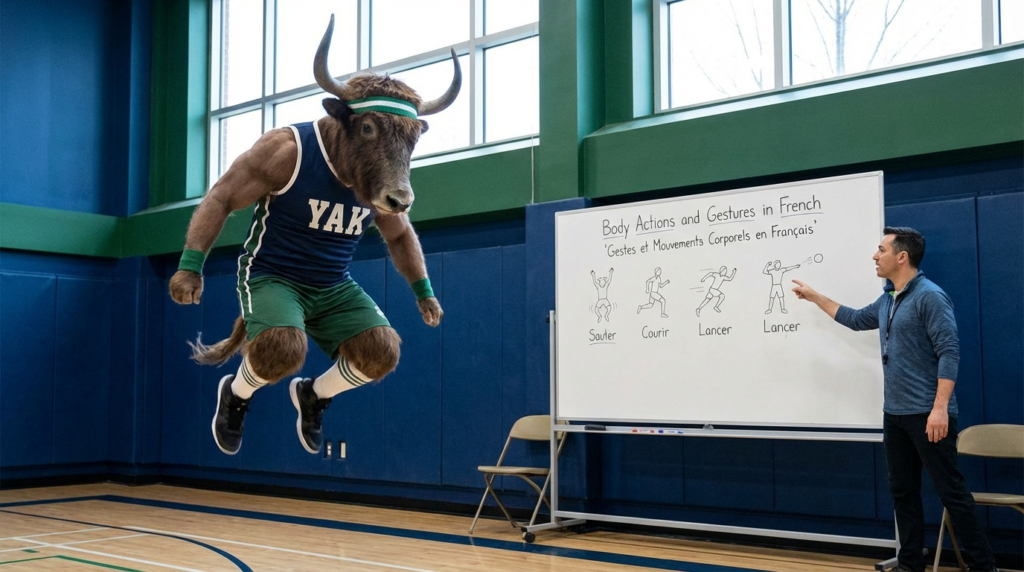
Body Actions and Gestures in French: 80+ Words & Phrases to Look Fluent
Topic: gestes & langage corporel (French body language). Learn the French you actually need for everyday “what are you doing with your face/hands?” moments—complete with IPA, examples, and tap-to-hear audio.
French body language vocabulary is secretly a superpower: it helps you describe what people are doing, react naturally in conversation, and understand what you’re seeing (hello, dramatic shoulder shrugs).
Tap the 🔊 buttons to hear a French voice. Copy the phrases into your daily life. Bonus: you’ll stop saying “he did… a… hand thing” in English. You’re welcome.
In French, a shrug is not just a shrug. It can mean “I don’t know,” “I don’t care,” “I am emotionally unavailable,” or “I am Paris.” Context is everything. Shoulders, too.
Starter Pack: 8 gestures you’ll see (and use) constantly
These are high-frequency. Learn them first, then add the “fancy eyebrow work.”
hocher la tête
IPA: /ɔ.ʃe la tɛt/
Meaning: to nod (often “yes”)
Example includedsecouer la tête
IPA: /sə.ku.e la tɛt/
Meaning: to shake your head (“no”)
Example includedhausser les épaules
IPA: /o.se le z‿e.pol/
Meaning: to shrug
Classic French energyfaire signe
IPA: /fɛʁ siɲ/
Meaning: to signal / gesture
Very usefulfaire un clin d’œil
IPA: /fɛʁ œ̃ klɛ̃ d‿œj/
Meaning: to wink
Playfulapplaudir
IPA: /a.plo.diʁ/
Meaning: to applaud / clap
No notesserrer la main
IPA: /sɛ.ʁe la mɛ̃/
Meaning: to shake hands
Politefaire la bise
IPA: /fɛʁ la biz/
Meaning: to do cheek-kiss greetings
Depends on context12 real-life phrases for daily “body language” moments
Steal these. Use them. Become mysteriously confident.
Je te fais signe.
Meaning: I’ll signal you.
Arrête de te ronger les ongles.
Meaning: Stop biting your nails.
Croise les doigts pour moi !
Meaning: Fingers crossed for me!
Ne hausse pas les épaules comme ça.
Meaning: Don’t shrug like that.
Regarde-moi dans les yeux.
Meaning: Look me in the eyes.
Il a levé les mains : « Je rends ! »
Meaning: He put his hands up: “I surrender!”
Elle a secoué la tête.
Meaning: She shook her head.
On se fait la bise ?
Meaning: Do we do cheek kisses?
On se serre la main.
Meaning: We’ll shake hands.
Il a tapoté mon épaule pour attirer mon attention.
Meaning: He tapped my shoulder to get my attention.
Je me suis étiré(e) en me levant.
Meaning: I stretched as I got up.
Fais-moi un clin d’œil.
Meaning: Give me a wink.
Pronunciation mini-hacks (so you sound human)
- Nasals like mains /mɛ̃/ and menton /mɑ̃.tɔ̃/ are “air through the nose” vowels—don’t pronounce the final n hard.
- Liaisons often appear in slow IPA as a tiny link: les‿yeux /le z‿jø/. You can aim for smooth flow.
- R is the French throat “r”: rire /ʁiʁ/, pleurer /plø.ʁe/.
Fast cultural note
- La bise varies by region and relationship. When in doubt: On se fait la bise ?
- Eye contact can be direct in conversation, but vibe matters—keep it friendly, not interrogator-chic.
- Shrugging is basically punctuation in France. Use responsibly.
If you learn only one thing today: faire signe covers half of humanity’s communication system. The other half is eyebrow work. Advanced level: both at once.
Face & head actions (18)
Useful for describing reactions, emotions, and “why is he making that face?”
| French | IPA | Meaning (EN) | Example (FR) | Translation (EN) | Audio |
|---|---|---|---|---|---|
| sourire | /su.ʁiʁ/ | to smile | Il sourit quand il est content. | He smiles when he’s happy. | |
| rire | /ʁiʁ/ | to laugh | On rit ensemble à la fin du film. | We laugh together at the end of the movie. | |
| pleurer | /plø.ʁe/ | to cry | Elle pleure parce qu’elle est émue. | She’s crying because she’s moved. | |
| cligner des yeux | /kli.ɲe de z‿jø/ | to blink | Je cligne des yeux à cause de la lumière. | I’m blinking because of the light. | |
| ouvrir grand les yeux | /u.vʁiʁ ɡʁɑ̃ le z‿jø/ | to open eyes wide | Il ouvre grand les yeux, surpris. | He opens his eyes wide, surprised. | |
| fermer les yeux | /fɛʁ.me le z‿jø/ | to close eyes | Ferme les yeux une seconde. | Close your eyes for a second. | |
| lever les sourcils | /lə.ve le suʁ.si/ | to raise eyebrows | Elle lève les sourcils : elle n’y croit pas. | She raises her eyebrows: she doesn’t believe it. | |
| froncer les sourcils | /fʁɔ̃.se le suʁ.si/ | to furrow brows | Il fronce les sourcils quand il réfléchit. | He furrows his brows when he’s thinking. | |
| faire la moue | /fɛʁ la mu/ | to pout | Ne fais pas la moue, on va trouver une solution. | Don’t pout, we’ll find a solution. | |
| bâiller | /bɑ.je/ | to yawn | Je bâille parce que je suis fatigué. | I’m yawning because I’m tired. | |
| éternuer | /e.tɛʁ.nɥe/ | to sneeze | Il éternue à cause du pollen. | He sneezes because of pollen. | |
| tousser | /tu.se/ | to cough | Elle tousse un peu ce matin. | She’s coughing a little this morning. | |
| se moucher | /sə mu.ʃe/ | to blow one’s nose | Je me mouche, puis je reviens. | I’ll blow my nose, then I’ll be back. | |
| rougir | /ʁu.ʒiʁ/ | to blush | Il rougit quand on le complimente. | He blushes when people compliment him. | |
| tirer la langue | /ti.ʁe la lɑ̃ɡ/ | to stick out one’s tongue | L’enfant tire la langue pour taquiner. | The kid sticks out their tongue to tease. | |
| se mordre la lèvre | /sə mɔʁdʁ la lɛvʁ/ | to bite one’s lip | Je me mords la lèvre quand je suis stressé. | I bite my lip when I’m stressed. | |
| incliner la tête | /ɛ̃.kli.ne la tɛt/ | to tilt the head | Elle incline la tête pour mieux écouter. | She tilts her head to listen better. | |
| tourner la tête | /tuʁ.ne la tɛt/ | to turn the head | Il tourne la tête quand il entend son nom. | He turns his head when he hears his name. |
Hands & arms gestures (18)
Signals, reactions, and the universal language of “come here.”
| French | IPA | Meaning (EN) | Example (FR) | Translation (EN) | Audio |
|---|---|---|---|---|---|
| faire coucou | /fɛʁ ku.ku/ | to wave “hi” (cute/casual) | Je fais coucou aux voisins. | I wave hi to the neighbors. | |
| saluer de la main | /sa.lɥe də la mɛ̃/ | to wave hello/goodbye | On salue de la main depuis la fenêtre. | We wave from the window. | |
| faire un signe | /fɛʁ œ̃ siɲ/ | to make a gesture/sign | Fais un signe si tu es prêt. | Give me a sign if you’re ready. | |
| faire signe de venir | /fɛʁ siɲ də və.niʁ/ | to motion “come here” | Elle me fait signe de venir. | She motions for me to come. | |
| faire signe de partir | /fɛʁ siɲ də paʁ.tiʁ/ | to motion “go away / leave” | Il nous fait signe de partir. | He signals us to leave. | |
| pointer du doigt | /pwɛ̃.te dy dwa/ | to point (with a finger) | Ne pointe pas du doigt, c’est impoli. | Don’t point, it’s rude. | |
| faire un pouce en l’air | /fɛʁ œ̃ pus ɑ̃ l‿ɛʁ/ | to give a thumbs-up | Il fait un pouce en l’air : tout va bien. | He gives a thumbs-up: everything’s fine. | |
| mettre le pouce vers le bas | /mɛtʁ(ə) lə pus vɛʁ lə bɑ/ | to give a thumbs-down | Elle met le pouce vers le bas : mauvaise idée. | She gives a thumbs-down: bad idea. | |
| croiser les doigts | /kʁwa.ze le dwa/ | to cross fingers | Je croise les doigts pour toi. | I’m keeping my fingers crossed for you. | |
| se ronger les ongles | /sə ʁɔ̃.ʒe le z‿ɔ̃ɡl/ | to bite one’s nails | Il se ronge les ongles avant l’examen. | He bites his nails before the exam. | |
| serrer le poing | /sɛ.ʁe lə pwɛ̃/ | to clench a fist | Il serre le poing, puis il respire. | He clenches his fist, then he breathes. | |
| tendre la main | /tɑ̃dʁ la mɛ̃/ | to hold out a hand | Je tends la main pour l’aider. | I hold out my hand to help him. | |
| joindre les mains | /ʒwɑ̃dʁ le mɛ̃/ | to put hands together | Elle joint les mains pour remercier. | She puts her hands together to say thanks. | |
| se frotter les mains | /sə fʁɔ.te le mɛ̃/ | to rub hands | Il se frotte les mains : il a froid. | He rubs his hands: he’s cold. | |
| se gratter | /sə ɡʁa.te/ | to scratch (oneself) | Je me gratte, ça me démange. | I’m scratching, it itches. | |
| se gratter la tête | /sə ɡʁa.te la tɛt/ | to scratch one’s head | Il se gratte la tête : il ne comprend pas. | He scratches his head: he doesn’t understand. | |
| se gratter le menton | /sə ɡʁa.te lə mɑ̃.tɔ̃/ | to scratch one’s chin | Elle se gratte le menton en réfléchissant. | She scratches her chin while thinking. | |
| applaudir | /a.plo.diʁ/ | to applaud | On applaudit très fort ! | We applaud really loudly! |
Posture & movement (18)
The verbs you need for stories, directions, and daily life.
| French | IPA | Meaning (EN) | Example (FR) | Translation (EN) | Audio |
|---|---|---|---|---|---|
| se lever | /sə lə.ve/ | to get up / stand up | Je me lève tôt le lundi. | I get up early on Mondays. | |
| s’asseoir | /s‿a.swaʁ/ | to sit down | Assieds-toi ici, s’il te plaît. | Sit here, please. | |
| se pencher | /sə pɑ̃.ʃe/ | to lean / bend forward | Il se penche pour ramasser ses clés. | He bends down to pick up his keys. | |
| se redresser | /sə ʁə.dʁɛ.se/ | to straighten up | Redresse-toi, tu seras plus à l’aise. | Straighten up, you’ll be more comfortable. | |
| s’étirer | /s‿e.ti.ʁe/ | to stretch | Je m’étire après le sport. | I stretch after working out. | |
| marcher | /maʁ.ʃe/ | to walk | On marche jusqu’au café. | We walk to the café. | |
| courir | /ku.ʁiʁ/ | to run | Il court pour attraper le bus. | He runs to catch the bus. | |
| sauter | /so.te/ | to jump | L’enfant saute de joie. | The child jumps for joy. | |
| danser | /dɑ̃.se/ | to dance | On danse un peu après le dîner. | We dance a bit after dinner. | |
| tomber | /tɔ̃.be/ | to fall | Attention, tu vas tomber ! | Careful, you’re going to fall! | |
| trébucher | /tʁe.by.ʃe/ | to trip / stumble | J’ai trébuché sur le trottoir. | I tripped on the sidewalk. | |
| se baisser | /sə bɛ.se/ | to bend down | Baisse-toi, tu gênes la vue. | Bend down, you’re blocking the view. | |
| s’accroupir | /s‿a.kʁu.piʁ/ | to squat | Elle s’accroupit pour parler à l’enfant. | She squats to speak to the child. | |
| s’agenouiller | /s‿a.ʒə.nu.je/ | to kneel | Il s’agenouille pour lacer ses chaussures. | He kneels to tie his shoes. | |
| se coucher | /sə ku.ʃe/ | to go to bed / lie down | Je me couche vers minuit. | I go to bed around midnight. | |
| s’allonger | /s‿a.lɔ̃.ʒe/ | to lie down (stretch out) | Je m’allonge sur le canapé. | I lie down on the couch. | |
| se retourner | /sə ʁə.tuʁ.ne/ | to turn around | Elle se retourne quand je l’appelle. | She turns around when I call her. | |
| se tourner | /sə tuʁ.ne/ | to turn | Tourne-toi vers moi, s’il te plaît. | Turn toward me, please. |
Touch & Interaction (18)
For “don’t touch that,” “give me that,” and “why did he poke me?” situations.
| French | IPA | Meaning (EN) | Example (FR) | Translation (EN) | Audio |
|---|---|---|---|---|---|
| toucher | /tu.ʃe/ | to touch | Ne touche pas à ça, c’est fragile. | Don’t touch that, it’s fragile. | |
| effleurer | /e.flœ.ʁe/ | to brush against / graze | Ma main l’a effleuré par accident. | My hand brushed against him by accident. | |
| tapoter | /ta.pɔ.te/ | to tap lightly | Elle tapote mon bras pour me prévenir. | She lightly taps my arm to warn me. | |
| pousser | /pu.se/ | to push | Pousse un peu la porte, elle est lourde. | Push the door a bit, it’s heavy. | |
| tirer | /ti.ʁe/ | to pull | Tire la chaise vers toi. | Pull the chair toward you. | |
| attraper | /a.tʁa.pe/ | to catch / grab | J’attrape mon sac et je file. | I grab my bag and I’m off. | |
| saisir | /sɛ.ziʁ/ | to seize / grasp | Il saisit la poignée et ouvre la porte. | He grabs the handle and opens the door. | |
| tenir | /tə.niʁ/ | to hold | Tiens mon téléphone deux secondes. | Hold my phone for two seconds. | |
| lâcher | /lɑ.ʃe/ | to let go / drop | Lâche ça, tu vas le casser. | Let go of that, you’re going to break it. | |
| poser | /po.ze/ | to put down / set | Pose la tasse ici, s’il te plaît. | Put the cup here, please. | |
| soulever | /su.lə.ve/ | to lift (up) | Souleve un peu le carton, je regarde dessous. | Lift the box a bit, I’m looking underneath. | |
| porter | /pɔʁ.te/ | to carry / wear | Je porte le sac, c’est bon. | I’ll carry the bag, it’s fine. | |
| frapper | /fʁa.pe/ | to hit / knock | Je frappe à la porte avant d’entrer. | I knock on the door before entering. | |
| pincer | /pɛ̃.se/ | to pinch | Arrête de me pincer, ça fait mal. | Stop pinching me, it hurts. | |
| pousser du coude | /pu.se dy kud/ | to nudge (with elbow) | Il me pousse du coude pour me faire réagir. | He nudges me with his elbow to get a reaction. | |
| caresser | /ka.ʁe.se/ | to stroke / pet | Elle caresse le chat doucement. | She pets the cat gently. | |
| chatouiller | /ʃa.tu.je/ | to tickle | Ne me chatouille pas, je vais rire ! | Don’t tickle me, I’m going to laugh! | |
| serrer dans ses bras | /sɛ.ʁe dɑ̃ se bʁa/ | to hug | Je la serre dans mes bras pour la rassurer. | I hug her to reassure her. |
Quick Swap Words (Sound More Natural)
Small upgrades that make you sound less “dictionary” and more “human with a spine”:
| Instead Of | Use This | Vibe |
|---|---|---|
| saisir | attraper (more everyday) / prendre (super neutral) | casual |
| frapper | toquer (to knock) / donner un coup (a hit) | precise |
| poser | mettre (general “put”) / déposer (set down gently) | nuance |
| serrer dans ses bras | faire un câlin (cute/casual “hug”) | warm |
Mini Practice: 6 Tiny Scenes (Steal These)
Tap audio, repeat, then swap one verb and do it again.
Tu me fais signe quand c’est bon ?
Meaning: Will you signal me when it’s good?
Arrête de me pousser du coude.
Meaning: Stop nudging me with your elbow.
Je me suis retourné(e) quand j’ai entendu mon nom.
Meaning: I turned around when I heard my name.
Ne me chatouille pas, je vais exploser de rire.
Meaning: Don’t tickle me, I’m going to burst out laughing.
Regarde-moi dans les yeux et dis-moi la vérité.
Meaning: Look me in the eyes and tell me the truth.
On se serre la main ou on fait la bise ?
Meaning: Do we shake hands or do cheek kisses?
Two Mini Grammar Notes
- Imperatives: Regarde, Ferme, Pose, Tire = direct “do it” verbs.
- Reflexives: je me, tu te, il/elle se in actions like se lever, s’asseoir, se retourner.
Fast Fluency Trick
- Pick 5 verbs you actually use daily and repeat them in 3 tenses: je, j’ai, je vais.
- Example: Je me lève → Je me suis levé(e) → Je vais me lever.
- That’s how you stop translating in your head like a stressed-out intern.
Congratulations: you now have the vocabulary to describe 90% of human behavior, including “doing nothing,” which in French can be a full-time sport.