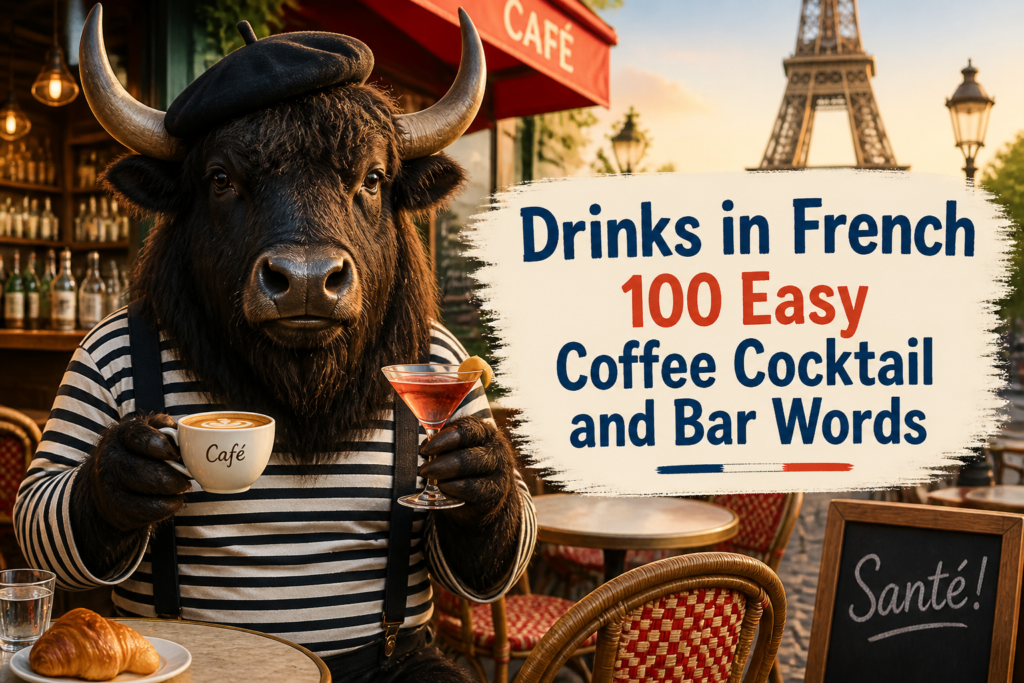
Ordering a drink in French sounds glamorous right up until your brain forgets the word for water and you end up pointing at someone else’s glass like a confused raccoon. The good news: drink vocabulary is practical, easy to reuse, and full of words you will hear constantly in cafés, bars, restaurants, hotels, and everyday conversation.
In this guide, you’ll learn beginner-friendly French for coffee, cocktails, soft drinks, bar basics, and useful phrases for ordering. We’ll stick to natural standard French from France, with simple pronunciation help and real example sentences so you can actually use these words instead of just admiring them from a safe academic distance.
Yes, you absolutely need to know the difference between un café and un café au lait. Your morning depends on it.
If you want more French practice after this, try the French placement test, test your word bank with the French vocabulary test, or browse more lessons on Learn French.
How To Read The Pronunciation
The pronunciation help here is simple, not super technical. It is meant to get you speaking, not to trap you in a tiny phonetics dungeon. A few quick reminders:
- Final consonants are often silent: froid sounds roughly like “frwah.”
- eu and u are tricky, but close enough is fine at first.
- French links words together a lot, especially in common phrases.
- L’ in words like l’eau shows elision: the vowel in la disappears before another vowel sound.
Yak Wisdom: If you can say the drink clearly enough that it arrives at your table, that counts as communication. Perfection can calm down.
The Most Useful Drink Words First
Let’s begin with the words you are most likely to need in real life: water, coffee, tea, juice, wine, beer, and a few basics for ordering.
| French | Pronunciation | Meaning | Example Sentence | Translation | Learner Note |
|---|---|---|---|---|---|
| une boisson | oon bwah-son | a drink, beverage | Je voudrais une boisson froide. | I’d like a cold drink. | Boisson is feminine. |
| à boire | ah bwahr | to drink, something to drink | Tu veux quelque chose à boire ? | Do you want something to drink? | Very common everyday phrase. |
| de l’eau | duh loh | water | Je bois de l’eau pendant le repas. | I drink water during the meal. | Uses de l’ before a vowel sound. |
| un café | uhn kah-fay | coffee | Je prends un café le matin. | I have a coffee in the morning. | In France, this often means espresso. |
| un thé | uhn tay | tea | Elle commande un thé vert. | She orders a green tea. | The accent matters in writing. |
| un jus | uhn zhoo | juice | Il boit un jus d’orange. | He drinks orange juice. | Usually followed by the fruit. |
| un soda | uhn soh-dah | soda | Les enfants veulent un soda. | The kids want a soda. | Common and easy to remember. |
| une bière | oon byair | beer | Nous prenons une bière en terrasse. | We’re having a beer on the terrace. | Feminine noun. |
| un verre | uhn vair | a glass | Je voudrais un verre d’eau. | I’d like a glass of water. | Verre means the container, and sometimes the serving. |
| une bouteille | oon boo-tay | a bottle | On partage une bouteille de vin. | We’re sharing a bottle of wine. | Very useful in restaurants. |
Coffee In French
Coffee words are some of the most useful food-and-drink vocabulary in French. Also, café culture in France is not a small side quest. It is a whole lifestyle.
| French | Pronunciation | Meaning | Example Sentence | Translation | Learner Note |
|---|---|---|---|---|---|
| un café | uhn kah-fay | coffee, often an espresso | Je prends un café après le déjeuner. | I have a coffee after lunch. | In France, plain café often means espresso. |
| un expresso | uhn ex-press-oh | espresso | Il commande un expresso serré. | He orders a strong espresso. | Expresso is widely used in French. |
| un café allongé | uhn kah-fay ah-lon-zhay | long coffee, diluted espresso | Je préfère un café allongé. | I prefer a long coffee. | Common in cafés in France. |
| un café au lait | uhn kah-fay oh lay | coffee with milk | Elle boit un café au lait au petit déjeuner. | She drinks coffee with milk at breakfast. | Classic breakfast coffee. |
| un café crème | uhn kah-fay krem | coffee with cream or foamy milk | Je voudrais un café crème, s’il vous plaît. | I’d like a creamy coffee, please. | Common at cafés in France. |
| un cappuccino | uhn kah-poo-chee-no | cappuccino | Tu prends un cappuccino ? | Are you having a cappuccino? | Borrowed word, easy to recognize. |
| un déca | uhn day-kah | decaf | Le soir, je prends un déca. | In the evening, I have a decaf. | Short for décaféiné. |
| décaféiné | day-kah-fay-ee-nay | decaffeinated | Vous avez du café décaféiné ? | Do you have decaffeinated coffee? | Often used as an adjective. |
| un latte | uhn lah-tay | latte | Elle aime les lattes vanille. | She likes vanilla lattes. | Common in trendy coffee shops. |
| un moka | uhn moh-kah | mocha | Je prends un moka quand j’ai envie de chocolat. | I get a mocha when I feel like chocolate. | Very understandable internationally. |
| du lait | duh lay | milk | Je prends mon café avec du lait. | I take my coffee with milk. | Use partitive du. |
| du sucre | duh soo-kr | sugar | Tu veux du sucre dans ton café ? | Do you want sugar in your coffee? | The final e is not pronounced. |
| sans sucre | sahn soo-kr | without sugar | Je le prends sans sucre. | I take it without sugar. | Very common ordering phrase. |
| avec du lait | ah-vek duh lay | with milk | Je voudrais un café avec du lait. | I’d like a coffee with milk. | Simple and useful. |
| à emporter | ah on-por-tay | to go, takeaway | Un café à emporter, s’il vous plaît. | A coffee to go, please. | Excellent survival phrase. |
Tea, Hot Chocolate, And Warm Drinks
| French | Pronunciation | Meaning | Example Sentence | Translation | Learner Note |
|---|---|---|---|---|---|
| un thé | uhn tay | tea | Je prends un thé après le dîner. | I have tea after dinner. | Masculine noun. |
| un thé vert | uhn tay vair | green tea | Elle boit du thé vert tous les matins. | She drinks green tea every morning. | Vert agrees with masculine thé. |
| un thé noir | uhn tay nwahr | black tea | Je préfère le thé noir au petit déjeuner. | I prefer black tea at breakfast. | Another useful café phrase. |
| une tisane | oon tee-zahn | herbal tea | Ma grand-mère boit une tisane le soir. | My grandmother drinks herbal tea in the evening. | Not technically regular tea. |
| une infusion | oon an-few-zyon | infusion, herbal tea | Je voudrais une infusion à la menthe. | I’d like a mint infusion. | Common on menus. |
| un chocolat chaud | uhn shoh-koh-lah show | hot chocolate | Les enfants veulent un chocolat chaud. | The children want a hot chocolate. | Very common and very useful. |
| chaud | show | hot | Le café est très chaud. | The coffee is very hot. | Watch the silent final consonant. |
| tiède | tyed | lukewarm | Le thé est tiède maintenant. | The tea is lukewarm now. | Useful complaint word, sadly. |
Cold Drinks And Soft Drinks
These are the words you will hear in cafés, convenience stores, restaurants, and supermarkets all the time.
| French | Pronunciation | Meaning | Example Sentence | Translation | Learner Note |
|---|---|---|---|---|---|
| une boisson froide | oon bwah-son frwad | a cold drink | Je cherche une boisson froide. | I’m looking for a cold drink. | Froide agrees with feminine boisson. |
| froid | frwah | cold | L’eau est bien froide. | The water is nice and cold. | Final d is silent. |
| de l’eau plate | duh loh plaht | still water | Je voudrais de l’eau plate. | I’d like still water. | Very important restaurant phrase. |
| de l’eau gazeuse | duh loh gah-zuhz | sparkling water | Tu préfères l’eau plate ou l’eau gazeuse ? | Do you prefer still or sparkling water? | Also called fizzy water. |
| de l’eau minérale | duh loh mee-nay-rahl | mineral water | Ils achètent de l’eau minérale. | They buy mineral water. | Very common in shops. |
| un jus d’orange | uhn zhoo dor-ahnzh | orange juice | Je prends un jus d’orange au petit déjeuner. | I have orange juice at breakfast. | Elision in d’orange. |
| un jus de pomme | uhn zhoo duh pom | apple juice | Elle boit un jus de pomme. | She drinks apple juice. | Simple pattern: jus de + fruit. |
| une limonade | oon lee-moh-nahd | lemonade | Je voudrais une limonade bien fraîche. | I’d like a nice cold lemonade. | Can mean a lemon soda style drink. |
| un coca | uhn koh-kah | a Coke | Il commande un coca sans glace. | He orders a Coke without ice. | Common casual shorthand. |
| un cola | uhn koh-lah | cola | Nous prenons deux colas. | We’re having two colas. | More generic than coca. |
| un jus de fruits | uhn zhoo duh frwee | fruit juice | Ce matin, j’ai bu un jus de fruits. | This morning, I drank some fruit juice. | Fruits final s is silent. |
| un sirop | uhn see-roh | syrup drink | Les enfants aiment le sirop à la grenadine. | The kids like grenadine syrup drink. | Very common in France. |
| une grenadine | oon grun-nah-deen | grenadine drink | Je prends une grenadine, pas d’alcool pour moi. | I’ll have a grenadine, no alcohol for me. | Often understood as a syrup-based soft drink. |
| avec des glaçons | ah-vek day glah-son | with ice cubes | Je voudrais de l’eau avec des glaçons. | I’d like water with ice cubes. | Des is plural. |
| sans glace | sahn glahs | without ice | Un soda sans glace, s’il vous plaît. | A soda without ice, please. | Useful in bars and fast food places. |
Alcohol And Bar Vocabulary
Even if you do not drink alcohol, these words are useful for menus, invitations, and basic social situations. Also, “bar French” is mostly just “human interaction French with more glasses.”
| French | Pronunciation | Meaning | Example Sentence | Translation | Learner Note |
|---|---|---|---|---|---|
| un alcool | uhn ahl-kol | an alcohol, alcoholic drink | Je ne bois pas d’alcool. | I don’t drink alcohol. | Very useful phrase. |
| une boisson alcoolisée | oon bwah-son ahl-koh-lee-zay | an alcoholic drink | Cette boisson est alcoolisée. | This drink is alcoholic. | More formal than everyday speech. |
| un bar | uhn bar | bar | On se retrouve au bar à huit heures. | Let’s meet at the bar at eight o’clock. | Easy cognate. |
| le comptoir | luh kon-twar | the counter, bar counter | Il attend au comptoir. | He is waiting at the counter. | Useful in cafés too. |
| un barman | uhn bar-mahn | bartender | Le barman prépare les cocktails. | The bartender is preparing the cocktails. | Un serveur may also serve drinks. |
| un serveur | uhn sair-vur | waiter | Le serveur apporte nos boissons. | The waiter brings our drinks. | Feminine: une serveuse. |
| une carte des boissons | oon kart day bwah-son | drink menu | Vous avez une carte des boissons ? | Do you have a drinks menu? | Very practical phrase. |
| un cocktail | uhn kok-tail | cocktail | Elle choisit un cocktail sans alcool. | She chooses a non-alcoholic cocktail. | Pronounced pretty close to English. |
| un mocktail | uhn mok-tail | mocktail | Je préfère un mocktail ce soir. | I prefer a mocktail tonight. | Modern borrowed word. |
| un apéritif | uhn ah-pay-ree-teef | aperitif, pre-dinner drink | On prend un apéritif avant le repas. | We’re having an aperitif before the meal. | Big cultural word in France. |
| un digestif | uhn dee-zhes-teef | digestif, after-dinner drink | Mon oncle prend un digestif après le dîner. | My uncle has a digestif after dinner. | More traditional. |
| ivre | eevr | drunk | Il est trop ivre pour conduire. | He is too drunk to drive. | Important safety word. |
| saoul | sool | drunk | Je ne veux pas être saoul. | I don’t want to be drunk. | Common informal word; feminine saoule. |
Beer, Wine, And Common Alcohol Words
| French | Pronunciation | Meaning | Example Sentence | Translation | Learner Note |
|---|---|---|---|---|---|
| une bière | oon byair | beer | Je prends une bière blonde. | I’ll have a lager. | Beer styles vary by context. |
| une bière pression | oon byair pray-syon | draft beer | Vous avez une bière pression ? | Do you have draft beer? | Very useful at bars. |
| un demi | uhn duh-mee | a half pint or small draft beer | Je vais prendre un demi. | I’ll have a small draft beer. | Classic bar order in France. |
| un vin | uhn van | wine | Ils boivent un bon vin rouge. | They’re drinking a good red wine. | Masculine noun. |
| du vin rouge | duh van roozh | red wine | Je préfère du vin rouge. | I prefer red wine. | Use partitive du. |
| du vin blanc | duh van blahn | white wine | Elle commande du vin blanc. | She orders white wine. | Good restaurant phrase. |
| du rosé | duh roh-zay | rosé wine | En été, on boit souvent du rosé. | In summer, people often drink rosé. | Extremely common in France. |
| du champagne | duh shahn-pahn-yuh | champagne | Ils ouvrent du champagne pour fêter ça. | They’re opening champagne to celebrate. | That middle sound is nasal. |
| un verre de vin | uhn vair duh van | a glass of wine | Je prends juste un verre de vin. | I’m just having a glass of wine. | Very practical phrase. |
| une bouteille de vin | oon boo-tay duh van | a bottle of wine | Nous partageons une bouteille de vin. | We’re sharing a bottle of wine. | Restaurant classic. |
| un whisky | uhn wees-kee | whisky | Mon père prend un whisky. | My father has a whisky. | Borrowed word. |
| un rhum | uhn rum | rum | Ce cocktail contient du rhum. | This cocktail contains rum. | Short and handy. |
| une vodka | oon vod-kah | vodka | Elle n’aime pas la vodka pure. | She doesn’t like straight vodka. | Feminine noun. |
| un gin | uhn jin | gin | Il préfère le gin au whisky. | He prefers gin to whisky. | Very common in cocktails. |
Popular Cocktails In French
Many cocktail names stay the same in French, which is honestly kind of polite of them.
| French | Pronunciation | Meaning | Example Sentence | Translation | Learner Note |
|---|---|---|---|---|---|
| un mojito | uhn moh-hee-toh | mojito | Je voudrais un mojito. | I’d like a mojito. | Very recognizable. |
| une margarita | oon mar-gah-ree-tah | margarita | Elle prend une margarita. | She’s having a margarita. | Feminine noun in French. |
| un martini | uhn mar-tee-nee | martini | Il commande un martini sec. | He orders a dry martini. | Sec means dry. |
| un spritz | uhn sprits | spritz | On prend deux spritz. | We’re having two spritzes. | Very common in Europe. |
| un gin tonic | uhn jin ton-ik | gin and tonic | Je préfère un gin tonic bien frais. | I prefer a nice cold gin and tonic. | Often written without extra fuss. |
| un ti-punch | uhn tee-punch | ti-punch | Aux Antilles, on boit souvent un ti-punch. | In the French Caribbean, people often drink ti-punch. | Regional and cultural. |
| un kir | uhn keer | kir | Ma tante adore le kir. | My aunt loves kir. | Classic French aperitif. |
| un kir royal | uhn keer rwah-yal | kir royal | Pour la fête, ils prennent un kir royal. | For the celebration, they’re having a kir royal. | A bit more festive. |
| sans alcool | sahn zahl-kol | non-alcoholic, without alcohol | Je voudrais un cocktail sans alcool. | I’d like a non-alcoholic cocktail. | Very useful phrase. |
| fort | for | strong | Ce cocktail est très fort. | This cocktail is very strong. | Useful for taste and alcohol strength. |
Useful Ordering Phrases
This is where vocabulary turns into actual survival French. Use these constantly.
| French | Pronunciation | Meaning | Example Sentence | Translation | Learner Note |
|---|---|---|---|---|---|
| Je voudrais… | zhuh voo-dray | I would like… | Je voudrais un café, s’il vous plaît. | I’d like a coffee, please. | Polite and essential. |
| Je prends… | zhuh prahn | I’ll have… | Je prends un thé. | I’ll have a tea. | Common and natural. |
| Pour moi, ce sera… | poor mwah suh suh-rah | For me, it will be… | Pour moi, ce sera un jus d’orange. | For me, it’ll be an orange juice. | Very natural in restaurants. |
| S’il vous plaît | seel voo play | please | Un verre d’eau, s’il vous plaît. | A glass of water, please. | Polite form. |
| Merci | mehr-see | thank you | Merci pour les boissons. | Thank you for the drinks. | Simple, vital, non-negotiable. |
| Qu’est-ce que vous avez ? | kess kuh voo zah-vay | What do you have? | Qu’est-ce que vous avez comme bières ? | What beers do you have? | Notice the linking sound in vous avez. |
| Vous avez… ? | voo zah-vay | Do you have…? | Vous avez du thé glacé ? | Do you have iced tea? | Liaison in vous avez. |
| Avec ou sans glaçons ? | ah-vek oo sahn glah-son | With or without ice? | Avec ou sans glaçons ? | With or without ice? | Good phrase to recognize. |
| L’addition, s’il vous plaît | lah-dee-syon seel voo play | The bill, please | L’addition, s’il vous plaît. | The bill, please. | Elision in l’addition. |
| À votre santé ! | ah vo-truh sahn-tay | Cheers! To your health! | À votre santé ! | Cheers! | More formal or plural. |
| Santé ! | sahn-tay | Cheers! | Santé ! On fête ton nouveau travail. | Cheers! We’re celebrating your new job. | Very common toast. |
| Tchin-tchin ! | chin-chin | cheers | Tchin-tchin ! | Cheers! | Playful and common, but know your audience. |
At The Café Or Bar: 20 More Handy Words
| French | Pronunciation | Meaning | Example Sentence | Translation | Learner Note |
|---|---|---|---|---|---|
| la terrasse | lah teh-rass | terrace, outdoor seating | On s’assoit en terrasse ? | Shall we sit outside? | Very French café life word. |
| une tasse | oon tahss | cup | Cette tasse de thé est très chaude. | This cup of tea is very hot. | For hot drinks. |
| une chope | oon shop | mug, beer mug | Il boit sa bière dans une chope. | He drinks his beer from a mug. | Less common for beginners, still useful. |
| une paille | oon pie | straw | Je n’ai pas besoin de paille. | I don’t need a straw. | Very practical. |
| un glaçon | uhn glah-son | ice cube | Ajoutez un glaçon, s’il vous plaît. | Add an ice cube, please. | Plural: des glaçons. |
| mélanger | may-lahn-zhay | to mix | Le serveur mélange le cocktail. | The waiter mixes the cocktail. | Useful verb. |
| servir | sair-veer | to serve | On sert le vin bien frais. | The wine is served nice and cold. | Common menu verb. |
| boire | bwar | to drink | Qu’est-ce que tu aimes boire ? | What do you like to drink? | Core verb, irregular. |
| trinquer | tran-kay | to toast, clink glasses | On trinque avant de boire. | We clink glasses before drinking. | Fun cultural verb. |
| commander | koh-mahn-day | to order | Je vais commander un café. | I’m going to order a coffee. | Very practical verb. |
| payer | pay-yay | to pay | Qui va payer l’addition ? | Who is going to pay the bill? | Always useful, sadly. |
| offrir un verre | oh-freer uhn vair | to buy someone a drink | Il m’offre un verre. | He’s buying me a drink. | Handy social phrase. |
| avoir soif | ah-vwar swaf | to be thirsty | J’ai soif après la marche. | I’m thirsty after the walk. | Literally “to have thirst.” |
| avoir envie de boire | ah-vwar ahn-vee duh bwar | to feel like drinking | J’ai envie de boire quelque chose de frais. | I feel like drinking something cold. | Common structure. |
| une tournée | oon toor-nay | a round of drinks | C’est ma tournée. | This round is on me. | Very useful social phrase. |
| sec | sek | dry | Je préfère le martini sec. | I prefer a dry martini. | Common for wine and cocktails. |
| doux | doo | sweet, mild | Je cherche un cocktail plus doux. | I’m looking for a sweeter cocktail. | Final x is silent. |
| amer | ah-mair | bitter | Ce soda est un peu amer. | This soda is a bit bitter. | Great taste word. |
| sucré | soo-kray | sweet, sugary | Ce jus est trop sucré. | This juice is too sugary. | Common review word. |
| frais / fraîche | fray / fresh | fresh, cool | Je veux quelque chose de frais. | I want something cold and refreshing. | Fraîche is feminine. |
Mini Grammar Notes You Actually Need
Drink vocabulary brings up a few very common French patterns.
- Use un / une for a countable drink: un café, une bière, un cocktail.
- Use du / de la / de l’ for some quantity: du vin, de la limonade, de l’eau.
- Use de after quantity words: un verre d’eau, une bouteille de vin, un jus d’orange.
- Use sans for “without”: sans sucre, sans glace, sans alcool.
- Use avec for “with”: avec du lait, avec des glaçons.
One important pronunciation detail: in vous avez, French often links the words together, so it sounds like voo-zah-vay. The same thing happens in lots of everyday speech, and yes, French does this because apparently one word at a time was too easy.
Common Mistakes English Speakers Make
- Saying “café” and expecting drip coffee. In France, un café often means espresso.
- Forgetting the article. Say un thé, not just thé in most normal ordering situations.
- Mixing up un verre and une bouteille. One is a glass, one is a bottle, and your evening may depend on the distinction.
- Using English word order too directly. French usually says un jus d’orange, literally “a juice of orange.”
- Ignoring gender. Une bière, but un vin.
- Forgetting polite formulas. Je voudrais… s’il vous plaît works almost everywhere.
Quick Practice
Try translating these into French:
- I’d like a coffee with milk.
- Do you have sparkling water?
- I’ll have a non-alcoholic cocktail.
- A glass of red wine, please.
- Without sugar.
- Cheers!
Possible answers:
- Je voudrais un café avec du lait.
- Vous avez de l’eau gazeuse ?
- Je prends un cocktail sans alcool.
- Un verre de vin rouge, s’il vous plaît.
- Sans sucre.
- Santé !
Quick Reference: 15 Must-Know Drink Phrases
- un café — coffee
- un thé — tea
- de l’eau — water
- de l’eau plate — still water
- de l’eau gazeuse — sparkling water
- un jus d’orange — orange juice
- une bière — beer
- du vin rouge — red wine
- un cocktail — cocktail
- sans alcool — without alcohol
- avec des glaçons — with ice cubes
- sans sucre — without sugar
- Je voudrais… — I would like…
- L’addition, s’il vous plaît — The bill, please
- Santé ! — Cheers!
Keep Going
If this article helped, keep building your French with the French placement test, check how many words you already know with the French vocabulary test, or revisit this guide here: Coffee, Cocktails & Drinks in French.
Yak Takeaway: if you can ask for de l’eau, un café, une bière, and l’addition, you are already dangerously close to functioning in French. Add s’il vous plaît and a confident nod, and suddenly you look like you know exactly what you’re doing.