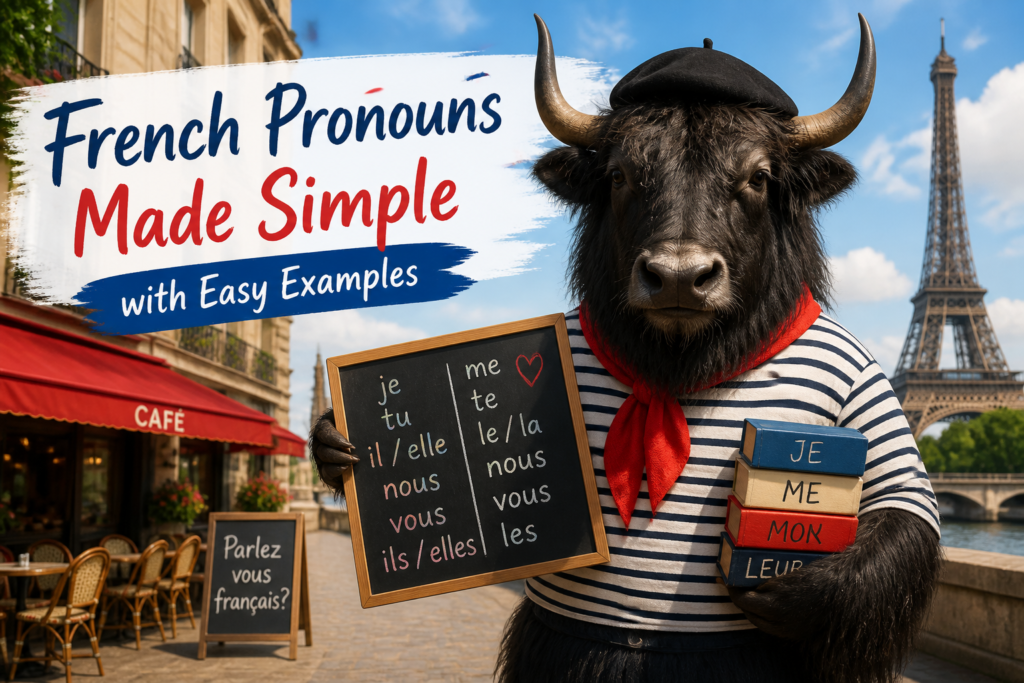
A yak teacher pointing to a whiteboard that displays French Pronouns Made Simple

French Pronouns • subject, object, possessive • with audio

French Pronouns Made Simple: 75+ Subject, Object & Possessive Forms

Pronouns are the little words doing the heavy lifting: I / me / mine, but in French. Tap 🔊 to hear a French voice, steal the example sentences, and you’ll sound dramatically more human.

👄 IPA show/hide
⏹️ Stop audio

What you’ll get: subject pronouns (je, tu, nous…), object pronouns (me, le, lui, y, en…), and possessives (mon / le mien…), each with IPA, meaning, and a real example.

How to use this: start with the “must-know” cards, then steal 12 ready-to-go phrases, then dip into the tables when your brain asks “wait—mine or my?”

Yak Snark: French pronouns are like tiny magnets—put them in the wrong place and the whole sentence sticks to the fridge sideways. We’re fixing that today.

The 8 Pronouns You’ll Use Constantly

These are the “if you learn nothing else, learn these” MVPs. Tap 🔊 to lock in the sound.

je
/ʒə/ (often /ʒ/ before a vowel)

I

tu
/ty/

you (informal, singular)

il / elle
/il/ • /ɛl/

he / she / it

on
/ɔ̃/

we (very common) / one / people

nous
/nu/

we / us

vous
/vu/

you (formal singular OR plural)

y
/i/

there / to it (a place or “to that”)

en
/ɑ̃/

some / of it / from there

12 Real-Life Phrases (Steal These)

These are pronoun-heavy, extremely usable, and politely allergic to textbook vibes.

Je m’appelle …
/ʒə mapɛl/

My name is …

Je m’appelle Léa. = My name is Léa.

Tu me manques.
/ty mə mɑ̃k/

I miss you. (literally: “you are missing to me”)

Tu me manques. = I miss you.

Je te le donne.
/ʒə tə lə dɔn/

I’m giving it to you.

Je te le donne. = I’m giving it to you.

On se voit ce soir ?
/ɔ̃ sə vwa sə swaʁ/

See you tonight? / Are we seeing each other tonight?

On se voit ce soir ? = See you tonight?

Vous y allez ?
/vu zi ale/

Are you going there?

Vous y allez ? = Are you going there?

Je n’en sais rien.
/ʒə nɑ̃ sɛ ʁjɛ̃/

I have no idea. (literally: “I know nothing about it”)

Je n’en sais rien. = I have no idea.

Je lui parle.
/ʒə lɥi paʁl/

I’m talking to him/her.

Je lui parle. = I’m talking to him/her.

Je leur écris.
/ʒə lœʁ ekʁi/

I’m writing to them.

Je leur écris. = I’m writing to them.

Elle s’en occupe.
/ɛl sɑ̃ nɔkyp/

She’s taking care of it.

Elle s’en occupe. = She’s taking care of it.

C’est à moi.
/sɛ ta mwa/

It’s mine.

C’est à moi. = It’s mine.

Le mien est ici.
/lə mjɛ̃ ɛt isi/

Mine is here.

Le mien est ici. = Mine is here.

On y va !
/ɔ̃ i va/

Let’s go!

On y va ! = Let’s go!

Cheat Sheets (Because Your Brain Deserves Snacks)

Tu vs Vous (the politeness dial)

tu = one person, informal (friends, kids, close colleagues). vous = formal (strangers, customer service) OR plural (two+ people).

Quick save: If you’d say “sir/ma’am” in English, vous is usually safer.

Object pronoun order (the famous “little word parade”)

In front of the verb, the order is usually:

(me/te/se/nous/vous) → (le/la/les) → (lui/leur) → (y) → (en)

Example: Je te le donne.Il nous en parle.J’y envoie Paul.
Yak Snark: If you’re thinking “I will never remember that order,” congratulations—you’re officially learning French like a normal person. Repetition does the remembering for you.

Subject Pronouns (Who’s doing the action?)

French Pronunciation (IPA) Meaning (EN) Example (FR) Translation (EN) Audio
je /ʒə/ I Je travaille aujourd’hui. I’m working today.
tu /ty/ you (informal, singular) Tu as faim ? Are you hungry?
il /il/ he / it (masc.) Il est en retard. He’s late.
elle /ɛl/ she / it (fem.) Elle arrive demain. She arrives tomorrow.
on very common /ɔ̃/ we / one / people On se retrouve à 18h. We’ll meet up at 6 p.m.
nous /nu/ we Nous partons bientôt. We’re leaving soon.
vous /vu/ you (formal singular / plural) Vous voulez un café ? Would you like a coffee?
ils /il/ (often /ilz/ before a vowel) they (mixed or all-male) Ils sont déjà là. They’re already here.
elles /ɛl/ (often /ɛlz/ before a vowel) they (all-female) Elles ont une idée. They have an idea.

Pronunciation tip: French loves linking sounds. Ils ont often sounds like /ilz‿ɔ̃/. Same idea for elles ont/ɛlz‿ɔ̃/.

Stressed (Tonic) Pronouns (Me, you, him… as a standalone)

Use these after prepositions (avec, pour, chez), for emphasis, or when you’re pointing dramatically (politely).

French Pronunciation (IPA) Meaning (EN) Example (FR) Translation (EN) Audio
moi /mwa/ me Moi, je préfère le thé. Me, I prefer tea.
toi /twa/ you (informal) C’est pour toi. It’s for you.
lui /lɥi/ him Je vais avec lui. I’m going with him.
elle /ɛl/ her Je suis chez elle. I’m at her place.
nous /nu/ us C’est pour nous. It’s for us.
vous /vu/ you (formal / plural) Je compte sur vous. I’m counting on you.
eux /ø/ them (mixed or all-male) Je pars avec eux. I’m leaving with them.
elles /ɛl/ them (all-female) Je suis avec elles. I’m with them.

Direct Object Pronouns (Who/what gets the action?)

Direct object = no “to” in English. Example: “I see him.” → Je le vois.

French Pronunciation (IPA) Meaning (EN) Example (FR) Translation (EN) Audio
me / m’ /mə/ (often /m/ before a vowel) me Il m’appelle. He calls me.
te / t’ /tə/ (often /t/ before a vowel) you (informal) Je t’écoute. I’m listening to you.
le / l’ /lə/ (often /l/ before a vowel) him / it (masc.) Je le connais. I know him / it.
la / l’ /la/ (often /l/ before a vowel) her / it (fem.) Je la vois. I see her / it.
nous /nu/ us Il nous invite. He invites us.
vous /vu/ you (formal / plural) Je vous comprends. I understand you.
les /le/ them Je les adore. I love them.

Indirect Object Pronouns (To whom? For whom?)

Indirect object often matches “to someone” in English. Example: “I talk to him.” → Je lui parle.

French Pronunciation (IPA) Meaning (EN) Example (FR) Translation (EN) Audio
me / m’ /mə/ to me Parle-moi, s’il te plaît. Talk to me, please.
te / t’ /tə/ to you (informal) Je te réponds demain. I’ll reply to you tomorrow.
lui /lɥi/ to him / to her Je lui donne le livre. I give him/her the book.
nous /nu/ to us Il nous parle souvent. He talks to us often.
vous /vu/ to you (formal / plural) Je vous écris ce soir. I’m writing to you tonight.
leur /lœʁ/ to them On leur explique tout. We explain everything to them.

The Two Tiny Superpowers: y & en

y often replaces a place or “to it/to that.” en often means “some” or “of it/of them” (and sometimes “from there”).

French Pronunciation (IPA) Meaning (EN) Example (FR) Translation (EN) Audio
y /i/ there / to it J’y pense souvent. I think about it often.
en /ɑ̃/ some / of it / of them Tu en veux ? Do you want some?

Reflexive Pronouns (for “myself/yourself/each other”)

You’ll see these with everyday verbs like se lever (to get up), s’appeler (to be named), se voir (to see each other).

French Pronunciation (IPA) Meaning (EN) Example (FR) Translation (EN) Audio
me / m’ /mə/ myself Je me réveille tôt. I wake up early.
te / t’ /tə/ yourself (informal) Tu t’habilles vite. You get dressed quickly.
se / s’ /sə/ himself/herself/itself/themselves Elle se repose. She’s resting.
nous /nu/ ourselves Nous nous amusons. We’re having fun.
vous /vu/ yourself/yourselves Vous vous trompez. You’re mistaken.
se / s’ /sə/ each other (often in context) Ils se voient souvent. They see each other often.

Possessive Adjectives (my/your/his/her/our… + noun)

Key idea: these agree with the thing owned (the noun), not the owner. So son can mean his OR her—it depends on the noun’s gender.

French Pronunciation (IPA) Meaning (EN) Example (FR) Translation (EN) Audio
mon/mɔ̃/my (masc. singular)C’est mon ami.That’s my friend.
ma/ma/my (fem. singular)Voici ma sœur.Here is my sister.
mes/me/my (plural)J’aime mes collègues.I like my coworkers.
ton/tɔ̃/your (informal, masc. singular)Où est ton téléphone ?Where is your phone?
ta/ta/your (informal, fem. singular)J’aime ta veste.I like your jacket.
tes/te/your (informal, plural)Tes idées sont bonnes.Your ideas are good.
son/sɔ̃/his/her/its (masc. singular noun)Son frère est sympa.His/Her brother is nice.
sa/sa/his/her/its (fem. singular noun)Sa voiture est neuve.His/Her car is new.
ses/se/his/her/its (plural noun)Ses parents arrivent.His/Her parents are arriving.
notre/nɔtʁ/our (singular noun)Notre plan est simple.Our plan is simple.
nos/no/our (plural noun)Nos amis sont là.Our friends are here.
votre/vɔtʁ/your (formal/plural, singular noun)Votre carte, s’il vous plaît.Your card, please.
vos/vo/your (formal/plural, plural noun)J’aime vos chaussures.I like your shoes.
leur/lœʁ/their (singular noun)Leur chien est gentil.Their dog is nice.
leurs/lœʁ/their (plural noun)Leurs enfants jouent.Their children are playing.
Yak Snark: Yes, son can mean “his” or “her.” French decided your brain was too relaxed and fixed that.

Possessive Pronouns (mine/yours/his… WITHOUT the noun)

These replace the whole thing: “my one,” “your one,” “their ones.” They agree with the thing possessed (masc/fem, singular/plural).

French Pronunciation (IPA) Meaning (EN) Example (FR) Translation (EN) Audio
le mien/lə mjɛ̃/mine (masc. sing.)C’est le mien.It’s mine.
la mienne/la mjɛn/mine (fem. sing.)La mienne est ici.Mine is here.
les miens/le mjɛ̃/mine (masc. plural)Ce sont les miens.Those are mine.
les miennes/le mjɛn/mine (fem. plural)Ce sont les miennes.Those are mine.
le tien/lə tjɛ̃/yours (informal, masc. sing.)C’est le tien.It’s yours.
la tienne/la tjɛn/yours (informal, fem. sing.)La tienne est belle.Yours is nice.
les tiens/le tjɛ̃/yours (informal, masc. plural)Où sont les tiens ?Where are yours?
les tiennes/le tjɛn/yours (informal, fem. plural)Je prends les tiennes.I’ll take yours.
le sien/lə sjɛ̃/his/hers/its (masc. sing.)C’est le sien.It’s his/hers.
la sienne/la sjɛn/his/hers/its (fem. sing.)La sienne est plus grande.His/Hers is bigger.
les siens/le sjɛ̃/his/hers/its (masc. plural)Je connais les siens.I know his/hers.
les siennes/le sjɛn/his/hers/its (fem. plural)J’aime les siennes.I like his/hers.
le nôtre/lə notʁ/ours (masc. sing.)C’est le nôtre.It’s ours.
la nôtre/la notʁ/ours (fem. sing.)La nôtre est en route.Ours is on the way.
les nôtres/le notʁ/ours (plural)Ce sont les nôtres.Those are ours.
le vôtre/lə votʁ/yours (formal/plural, masc. sing.)C’est le vôtre ?Is it yours?
la vôtre/la votʁ/yours (formal/plural, fem. sing.)La vôtre est prête.Yours is ready.
les vôtres/le votʁ/yours (formal/plural, plural)Où sont les vôtres ?Where are yours?
le leur/lə lœʁ/theirs (masc. sing.)C’est le leur.It’s theirs.
la leur/la lœʁ/theirs (fem. sing.)La leur est plus ancienne.Theirs is older.
les leurs/le lœʁ/theirs (plural)Ce sont les leurs.Those are theirs.

“À moi / à toi…” (Another clean way to say “mine/yours”)

Super common with c’est: C’est à moi (It’s mine). Nice and simple.

French Pronunciation (IPA) Meaning (EN) Example (FR) Translation (EN) Audio
à moi/a mwa/mine (to me)C’est à moi.It’s mine.
à toi/a twa/yours (informal)C’est à toi.It’s yours.
à lui/a lɥi/his (to him)C’est à lui.It’s his.
à elle/a ɛl/hers (to her)C’est à elle.It’s hers.
à nous/a nu/ours (to us)C’est à nous.It’s ours.
à vous/a vu/yours (formal/plural)C’est à vous ?Is it yours?
à eux/a ø/theirs (mixed/all-male)C’est à eux.It’s theirs.
à elles/a ɛl/theirs (all-female)C’est à elles.It’s theirs.
Final Yak Snark: If pronouns feel like chaos, remember: you don’t learn them by “understanding harder.” You learn them by stealing 10 good sentences and reusing them shamelessly. Like a polite language raccoon.