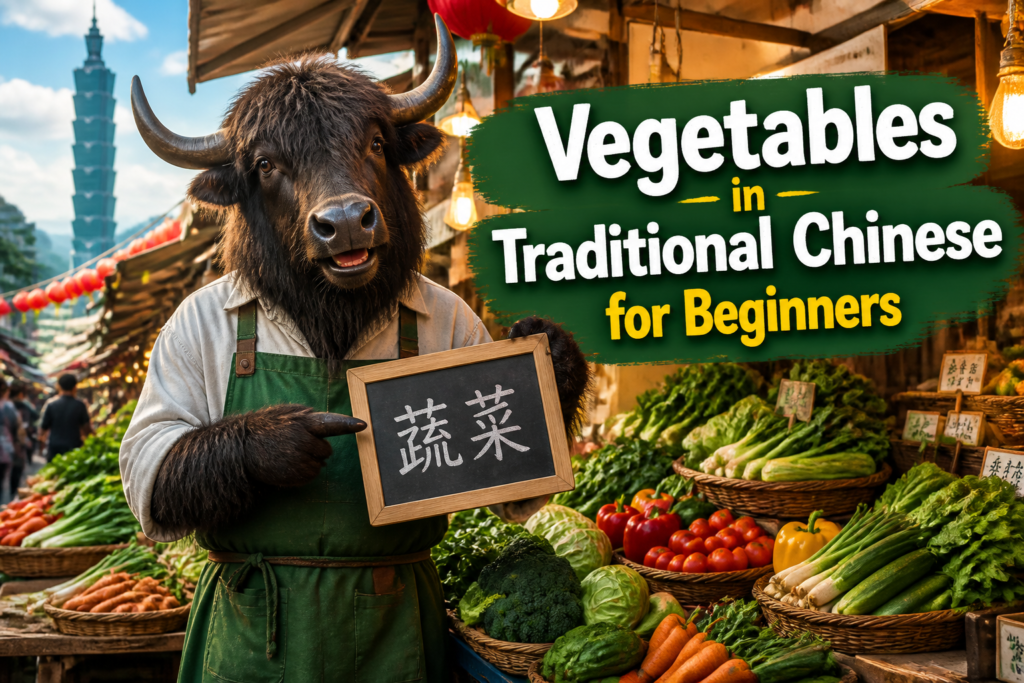
蔬菜 shūcài means vegetables, and yes, Mandarin has plenty of them. Some are common, some are weirdly specific, and some are the reason people suddenly get very serious at the market. By the end of this guide, you’ll know how to say 80+ useful vegetable words and real-life phrases in Traditional Chinese, with pinyin and simple English meanings.
If you’ve ever stood in a Taiwanese wet market pretending to know the difference between 高麗菜 gāolìcài and 包心菜 bāoxīncài, this article is for you. Tiny spoiler: sometimes the same vegetable has more than one name, because language enjoys making simple things annoying.
We’ll keep things practical. You’ll learn the words you can actually use when ordering food, cooking, shopping, or trying not to accidentally buy a giant root that turns out to be something extremely specific.
For a broader study path, you can also visit the main Traditional Chinese learning hub, then come back here and act like vegetable vocabulary was never a problem.
Core Vegetable Words
Here are the everyday vegetables you will hear again and again in Taiwan and other Mandarin-speaking places. Use these first. They do the heavy lifting.
| Traditional Chinese | Pinyin | English Meaning | Example (ZH) | Example (Pinyin) | Translation (EN) |
|---|---|---|---|---|---|
| 蔬菜 | shūcài | vegetables | 我每天都吃很多蔬菜。 | Wǒ měitiān dōu chī hěn duō shūcài. | I eat a lot of vegetables every day. |
| 青菜 | qīngcài | leafy greens; vegetables in general in Taiwan usage | 今天的青菜很新鮮。 | Jīntiān de qīngcài hěn xīnxiān. | Today’s greens are very fresh. |
| 高麗菜 | gāolìcài | cabbage | 我想買一顆高麗菜。 | Wǒ xiǎng mǎi yì kē gāolìcài. | I want to buy a head of cabbage. |
| 花椰菜 | huāyēcài | cauliflower | 花椰菜可以清炒。 | Huāyēcài kěyǐ qīngchǎo. | Cauliflower can be stir-fried simply. |
| 青花菜 | qīnghuācài | broccoli | 我喜歡青花菜。 | Wǒ xǐhuān qīnghuācài. | I like broccoli. |
| 紅蘿蔔 | hóngluóbo | carrot | 紅蘿蔔很適合煮湯。 | Hóngluóbo hěn shìhé zhǔ tāng. | Carrots are great for soup. |
| 番茄 | fānqié | tomato | 番茄炒蛋很好吃。 | Fānqié chǎodàn hěn hàochī. | Tomato and egg stir-fry is delicious. |
| 小黃瓜 | xiǎohuángguā | cucumber | 我午餐吃了小黃瓜沙拉。 | Wǒ wǔcān chī le xiǎohuángguā shālā. | I ate cucumber salad for lunch. |
| 洋蔥 | yángcōng | onion | 洋蔥炒肉很好吃。 | Yángcōng chǎo ròu hěn hàochī. | Onion stir-fried with meat is tasty. |
| 大蒜 | dàsuàn | garlic | 我喜歡多一點大蒜。 | Wǒ xǐhuān duō yìdiǎn dàsuàn. | I like a little more garlic. |
Taiwan’s Ministry of Education is a solid place to check Mandarin usage if you want a boring but reliable reference. Boring is good. Boring means accurate.
More Useful Vegetable Words
Now for the extended list. These are still common enough to matter, especially if you like cooking, eating, or reading menus without guessing like a raccoon in a supermarket.
| Traditional Chinese | Pinyin | English Meaning | Example (ZH) | Example (Pinyin) | Translation (EN) |
|---|---|---|---|---|---|
| 菠菜 | bōcài | spinach | 菠菜可以做湯。 | Bōcài kěyǐ zuò tāng. | Spinach can be made into soup. |
| 空心菜 | kōngxīncài | water spinach | 我超喜歡空心菜。 | Wǒ chāo xǐhuān kōngxīncài. | I really like water spinach. |
| 地瓜葉 | dìguāyè | sweet potato leaves | 地瓜葉炒蒜頭很香。 | Dìguāyè chǎo suàntóu hěn xiāng. | Sweet potato leaves stir-fried with garlic smell great. |
| 地瓜 | dìguā | sweet potato | 我買了地瓜當點心。 | Wǒ mǎi le dìguā dāng diǎnxīn. | I bought sweet potatoes for a snack. |
| 馬鈴薯 | mǎlíngshǔ | potato | 馬鈴薯可以炸成薯條。 | Mǎlíngshǔ kěyǐ zhà chéng shǔtiáo. | Potatoes can be fried into French fries. |
| 玉米 | yùmǐ | corn | 夜市的烤玉米很好吃。 | Yèshì de kǎo yùmǐ hěn hàochī. | Night market grilled corn is delicious. |
| 竹筍 | zhúsǔn | bamboo shoot | 竹筍排骨湯很受歡迎。 | Zhúsǔn páigǔ tāng hěn shòu huānyíng. | Bamboo shoot and pork rib soup is very popular. |
| 茄子 | qiézi | eggplant | 茄子不要炒太久。 | Qiézi bú yào chǎo tài jiǔ. | Don’t stir-fry eggplant too long. |
| 苦瓜 | kǔguā | bitter melon | 苦瓜真的很苦。 | Kǔguā zhēn de hěn kǔ. | Bitter melon really is bitter. |
| 絲瓜 | sīguā | luffa; sponge gourd | 絲瓜煮蛤蜊很好喝。 | Sīguā zhǔ gělì hěn hǎohē. | Luffa cooked with clams tastes great. |
| 南瓜 | nánguā | pumpkin | 南瓜湯很濃郁。 | Nánguā tāng hěn nóngyù. | Pumpkin soup is rich. |
| 冬瓜 | dōngguā | winter melon | 我想喝冬瓜茶。 | Wǒ xiǎng hē dōngguā chá. | I want to drink winter melon tea. |
| 白蘿蔔 | báiluóbo | daikon radish | 白蘿蔔燉湯很甜。 | Báiluóbo dùn tāng hěn tián. | Daikon radish is sweet in soup. |
| 蘿蔔 | luóbo | radish; often used generally | 蘿蔔絲餅很好吃。 | Luóbo sī bǐng hěn hàochī. | Radish pancakes are delicious. |
| 芹菜 | qíncài | celery | 芹菜炒豆干很常見。 | Qíncài chǎo dòugān hěn chángjiàn. | Celery stir-fried with dried tofu is common. |
| 韭菜 | jiǔcài | garlic chives | 韭菜盒子很好吃。 | Jiǔcài hézi hěn hàochī. | Chive pockets are delicious. |
| 韭菜花 | jiǔcàihuā | garlic chive flower | 韭菜花可以炒肉絲。 | Jiǔcàihuā kěyǐ chǎo ròusī. | Garlic chive flower can be stir-fried with shredded meat. |
| 豆芽 | dòuyá | bean sprouts | 我加了很多豆芽。 | Wǒ jiā le hěn duō dòuyá. | I added a lot of bean sprouts. |
| 豆苗 | dòumiáo | pea shoots | 豆苗炒蒜頭很清爽。 | Dòumiáo chǎo suàntóu hěn qīngshuǎng. | Pea shoots stir-fried with garlic are refreshing. |
| 四季豆 | sìjìdòu | green bean | 四季豆要炒熟。 | Sìjìdòu yào chǎo shú. | Green beans need to be cooked thoroughly. |
| 扁豆 | biǎndòu | flat bean; lentil in some contexts | 扁豆可以煮湯。 | Biǎndòu kěyǐ zhǔ tāng. | Flat beans can be cooked in soup. |
| 菜豆 | càidòu | bean; green bean variety | 菜豆炒肉末很下飯。 | Càidòu chǎo ròumò hěn xiàfàn. | Beans stir-fried with minced meat go well with rice. |
| 洋蔥頭 | yángcōngtóu | onion bulb | 我切了半顆洋蔥頭。 | Wǒ qiē le bàn kē yángcōngtóu. | I sliced half an onion bulb. |
| 蔥 | cōng | scallion; green onion | 蔥花可以加在麵上。 | Cōnghuā kěyǐ jiā zài miàn shàng. | Scallions can be added to noodles. |
| 蒜頭 | suàntóu | garlic clove | 我需要三顆蒜頭。 | Wǒ xūyào sān kē suàntóu. | I need three garlic cloves. |
Common Phrases For Buying Vegetables
These phrases are your best friend at markets, supermarkets, and small restaurants. They are short, useful, and politely direct. A rare combination.
| Traditional Chinese | Pinyin | English Meaning | Example (ZH) | Example (Pinyin) | Translation (EN) |
|---|---|---|---|---|---|
| 我要買菜。 | Wǒ yào mǎi cài. | I want to buy vegetables. | 我要買菜,請問哪裡有市場? | Wǒ yào mǎi cài, qǐngwèn nǎlǐ yǒu shìchǎng? | I want to buy vegetables; where is the market? |
| 這個多少錢? | Zhège duōshǎo qián? | How much is this? | 這個多少錢一斤? | Zhège duōshǎo qián yì jīn? | How much is this per catty? |
| 我要一斤。 | Wǒ yào yì jīn. | I want one catty. | 我要一斤高麗菜。 | Wǒ yào yì jīn gāolìcài. | I want one catty of cabbage. |
| 我要半斤。 | Wǒ yào bàn jīn. | I want half a catty. | 我要半斤番茄。 | Wǒ yào bàn jīn fānqié. | I want half a catty of tomatoes. |
| 請給我兩顆番茄。 | Qǐng gěi wǒ liǎng kē fānqié. | Please give me two tomatoes. | 請給我兩顆番茄,謝謝。 | Qǐng gěi wǒ liǎng kē fānqié, xièxie. | Please give me two tomatoes, thank you. |
| 這個要洗嗎? | Zhège yào xǐ ma? | Do I need to wash this? | 這個要洗嗎,還是可以直接煮? | Zhège yào xǐ ma, háishì kěyǐ zhíjiē zhǔ? | Do I need to wash this, or can I cook it directly? |
| 可以便宜一點嗎? | Kěyǐ piányí yìdiǎn ma? | Can it be a little cheaper? | 老闆,可以便宜一點嗎? | Lǎobǎn, kěyǐ piányí yìdiǎn ma? | Boss, can it be a little cheaper? |
| 我要最新鮮的。 | Wǒ yào zuì xīnxiān de. | I want the freshest ones. | 我要最新鮮的青菜。 | Wǒ yào zuì xīnxiān de qīngcài. | I want the freshest greens. |
| 這個怎麼煮? | Zhège zěnme zhǔ? | How do you cook this? | 這個怎麼煮比較好吃? | Zhège zěnme zhǔ bǐjiào hǎochī? | How is this best cooked? |
| 我不吃辣。 | Wǒ bù chī là. | I don’t eat spicy food. | 我不吃辣,請不要加辣椒。 | Wǒ bù chī là, qǐng bú yào jiā làjiāo. | I don’t eat spicy food, please don’t add chili. |
| 不要加蒜。 | Bú yào jiā suàn. | Don’t add garlic. | 我今天不要加蒜。 | Wǒ jīntiān bú yào jiā suàn. | I don’t want garlic today. |
| 多一點菜。 | Duō yìdiǎn cài. | More vegetables. | 可以多一點菜嗎? | Kěyǐ duō yìdiǎn cài ma? | Can I have more vegetables? |
| 少油少鹽。 | Shǎo yóu shǎo yán. | Less oil, less salt. | 我想要少油少鹽。 | Wǒ xiǎng yào shǎo yóu shǎo yán. | I want less oil and less salt. |
| 幫我切好。 | Bāng wǒ qiē hǎo. | Please cut it for me. | 這些菜可以幫我切好嗎? | Zhèxiē cài kěyǐ bāng wǒ qiē hǎo ma? | Can you cut these vegetables for me? |
Quick note: in Taiwan, people often say 買菜 mǎi cài for grocery shopping, especially when talking about fresh ingredients. It is not only about vegetables, but vegetables are the star of the show.
Cooking And Eating Phrases
Once the vegetables are home, they need verbs. Mandarin is very happy to help with that.
| Traditional Chinese | Pinyin | English Meaning | Example (ZH) | Example (Pinyin) | Translation (EN) |
|---|---|---|---|---|---|
| 清炒 | qīngchǎo | stir-fry simply | 這道菜是清炒青菜。 | Zhè dào cài shì qīngchǎo qīngcài. | This dish is simply stir-fried greens. |
| 煮 | zhǔ | to boil; cook | 我會煮蔬菜湯。 | Wǒ huì zhǔ shūcài tāng. | I can cook vegetable soup. |
| 炒 | chǎo | to stir-fry | 我們今晚炒青花菜。 | Wǒmen jīnwǎn chǎo qīnghuācài. | We are stir-frying broccoli tonight. |
| 燙 |