This A2 Elementary retelling of 牛郎織女 keeps the plot clear for learners while still giving the story some atmosphere and momentum.
This version teaches Traditional Chinese through English and includes clickable word help inside the story, full story audio, and lesson notes after the reading. It is free to use on Yak Yacker and is designed to feel natural, readable, and manageable for learners.
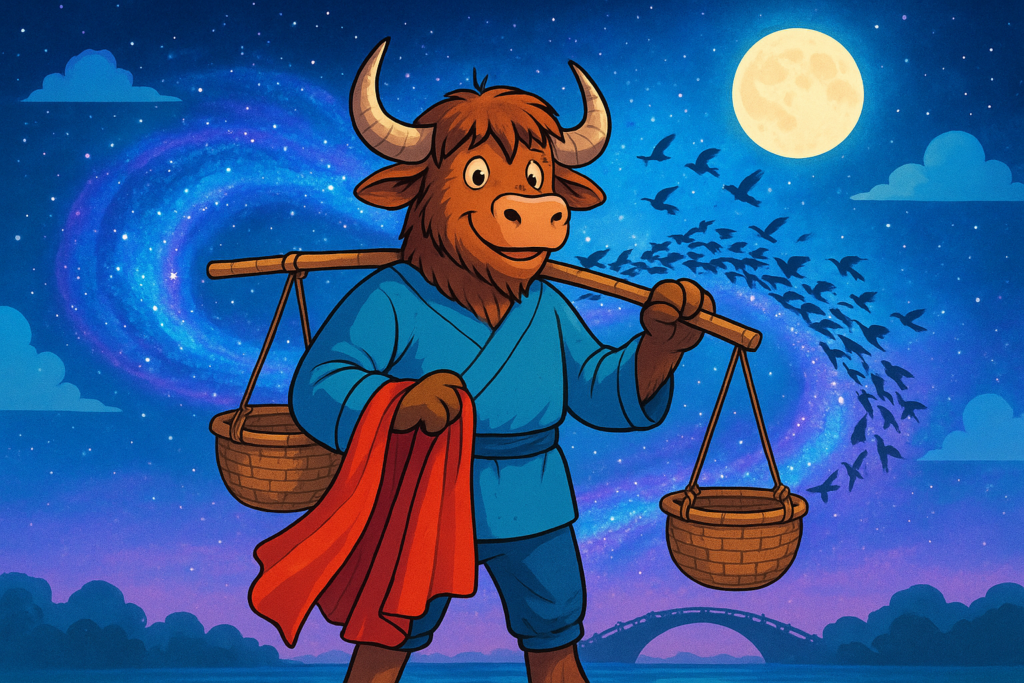
從前,有一個的牛郎。他每天跟他的老牛一起工作,生活很簡單,但是很。
有一天,老牛突然了!牠說:「牛郎,明天傍晚,去河邊。你會看見七個仙女在。把那件紅色的衣服。」
牛郎很,但是了。最小的仙女找不到衣服,很。牛郎說:「對不起,請你不要走。我是牛郎,你叫什麼名字?」她說:「我是織女。」他們,慢慢喜歡彼此了。
織女決定人間,跟牛郎。他們生了一個兒子和一個女兒,生活很幸福。織女每天很美麗的布,牛郎在田裡工作。
可是,天上的發現織女不見了。她非常,派把織女帶回天上。牛郎和孩子們很,一直哭。
這時,老牛又了:「牛郎,等我死了,用我的皮做成衣服。你可以去找織女。」牛郎照做了,用挑著兩個孩子,飛上天去。
王母娘娘看見牛郎,用髮簪畫出一條大河(),把他們。牛郎和孩子過不去,只能一直哭。
喜鵲們很他們,每年七月七日,無數喜鵲一座橋。牛郎和織女就可以在橋上。那一天,常常會下,那是他們快樂的眼淚。
Once upon a time, there was a young cowherd. He worked with his old ox every day. His life was simple but lonely.
One day, the old ox suddenly spoke! It said, 'Cowherd, go to the river tomorrow evening. You will see seven fairies bathing. Hide the red dress.'
The cowherd was surprised but did as told. The youngest fairy couldn't find her dress and was anxious. The cowherd said, 'I'm sorry, please don't go. I'm the cowherd, what's your name?' She said, 'I'm the Weaver Girl.' They talked a lot and slowly fell for each other.
The Weaver Girl decided to stay on Earth and marry the cowherd. They had a son and a daughter, living happily. She wove beautiful cloth every day, and he worked in the fields.
But the Queen Mother of Heaven discovered the Weaver Girl was missing. She was furious and sent heavenly soldiers to take her back. The cowherd and children were heartbroken and cried endlessly.
Then the old ox spoke again: 'Cowherd, after I die, use my hide to make clothes. You can fly to heaven to find the Weaver Girl.' He did so, carrying the two children with a pole, and flew up.
Seeing the cowherd chase, the Queen Mother drew a river (the Milky Way) with her hairpin, separating them. The cowherd and children couldn't cross and could only cry.
The magpies took pity on them. Every year on the seventh day of the seventh month, countless magpies form a bridge. The cowherd and Weaver Girl can meet on the bridge. That day, it often drizzles-their happy tears.
Meet the main characters: 牛郎 (niúláng) is the cowherd, and 織女 (zhīnǚ) is the weaver girl. The wise 老牛 (lǎo niú) is the old ox who speaks, and the 仙女 (xiānnǚ) are celestial maidens bathing in the river.
When emotions run high, you'll see 著急 (zháojí, anxious), 生氣 (shēngqì, angry), 傷心 (shāngxīn, heartbroken), and 幸福 (xìngfú, happy). At the end, 喜鵲 (xǐquè, magpies) build a 橋 (qiáo, bridge), and 毛毛雨 (máomáoyǔ, drizzle) falls like happy tears.
- 河邊 (hébiān) - riverside
- 藏起來 (cáng qǐlái) - to hide (something)
- 結婚 (jiéhūn) - to get married
- 扁擔 (biǎndan) - carrying pole (used to carry the children)
When the cowherd hides the red dress, the story says: 把那件紅色的衣服藏起來. This is the 把 structure, used to show how you handle or deal with an object.
Think of it like 'take the clothes and hide them.' In Chinese, the object comes right after 把, then the action. Notice other examples: 王母娘娘把他們分開 (the Queen Mother separated them), 用髮簪畫出一條大河 (drew a river with a hairpin).
- Pattern: Subject + 把 + Object + Verb + Result
- Use it when the action changes the object's state or location.
- Without 把: 藏起來那件紅色的衣服 ❌ → natural with 把 ✅
The tale explains the Qixi Festival (七夕節), sometimes called Chinese Valentine's Day. On the 7th day of the 7th lunar month, magpies form a bridge so the lovers can meet.
You'll often hear the phrase 銀河 (yínhé, Silver River) for the Milky Way, and couples pray for happiness. Next time you see drizzle on that day, remember-it's their joyful tears!
- Qixi traditions: making wishes, stargazing, and eating 巧果 (qiǎoguǒ, pastry).
Read the story again, but this time underline every 把 sentence you spot-you'll be surprised how many there are! Then try retelling the legend in your own words, using a few of the new words.
For a challenge, look up the original poem 迢迢牽牛星 or watch a short Qixi animation. Every version adds a little magic, and your Chinese will grow with each one.
牛郎織女 comes from the Chinese / legend tradition and is best known as a romantic legend. This Yak Yacker article is an original learner retelling based on Traditional Qixi legend; public domain, so the wording here is simplified for modern learners rather than copied from one old edition.
Older printings, translations, and retellings of this story can vary quite a bit. The original audience was usually general/kids, but this version is adapted for A2 Elementary learners studying Traditional Chinese. Sad romantic myth; keep simple for A2.
If you want to look into the source tradition, start with Wikipedia.
If you want to keep going, browse more in our Traditional Chinese section. After that, try Essential Traditional Chinese Grammar Words for another useful next step.
More Traditional Chinese to explore
The Frog at the Bottom of the Well: A1 Beginner Traditional Chinese Story with Audio
Chang’e Flies to the Moon: A2 Elementary Traditional Chinese Story with Audio
Journey to the West: B1 Intermediate Traditional Chinese Story with Audio