


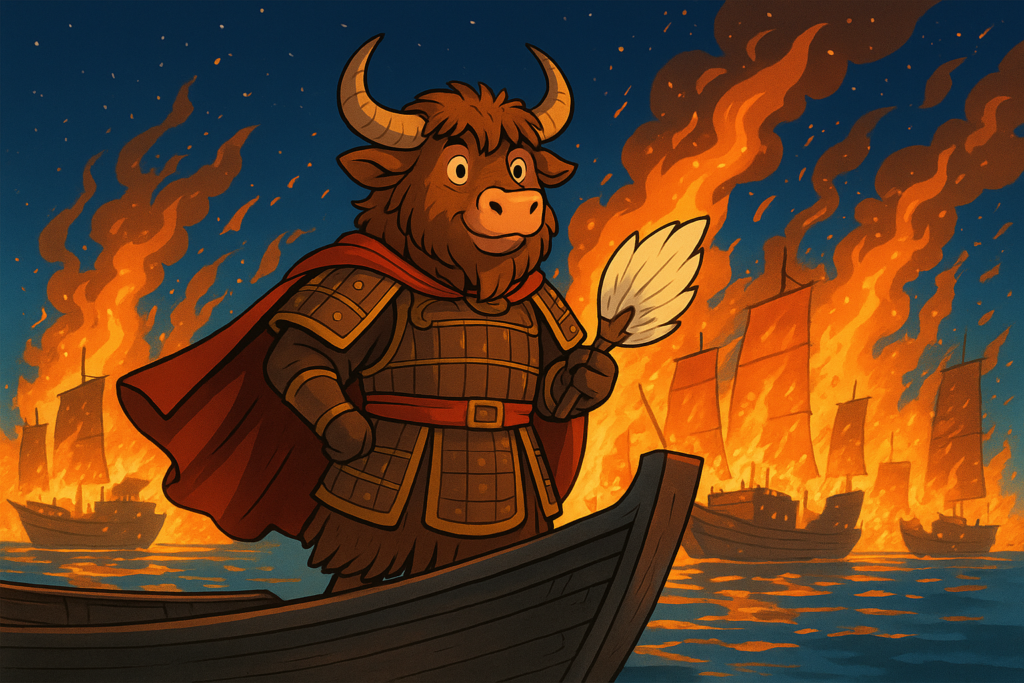
This B1 Intermediate retelling of 赤壁之戰 keeps the plot clear for learners while still giving the story some atmosphere and momentum.
This version teaches Traditional Chinese through English and includes clickable word help inside the story, full story audio, and lesson notes after the reading. It is free to use on Yak Yacker and is designed to feel natural, readable, and manageable for learners.
曹操統一了北方,他的軍隊有幾十萬人。他想繼續南下,攻打劉備和孫權,統一整個中國。
劉備在南方,勢力很弱。他的軍師諸葛亮說:「我們需要和孫權合作,一起對抗曹操。」
,見到孫權。孫權問他:「曹操有這麼多,我們真的能他嗎?」
江東的許多害怕曹操,他們想。但諸葛亮用和,一個一個他們。
最後,諸葛亮對孫權說:「曹操雖然,但他們,已經很。而且北方人不習慣,這是我們的機會。」孫權終於決定。
任命周瑜為,帶領三萬。劉備也派了關羽和張飛幫助。兩軍在。
曹操的大軍在長江北岸。他的連在一起,上面鋪上木板,使士兵不會。
老將黃蓋向周瑜建議:「曹操的船,如果用,可以一次燒光它們。」
周瑜同意這個。他們準備了十艘小船,裡面裝滿了和,外面蓋上布。
黃蓋派人送信給曹操,說他要。曹操很高興,不他。
一個晚上,吹著。黃蓋帶船隊,船開得很快。快到曹操水寨時,黃蓋下令:「!」
小船上的點著了,船像一樣衝向曹軍的。風很大,大火很快整個艦隊。
曹操的士兵,到處都是火和煙。許多士兵跳入水中,但不會,了很多人。
這時,周瑜和劉備的軍隊從岸上,曹軍。曹操帶著少數人馬北方。
赤壁之戰後,曹操失去了的力量。劉備和孫權,的局面開始形成。
Cao Cao had unified the north, and his army numbered several hundred thousand. He wanted to continue south to attack Liu Bei and Sun Quan and unify all of China.
Liu Bei was in the south with very weak forces. His advisor Zhuge Liang said, "We need to cooperate with Sun Quan to resist Cao Cao together."
Zhuge Liang went to Jiangdong and met Sun Quan. Sun Quan asked him, "Cao Cao has so many troops; can we really defeat him?"
Many civil officials in Jiangdong feared Cao Cao and wanted to surrender. But Zhuge Liang used his wisdom and eloquence to refute them one by one.
Finally, Zhuge Liang said to Sun Quan, "Although Cao Cao has many troops, they have marched a long way and are already exhausted. Moreover, the northerners are not used to naval warfare; this is our opportunity." Sun Quan finally decided to resist.
Sun Quan appointed Zhou Yu as the Grand Commander, leading 30,000 naval troops. Liu Bei also sent Guan Yu and Zhang Fei to help. The two armies joined forces at Red Cliffs.
Cao Cao's great army camped on the north bank of the Yangtze River. His warships were linked together and covered with planks so that the soldiers would not get seasick.
The veteran general Huang Gai suggested to Zhou Yu, "Cao Cao's ships are linked together; if we use a fire attack, we can burn them all at once."
Zhou Yu agreed with the plan. They prepared ten small boats filled with dry grass and oil, covered with cloth on the outside.
Huang Gai sent someone to deliver a letter to Cao Cao, saying he wanted to surrender. Cao Cao was very pleased and did not suspect him.
One evening, with a southeast wind blowing, Huang Gai led the fleet out. The boats moved quickly. As they approached Cao Cao's naval camp, Huang Gai ordered, "Set fire!"
The torches on the small boats were lit, and the boats rushed like fiery dragons toward Cao Cao's chained ships. With a strong wind, the big fire quickly spread throughout the entire fleet.
Cao Cao's soldiers panicked; everywhere there was fire and smoke. Many soldiers jumped into the water but could not swim, and a large number drowned.
At this moment, the armies of Zhou Yu and Liu Bei attacked from the shore, and Cao Cao's forces were routed. Cao Cao fled northward with a small number of men.
After the Battle of Red Cliffs, Cao Cao lost the ability to advance south. Liu Bei and Sun Quan consolidated their positions, and the tripartite division of the country began to take shape.
This story is packed with words that capture the chaos, strategy, and drama of ancient warfare. Here are a few standouts to add to your arsenal.
Notice how many of these terms involve joint action or forceful results-perfect for describing high-stakes situations.
- 軍隊 (jūnduì) - army; troops. Note the 軍 (military) and 隊 (team) pairing.
- 投降 (tóuxiáng) - to surrender. A vivid compound: 投 (throw oneself) + 降 (descend).
- 火攻 (huǒgōng) - fire attack. 攻 means attack, so together: attack using fire.
- 驚慌失措 (jīnghuāng shīcuò) - panic-stricken. A four-character idiom: 'shocked and at a loss.'
Chinese loves telling you the outcome of an action right inside the verb. A resultative complement attaches a result word to the verb, showing what happened-completely, firmly, or successfully.
In the story, you saw 燒光 (shāo guāng - burn completely) and 站穩 (zhàn wěn - stand firmly). The pattern is: Verb + Result. Easy to adapt: 吃完 (eat up), 聽懂 (listen and understand).
- Verb + 光 (guāng): finish off / use up. e.g., 把飯吃光 (finish the rice).
- Verb + 穩 (wěn): make steady / stable. e.g., 站穩腳跟 (gain a firm foothold).
- Verb + 完 (wán): complete. e.g., 看完書 (finish reading the book).
- Practice: What would 'to burn the boats completely' be? 把船燒光!
Directional verbs like 來 (lái) and 去 (qù) pair with action verbs to show movement relative to the speaker. But simple directions like 下 (xià - down) and 入 (rù - enter) can also follow a verb to add a spatial flair.
From the text: 南下 (nán xià - go south), literally 'south down,' and 跳入 (tiào rù - jump into). These complements make the action more visual and precise.
- Verb + 下: downward movement. e.g., 坐下 (sit down), 南下 (head south).
- Verb + 入: entering. e.g., 走進 (walk in), 跳入水中 (jump into the water).
- Combine with 來/去 for distance: 跳下來 (jump down here) vs. 跳下去 (jump down there).
- Try describing: 'He fled north' - 他逃往北方 (táo wǎng běifāng) or 他北逃.
You've just navigated one of China's most epic tales-and picked up language tools to tell your own stories with impact. Try retelling a short battle scene using resultative and directional complements, and maybe a new idiom or two.
Remember, these patterns aren't just for history-they're for daily life. You can 吃完飯 (finish eating) just as dramatically as you 燒光敵船 (burn the enemy boats)! Keep playing.
赤壁之戰 comes from the Chinese / Romance of Three Kingdoms tradition and is best known as a historical novel episode. This Yak Yacker article is an original learner retelling based on Romance of the Three Kingdoms; public domain, so the wording here is simplified for modern learners rather than copied from one old edition.
Older printings, translations, and retellings of this story can vary quite a bit. The original audience was usually general/adult, but this version is adapted for B1 Intermediate learners studying Traditional Chinese. War story; use clean strategic retelling.
If you want to look into the source tradition, start with Project Gutenberg.
If you want to keep going, browse more in our Traditional Chinese section. After that, try Essential Traditional Chinese Grammar Words for another useful next step.