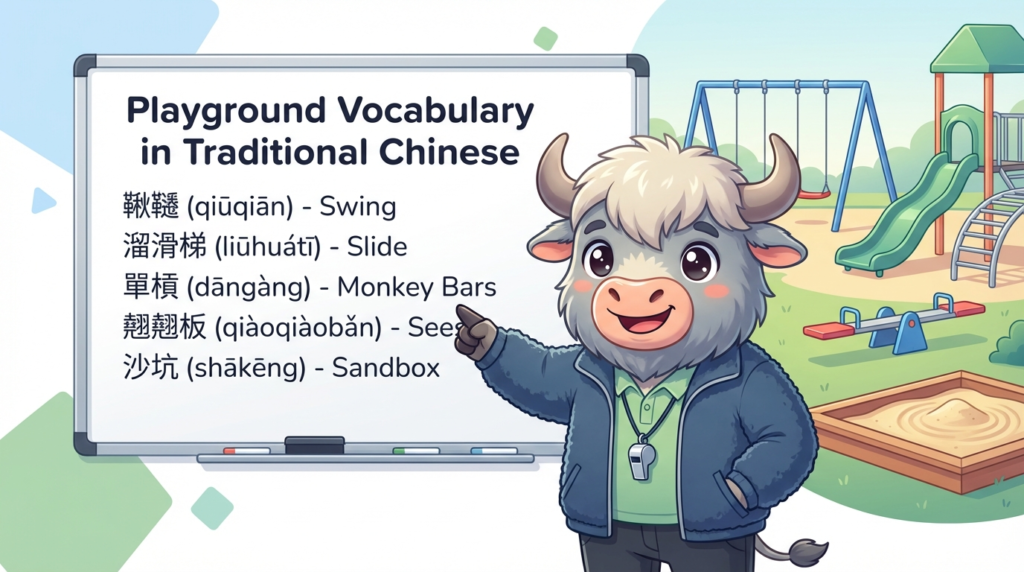
Playground Vocabulary in Traditional Chinese
主題:遊樂場/遊戲場詞彙(Traditional Chinese + pinyin + real sentences)
Here’s your playground survival kit: Traditional Chinese words with pinyin (tone marks), clear meanings, and short, real-life sentences you can copy.
Tap the speaker buttons to hear Taiwan Mandarin pronunciation. Because “interpretive miming next to a slide” is… a choice.
If you only learn one playground rule, make it this: 不要推! (bú yào tuī, “Don’t push!”). It’s magically useful in every language and every age group.
Quick Visual Cards
遊樂場
yóu lè chǎng
playground (common term)
我們放學後去遊樂場玩。
Wǒ men fàng xué hòu qù yóu lè chǎng wán.
We’ll go play at the playground after school.
鞦韆
qiū qiān
swing
他最喜歡盪鞦韆。
Tā zuì xǐ huān dàng qiū qiān.
He likes swinging the most.
滑梯
huá tī
slide
排隊才能玩滑梯。
Pái duì cái néng wán huá tī.
You have to line up to use the slide.
蹺蹺板
qiāo qiāo bǎn
seesaw
我們一起玩蹺蹺板,好嗎?
Wǒ men yì qǐ wán qiāo qiāo bǎn, hǎo ma?
Want to play on the seesaw together?
攀爬架
pān pá jià
climbing frame
他爬上攀爬架,又快又穩。
Tā pá shàng pān pá jià, yòu kuài yòu wěn.
He climbed up the frame—fast and steady.
沙坑
shā kēng
sandbox
小朋友在沙坑裡堆城堡。
Xiǎo péng yǒu zài shā kēng lǐ duī chéng bǎo.
Kids are building sandcastles in the sandbox.
排隊
pái duì
to line up
大家請排隊,慢慢來。
Dà jiā qǐng pái duì, màn màn lái.
Everyone, please line up—take it slow.
小心
xiǎo xīn
be careful
小心!地上有水會滑。
Xiǎo xīn! Dì shàng yǒu shuǐ huì huá.
Careful! There’s water on the ground—it’s slippery.
Useful Playground Phrases
These are the sentences you actually say at a playground: asking to join, taking turns, reminding people to be careful, and negotiating “five more minutes.”
我們去遊樂場吧!
Wǒ men qù yóu lè chǎng ba!
Let’s go to the playground!
媽媽說:「我們去遊樂場吧!」
Mā ma shuō: “Wǒ men qù yóu lè chǎng ba!”
Mom said, “Let’s go to the playground!”
你想玩什麼?
Nǐ xiǎng wán shén me?
What do you want to play?
到了公園,我問他:「你想玩什麼?」
Dào le gōng yuán, wǒ wèn tā: “Nǐ xiǎng wán shén me?”
At the park, I asked, “What do you want to play?”
我可以一起玩嗎?
Wǒ kě yǐ yì qǐ wán ma?
Can I play with you?
我笑著說:「我可以一起玩嗎?」
Wǒ xiào zhe shuō: “Wǒ kě yǐ yì qǐ wán ma?”
I smiled and said, “Can I play with you?”
請排隊。
Qǐng pái duì.
Please line up.
老師提醒大家:「請排隊。」
Lǎo shī tí xǐng dà jiā: “Qǐng pái duì.”
The teacher reminded everyone, “Please line up.”
輪到我了嗎?
Lún dào wǒ le ma?
Is it my turn?
我指著滑梯問:「輪到我了嗎?」
Wǒ zhǐ zhe huá tī wèn: “Lún dào wǒ le ma?”
I pointed at the slide and asked, “Is it my turn?”
我們換一下。
Wǒ men huàn yí xià.
Let’s switch.
玩了兩次後,我說:「我們換一下。」
Wán le liǎng cì hòu, wǒ shuō: “Wǒ men huàn yí xià.”
After two turns, I said, “Let’s switch.”
不要推!
Bú yào tuī!
Don’t push!
我大聲說:「不要推!」
Wǒ dà shēng shuō: “Bú yào tuī!”
I said loudly, “Don’t push!”
慢一點。
Màn yì diǎn.
A little slower.
他跑太快,我說:「慢一點。」
Tā pǎo tài kuài, wǒ shuō: “Màn yì diǎn.”
He ran too fast, so I said, “Slower.”
你沒事吧?
Nǐ méi shì ba?
Are you okay?
他跌倒了,我趕快問:「你沒事吧?」
Tā diē dǎo le, wǒ gǎn kuài wèn: “Nǐ méi shì ba?”
He fell, and I quickly asked, “Are you okay?”
我受傷了。
Wǒ shòu shāng le.
I’m hurt.
他皺著眉說:「我受傷了。」
Tā zhòu zhe méi shuō: “Wǒ shòu shāng le.”
He frowned and said, “I’m hurt.”
可以借我一下嗎?
Kě yǐ jiè wǒ yí xià ma?
Can I borrow it for a moment?
我指著球問:「可以借我一下嗎?」
Wǒ zhǐ zhe qiú wèn: “Kě yǐ jiè wǒ yí xià ma?”
I pointed at the ball and asked, “Can I borrow it?”
我去喝水。
Wǒ qù hē shuǐ.
I’m going to drink water.
天氣太熱了,我說:「我去喝水。」
Tiān qì tài rè le, wǒ shuō: “Wǒ qù hē shuǐ.”
It’s too hot, so I said, “I’m going to drink water.”
該回家了。
Gāi huí jiā le.
It’s time to go home.
天快黑了,爸爸說:「該回家了。」
Tiān kuài hēi le, bà ba shuō: “Gāi huí jiā le.”
It’s getting dark, and Dad said, “Time to go home.”
再玩五分鐘。
Zài wán wǔ fēn zhōng.
Five more minutes.
我討價還價說:「再玩五分鐘。」
Wǒ tǎo jià huán jià shuō: “Zài wán wǔ fēn zhōng.”
I negotiated: “Five more minutes.”
A small Taiwan note: 遊樂場 vs 遊戲場
In Taiwan, you’ll often hear 遊戲場 (yóu xì chǎng) for the kids’ playground area, especially inside a park. 遊樂場 (yóu lè chǎng) also works and is widely understood. If you say either one, nobody will call the playground police.
Table of Words
Places and things around the playground
| Traditional Chinese | Pinyin | Meaning (EN) | Example (ZH) | Translation (EN) | Audio |
|---|---|---|---|---|---|
公園 | gōng yuán | park | 這個公園很大。Zhè ge gōng yuán hěn dà. | This park is big. | |
遊戲場 | yóu xì chǎng | playground area | 遊戲場在右邊。Yóu xì chǎng zài yòu biān. | The playground is on the right. | |
兒童遊戲區 | ér tóng yóu xì qū | kids’ play area | 兒童遊戲區禁止吸菸。Ér tóng yóu xì qū jìn zhǐ xī yān. | No smoking in the kids’ play area. | |
入口 | rù kǒu | entrance | 入口在那邊。Rù kǒu zài nà biān. | The entrance is over there. | |
出口 | chū kǒu | exit | 我們從出口走。Wǒ men cóng chū kǒu zǒu. | Let’s leave from the exit. | |
長椅 | cháng yǐ | bench | 我在長椅上等你。Wǒ zài cháng yǐ shàng děng nǐ. | I’ll wait for you on the bench. | |
垃圾桶 | lā jī tǒng | trash can | 垃圾丟進垃圾桶。Lā jī diū jìn lā jī tǒng. | Throw the trash in the trash can. | |
飲水台 | yǐn shuǐ tái | drinking fountain | 飲水台在廁所旁邊。Yǐn shuǐ tái zài cè suǒ páng biān. | The fountain is next to the restroom. | |
廁所 | cè suǒ | restroom | 我先去廁所。Wǒ xiān qù cè suǒ. | I’m going to the restroom first. | |
樹蔭 | shù yīn | shade (under trees) | 我們去樹蔭下休息。Wǒ men qù shù yīn xià xiū xí. | Let’s rest in the shade. | |
草地 | cǎo dì | grass / lawn | 不要踩到花,走草地旁邊。Bú yào cǎi dào huā, zǒu cǎo dì páng biān. | Don’t step on the flowers—walk by the lawn. | |
護欄 | hù lán | fence / railing | 不要爬護欄。Bú yào pá hù lán. | Don’t climb the railing. |
Extra playground equipment
| Traditional Chinese | Pinyin | Meaning (EN) | Example (ZH) | Translation (EN) | Audio |
|---|---|---|---|---|---|
單槓 | dān gàng | horizontal bar | 他在單槓上吊了五秒。Tā zài dān gàng shàng diào le wǔ miǎo. | He hung on the bar for five seconds. | |
平衡木 | píng héng mù | balance beam | 走平衡木要慢慢來。Zǒu píng héng mù yào màn màn lái. | Walk the balance beam slowly. | |
攀岩牆 | pān yán qiáng | climbing wall | 攀岩牆看起來有點高。Pān yán qiáng kàn qǐ lái yǒu diǎn gāo. | The climbing wall looks a bit tall. | |
爬網 | pá wǎng | climbing net | 他抓緊爬網往上爬。Tā zhuā jǐn pá wǎng wǎng shàng pá. | He held the net tight and climbed up. | |
網繩橋 | wǎng shéng qiáo | rope bridge | 走網繩橋要抓著旁邊。Zǒu wǎng shéng qiáo yào zhuā zhe páng biān. | Hold the sides when crossing the rope bridge. | |
溜索 | liū suǒ | zip line | 他坐上溜索,一下就到對面。Tā zuò shàng liū suǒ, yí xià jiù dào duì miàn. | He got on the zip line and reached the other side quickly. | |
轉盤 | zhuàn pán | spinning disk | 轉盤轉太快會頭暈。Zhuàn pán zhuàn tài kuài huì tóu yūn. | Spinning too fast can make you dizzy. | |
彈簧搖搖馬 | tán huáng yáo yáo mǎ | spring rider | 小朋友坐在彈簧搖搖馬上搖來搖去。Xiǎo péng yǒu zuò zài tán huáng yáo yáo mǎ shàng yáo lái yáo qù. | Kids rock back and forth on the spring rider. |
Actions and games
| Traditional Chinese | Pinyin | Meaning (EN) | Example (ZH) | Translation (EN) | Audio |
|---|---|---|---|---|---|
盪 | dàng | to swing (back and forth) | 你想盪高一點嗎?Nǐ xiǎng dàng gāo yì diǎn ma? | Do you want to swing a bit higher? | |
滑下來 | huá xià lái | to slide down | 他從滑梯滑下來。Tā cóng huá tī huá xià lái. | He slid down the slide. | |
爬上去 | pá shàng qù | to climb up | 先慢慢爬上去。Xiān màn màn pá shàng qù. | Climb up slowly first. | |
跳 | tiào | to jump | 不要從那裡跳下來。Bú yào cóng nà lǐ tiào xià lái. | Don’t jump down from there. | |
跑 | pǎo | to run | 在遊戲場裡不要跑太快。Zài yóu xì chǎng lǐ bú yào pǎo tài kuài. | Don’t run too fast in the play area. | |
追 | zhuī | to chase | 他們在草地上追來追去。Tā men zài cǎo dì shàng zhuī lái zhuī qù. | They’re chasing each other on the grass. | |
躲貓貓 | duǒ māo māo | hide-and-seek | 我們來玩躲貓貓。Wǒ men lái wán duǒ māo māo. | Let’s play hide-and-seek. | |
等一下 | děng yí xià | wait a moment | 等一下,馬上就輪到你。Děng yí xià, mǎ shàng jiù lún dào nǐ. | Wait a moment—your turn is coming. | |
輪流 | lún liú | to take turns | 大家輪流玩,不要搶。Dà jiā lún liú wán, bú yào qiǎng. | Everyone take turns—don’t grab. | |
分享 | fēn xiǎng | to share | 玩具要記得分享。Wán jù yào jì de fēn xiǎng. | Remember to share the toys. | |
借 | jiè | to borrow | 我可以借你的球嗎?Wǒ kě yǐ jiè nǐ de qiú ma? | Can I borrow your ball? | |
還給 | huán gěi | to return (give back) | 用完要還給人家。Yòng wán yào huán gěi rén jiā. | Return it when you’re done. |
Safety and rule words
| Traditional Chinese | Pinyin | Meaning (EN) | Example (ZH) | Translation (EN) | Audio |
|---|---|---|---|---|---|
規則 | guī zé | rules | 先看清楚規則再玩。Xiān kàn qīng chǔ guī zé zài wán. | Read the rules before playing. | |
安全 | ān quán | safe / safety | 安全第一。Ān quán dì yī. | Safety first. | |
危險 | wēi xiǎn | dangerous | 那樣做很危險。Nà yàng zuò hěn wēi xiǎn. | Doing that is dangerous. | |
注意 | zhù yì | pay attention | 注意腳下。Zhù yì jiǎo xià. | Watch your step. | |
跌倒 | diē dǎo | to fall down | 他跑太快就跌倒了。Tā pǎo tài kuài jiù diē dǎo le. | He ran too fast and fell. | |
受傷 | shòu shāng | to get injured | 如果受傷,先告訴大人。Rú guǒ shòu shāng, xiān gào sù dà rén. | If you’re hurt, tell an adult first. | |
擦傷 | cā shāng | scrape / abrasion | 他膝蓋有點擦傷。Tā xī gài yǒu diǎn cā shāng. | His knee is a bit scraped. | |
瘀青 | yū qīng | bruise | 手臂上有一塊瘀青。Shǒu bì shàng yǒu yí kuài yū qīng. | There’s a bruise on the arm. | |
流血 | liú xuè | to bleed | 傷口在流血。Shāng kǒu zài liú xuè. | The wound is bleeding. | |
疼 | téng | to hurt / painful | 這裡很疼。Zhè lǐ hěn téng. | It hurts here. | |
創可貼 | chuàng kě tiē | bandage (Band-Aid) | 我幫你貼創可貼。Wǒ bāng nǐ tiē chuàng kě tiē. | I’ll put a bandage on you. | |
急救箱 | jí jiù xiāng | first-aid kit | 急救箱在包包裡。Jí jiù xiāng zài bāo bāo lǐ. | The first-aid kit is in the backpack. | |
監護人 | jiān hù rén | guardian | 小朋友需要監護人陪同。Xiǎo péng yǒu xū yào jiān hù rén péi tóng. | Kids need a guardian with them. | |
陪同 | péi tóng | to accompany | 請家長陪同入場。Qǐng jiā zhǎng péi tóng rù chǎng. | Parents/guardians, please accompany entry. |
People, feelings, and “I need a break” words
| Traditional Chinese | Pinyin | Meaning (EN) | Example (ZH) | Translation (EN) | Audio |
|---|---|---|---|---|---|
小朋友 | xiǎo péng yǒu | kid / little one | 很多小朋友在玩。Hěn duō xiǎo péng yǒu zài wán. | Lots of kids are playing. | |
大人 | dà rén | adult | 有事就找大人。Yǒu shì jiù zhǎo dà rén. | If something happens, find an adult. | |
家長 | jiā zhǎng | parent/guardian | 家長請在旁邊看好。Jiā zhǎng qǐng zài páng biān kàn hǎo. | Parents, please keep an eye nearby. | |
朋友 | péng yǒu | friend | 我跟朋友一起來。Wǒ gēn péng yǒu yì qǐ lái. | I came with a friend. | |
謝謝 | xiè xie | thank you | 謝謝你讓我先玩。Xiè xie nǐ ràng wǒ xiān wán. | Thanks for letting me go first. | |
對不起 | duì bù qǐ | sorry | 對不起,我不是故意的。Duì bù qǐ, wǒ bú shì gù yì de. | Sorry, I didn’t mean it. | |
沒關係 | méi guān xì | it’s okay / no worries | 沒關係,你沒事就好。Méi guān xì, nǐ méi shì jiù hǎo. | It’s okay—as long as you’re fine. | |
開心 | kāi xīn | happy | 他玩得很開心。Tā wán de hěn kāi xīn. | He’s having a great time. | |
害怕 | hài pà | scared | 如果你害怕,就不要勉強。Rú guǒ nǐ hài pà, jiù bú yào miǎn qiǎng. | If you’re scared, don’t force it. | |
累 | lèi | tired | 我有點累,想休息。Wǒ yǒu diǎn lèi, xiǎng xiū xí. | I’m a bit tired—I want a break. | |
口渴 | kǒu kě | thirsty | 我口渴了,我去喝水。Wǒ kǒu kě le, wǒ qù hē shuǐ. | I’m thirsty—I’m going to drink water. |
Weather, time, and what you bring
| Traditional Chinese | Pinyin | Meaning (EN) | Example (ZH) | Translation (EN) | Audio |
|---|---|---|---|---|---|
太陽 | tài yáng | sun | 太陽很大,要擦防曬。Tài yáng hěn dà, yào cā fáng shài. | The sun is strong—put on sunscreen. | |
下雨 | xià yǔ | to rain | 下雨了,我們先回家。Xià yǔ le, wǒ men xiān huí jiā. | It’s raining—let’s go home first. | |
濕滑 | shī huá | wet and slippery | 地板很濕滑,小心走。Dì bǎn hěn shī huá, xiǎo xīn zǒu. | The ground is slippery—walk carefully. | |
早上 | zǎo shang | morning | 早上人比較少。Zǎo shang rén bǐ jiào shǎo. | There are fewer people in the morning. | |
下午 | xià wǔ | afternoon | 下午去公園剛剛好。Xià wǔ qù gōng yuán gāng gāng hǎo. | The afternoon is a great time to go to the park. | |
週末 | zhōu mò | weekend | 週末遊戲場會很熱鬧。Zhōu mò yóu xì chǎng huì hěn rè nào. | The playground gets lively on weekends. | |
帽子 | mào zi | hat | 戴帽子比較不會曬黑。Dài mào zi bǐ jiào bú huì shài hēi. | Wearing a hat helps you not get too sunburned. | |
防曬 | fáng shài | sunscreen / sun protection | 出門前記得擦防曬。Chū mén qián jì de cā fáng shài. | Remember sunscreen before going out. | |
水壺 | shuǐ hú | water bottle | 把水壺放進背包。Bǎ shuǐ hú fàng jìn bēi bāo. | Put the water bottle in the backpack. | |
點心 | diǎn xīn | snack | 玩累了就吃點心。Wán lèi le jiù chī diǎn xīn. | When you’re tired from playing, have a snack. |
Optional Variants: Measure words & “Don’t push” upgrades
| What | Common measure word | Example (ZH) | Translation (EN) | Audio |
|---|---|---|---|---|
遊樂場 yóu lè chǎng | 一個/一座 yí ge / yí zuò | 這裡有一個遊樂場。Zhè lǐ yǒu yí ge yóu lè chǎng. | There’s a playground here. | |
滑梯 huá tī | 一座 yí zuò | 那邊有一座滑梯。Nà biān yǒu yí zuò huá tī. | There’s a slide over there. | |
鞦韆 qiū qiān | 一架 yí jià | 我想玩那一架鞦韆。Wǒ xiǎng wán nà yí jià qiū qiān. | I want to play on that swing. | |
不要推 bú yào tuī | 別推 bié tuī | 別推,大家會跌倒。Bié tuī, dà jiā huì diē dǎo. | Don’t push—people will fall. |
Playground Mandarin is basically three skills: asking nicely, taking turns, and preventing chaos. Congratulations—you now have all three. Use them responsibly (or at least loudly).