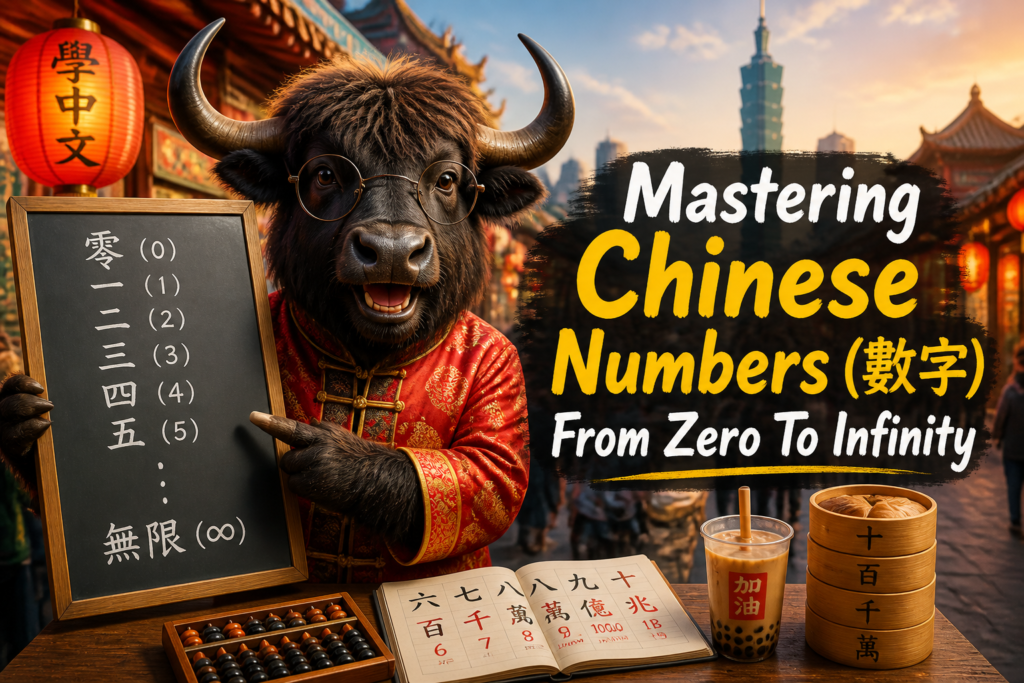
Chinese numbers from zero upward in Traditional Chinese

Mastering Chinese Numbers (數字) From Zero To Infinity

數字 shùzì means “numbers.” And yes, Chinese numbers are one of those topics that look scary for about five minutes, then become weirdly satisfying. The system is clean, logical, and honestly a bit smug about it.

For the broader learning path, visit our parent guide.

By the end of this guide, you’ll know how to count in Traditional Chinese, read big numbers, say dates, use money naturally in Taiwan, and avoid the classic learner traps that make native speakers politely blink at you.

If you want a boring-but-useful reference while you study, the TOCFL placement test and this Traditional Chinese vocabulary test are good reality checks. Nothing says “serious learning” like a test. Thrilling stuff.

The Basic Counting System

Chinese counting is built on simple blocks: one, ten, hundred, thousand, ten thousand, hundred million. Once you know the pattern, the numbers stop feeling random and start feeling like LEGO.

Traditional ChinesePinyinEnglish MeaningExample (ZH)Example (Pinyin)Translation (EN)
língzero電話號碼是零九一二。Diànhuà hàomǎ shì líng jiǔ yī èr.The phone number is 0912.
one我有一個問題。Wǒ yǒu yī gè wèntí.I have one question.
èrtwo我有兩本書,這本是第二本。Wǒ yǒu liǎng běn shū, zhè běn shì dì-èr běn.I have two books, and this one is the second book.
sānthree三點見。Sān diǎn jiàn.See you at three.
four四號出口在哪裡?Sì hào chūkǒu zài nǎlǐ?Where is Exit 4?
five我五點下班。Wǒ wǔ diǎn xiàbān.I get off work at five.
liùsix六張票夠嗎?Liù zhāng piào gòu ma?Are six tickets enough?
seven七月很熱。Qī yuè hěn rè.July is very hot.
eight八點開始上課。Bā diǎn kāishǐ shàngkè.Class starts at eight.
jiǔnine九折比較便宜。Jiǔ zhé bǐjiào piányí.Ten percent off? That’s cheaper.
shíten十個人來了。Shí gè rén lái le.Ten people came.

Notice something nice? , èr, sān do not need weird memory tricks. The pain comes later, when the numbers get larger and suddenly your brain has to stop being dramatic.

The Big Building Blocks

After ten, Chinese uses a very regular structure:

Traditional ChinesePinyinMeaningExample (ZH)Example (Pinyin)Translation (EN)
shíten十二shí èrtwelve
bǎihundred三百sān bǎithree hundred
qiānthousand兩千liǎng qiāntwo thousand
wànten thousand五萬wǔ wànfifty thousand / five ten-thousands
hundred million三億sān yìthree hundred million

The key idea is that Chinese groups numbers by ten thousand, not by thousand. That’s why wàn matters so much. English speakers often expect “million” to be the main giant number, but Chinese likes to climb the ladder differently. Languages, like cats, do not care about your expectations.

Quick rule: Chinese counts in units of (10), (100), (1,000), (10,000), and (100,000,000).

Useful Number Phrases For Real Life

These are the number phrases you’ll actually use in Taiwan, whether you’re buying breakfast, asking for a platform number, or trying not to embarrass yourself with a price tag.

Traditional ChinesePinyinEnglish MeaningExample (ZH)Example (Pinyin)Translation (EN)
how many / a few你有幾本書?Nǐ yǒu jǐ běn shū?How many books do you have?
多少duōshǎohow much / how many這個多少錢?Zhège duōshao qián?How much is this?
ordinal marker: -th / first, second, third我是第一個到的。Wǒ shì dì-yī gè dào de.I was the first one to arrive.
bànhalf我等了半個小時。Wǒ děng le bàn gè xiǎoshí.I waited half an hour.
零點五líng diǎn wǔ0.5我只喝零點五杯咖啡。Wǒ zhǐ hē líng diǎn wǔ bēi kāfēi.I only drank half a cup of coffee.
一百yì bǎione hundred一百塊夠嗎?Yì bǎi kuài gòu ma?Is one hundred dollars enough?
一千yì qiānone thousand這台手機一千元買不到。Zhè tái shǒujī yì qiān yuán mǎi bù dào.You can’t buy this phone for one thousand yuan.
一萬yí wànten thousand房租要一萬塊。Fángzū yào yí wàn kuài.The rent is ten thousand dollars.
一億yí yìone hundred million一億不是小數字。Yí yì bú shì xiǎo shùzì.One hundred million is not a small number.
左右zuǒyòuabout / around我大概十點左右到。Wǒ dàgài shí diǎn zuǒyòu dào.I’ll arrive around ten.
以上yǐshàngand above十八歲以上可以進去。Shíbā suì yǐshàng kěyǐ jìnqù.People 18 and above can enter.
以下yǐxiàand below五公斤以下比較方便帶。Wǔ gōngjīn yǐxià bǐjiào fāngbiàn dài.Under five kilos is easier to carry.

How To Say Large Numbers

Here’s the part that makes Chinese numbers feel beautifully efficient.

Instead of saying “one thousand two hundred thirty-four” in a long chain, Chinese keeps the structure compact:

NumberTraditional ChinesePinyinEnglish
12十二shí èrtwelve
25二十五èr shí wǔtwenty-five
108一百零八yì bǎi líng bāone hundred eight
203二百零三èr bǎi líng sāntwo hundred three
1,256一千二百五十六yì qiān èr bǎi wǔ shí liùone thousand two hundred fifty-six
10,000一萬yí wànten thousand
25,000兩萬五千liǎng wàn wǔ qiāntwenty-five thousand
100,000十萬shí wànone hundred thousand
1,000,000一百萬yì bǎi wànone million
10,000,000一千萬yì qiān wànten million
100,000,000一億yí yìone hundred million

Two important notes:

  • Use líng to mark missing place values, like 一百零八 yì bǎi líng bā.
  • In Taiwan, people often say liǎng before measure words and some nouns, especially for “two” in everyday speech: 兩個 liǎng gè, 兩本 liǎng běn, 兩千 liǎng qiān.

So yes, èr and liǎng both mean “two,” but they are not used in exactly the same places. Tiny detail, giant importance. Mandarin loves those.

Zero, One, Two, And The Weird Bits

Let’s clean up the tricky spots before they turn into permanent bad habits.

PatternMeaningExample (ZH)PinyinEnglish
língzero; used for missing positions一千零一yì qiān líng yī1001
one; changes tone in some situations一天yì tiānone day
liǎngtwo; often before measure words兩杯咖啡liǎng bēi kāfēitwo cups of coffee
èrtwo; used in counting, ordinals, phone-like lists二十èr shítwenty
兩個 liǎng gètwo items/people兩個人liǎng gè réntwo people
+ numberordinal number第二dì-èrsecond

Tone note: changes tone depending on what comes after it. In basic speech, it often becomes or .

  • before a first tone, second tone, or third tone can often become or stay neutral in fast speech.
  • Before a fourth tone, it often becomes in common speech: 一樣 yíyàng.
  • In numbers by itself, it is usually read as when counting, but pronunciation can shift in phrases. Chinese likes to keep learners humble.

Money, Prices, And Taiwan Everyday Speech

In Taiwan, you will hear money talked about with kuài in casual speech and yuán in more formal writing. Both refer to New Taiwan dollars in everyday life.

Traditional ChinesePinyinMeaningExample (ZH)PinyinEnglish
多少錢duōshao qiánhow much money / how much這杯咖啡多少錢?Zhè bēi kāfēi duōshao qián?How much is this cup of coffee?
幾塊jǐ kuàihow many dollars這個多少?三十幾塊嗎?Zhège duōshao? Sānshí jǐ kuài ma?How much is this? Around thirty dollars?
五十塊wǔshí kuàififty dollars這個五十塊。Zhège wǔshí kuài.This is fifty dollars.
一百元yì bǎi yuánone hundred dollars一百元可以嗎?Yì bǎi yuán kěyǐ ma?Is one hundred dollars okay?
找錢zhǎoqiánchange money; give change店員幫我找錢。Diànyuán bāng wǒ zhǎoqián.The clerk gave me change.
零錢língqiáncoins; small change我只有零錢。Wǒ zhǐyǒu língqián.I only have small change.

Real-life sample:

這個多少錢? Zhège duōshao qián? — How much is this?

三十塊。 Sānshí kuài. — Thirty dollars.

Short, clear, and useful. No need for financial poetry.

Dates, Time, And Numbers You’ll See Every Day

Numbers show up constantly in dates, time, addresses, and schedules. If you can handle these, life gets much easier very quickly.

Traditional ChinesePinyinMeaningExample (ZH)Example (Pinyin)Translation (EN)
星期一xīngqī yīMonday我們星期一見。Wǒmen xīngqī yī jiàn.We’ll meet on Monday.
一月yī yuèJanuary一月很冷。Yī yuè hěn lěng.January is cold.
十點半shí diǎn bàn10:30十點半出發。Shí diǎn bàn chūfā.Leave at 10:30.
三十分鐘sānshí fēnzhōng30 minutes大概三十分鐘到。Dàgài sānshí fēnzhōng dào.It takes about 30 minutes.
第二天dì-èr tiānthe second day / next day第二天我就忘了。Dì-èr tiān wǒ jiù wàng le.The next day I already forgot.
第十頁dì shí yèpage 10請翻到第十頁。Qǐng fān dào dì shí yè.Please turn to page 10.

Good to know: dates in Chinese usually go from big to small: year, month, day.

2026年5月3日 èr líng èr liù nián wǔ yuè sān rì — May 3, 2026

If you see , hào, or in dates, don’t panic. Different contexts use different forms, but the pattern is still calm and orderly. Unlike some calendars, which seem designed by a committee of raccoons.

Ordinals: First, Second, Third

Ordinals in Chinese are easy once you know one tiny marker: .

PatternMeaningExample (ZH)PinyinEnglish
第一first我是第一個到的。Wǒ shì dì-yī gè dào de.I was the first one to arrive.
第二second他坐第二排。Tā zuò dì-èr pái.He sits in the second row.
第三third第三題很難。Dì-sān tí hěn nán.The third question is hard.
第十tenth第十名很厲害。Dì shí míng hěn lìhai.Coming in tenth is impressive.

Important: don’t use for plain counting. You say 三個人 sān gè rén for “three people,” but 第三個人 dì-sān gè rén for “the third person.”

Common Number Phrases You Should Memorize

Here’s the practical shortlist. These are the phrases that will save you time, confusion, and the occasional awkward stare.

Traditional ChinesePinyinEnglish MeaningExample (ZH)Example (Pinyin)Translation (EN)
一個yī gèone item/person我要一個。Wǒ yào yī gè.I want one.
兩個liǎng gètwo items/people我要兩個便當。Wǒ yào liǎng gè biàndāng.I want two lunch boxes.
幾個jǐ gèa few / how many你有幾個朋友?Nǐ yǒu jǐ gè péngyǒu?How many friends do you have?
十幾shí jǐmore than ten, around 10-something我等了十幾分鐘。Wǒ děng le shí jǐ fēnzhōng.I waited for more than ten minutes.
二十幾èrshí jǐaround twenty-something他二十幾歲。Tā èrshí jǐ suì.He is in his twenties.
三十幾sānshí jǐaround thirty-something價格大概三十幾塊。Jiàgé dàgài sānshí jǐ kuài.The price is probably around thirty-something dollars.
一半yī bànhalf我要一半糖。Wǒ yào yī bàn táng.I want half sugar.
一點yī diǎna little; 1 o’clock我只會一點中文。Wǒ zhǐ huì yī diǎn Zhōngwén.I only know a little Chinese.
一點五yī diǎn wǔ1.5這裡要一點五公升水。Zhèlǐ yào yī diǎn wǔ gōngshēng shuǐ.We need 1.5 liters of water here.
百分之bǎifēnzhīpercent他考了百分之九十。Tā kǎo le bǎifēnzhī jiǔshí.He scored 90 percent.

Common Mistakes And Easy Fixes

English speakers often make the same few number mistakes. Good news: they are easy to fix once you notice them.

MistakeWhy It HappensBetter WayExample
Using everywhereEnglish just says “two” in all placesUse before many measure words and nouns in Taiwan兩個人 liǎng gè rén
Forgetting in the middleTrying to read numbers like EnglishSay the zero when a place value is skipped一百零五 yì bǎi líng wǔ
Mixing up and comma groupingEnglish uses thousands separators differentlyRead by ten-thousands, not by thousands alone二十萬 èr shí wàn = 200,000
Using for countingOrdinals and cardinals feel similar in EnglishUse only for order第三本 dì-sān běn
Reading money too formallyTextbook habitIn Taiwan, casual speech often uses 五十塊 wǔshí kuài
Ignoring tone changes with It looks like one simple numberListen to how it sounds in phrases一樣 yíyàng

Practice Time

Try these out loud. Numbers are one of those things you really do need to say, not just recognize silently like a haunted spreadsheet.

  • Translate: 7, 12, 20, 108, 2,500, 30,000
  • Say these aloud: 兩本書, 一百零三, 第十課, 三十幾歲
  • Fill in the blank: 我有 ___ 個朋友。 (Wǒ yǒu ___ gè péngyǒu.)
  • Choose the better form in Taiwan: 二個 or 兩個
  • Read the price: 一千二百五十塊
  • Convert to Chinese: 2026, 9:30, 1.5, 90%

Answers:, 十二 shí èr, 二十 èr shí, 一百零八 yì bǎi líng bā, 二千五百 or more naturally 兩千五百 liǎng qiān wǔ bǎi, 三萬 sān wàn; 兩個 is usually better in Taiwan; 一千二百五十塊 = 1,250 dollars.

Quick Reference Summary

TopicKey Point
CountingUse 一、二、三 and then 十、百、千、萬、億.
Zero marks missing place values.
TwoUse often before measure words in Taiwan.
OrdinalsUse for first, second, third, etc.
Money is common in casual Taiwan speech; is more formal.
DatesYear + month + day order is standard.
Large NumbersChinese groups by ten-thousands, not thousands.

Numbers in Chinese are not random trivia. They show up in food orders, schedules, prices, addresses, and everyday life. Learn them well, and suddenly a lot of the language becomes less scary and more usable. Which is the whole point, really.

Yak Takeaway: once you get comfortable with wàn, liǎng, and líng, Chinese numbers stop being a monster and start being a very tidy toolbox. A slightly smug toolbox, but still useful.