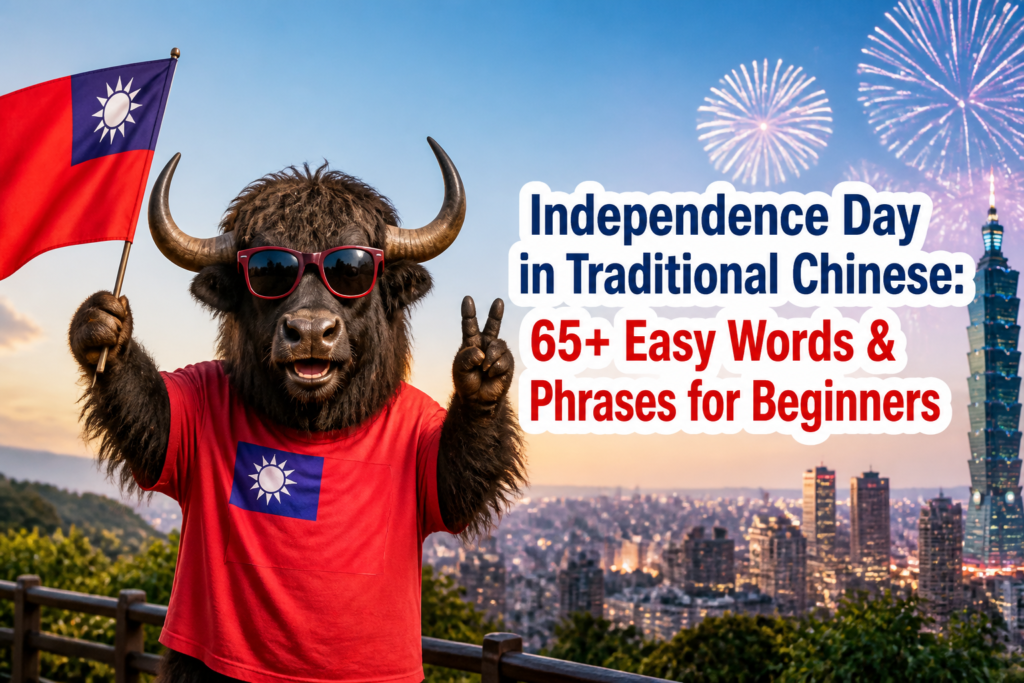
If you want to talk about Independence Day in Traditional Chinese, the main phrase is 國慶日 (guóqìngrì), which means “National Day.” In Taiwan, that usually refers to 雙十節 (Shuāng Shí Jié), the Double Ten Day holiday on October 10. Yes, Mandarin can be very practical and slightly dramatic at the same time.
For the broader learning path, visit our parent guide.
In this article, you’ll learn more than 65 beginner-friendly words and phrases for Independence Day-style conversations in Traditional Chinese. You’ll get the key holiday words, real-life sentences, and useful Taiwan-style vocabulary for flags, parades, fireworks, time off, and celebrations.
For a quick reference on the holiday itself, you can also check the boring-but-useful Wikipedia page for National Day of the Republic of China. Not glamorous. Very helpful. Like a dictionary wearing a tie.
Core Holiday Words
| Traditional Chinese | Pinyin | Meaning | Example (ZH) | Example (Pinyin) | Translation (EN) |
|---|---|---|---|---|---|
| 國慶日 | guóqìngrì | National Day | 台灣的國慶日是十月十日。 | Táiwān de guóqìngrì shì shí yuè shí rì. | Taiwan’s National Day is October 10. |
| 雙十節 | Shuāng Shí Jié | Double Ten Day | 雙十節是台灣很重要的節日。 | Shuāng Shí Jié shì Táiwān hěn zhòngyào de jiérì. | Double Ten Day is an important holiday in Taiwan. |
| 國慶 | guóqìng | national celebration / National Day | 今年的國慶活動很熱鬧。 | Jīnnián de guóqìng huódòng hěn rènao. | This year’s National Day events are lively. |
| 節日 | jiérì | holiday; festival | 我喜歡有節日的時候。 | Wǒ xǐhuan yǒu jiérì de shíhou. | I like it when there is a holiday. |
| 慶祝 | qìngzhù | to celebrate | 大家一起慶祝國慶日。 | Dàjiā yìqǐ qìngzhù guóqìngrì. | Everyone celebrates National Day together. |
| 放假 | fàngjià | to have a holiday; take time off | 國慶日大家通常會放假。 | Guóqìngrì dàjiā tōngcháng huì fàngjià. | People usually get a day off on National Day. |
| 假期 | jiàqī | vacation; holiday period | 我想利用假期出去玩。 | Wǒ xiǎng lìyòng jiàqī chūqù wán. | I want to use the holiday to go out and have fun. |
| 活動 | huódòng | event; activity | 今天有很多國慶活動。 | Jīntiān yǒu hěn duō guóqìng huódòng. | There are many National Day events today. |
| 遊行 | yóuxíng | parade | 我們去看遊行吧。 | Wǒmen qù kàn yóuxíng ba. | Let’s go watch the parade. |
| 煙火 | yānhuǒ | fireworks | 晚上會有煙火表演。 | Wǎnshang huì yǒu yānhuǒ biǎoyǎn. | There will be a fireworks show at night. |
Notice how Taiwan often says 雙十節 (Double Ten Day). It sounds a little more festive than a plain translation, which is probably why people keep using it. Language loves a good nickname.
Useful Phrases For Talking About The Holiday
| Traditional Chinese | Pinyin | Meaning | Example (ZH) | Example (Pinyin) | Translation (EN) |
|---|---|---|---|---|---|
| 國慶日快樂! | Guóqìngrì kuàilè! | Happy National Day! | 國慶日快樂! | Guóqìngrì kuàilè! | Happy National Day! |
| 雙十節快樂! | Shuāng Shí Jié kuàilè! | Happy Double Ten Day! | 雙十節快樂! | Shuāng Shí Jié kuàilè! | Happy Double Ten Day! |
| 今天放假。 | Jīntiān fàngjià. | It’s a holiday today. | 今天放假,我可以休息。 | Jīntiān fàngjià, wǒ kěyǐ xiūxi. | It’s a holiday today, so I can rest. |
| 一起去看遊行。 | Yìqǐ qù kàn yóuxíng. | Let’s go watch the parade together. | 我們一起去看遊行。 | Wǒmen yìqǐ qù kàn yóuxíng. | Let’s go watch the parade together. |
| 有煙火表演。 | Yǒu yānhuǒ biǎoyǎn. | There is a fireworks show. | 今晚有煙火表演。 | Jīnwǎn yǒu yānhuǒ biǎoyǎn. | There is a fireworks show tonight. |
| 人很多。 | Rén hěn duō. | There are many people. | 國慶活動現場人很多。 | Guóqìng huódòng xiànchǎng rén hěn duō. | There are many people at the National Day event. |
| 很熱鬧。 | Hěn rènao. | lively; bustling | 這裡很熱鬧。 | Zhèlǐ hěn rènao. | This place is lively. |
| 大家一起慶祝。 | Dàjiā yìqǐ qìngzhù. | Everyone celebrates together. | 大家一起慶祝國慶日。 | Dàjiā yìqǐ qìngzhù guóqìngrì. | Everyone celebrates National Day together. |
| 我想拍照。 | Wǒ xiǎng pāizhào. | I want to take photos. | 我想拍照留念。 | Wǒ xiǎng pāizhào liúniàn. | I want to take photos as a keepsake. |
| 這是很重要的日子。 | Zhè shì hěn zhòngyào de rìzi. | This is a very important day. | 對很多人來說,這是很重要的日子。 | Duì hěn duō rén lái shuō, zhè shì hěn zhòngyào de rìzi. | For many people, this is a very important day. |
| 我要去看升旗。 | Wǒ yào qù kàn shēngqí. | I’m going to watch the flag-raising. | 早上我想去看升旗。 | Zǎoshang wǒ xiǎng qù kàn shēngqí. | I want to watch the flag-raising in the morning. |
| 今天很有節日氣氛。 | Jīntiān hěn yǒu jiérì qìfēn. | It feels very festive today. | 今天很有節日氣氛。 | Jīntiān hěn yǒu jiérì qìfēn. | It feels very festive today. |
Words For Flags, Ceremonies, And Public Events
| Traditional Chinese | Pinyin | Meaning | Example (ZH) | Example (Pinyin) | Translation (EN) |
|---|---|---|---|---|---|
| 國旗 | guóqí | national flag | 國旗在風中飄揚。 | Guóqí zài fēng zhōng piāoyáng. | The national flag is waving in the wind. |
| 升旗 | shēngqí | to raise the flag | 早上有升旗典禮。 | Zǎoshang yǒu shēngqí diǎnlǐ. | There is a flag-raising ceremony in the morning. |
| 典禮 | diǎnlǐ | ceremony | 國慶典禮很正式。 | Guóqìng diǎnlǐ hěn zhèngshì. | The National Day ceremony is very formal. |
| 表演 | biǎoyǎn | performance | 現場有精彩的表演。 | Xiànchǎng yǒu jīngcǎi de biǎoyǎn. | There is a wonderful performance on site. |
| 致詞 | zhìcí | to give a speech | 代表會上台致詞。 | Dàibiǎo huì shàngtái zhìcí. | The representative will go on stage to give a speech. |
| 主持人 | zhǔchí rén | host; MC | 主持人介紹了活動。 | Zhǔchí rén jièshào le huódòng. | The host introduced the event. |
| 觀眾 | guānzhòng | audience; spectators | 很多觀眾在看表演。 | Hěn duō guānzhòng zài kàn biǎoyǎn. | Many spectators are watching the performance. |
| 現場 | xiànchǎng | onsite; at the scene | 現場很熱鬧。 | Xiànchǎng hěn rènao. | The scene is lively. |
| 人群 | rénqún | crowd | 人群慢慢移動。 | Rénqún mànman yídòng. | The crowd moves slowly. |
| 遊客 | yóukè | tourist | 很多遊客來看活動。 | Hěn duō yóukè lái kàn huódòng. | Many tourists come to watch the event. |
Words For Time Off, Travel, And Daily Life
| Traditional Chinese | Pinyin | Meaning | Example (ZH) | Example (Pinyin) | Translation (EN) |
|---|---|---|---|---|---|
| 休息 | xiūxi | to rest | 放假我想好好休息。 | Fàngjià wǒ xiǎng hǎohǎo xiūxi. | On the holiday, I want to rest well. |
| 出門 | chūmén | to go out | 下午我想出門。 | Xiàwǔ wǒ xiǎng chūmén. | I want to go out in the afternoon. |
| 旅遊 | lǚyóu | to travel | 國慶假期很多人去旅遊。 | Guóqìng jiàqī hěn duō rén qù lǚyóu. | Many people travel during the National Day holiday. |
| 回家 | huíjiā | to go home | 我想早點回家。 | Wǒ xiǎng zǎodiǎn huíjiā. | I want to go home early. |
| 交通 | jiāotōng | traffic; transportation | 國慶日交通可能很忙。 | Guóqìngrì jiāotōng kěnéng hěn máng. | Traffic may be busy on National Day. |
| 塞車 | sāichē | traffic jam | 我們遇到塞車了。 | Wǒmen yùdào sāichē le. | We ran into a traffic jam. |
| 捷運 | jiéyùn | MRT / subway | 去市區可以搭捷運。 | Qù shìqū kěyǐ dā jiéyùn. | You can take the MRT to the city area. |
| 公車 | gōngchē | bus | 我搭公車去活動現場。 | Wǒ dā gōngchē qù huódòng xiànchǎng. | I take the bus to the event site. |
| 步行 | bùxíng | to walk | 從這裡步行十分鐘就到。 | Cóng zhèlǐ bùxíng shí fēn zhōng jiù dào. | It’s a ten-minute walk from here. |
| 便利商店 | biànlì shāngdiàn | convenience store | 我們先去便利商店買水。 | Wǒmen xiān qù biànlì shāngdiàn mǎi shuǐ. | Let’s go to a convenience store to buy water first. |
Words For Food, Snacks, And Casual Celebrating
| Traditional Chinese | Pinyin | Meaning | Example (ZH) | Example (Pinyin) | Translation (EN) |
|---|---|---|---|---|---|
| 聚餐 | jùcān | to have a meal together | 晚上我們要聚餐。 | Wǎnshang wǒmen yào jùcān. | We’re having a meal together tonight. |
| 小吃 | xiǎochī | snack; street food | 夜市有很多小吃。 | Yèshì yǒu hěn duō xiǎochī. | The night market has lots of snacks. |
| 飲料 | yǐnliào | drink; beverage | 我想買一杯飲料。 | Wǒ xiǎng mǎi yì bēi yǐnliào. | I want to buy a drink. |
| 蛋糕 | dàngāo | cake | 我們切蛋糕慶祝。 | Wǒmen qiē dàngāo qìngzhù. | We cut cake to celebrate. |
| 零食 | língshí | snacks | 我準備了一些零食。 | Wǒ zhǔnbèi le yìxiē língshí. | I prepared some snacks. |
| 好吃 | hǎochī | tasty | 這個小吃很好吃。 | Zhège xiǎochī hěn hǎochī. | This snack is very tasty. |
| 分享 | fēnxiǎng | to share | 大家一起分享食物。 | Dàjiā yìqǐ fēnxiǎng shíwù. | Everyone shares the food together. |
| 乾杯 | gānbēi | cheers | 大家一起乾杯! | Dàjiā yìqǐ gānbēi! | Everyone, cheers together! |
| 拍照留念 | pāizhào liúniàn | to take photos as a keepsake | 我們在旗子前拍照留念。 | Wǒmen zài qízi qián pāizhào liúniàn. | We take photos in front of the flag as a keepsake. |
| 紀念 | jìniàn | to commemorate; remember | 大家用活動來紀念這一天。 | Dàjiā yòng huódòng lái jìniàn zhè yì tiān. | People use events to commemorate this day. |
Curious Bit: Taiwan Usage You Should Know
In Taiwan, 國慶日 usually points to 中華民國國慶日 (Zhōnghuá Mínguó Guóqìngrì), and people often say 雙十節 because the date is October 10. If you hear 十月十日 (Shí yuè shí rì), that is the date written out clearly: October 10.
For general holiday vocabulary, Taiwan Mandarin often prefers words like 放假 (fàngjià), 休假 (xiūjià), 熱鬧 (rènao), and 便利商店 (biànlì shāngdiàn). That last one is a classic Taiwan word. It’s the kind of phrase that shows up everywhere, from school to signs to your snack emergency.
There is also a useful official reference for learners: the Taiwan Ministry of Education’s dictionary site, 重編國語辭典修訂本, which is about as unexciting as a government website can be, and therefore perfect.
More Beginner Phrases You Can Actually Use
| Traditional Chinese | Pinyin | Meaning | Example (ZH) | Example (Pinyin) | Translation (EN) |
|---|---|---|---|---|---|
| 你要去哪裡? | Nǐ yào qù nǎlǐ? | Where are you going? | 國慶日你要去哪裡? | Guóqìngrì nǐ yào qù nǎlǐ? | Where are you going on National Day? |
| 我想去市區。 | Wǒ xiǎng qù shìqū. | I want to go downtown. | 我想去市區看活動。 | Wǒ xiǎng qù shìqū kàn huódòng. | I want to go downtown to see the event. |
| 要不要一起去? | Yào bú yào yìqǐ qù? | Do you want to go together? | 要不要一起去看煙火? | Yào bú yào yìqǐ qù kàn yānhuǒ? | Do you want to go watch fireworks together? |
| 我可以參加嗎? | Wǒ kěyǐ cānjiā ma? | Can I join? | 我可以參加這個活動嗎? | Wǒ kěyǐ cānjiā zhège huódòng ma? | Can I join this event? |
| 太棒了! | Tài bàng le! | Awesome! | 有煙火,太棒了! | Yǒu yānhuǒ, tài bàng le! | There are fireworks. Awesome! |
| 真有意思。 | Zhēn yǒu yìsi. | Really interesting. | 這個活動真有意思。 | Zhège huódòng zhēn yǒu yìsi. | This event is really interesting. |
| 我聽不懂。 | Wǒ tīng bù dǒng. | I don’t understand when listening. | 抱歉,我聽不懂。 | Bàoqiàn, wǒ tīng bù dǒng. | Sorry, I don’t understand. |
| 可以再說一次嗎? | Kěyǐ zài shuō yí cì ma? | Can you say it again? | 你可以再說一次嗎? | Nǐ kěyǐ zài shuō yí cì ma? | Can you say it again? |
| 我來自台灣。 | Wǒ láizì Táiwān. | I’m from Taiwan. | 我來自台灣,今天想參加慶祝活動。 | Wǒ láizì Táiwān, jīntiān xiǎng cānjiā qìngzhù huódòng. | I’m from Taiwan, and today I want to join the celebration event. |
| 我們一起加油! | Wǒmen yìqǐ jiāyóu! | Let’s cheer each other on! | 我們一起加油,活動一定很順利。 | Wǒmen yìqǐ jiāyóu, huódòng yídìng hěn shùnlì. | Let’s cheer each other on; the event will surely go smoothly. |
Mini Grammar Note: The Useful Particles In Holiday Talk
| Pattern | Meaning | Example (ZH) | Pinyin | English |
|---|---|---|---|---|
| 嗎 | question particle | 你要去看遊行嗎? | Nǐ yào qù kàn yóuxíng ma? | Are you going to watch the parade? |
| 呢 | soft follow-up question | 你呢? | Nǐ ne? | How about you? |
| 了 | change / completed action | 大家都出門了。 | Dàjiā dōu chūmén le. | Everyone has gone out. |
| 也 | also | 我也想看煙火。 | Wǒ yě xiǎng kàn yānhuǒ. | I also want to watch fireworks. |
| 都 | all; both | 大家都很開心。 | Dàjiā dōu hěn kāixīn. | Everyone is happy. |
| 就 | then; right away | 我們一到就開始拍照。 | Wǒmen yí dào jiù kāishǐ pāizhào. | As soon as we arrived, we started taking photos. |
| 才 | only then | 等到晚上才有煙火。 | Děng dào wǎnshang cái yǒu yānhuǒ. | Only at night are there fireworks. |
| 吧 | suggestion; soft tone | 我們去現場吧。 | Wǒmen qù xiànchǎng ba. | Let’s go to the site. |
Small particles do a lot of work. They are like the backstage crew of Mandarin: not flashy, but everything gets weird without them. Very on-brand for a holiday conversation, honestly.
Practice: Try Saying These Out Loud
| Task | Traditional Chinese | Pinyin | English |
|---|---|---|---|
| 1. Greeting | 國慶日快樂! | Guóqìngrì kuàilè! | Happy National Day! |
| 2. Ask about plans | 你要去哪裡? | Nǐ yào qù nǎlǐ? | Where are you going? |
| 3. Suggest going together | 要不要一起去看遊行? | Yào bú yào yìqǐ qù kàn yóuxíng? | Do you want to go watch the parade together? |
| 4. Talk about the atmosphere | 今天很熱鬧。 | Jīntiān hěn rènao. | It’s lively today. |
| 5. Say what you want | 我想拍照留念。 | Wǒ xiǎng pāizhào liúniàn. | I want to take photos as a keepsake. |
| 6. Make a simple plan | 我們先去便利商店買水。 | Wǒmen xiān qù biànlì shāngdiàn mǎi shuǐ. | Let’s go to a convenience store to buy water first. |
| 7. Show excitement | 太棒了! | Tài bàng le! | Awesome! |
| 8. Ask for help | 可以再說一次嗎? | Kěyǐ zài shuō yí cì ma? | Can you say it again? |
Now try swapping one word in each sentence. For example, change 遊行 (yóuxíng) to 煙火 (yānhuǒ), or change 便利商店 (biànlì shāngdiàn) to 公車 (gōngchē) if you want to talk about transportation. Small changes, big confidence boost.
Common Mistakes And Easy Fixes
| Mistake | Better Version | Why It Helps |
|---|---|---|
| Saying 獨立日 for Taiwan’s holiday in every case | Use 國慶日 or 雙十節 for Taiwan context. | Taiwan learners usually hear these more naturally. |
| Using Simplified forms by accident | Write 國慶日、雙十節、慶祝、遊行、煙火 | This article uses Traditional Chinese only. |
| Forgetting pinyin tone marks | Say guóqìngrì, not just “guoqingri.” | Tone marks help pronunciation and learning speed. |
| Using 放假 like a noun only | 今天放假。 | In Mandarin, it often works as “to have a holiday / time off.” |
| Translating word-for-word from English | 今天很熱鬧。 | This sounds natural in Mandarin. |
| Forgetting 嗎 in yes/no questions | 你要去看煙火嗎? | 嗎 makes a clear question. |
| Using only 節日 when 國慶日 is better | 國慶日是重要的節日。 | Both words can work, but the specific holiday name is clearer. |
If you want a bigger review of beginner Mandarin words, the related guide on Traditional Chinese basic words and phrases is a good next stop. Also useful: the holiday-themed vocabulary in New Year’s vocab in Traditional Chinese. Holidays love to share vocabulary. They are generous like that.
Quick Reference Summary
| Category | Key Words |
|---|---|
| Holiday name | 國慶日 (guóqìngrì), 雙十節 (Shuāng Shí Jié) |
| Celebration | 慶祝 (qìngzhù), 活動 (huódòng), 典禮 (diǎnlǐ) |
| Public event | 遊行 (yóuxíng), 表演 (biǎoyǎn), 觀眾 (guānzhòng) |
| Holiday feeling | 熱鬧 (rènao), 節日氣氛 (jiérì qìfēn) |
| Time off | 放假 (fàngjià), 假期 (jiàqī), 休息 (xiūxi) |
| Travel and transport | 交通 (jiāotōng), 塞車 (sāichē), 捷運 (jiéyùn), 公車 (gōngchē) |
| Food and fun | 小吃 (xiǎochī), 飲料 (yǐnliào), 乾杯 (gānbēi) |
If you can say 國慶日快樂!, talk about 放假, and ask 要不要一起去看遊行?, you already have a solid beginner toolkit. That is enough to survive a holiday chat without hiding behind your phone like a startled turtle.
For more practice, you can try the Traditional Chinese vocabulary test or check your level with the Traditional Chinese placement test (TOCFL). And if you still want more greetings, the guide to Traditional Chinese greetings is a nice next step. Yak takeaway: holidays are fun, and Mandarin holiday words are even better when you know the right ones.