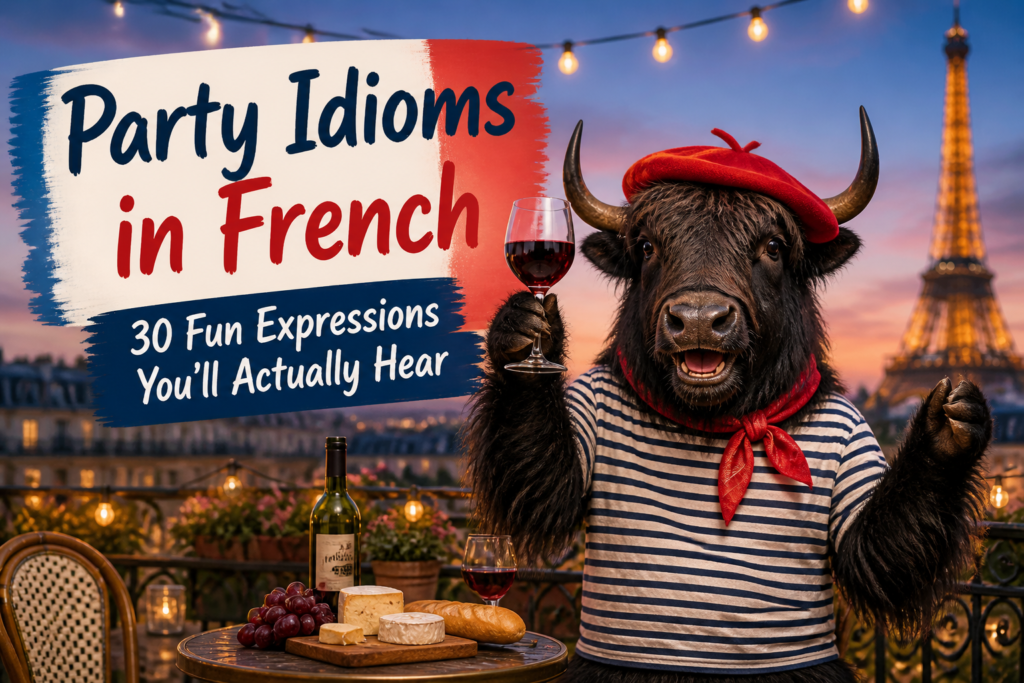
French party language is a lovely little mess. Some expressions are cheerful, some are dramatic, and some make it sound like everyone is either dancing on tables or recovering from it the next morning.
In this guide, you’ll learn real French expressions people use around parties, celebrations, nights out, birthdays, and generally having a good time. Some are neutral and useful everywhere. Others are casual, a bit slangy, and best saved for friends instead of your future boss.
If you already know a few everyday idioms, this is where French starts sounding much more alive. And slightly more chaotic. For a broader intro to idiomatic French, you can also check popular French idioms.
How To Use These Party Expressions
Most of these expressions are common in France French. I’ll flag anything especially casual or slangy. When useful, I’ll also mention if the phrase works best for talking about a wild party, a friendly celebration, or the tired little aftermath when everyone says they are “fine” and absolutely are not.
Pronunciation is given in simple English-style hints, not a full phonetics lecture in a tiny beret.
30 Party Idioms And Expressions You’ll Actually Hear
| French | Pronunciation | Meaning | Example Sentence | Translation | Learner Note |
|---|---|---|---|---|---|
| faire la fête | fehr lah fet | to party, to celebrate | On va faire la fête ce soir pour son anniversaire. | We’re going to party tonight for his birthday. | Very common, neutral, useful everywhere. |
| mettre l’ambiance | meh-tr l ahn-bee-ahns | to get the party going, create a fun atmosphere | C’est toujours Julie qui met l’ambiance. | Julie is always the one who gets the atmosphere going. | Ambiance in French means mood or atmosphere, not just background music. |
| avoir de l’ambiance | ah-vwar duh lahm-bee-ahns | to have a lively atmosphere | Cette soirée a vraiment de l’ambiance. | This party really has a great vibe. | Useful for parties, bars, weddings, festivals. |
| être de la partie | etr duh lah par-tee | to join in, be part of the fun | Tout le monde sera de la partie samedi. | Everyone will be joining in on Saturday. | Not slangy; good general expression. |
| passer une bonne soirée | pah-say ewn bun swah-ray | to have a good evening | On a passé une très bonne soirée chez eux. | We had a very good evening at their place. | More neutral than “party hard.” Great everyday phrase. |
| s’éclater | say-klah-tay | to have a blast | Les enfants se sont éclatés à la fête. | The kids had a blast at the party. | Casual and very common. Works for adults too. |
| bien s’amuser | byan zah-myoo-zay | to have a good time | On s’est bien amusés hier soir. | We had a great time last night. | Friendly, simple, and safer than slang. |
| faire la bringue | fehr lah brang | to party hard, go on a bender | Ils ont fait la bringue toute la nuit. | They partied hard all night. | Casual, slightly old-school but still understood. |
| sortir le grand jeu | sor-teer luh grahn zhuh | to pull out all the stops | Pour ses trente ans, ils ont sorti le grand jeu. | For her thirtieth birthday, they pulled out all the stops. | Works for parties, romance, hospitality, events. |
| marquer le coup | mar-kay luh koo | to mark the occasion | On va marquer le coup avec un dîner et quelques verres. | We’re going to mark the occasion with dinner and a few drinks. | Very natural for birthdays, promotions, milestones. |
Those first ten are the ones you’ll use the fastest. If you only remember one today, make it faire la fête. It works almost everywhere and instantly sounds natural.
More Expressions For A Lively Party
| French | Pronunciation | Meaning | Example Sentence | Translation | Learner Note |
|---|---|---|---|---|---|
| battre son plein | bah-tr son plan | to be in full swing | Quand on est arrivés, la fête battait son plein. | When we arrived, the party was in full swing. | Very useful idiom for events already buzzing. |
| mettre le feu | meh-tr luh fuh | to set the place on fire, rock the place | Le DJ a mis le feu à la soirée. | The DJ set the party on fire. | Figurative, obviously. Means someone made it amazing. |
| chauffer la salle | show-fay lah sal | to warm up the crowd | Le groupe d’ouverture a bien chauffé la salle. | The opening band warmed up the crowd well. | Common for concerts and big events. |
| lâcher prise | lah-shay preez | to let go, relax | Ce soir, je veux juste lâcher prise et profiter. | Tonight, I just want to let go and enjoy myself. | Not only for parties, but very common around stress relief. |
| profiter à fond | pro-fee-tay ah fon | to enjoy to the fullest | Ils ont profité à fond de leur week-end de fête. | They made the most of their party weekend. | À fond means fully, all-out, intensely. |
| être sur son trente-et-un | etr sewr son tront ay un | to be dressed to the nines | Pour le mariage, tout le monde était sur son trente-et-un. | For the wedding, everyone was dressed to the nines. | Great for fancy parties and celebrations. |
| lever son verre | luh-vay son vehr | to raise a glass | On a levé nos verres à leur santé. | We raised our glasses to their health. | Classic phrase for toasts and celebrations. |
| porter un toast | por-tay un tost | to make a toast | Son frère a porté un toast très émouvant. | Her brother gave a very moving toast. | More formal than lever son verre. |
| trinquer | tran-kay | to clink glasses; sometimes to suffer | On a trinqué au Nouvel An à minuit. | We clinked glasses at midnight on New Year’s Eve. | In party context it means clink glasses. In other contexts it can mean “pay the price.” Sneaky word. |
| arroser ça | ah-ro-zay sah | to celebrate with drinks | Tu as eu ton diplôme ? Il faut arroser ça ! | You got your diploma? We have to celebrate that with drinks! | Very common casual expression. |
Arroser ça literally sounds like “water that,” but no one is talking about gardening. It means celebrating with drinks.
Expressions For Drinking, Going Out, And Partying Harder
This is where the register matters. The phrases below are common, but several are casual or slangy. Great with friends. Maybe not ideal in a polite email to a professor.
| French | Pronunciation | Meaning | Example Sentence | Translation | Learner Note |
|---|---|---|---|---|---|
| prendre un verre | prondr un vehr | to have a drink | On va prendre un verre après le boulot ? | Shall we go for a drink after work? | Super common and not necessarily heavy drinking. |
| sortir en boîte | sor-teer ahn bwat | to go clubbing | Ils sortent en boîte tous les samedis. | They go clubbing every Saturday. | Une boîte here means nightclub, from boîte de nuit. |
| faire la tournée des bars | fehr lah too-rnay day bar | to do a bar crawl | On a fait la tournée des bars dans le centre-ville. | We did a bar crawl downtown. | Very practical travel-nightlife phrase. |
| avoir un coup dans le nez | ah-vwar un koo dahn luh nay | to be a bit drunk | Il avait déjà un coup dans le nez avant minuit. | He was already a bit drunk before midnight. | Funny, common idiom. Means tipsy or mildly drunk. |
| être pompette | etr pon-pet | to be tipsy | Après deux coupes, elle était un peu pompette. | After two glasses, she was a little tipsy. | Light, slightly playful tone. |
| être rond | etr ron | to be drunk | À la fin de la soirée, il était complètement rond. | By the end of the evening, he was completely drunk. | Casual and common. Stronger than pompette. |
| prendre une cuite | prondr ewn kweet | to get very drunk | Il a pris une cuite à la fête de départ. | He got very drunk at the farewell party. | Very informal. Best understood, not always best repeated. |
| avoir la gueule de bois | ah-vwar lah gul duh bwah | to have a hangover | Le lendemain, j’avais une terrible gueule de bois. | The next day, I had a terrible hangover. | Very common informal expression. |
| rentrer au petit matin | rahn-tray oh puh-tee ma-tan | to get home at dawn | On est rentrés au petit matin après la soirée. | We got home at dawn after the party. | Not an idiom only for partying, but often used that way. |
| finir la nuit | fee-neer lah nwee | to keep going until late, finish out the night | Ils ont fini la nuit chez des amis. | They ended up finishing the night at some friends’ place. | Suggests the party continued elsewhere or very late. |
Expressions For Big Celebrations And Special Occasions
| French | Pronunciation | Meaning | Example Sentence | Translation | Learner Note |
|---|---|---|---|---|---|
| fêter ça dignement | fay-tay sah deen-yuh-mon | to celebrate properly | On va fêter ça dignement ce week-end. | We’re going to celebrate that properly this weekend. | Common and natural when something important happens. |
| en grande pompe | ahn grahnd pomp | with great ceremony, in grand style | Le mariage a été célébré en grande pompe. | The wedding was celebrated in grand style. | More formal, a bit dramatic, often for big events. |
| faire les choses en grand | fehr lay shoz ahn grahn | to do things in a big way | Pour ses quarante ans, ils ont fait les choses en grand. | For his fortieth birthday, they did things in a big way. | Very natural for birthdays, weddings, launches. |
| ne pas faire les choses à moitié | nuh pah fehr lay shoz ah mwah-tyay | not to do things by halves | Avec eux, on ne fait jamais les choses à moitié. | With them, things are never done halfway. | Can be positive or slightly critical depending on tone. |
| avoir le sens de la fête | ah-vwar luh sons duh lah fet | to know how to celebrate, have a festive spirit | Les Bretons ont la réputation d’avoir le sens de la fête. | Bretons are said to know how to celebrate. | Cultural and descriptive rather than slangy. |
| être d’humeur festive | etr dy-mur fes-teev | to be in a festive mood | Ce soir, tout le monde est d’humeur festive. | Tonight, everyone is in a festive mood. | Useful around holidays and parties. |
| faire la tournée | fehr lah too-rnay | to go around visiting people or rounds of places | À Noël, on fait la tournée de la famille. | At Christmas, we go around visiting family. | Not only bars. Context decides. |
| ouvrir le bal | oo-vreer luh bal | to open the ball; to kick things off | Les mariés ont ouvert le bal à vingt-deux heures. | The newlyweds opened the dance at ten p.m. | Literal at weddings, figurative in many contexts. |
| faire danser quelqu’un | fehr dahn-say kel-kun | to get someone dancing | Cette chanson fait danser tout le monde. | This song gets everyone dancing. | Not really idiomatic, but very useful and natural in party talk. |
| mettre les petits plats dans les grands | meh-tr lay puh-tee plah dahn lay grahn | to go all out for guests | Pour le réveillon, ils ont mis les petits plats dans les grands. | For New Year’s Eve, they really went all out for their guests. | Classic French idiom for making a special effort. |
Quick Notes On Register And Real-Life Use
- Neutral and safe: faire la fête, passer une bonne soirée, marquer le coup, prendre un verre, porter un toast.
- Casual and common: s’éclater, arroser ça, sortir en boîte, être rond, avoir la gueule de bois.
- A bit stronger or more slangy: prendre une cuite, faire la bringue.
- More polished or formal: en grande pompe, être sur son trente-et-un, porter un toast.
If you want to sound natural without risking awkward slang, start with the neutral set. Then add a few casual ones once you hear how native speakers use them. That is usually a better strategy than launching prendre une cuite into a family dinner conversation and hoping for the best.
Common Little Grammar Notes
- Faire la fête: literally “to do the party,” but it means “to party.” French loves using faire for everyday actions.
- S’éclater: this is a reflexive verb, so you say je m’éclate, on s’éclate, ils se sont éclatés.
- Arroser ça: the ça means “that,” referring to the event you’re celebrating. Example: Tu as trouvé un boulot ? On va arroser ça.
- Être sur son trente-et-un: after être, many past forms and adjectives agree when needed, but here the expression stays fixed.
- Trinquer: often used with à. Example: On trinque à ta réussite. = We’re toasting your success.
Mini Confusion Zone
Here are a few easy mix-ups that trip learners up.
| Expression | What Learners Think | What It Really Means | Tip |
|---|---|---|---|
| ambiance | ambience as in décor only | mood, atmosphere, party vibe | Very common in spoken French. |
| trinquer | always “to drink” | to clink glasses, or in another context, to suffer | Use context carefully. |
| boîte | just “box” | nightclub in boîte de nuit | French loves recycled words. |
| gueule | neutral word for face | informal, rougher word; here part of a fixed expression | Fine in gueule de bois, less polite elsewhere. |
| rond | round only | drunk, in casual spoken French | Useful but informal. |
Practice: Match The Situation To The Best Expression
- Your friend got a promotion, and you want to celebrate with drinks. Best choice: arroser ça.
- You arrive at a wedding and everyone is dressed beautifully. Best choice: être sur son trente-et-un.
- The party is already very lively when you arrive. Best choice: battre son plein.
- Someone had a terrible morning after too much wine. Best choice: avoir la gueule de bois.
- The hosts made a huge effort with food and decorations. Best choice: mettre les petits plats dans les grands.
- You just want to say “we had a great evening” in a normal, natural way. Best choice: passer une bonne soirée.
Three Ready-To-Use Mini Dialogues
1. After Good News
— J’ai enfin eu mon diplôme !
— Bravo ! Il faut arroser ça.
Translation:
— I finally got my diploma!
— Congrats! We have to celebrate that with drinks.
2. At The Party
— Alors, tu t’amuses ?
— Oui, franchement, je m’éclate.
Translation:
— So, are you having fun?
— Yes, honestly, I’m having a blast.
3. The Next Morning, Tragically
— T’as l’air fatigué.
— Normal, on est rentrés au petit matin et j’ai la gueule de bois.
Translation:
— You look tired.
— Makes sense, we got home at dawn and I’ve got a hangover.
Related French You Might Want Next
If you want to keep building your real-life French, these next steps make sense:
- See more figurative everyday French in popular French idioms.
- Learn the casual side of spoken French in common French slang.
- If you need less party and more office survival, try work idioms in French.
- Check your level with the French placement test.
- Or test your word power with the French vocabulary test.
- Browse more lessons on the main Learn French page.
Quick Reference Summary
- faire la fête = to party
- s’éclater = to have a blast
- marquer le coup = to mark the occasion
- arroser ça = to celebrate with drinks
- battre son plein = to be in full swing
- être sur son trente-et-un = to be dressed to the nines
- avoir un coup dans le nez = to be a bit drunk
- être rond = to be drunk
- avoir la gueule de bois = to have a hangover
- mettre les petits plats dans les grands = to go all out for guests
Yak Takeaway: if you can say faire la fête, arroser ça, s’éclater, and avoir la gueule de bois, you can already describe the beginning, middle, and regrettable end of quite a lot of French social life.