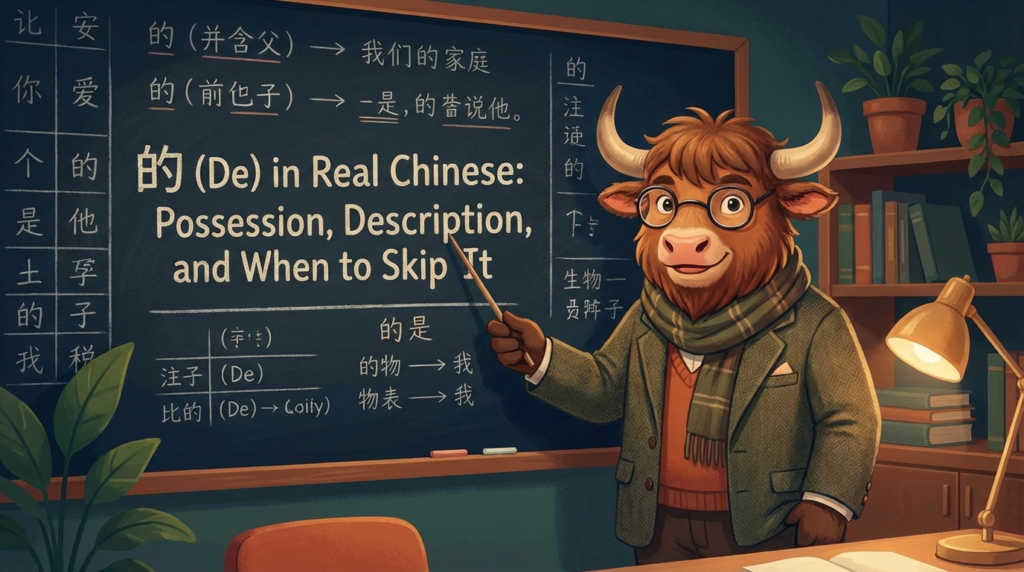
How To Use 的 (de) In Real Chinese
Topic: 的 (de) — the “linking” particle for possession and description (neutral tone / 輕聲 qīngshēng).
You’ll learn what 的 actually does, how native speakers use it in everyday Taiwan Mandarin, and the big secret: when skipping 的 sounds more natural.
If English had a magic “connect-the-words” glue, that glue would be 的 (de). It links a modifier to a noun: “X-ish thing” or “X’s thing.” But Chinese is also allergic to unnecessary glue—so you’ll often drop 的 when the relationship is obvious.
Yak Snark: If you put 的 between every two nouns, you’ll sound like you’re narrating a documentary. Useful sometimes. Weird at brunch.
What 的 Does In One Sentence
的 (de) links a modifier to a noun: “[modifier] 的 [noun]”.
| Pattern | Meaning | Example (ZH) | Example (Pinyin) | Translation (EN) |
|---|---|---|---|---|
| A 的 B | A’s B (possession/relationship) | 我朋友的車 | Wǒ péngyǒu de chē | My friend’s car |
| Adj 的 N | adjective + noun | 好吃的麵 | Hǎochī de miàn | tasty noodles |
| Clause 的 N | relative clause | 我昨天買的書 | Wǒ zuótiān mǎi de shū | the book I bought yesterday |
| … 的 | “the one that…” (nominalized) | 我喜歡的 | Wǒ xǐhuān de | the one I like |
Fast Pattern Cards
我的 (wǒ de) — my
Example: 這是我的手機。
Zhè shì wǒ de shǒujī. — This is my phone.
你的 (nǐ de) — your
Example: 你的外套在那邊。
Nǐ de wàitào zài nàbiān. — Your coat is over there.
他/她的 (tā de) — his / her
Example: 那是他的位子。
Nà shì tā de wèizi. — That’s his seat.
好吃的 (hǎochī de) — tasty (one/thing)
Example: 我想吃好吃的。
Wǒ xiǎng chī hǎochī de. — I want to eat something tasty.
我昨天買的 (wǒ zuótiān mǎi de) — the one I bought yesterday
Example: 我昨天買的在這裡。
Wǒ zuótiān mǎi de zài zhèlǐ. — The one I bought yesterday is here.
不用的 (búyòng de) — not needed / unused (one)
Example: 不用的先收起來。
Búyòng de xiān shōu qǐlái. — Put away the ones you don’t need first.
Possession With 的
Use A 的 B when you mean “A’s B” (ownership, relationships, “belongs to,” “associated with”).
Key Phrase: 我的 (wǒ de) — my
Example: 我的是黑色的。
Wǒ de shì hēisè de. — Mine is black.
Key Phrase: 你的 (nǐ de) — your
Example: 這杯是你的嗎?
Zhè bēi shì nǐ de ma? — Is this cup yours?
Key Phrase: 我們的 (wǒmen de) — our
Example: 我們的店在巷口。
Wǒmen de diàn zài xiàngkǒu. — Our shop is at the lane entrance.
Key Phrase: 老闆的 (lǎobǎn de) — the boss’s
Example: 這是老闆的決定。
Zhè shì lǎobǎn de juédìng. — This is the boss’s decision.
When Native Speakers Skip 的 In Possession
In casual speech, you often drop 的 when the relationship is super obvious—especially with close family, close people, or “my + role/place.”
我媽 (wǒ māma) — my mom
Example: 我媽今天不在家。
Wǒ māma jīntiān bú zài jiā. — My mom isn’t home today.
Alternative: 我的媽媽 (wǒ de māma) — sounds more formal / emphasizing “my mom.”
我朋友 (wǒ péngyǒu) — my friend
Example: 我朋友在台北工作。
Wǒ péngyǒu zài Táiběi gōngzuò. — My friend works in Taipei.
With 的: 我朋友的車 (wǒ péngyǒu de chē) — my friend’s car (you usually keep 的 here).
Rule-ish vibe: Dropping 的 is common when it’s “my + person/role” (我媽 wǒ māma, 我哥 wǒ gē, 我同事 wǒ tóngshì, 我主管 wǒ zhǔguǎn). But when you add a second noun after that, you often need 的 again: 我哥的車 (wǒ gē de chē) — my older brother’s car.
Description With 的
Use 的 when the modifier is a full description, not just a simple label.
Key Phrase: 漂亮的 (piàoliàng de) — pretty
Example: 她買了一件漂亮的裙子。
Tā mǎi le yí jiàn piàoliàng de qúnzi. — She bought a pretty dress.
Key Phrase: 很重要的 (hěn zhòngyào de) — very important
Example: 這是一個很重要的問題。
Zhè shì yí gè hěn zhòngyào de wèntí. — This is a very important question.
When To Skip 的 In Descriptions
For short, simple modifiers, Chinese often drops 的—especially with common adjectives, categories, or “noun + noun” compounds.
| Natural (Often No 的) | Pinyin | Meaning | Also Possible (With 的) | Meaning Difference |
|---|---|---|---|---|
| 大房子 | Dà fángzi | a big house | 大的房子 (dà de fángzi) | More emphasis: “the big one (among others)” |
| 新手機 | Xīn shǒujī | a new phone | 新的手機 (xīn de shǒujī) | More descriptive / contrastive |
| 台灣菜 | Táiwān cài | Taiwanese food | 台灣的菜 (Táiwān de cài) | More like “the dishes from Taiwan” |
| 咖啡杯 | Kāfēi bēi | coffee cup | 咖啡的杯子 (kāfēi de bēizi) | Sounds like “a cup belonging to coffee” (odd) |
Key Phrase: 大房子 (dà fángzi) — big house
Example: 我想租大房子。
Wǒ xiǎng zū dà fángzi. — I want to rent a big house.
Key Phrase: 大的房子 (dà de fángzi) — the big house / the bigger one
Example: 我想看大的房子。
Wǒ xiǎng kàn dà de fángzi. — I want to see the bigger house (not the smaller one).
Relative Clauses: 的 Is Doing Heavy Lifting
This is the super useful “real Chinese” use: a whole clause can modify a noun, and 的 glues it together.
Key Phrase: 我昨天買的書 (wǒ zuótiān mǎi de shū) — the book I bought yesterday
Example: 我昨天買的書很好看。
Wǒ zuótiān mǎi de shū hěn hǎokàn. — The book I bought yesterday is really good.
Key Phrase: 你推薦的店 (nǐ tuījiàn de diàn) — the shop you recommended
Example: 你推薦的店真的不錯。
Nǐ tuījiàn de diàn zhēn de búcuò. — The shop you recommended is genuinely good.
Key Phrase: 在樓下等你的那個人 (zài lóuxià děng nǐ de nàgè rén) — the person waiting for you downstairs
Example: 在樓下等你的那個人是我同事。
Zài lóuxià děng nǐ de nàgè rén shì wǒ tóngshì. — The person waiting for you downstairs is my coworker.
Nominalization: Turning Descriptions Into “The One”
When you end on 的, it can mean “the one that…” (you’re omitting the noun because context makes it obvious).
Key Phrase: 貴的 (guì de) — the expensive one
Example: 我不要便宜的,我要貴的。
Wǒ bú yào piányí de, wǒ yào guì de. — I don’t want the cheap one; I want the expensive one.
Key Phrase: 新的 (xīn de) — the new one
Example: 舊的可以丟了,留新的。
Jiù de kěyǐ diū le, liú xīn de. — You can throw away the old one; keep the new one.
Key Phrase: 我喜歡的 (wǒ xǐhuān de) — the one I like
Example: 我喜歡的在右邊。
Wǒ xǐhuān de zài yòubiān. — The one I like is on the right.
Noun + Noun: Where 的 Often Feels Wrong
Chinese loves compact compounds: noun + noun often works without 的, especially for material, purpose, type, or category.
Key Phrase: 木桌 (mù zhuō) — wooden table
Example: 這張木桌很穩。
Zhè zhāng mù zhuō hěn wěn. — This wooden table is sturdy.
Key Phrase: 木頭的桌子 (mùtou de zhuōzi) — a table made of wood
Example: 我想買木頭的桌子,不要塑膠的。
Wǒ xiǎng mǎi mùtou de zhuōzi, bú yào sùjiāo de. — I want a wooden table, not a plastic one.
Key Phrase: 學生證 (xuéshēngzhèng) — student ID
Example: 進圖書館要出示學生證。
Jìn túshūguǎn yào chūshì xuéshēngzhèng. — To enter the library, you need to show your student ID.
Useful Phrases And Real-Life Sentences
Key Phrase: 你的意思 (nǐ de yìsi) — what you mean / your meaning
Example: 我懂你的意思。
Wǒ dǒng nǐ de yìsi. — I get what you mean.
Key Phrase: 他的問題 (tā de wèntí) — his issue / his question
Example: 他的問題很常見。
Tā de wèntí hěn chángjiàn. — His question is very common.
Key Phrase: 公司的規定 (gōngsī de guīdìng) — company rules
Example: 這是公司的規定。
Zhè shì gōngsī de guīdìng. — These are company rules.
Key Phrase: 我常去的咖啡店 (wǒ cháng qù de kāfēidiàn) — the café I often go to
Example: 我常去的咖啡店在捷運站旁邊。
Wǒ cháng qù de kāfēidiàn zài jiéyùnzhàn pángbiān. — The café I often go to is next to the MRT station.
Key Phrase: 你想要的 (nǐ xiǎng yào de) — the one you want
Example: 你想要的我可以幫你找。
Nǐ xiǎng yào de wǒ kěyǐ bāng nǐ zhǎo. — I can help you find the one you want.
Key Phrase: 好看的 (hǎokàn de) — good-looking (one/thing)
Example: 我想挑好看的。
Wǒ xiǎng tiāo hǎokàn de. — I want to pick a good-looking one.
Key Phrase: 便宜的 (piányí de) — the cheap one
Example: 便宜的通常比較快賣完。
Piányí de tōngcháng bǐjiào kuài mài wán. — The cheap ones usually sell out faster.
Key Phrase: 最重要的 (zuì zhòngyào de) — the most important (thing)
Example: 最重要的是你要先休息。
Zuì zhòngyào de shì nǐ yào xiān xiūxi. — The most important thing is you need to rest first.
Key Phrase: 有名的 (yǒumíng de) — famous
Example: 這家店很有名。
Zhè jiā diàn hěn yǒumíng. — This shop is very famous.
Key Phrase: 在這裡工作的 (zài zhèlǐ gōngzuò de) — the ones who work here
Example: 在這裡工作的人都很忙。
Zài zhèlǐ gōngzuò de rén dōu hěn máng. — The people who work here are all busy.
Quick But Crucial: 的 vs 得 vs 地
Same-ish sound, totally different jobs. Don’t mix them unless you enjoy confusing your reader.
| Character | Pinyin | Main Job | Pattern | Example (ZH) | Example (Pinyin) | Translation (EN) |
|---|---|---|---|---|---|---|
| 的 | de | modifier → noun | … 的 … | 我買的書 | Wǒ mǎi de shū | the book I bought |
| 得 | de | verb → result/degree | V 得 Adj | 他跑得很快 | Tā pǎo de hěn kuài | He runs very fast. |
| 地 | de | adverb → verb | Adj 地 V | 他認真地說 | Tā rènzhēn de shuō | He said it seriously. |
Practice: Add 的 Or Skip It?
Try these out loud. Then check the suggested answers. (Multiple answers can be natural depending on what you want to emphasize.)
- “My older sister’s bag” → ________ 包包
Hint: 姐姐 (jiějie) — older sister - “Big car” → ________ 車
Hint: 大 (dà) — big - “The noodles I ate yesterday” → 我昨天吃________ 麵
Hint: 吃 (chī) — to eat - “My mom is here” → 我________ 在這裡
Hint: 媽媽 (māma) — mom - “A wooden chair (not plastic)” → ________ 椅子
Hint: 木頭 (mùtou) — wood
Suggested Answers
1) 姐姐的包包 (jiějie de bāobāo) — your sister’s bag
2) 大車 (dà chē) is common; 大的車 (dà de chē) emphasizes “the bigger one”
3) 我昨天吃的麵 (wǒ zuótiān chī de miàn)
4) 我媽在這裡 (wǒ māma zài zhèlǐ) is super natural; 我的媽媽在這裡 (wǒ de māma zài zhèlǐ) adds emphasis
5) 木頭的椅子 (mùtou de yǐzi) — “made of wood,” especially in contrast
Common Mistakes And Fast Fixes
- Mistake: Using 的 for every noun+noun combo.
Fix: Learn common compounds: 咖啡杯 (kāfēi bēi), 學生證 (xuéshēngzhèng), 台灣菜 (Táiwān cài). - Mistake: Skipping 的 in relative clauses.
Fix: If a whole action describes the noun, you usually need 的: 我昨天買的書 (wǒ zuótiān mǎi de shū). - Mistake: Confusing 的 / 得 / 地 in writing.
Fix: Noun? Use 的. Verb result? Use 得. Adverb → verb? Use 地. - Mistake: Over-formal “我的媽媽、我的爸爸” all the time.
Fix: In casual speech, try 我媽 (wǒ māma), 我爸 (wǒ bàba), but keep 的 when needed: 我爸的朋友 (wǒ bà de péngyǒu).
Quick Reference Summary
| What You Want To Say | Best Go-To | Example (ZH) | Example (Pinyin) | Translation (EN) |
|---|---|---|---|---|
| “A’s B” (possession) | A 的 B | 我朋友的車 | Wǒ péngyǒu de chē | My friend’s car |
| Close family / obvious relationship | Often no 的 | 我媽 | Wǒ māma | my mom |
| Simple adjective + noun | Often no 的 | 新手機 | Xīn shǒujī | a new phone |
| Emphasis / contrast (“the big one”) | Adj 的 N | 大的房子 | Dà de fángzi | the bigger house |
| Relative clause (“the one I…”) | Clause 的 N | 你推薦的店 | Nǐ tuījiàn de diàn | the shop you recommended |
| “the one that…” | … 的 (nominalized) | 我喜歡的 | Wǒ xǐhuān de | the one I like |
FAQ: Can I Always Add 的 “Just To Be Safe”?
You can, but it changes the vibe. Adding 的 often sounds more explicit, careful, or contrastive. If you want everyday natural speech, learn the common “no 的” zones: close family (我媽 wǒ māma), simple adjective labels (新手機 xīn shǒujī), and set compounds (咖啡杯 kāfēi bēi).
Final Yak Box: Your “的” Survival Strategy
- Use 的 for possession (A 的 B) and for full descriptions (clauses) before a noun.
- Skip 的 for close family/obvious relationships and many short “label” modifiers.
- Use 的 on purpose when you want emphasis: “the one that’s…” / “the bigger one.”