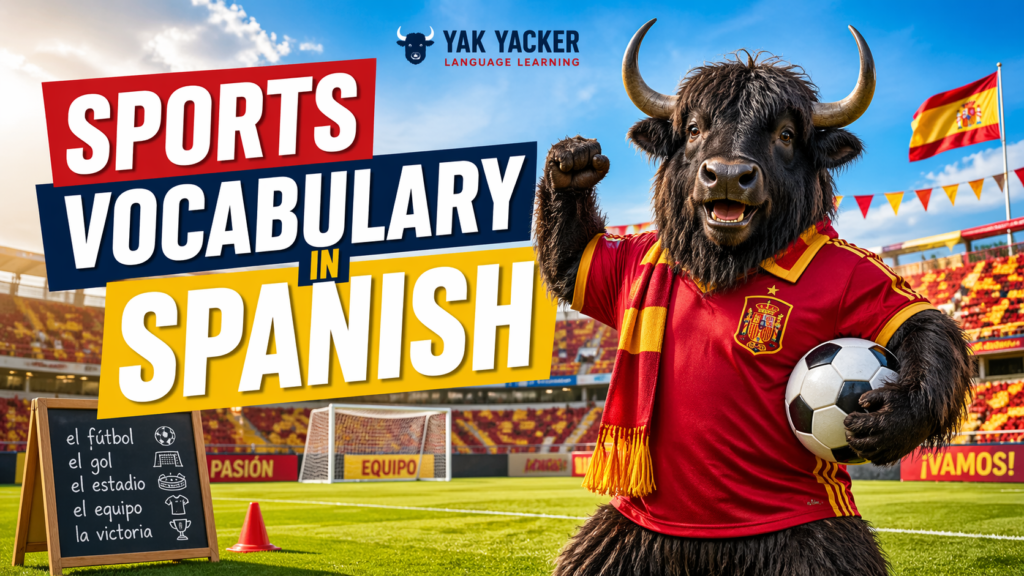
Want to talk about soccer, basketball, baseball, the gym, or that one friend who treats pickleball like the Olympics? This guide gives you the Spanish sports vocabulary you need for real conversations.
You will learn the names of sports, people, places, equipment, verbs, scoring words, fan phrases, and useful sentences. The Spanish here is natural for Mexican Spanish, with a few notes when another version is common too.
Use jugar for playing a sport or game, hacer for doing an activity, and practicar when you mean training or practicing.
- Juego fútbol los sábados. — I play soccer on Saturdays.
- Hago ejercicio en la mañana. — I exercise in the morning.
- Practico tenis tres veces por semana. — I practice tennis three times a week.
Tiny grammar win. Big “look at me, functioning in Spanish” energy.
Quick Sports Vocabulary Cards
These are the words that show up constantly when people talk about sports in Spanish.
El Deporte
Meaning: sport
Example: Mi deporte favorito es el fútbol. — My favorite sport is soccer.
El Equipo
Meaning: team
Example: Nuestro equipo juega muy bien. — Our team plays very well.
El Partido
Meaning: game, match
Example: El partido empieza a las ocho. — The game starts at eight.
El Jugador / La Jugadora
Meaning: player
Example: Esa jugadora es rapidísima. — That player is super fast.
La Cancha
Meaning: court, field
Example: La cancha está mojada. — The field is wet.
La Pelota / El Balón
Meaning: ball
Example: Pásame la pelota, por favor. — Pass me the ball, please.
Ganar
Meaning: to win
Example: Queremos ganar el campeonato. — We want to win the championship.
Perder
Meaning: to lose
Example: No me gusta perder, pero pasa. — I do not like losing, but it happens.
Names Of Sports In Spanish
Start here. These are the most useful sport names for daily conversation, school, travel, TV, and awkward small talk with athletic cousins.
| Spanish | English Meaning | Example 1 | Example 2 | Example 3 |
|---|---|---|---|---|
| el fútbol | soccer | Me gusta ver fútbol. — I like watching soccer. | Juego fútbol con mis amigos. — I play soccer with my friends. | El fútbol es muy popular. — Soccer is very popular. |
| el fútbol americano | American football | Mi hermano juega fútbol americano. — My brother plays American football. | El fútbol americano tiene muchos fans. — American football has many fans. | Vemos fútbol americano los domingos. — We watch American football on Sundays. |
| el básquetbol | basketball | Juego básquetbol después de clases. — I play basketball after class. | El básquetbol es rápido. — Basketball is fast. | Me encanta el básquetbol. — I love basketball. |
| el baloncesto | basketball | Baloncesto is also understood. — Baloncesto is also understood. | El baloncesto requiere precisión. — Basketball requires precision. | Vimos un partido de baloncesto. — We watched a basketball game. |
| el béisbol | baseball | El béisbol me relaja. — Baseball relaxes me. | Mi papá juega béisbol. — My dad plays baseball. | Compré boletos para el béisbol. — I bought tickets for baseball. |
| el tenis | tennis | Practico tenis los martes. — I practice tennis on Tuesdays. | El tenis es difícil. — Tennis is hard. | Ella juega tenis muy bien. — She plays tennis very well. |
| el vóleibol | volleyball | Jugamos vóleibol en la playa. — We play volleyball at the beach. | El vóleibol es divertido. — Volleyball is fun. | Necesitamos una red para vóleibol. — We need a net for volleyball. |
| la natación | swimming | La natación es buen ejercicio. — Swimming is good exercise. | Practico natación en la mañana. — I practice swimming in the morning. | Me gusta la natación. — I like swimming. |
| el atletismo | track and field | El atletismo incluye carreras. — Track and field includes races. | Mi prima practica atletismo. — My cousin practices track and field. | El atletismo cansa mucho. — Track and field is very tiring. |
| el ciclismo | cycling | El ciclismo fortalece las piernas. — Cycling strengthens the legs. | Hago ciclismo los fines de semana. — I cycle on weekends. | El ciclismo me gusta mucho. — I like cycling a lot. |
| el boxeo | boxing | El boxeo requiere disciplina. — Boxing requires discipline. | Vimos una pelea de boxeo. — We watched a boxing match. | Mi tío entrena boxeo. — My uncle trains boxing. |
| el golf | golf | El golf parece tranquilo. — Golf seems calm. | Juego golf con mi abuelo. — I play golf with my grandfather. | El golf no es tan fácil. — Golf is not that easy. |
More Sports In Spanish
Here are more sports you will see on signs, TV schedules, fitness apps, and gym conversations.
| Spanish | English Meaning | Example 1 | Example 2 | Example 3 |
|---|---|---|---|---|
| la gimnasia | gymnastics | La gimnasia exige mucha flexibilidad. — Gymnastics demands a lot of flexibility. | Ella practica gimnasia. — She practices gymnastics. | La gimnasia se ve impresionante. — Gymnastics looks impressive. |
| el surf | surfing | Quiero aprender surf. — I want to learn surfing. | El surf depende de las olas. — Surfing depends on the waves. | Hicimos surf en la playa. — We surfed at the beach. |
| el patinaje | skating | El patinaje es divertido. — Skating is fun. | Me caí practicando patinaje. — I fell while practicing skating. | El patinaje necesita equilibrio. — Skating needs balance. |
| el esquí | skiing | El esquí es caro, sorpresa. — Skiing is expensive, surprise. | Quiero practicar esquí. — I want to practice skiing. | El esquí me da miedo. — Skiing scares me. |
| el hockey | hockey | El hockey es intenso. — Hockey is intense. | Vimos hockey anoche. — We watched hockey last night. | El hockey usa un disco. — Hockey uses a puck. |
| el rugby | rugby | El rugby es muy físico. — Rugby is very physical. | Mi amigo juega rugby. — My friend plays rugby. | No entiendo todas las reglas del rugby. — I do not understand all the rugby rules. |
| el bádminton | badminton | El bádminton es rápido. — Badminton is fast. | Jugamos bádminton en el parque. — We played badminton in the park. | Necesito una raqueta de bádminton. — I need a badminton racket. |
| el tenis de mesa | table tennis | El tenis de mesa parece fácil. — Table tennis seems easy. | Soy malo en tenis de mesa. — I am bad at table tennis. | Jugamos tenis de mesa en casa. — We play table tennis at home. |
| el pádel | padel | El pádel está de moda. — Padel is trendy. | Reservé una cancha de pádel. — I reserved a padel court. | El pádel se juega en parejas. — Padel is played in pairs. |
| las artes marciales | martial arts | Practico artes marciales. — I practice martial arts. | Las artes marciales enseñan disciplina. — Martial arts teach discipline. | Mi hijo toma artes marciales. — My son takes martial arts. |
| el karate | karate | El karate requiere concentración. — Karate requires focus. | Ella practica karate. — She practices karate. | Tengo clase de karate hoy. — I have karate class today. |
| el judo | judo | El judo usa técnica. — Judo uses technique. | Mi hermano aprende judo. — My brother learns judo. | El judo no es solo fuerza. — Judo is not only strength. |
| la lucha libre | wrestling; Mexican pro wrestling | La lucha libre es famosa en México. — Lucha libre is famous in Mexico. | Fuimos a ver lucha libre. — We went to watch wrestling. | La máscara es parte de la lucha libre. — The mask is part of lucha libre. |
| el levantamiento de pesas | weightlifting | El levantamiento de pesas fortalece el cuerpo. — Weightlifting strengthens the body. | Practico levantamiento de pesas. — I practice weightlifting. | El levantamiento de pesas requiere técnica. — Weightlifting requires technique. |
| el automovilismo | motorsport | El automovilismo es emocionante. — Motorsport is exciting. | Vimos automovilismo en la tele. — We watched motorsport on TV. | El automovilismo puede ser peligroso. — Motorsport can be dangerous. |
People In Sports
Sports are not just balls and shouting. People are involved too. Many of them are sweaty. Some are paid. Some are your friends pretending they are paid.
| Spanish | English Meaning | Example 1 | Example 2 | Example 3 |
|---|---|---|---|---|
| el jugador / la jugadora | player | El jugador está cansado. — The player is tired. | La jugadora metió un gol. — The player scored a goal. | Ese jugador es muy rápido. — That player is very fast. |
| el atleta / la atleta | athlete | La atleta entrena diario. — The athlete trains daily. | Ese atleta tiene mucha fuerza. — That athlete has a lot of strength. | Los atletas llegaron temprano. — The athletes arrived early. |
| el entrenador / la entrenadora | coach, trainer | El entrenador explicó la jugada. — The coach explained the play. | Mi entrenadora es exigente. — My coach is demanding. | Necesito hablar con el entrenador. — I need to talk to the coach. |
| el árbitro / la árbitra | referee | El árbitro marcó falta. — The referee called a foul. | La árbitra detuvo el partido. — The referee stopped the game. | El árbitro no vio nada. — The referee saw nothing. |
| el capitán / la capitana | captain | La capitana animó al equipo. — The captain encouraged the team. | El capitán habló con el árbitro. — The captain spoke with the referee. | Nuestro capitán está lesionado. — Our captain is injured. |
| el portero / la portera | goalkeeper | El portero salvó el partido. — The goalkeeper saved the game. | La portera atrapó el balón. — The goalkeeper caught the ball. | Ese portero tiene reflejos. — That goalkeeper has reflexes. |
| el defensa / la defensa | defender | El defensa bloqueó el tiro. — The defender blocked the shot. | La defensa jugó muy bien. — The defender played very well. | Necesitamos otro defensa. — We need another defender. |
| el delantero / la delantera | forward, striker | El delantero anotó dos goles. — The forward scored two goals. | La delantera es peligrosa. — The forward is dangerous. | Ese delantero no perdona. — That striker does not miss chances. |
| el aficionado / la aficionada | fan | Soy aficionado del equipo local. — I am a fan of the local team. | Las aficionadas gritaron mucho. — The fans shouted a lot. | Un aficionado compró la camiseta. — A fan bought the jersey. |
| la porra | cheering section, fan group | La porra no dejó de cantar. — The fan group did not stop singing. | La porra está muy animada. — The cheering section is very lively. | Me senté cerca de la porra. — I sat near the fan group. |
Places For Sports
These words help you understand where the action happens.
| Spanish | English Meaning | Example 1 | Example 2 | Example 3 |
|---|---|---|---|---|
| el estadio | stadium | El estadio está lleno. — The stadium is full. | Vamos al estadio mañana. — We are going to the stadium tomorrow. | El estadio queda lejos. — The stadium is far away. |
| la cancha | court, field | La cancha está limpia. — The court is clean. | Reservé una cancha. — I reserved a court. | Los niños juegan en la cancha. — The kids play on the court. |
| el campo | field | El campo está mojado. — The field is wet. | Entramos al campo. — We entered the field. | El campo es enorme. — The field is huge. |
| la pista | track | Corro en la pista. — I run on the track. | La pista está abierta. — The track is open. | La pista mide mucho. — The track is long. |
| la alberca | swimming pool | La alberca está fría. — The pool is cold. | Nado en la alberca del gimnasio. — I swim in the gym pool. | La alberca abre a las seis. — The pool opens at six. |
| el gimnasio | gym | Voy al gimnasio temprano. — I go to the gym early. | El gimnasio tiene pesas. — The gym has weights. | Mi gimnasio está cerca. — My gym is nearby. |
| el ring | boxing ring | El boxeador subió al ring. — The boxer got into the ring. | El ring está listo. — The ring is ready. | La pelea fue en ese ring. — The fight was in that ring. |
| las gradas | stands, bleachers | Nos sentamos en las gradas. — We sat in the stands. | Las gradas están llenas. — The stands are full. | La porra canta en las gradas. — The fan group sings in the stands. |
Sports Equipment In Spanish
These are the objects you need to play, train, or at least look like you know what you are doing.
| Spanish | English Meaning | Example 1 | Example 2 | Example 3 |
|---|---|---|---|---|
| la pelota | ball | La pelota está en la mochila. — The ball is in the backpack. | Pásame la pelota. — Pass me the ball. | Compré una pelota nueva. — I bought a new ball. |
| el balón | ball, usually larger sports ball | El balón salió de la cancha. — The ball went out of the field. | Infla el balón, por favor. — Inflate the ball, please. | El balón es oficial. — The ball is official. |
| la raqueta | racket | Necesito una raqueta. — I need a racket. | Mi raqueta es ligera. — My racket is light. | Traje dos raquetas. — I brought two rackets. |
| el bate | bat | El bate es de madera. — The bat is wooden. | Agarró el bate con fuerza. — He grabbed the bat firmly. | Olvidé mi bate. — I forgot my bat. |
| el guante | glove | El guante es nuevo. — The glove is new. | Necesito un guante de béisbol. — I need a baseball glove. | El portero usa guantes. — The goalkeeper wears gloves. |
| la red | net | La red está rota. — The net is broken. | Necesitamos una red para vóleibol. — We need a volleyball net. | El balón tocó la red. — The ball touched the net. |
| los tenis | sneakers, athletic shoes | Mis tenis están sucios. — My sneakers are dirty. | Compra tenis cómodos. — Buy comfortable sneakers. | Uso tenis para correr. — I wear sneakers to run. |
| el uniforme | uniform | El uniforme es azul. — The uniform is blue. | Trae tu uniforme mañana. — Bring your uniform tomorrow. | El equipo estrenó uniforme. — The team debuted a uniform. |
| la camiseta | jersey, T-shirt | Compré la camiseta del equipo. — I bought the team jersey. | Tu camiseta está al revés. — Your shirt is inside out. | La camiseta tiene mi número. — The jersey has my number. |
| el casco | helmet | Usa casco para andar en bici. — Wear a helmet to ride a bike. | El casco me queda grande. — The helmet is too big for me. | El jugador necesita casco. — The player needs a helmet. |
| las pesas | weights | Levanto pesas en el gimnasio. — I lift weights at the gym. | Las pesas están pesadas. — The weights are heavy. | No tires las pesas. — Do not drop the weights. |
| la medalla | medal | Ganó una medalla de oro. — She won a gold medal. | La medalla brilla mucho. — The medal shines a lot. | Quiere ganar una medalla. — He wants to win a medal. |
Important Sports Verbs In Spanish
Verbs make your Spanish useful. Without them, you are just pointing at balls and hoping people understand. Brave, but not ideal.
| Spanish | English Meaning | Example 1 | Example 2 | Example 3 |
|---|---|---|---|---|
| jugar | to play | Quiero jugar tenis. — I want to play tennis. | Jugamos los viernes. — We play on Fridays. | ¿Sabes jugar béisbol? — Do you know how to play baseball? |
| hacer ejercicio | to exercise | Hago ejercicio en casa. — I exercise at home. | Necesito hacer más ejercicio. — I need to exercise more. | Ella hace ejercicio diario. — She exercises daily. |
| entrenar | to train | Entreno por la tarde. — I train in the afternoon. | El equipo entrena hoy. — The team trains today. | Necesito entrenar más. — I need to train more. |
| practicar | to practice | Practico natación. — I practice swimming. | Vamos a practicar tiros. — We are going to practice shots. | Practica antes del partido. — Practice before the game. |
| correr | to run | Corro cinco kilómetros. — I run five kilometers. | Corre más rápido. — Run faster. | Me gusta correr en la mañana. — I like running in the morning. |
| nadar | to swim | Sé nadar. — I know how to swim. | Nadamos en la alberca. — We swim in the pool. | Quiero nadar mejor. — I want to swim better. |
| lanzar | to throw | Lanza la pelota. — Throw the ball. | El pitcher lanzó rápido. — The pitcher threw fast. | No lances tan fuerte. — Do not throw so hard. |
| patear | to kick | Patea el balón. — Kick the ball. | El jugador pateó al arco. — The player kicked toward the goal. | No patees la mesa. — Do not kick the table. |
| pasar | to pass | Pásame el balón. — Pass me the ball. | Ella pasó la pelota. — She passed the ball. | Necesitamos pasar mejor. — We need to pass better. |
| tirar | to shoot, to throw | Tira a la canasta. — Shoot at the basket. | Tiró desde lejos. — He shot from far away. | No tires sin mirar. — Do not shoot without looking. |
| anotar | to score | Quiero anotar un gol. — I want to score a goal. | Anotaron en el último minuto. — They scored in the last minute. | Ella anotó tres puntos. — She scored three points. |
| ganar | to win | Vamos a ganar. — We are going to win. | Ganaron el partido. — They won the game. | Quiero ganar la carrera. — I want to win the race. |
| perder | to lose | No quiero perder. — I do not want to lose. | Perdimos por un punto. — We lost by one point. | El equipo perdió ayer. — The team lost yesterday. |
| empatar | to tie | El partido terminó empatado. — The game ended tied. | Empatamos dos a dos. — We tied two to two. | No me gusta empatar. — I do not like tying. |
| defender | to defend | Tenemos que defender mejor. — We have to defend better. | Ella defendió muy bien. — She defended very well. | Defiende tu lado. — Defend your side. |
| bloquear | to block | Bloqueó el tiro. — He blocked the shot. | Necesitamos bloquear más. — We need to block more. | La defensa bloqueó el pase. — The defense blocked the pass. |
Scoring, Rules, And Game Words
Use these when you are watching a game, explaining what happened, or arguing politely with the TV.
| Spanish | English Meaning | Example 1 | Example 2 | Example 3 |
|---|---|---|---|---|
| el gol | goal | ¡Qué gol! — What a goal! | Metió un gol increíble. — He scored an incredible goal. | Necesitamos otro gol. — We need another goal. |
| el punto | point | Ganamos por un punto. — We won by one point. | Ella anotó tres puntos. — She scored three points. | Cada punto cuenta. — Every point counts. |
| el marcador | score | ¿Cuál es el marcador? — What is the score? | El marcador va dos a uno. — The score is two to one. | El marcador cambió rápido. — The score changed quickly. |
| la falta | foul | Eso fue falta. — That was a foul. | El árbitro marcó falta. — The referee called a foul. | Cometió una falta. — He committed a foul. |
| el penal | penalty kick, penalty | Van a tirar un penal. — They are going to take a penalty. | Falló el penal. — He missed the penalty. | El penal decidió el partido. — The penalty decided the game. |
| la tarjeta amarilla | yellow card | Le sacaron tarjeta amarilla. — They gave him a yellow card. | La tarjeta amarilla fue justa. — The yellow card was fair. | Ya tiene tarjeta amarilla. — He already has a yellow card. |
| la tarjeta roja | red card | Le sacaron tarjeta roja. — They gave him a red card. | La tarjeta roja cambió todo. — The red card changed everything. | El jugador recibió tarjeta roja. — The player received a red card. |
| fuera de lugar | offside | Estaba fuera de lugar. — He was offside. | Marcaron fuera de lugar. — They called offside. | No era fuera de lugar. — It was not offside. |
| el tiempo extra | extra time, overtime | El partido se fue a tiempo extra. — The game went to extra time. | Ganaron en tiempo extra. — They won in overtime. | Odio el tiempo extra. — I hate overtime. |
| el medio tiempo | halftime | Vamos por comida en el medio tiempo. — Let’s get food at halftime. | El marcador está empatado al medio tiempo. — The score is tied at halftime. | El entrenador habló en el medio tiempo. — The coach spoke at halftime. |
| la final | final | El equipo llegó a la final. — The team reached the final. | La final es el sábado. — The final is on Saturday. | Quiero ver la final. — I want to watch the final. |
| el campeonato | championship | Ganaron el campeonato. — They won the championship. | El campeonato empieza pronto. — The championship starts soon. | Soñamos con el campeonato. — We dream of the championship. |
Useful Sports Phrases In Spanish
These phrases help you talk before, during, and after a game. They are short, useful, and much better than yelling random nouns. Though random nouns are a bold strategy.
| Spanish Phrase | English Meaning | Example 1 | Example 2 | Example 3 |
|---|---|---|---|---|
| ¿Cuál es tu deporte favorito? | What is your favorite sport? | ¿Cuál es tu deporte favorito? El mío es el fútbol. — What is your favorite sport? Mine is soccer. | Le pregunté: ¿Cuál es tu deporte favorito? — I asked him: What is your favorite sport? | ¿Cuál es tu deporte favorito para ver? — What is your favorite sport to watch? |
| ¿A qué hora empieza el partido? | What time does the game start? | ¿A qué hora empieza el partido de hoy? — What time does today’s game start? | No sé a qué hora empieza el partido. — I do not know what time the game starts. | ¿A qué hora empieza el partido de México? — What time does Mexico’s game start? |
| ¿Quién va ganando? | Who is winning? | Acabo de llegar. ¿Quién va ganando? — I just arrived. Who is winning? | ¿Quién va ganando el partido? — Who is winning the game? | Pregunté quién iba ganando. — I asked who was winning. |
| ¿Cuál es el marcador? | What is the score? | ¿Cuál es el marcador ahorita? — What is the score right now? | No vi el marcador. — I did not see the score. | ¿Me dices el marcador? — Can you tell me the score? |
| Vamos empatados. | We are tied. | Vamos empatados a cero. — We are tied zero to zero. | Vamos empatados en el último minuto. — We are tied in the last minute. | No está mal; vamos empatados. — Not bad; we are tied. |
| Vamos perdiendo. | We are losing. | Vamos perdiendo por dos puntos. — We are losing by two points. | Vamos perdiendo, pero todavía hay tiempo. — We are losing, but there is still time. | No grites; vamos perdiendo. — Do not yell; we are losing. |
| Vamos ganando. | We are winning. | Vamos ganando uno a cero. — We are winning one to zero. | Vamos ganando, pero falta mucho. — We are winning, but there is a long way to go. | ¡Vamos ganando! — We are winning! |
| ¡Qué buena jugada! | What a great play! | ¡Qué buena jugada hizo! — What a great play he made! | Todos gritaron: ¡Qué buena jugada! — Everyone shouted: What a great play! | Fue una buena jugada. — It was a good play. |
| ¡Qué golazo! | What an amazing goal! | ¡Qué golazo metió! — What an amazing goal he scored! | Ese golazo fue hermoso. — That amazing goal was beautiful. | Todos celebraron el golazo. — Everyone celebrated the amazing goal. |
| ¡No puede ser! | No way! I can’t believe it! | ¡No puede ser! Falló el penal. — No way! He missed the penalty. | ¡No puede ser! Perdimos otra vez. — No way! We lost again. | Dije: ¡No puede ser! — I said: I can’t believe it! |
| ¡Eso fue falta! | That was a foul! | ¡Eso fue falta, árbitro! — That was a foul, ref! | Todos gritaron: ¡Eso fue falta! — Everyone shouted: That was a foul! | Creo que eso fue falta. — I think that was a foul. |
| ¡Pásala! | Pass it! | ¡Pásala rápido! — Pass it quickly! | Grité: ¡Pásala! — I yelled: Pass it! | ¡Pásala antes de perderla! — Pass it before losing it! |
| ¡Tira! | Shoot! | ¡Tira ya! — Shoot now! | La gente gritó: ¡Tira! — The people shouted: Shoot! | ¡Tira a la canasta! — Shoot at the basket! |
| ¡Corre! | Run! | ¡Corre más rápido! — Run faster! | El entrenador gritó: ¡Corre! — The coach shouted: Run! | ¡Corre, que te alcanzan! — Run, they are catching you! |
| ¡Bien jugado! | Well played! | ¡Bien jugado, equipo! — Well played, team! | Le dije: ¡Bien jugado! — I told him: Well played! | Perdimos, pero bien jugado. — We lost, but well played. |
| Buen partido. | Good game. | Buen partido, nos vemos luego. — Good game, see you later. | Fue un buen partido. — It was a good game. | Les dije buen partido. — I told them good game. |
Soccer Vocabulary In Spanish
In most Spanish-speaking places, fútbol means soccer. If you mean American football, say fútbol americano. This saves confusion, unless confusion is your cardio.
| Spanish | English Meaning | Example 1 | Example 2 | Example 3 |
|---|---|---|---|---|
| el arco / la portería | goal | Tiró al arco. — He shot at the goal. | La portería está vacía. — The goal is empty. | Defiende la portería. — Defend the goal. |
| el portero / la portera | goalkeeper | El portero atrapó el balón. — The goalkeeper caught the ball. | La portera salvó el gol. — The goalkeeper saved the goal. | Necesitamos un buen portero. — We need a good goalkeeper. |
| el defensa | defender | El defensa despejó el balón. — The defender cleared the ball. | Ese defensa es fuerte. — That defender is strong. | La defensa jugó tranquila. — The defender played calmly. |
| el medio | midfielder | El medio controla el juego. — The midfielder controls the game. | Necesitan un medio creativo. — They need a creative midfielder. | El medio dio un pase perfecto. — The midfielder gave a perfect pass. |
| el delantero | forward, striker | El delantero metió gol. — The forward scored a goal. | Ese delantero es peligroso. — That forward is dangerous. | La delantera corre mucho. — The forward runs a lot. |
| el pase | pass | Buen pase. — Good pass. | El pase fue perfecto. — The pass was perfect. | Necesitamos pases cortos. — We need short passes. |
| el tiro | shot | Su tiro fue fuerte. — His shot was strong. | El tiro salió alto. — The shot went high. | Practica tus tiros. — Practice your shots. |
| el saque de esquina | corner kick | Tenemos saque de esquina. — We have a corner kick. | El saque de esquina fue peligroso. — The corner kick was dangerous. | Ella cobró el saque de esquina. — She took the corner kick. |
| el tiro libre | free kick | Van a cobrar un tiro libre. — They are going to take a free kick. | El tiro libre fue directo. — The free kick was direct. | Anotó de tiro libre. — He scored from a free kick. |
| la barrida | slide tackle | La barrida fue limpia. — The slide tackle was clean. | Hizo una barrida peligrosa. — He made a dangerous slide tackle. | No hagas barridas tarde. — Do not make late slide tackles. |
Basketball Vocabulary In Spanish
In Mexico, many people say básquetbol or just básquet. Baloncesto is also correct and widely understood.
| Spanish | English Meaning | Example 1 | Example 2 | Example 3 |
|---|---|---|---|---|
| la canasta | basket | Tira a la canasta. — Shoot at the basket. | La canasta está alta. — The basket is high. | Metió la pelota en la canasta. — He put the ball in the basket. |
| el triple | three-pointer | Anotó un triple. — She scored a three-pointer. | Ese triple cambió el partido. — That three-pointer changed the game. | Practico triples después de entrenar. — I practice threes after training. |
| el rebote | rebound | Ganó el rebote. — He got the rebound. | Necesitamos más rebotes. — We need more rebounds. | El rebote fue clave. — The rebound was key. |
| la clavada | dunk | Hizo una clavada increíble. — He made an incredible dunk. | La clavada levantó al público. — The dunk energized the crowd. | Quiero hacer una clavada. — I want to dunk. |
| el tiro libre | free throw | Falló el tiro libre. — She missed the free throw. | Tiene dos tiros libres. — He has two free throws. | Practicamos tiros libres. — We practice free throws. |
| botar el balón | to dribble the ball | Bota el balón con la izquierda. — Dribble the ball with your left hand. | No dejes de botar el balón. — Do not stop dribbling the ball. | Ella bota el balón muy bien. — She dribbles the ball very well. |
Baseball Vocabulary In Spanish
Baseball vocabulary is especially useful in Mexico, the Caribbean, and parts of Central America. Some English loanwords appear often, but these Spanish words will carry you through most conversations.
| Spanish | English Meaning | Example 1 | Example 2 | Example 3 |
|---|---|---|---|---|
| el pitcher / el lanzador | pitcher | El pitcher lanzó rápido. — The pitcher threw fast. | El lanzador está cansado. — The pitcher is tired. | Cambiaron al pitcher. — They changed the pitcher. |
| el bateador / la bateadora | batter | El bateador está listo. — The batter is ready. | La bateadora conectó bien. — The batter hit well. | Ese bateador es peligroso. — That batter is dangerous. |
| el jonrón | home run | ¡Jonrón! — Home run! | Conectó un jonrón enorme. — He hit a huge home run. | El jonrón ganó el juego. — The home run won the game. |
| la base | base | Llegó a primera base. — He reached first base. | Corre a la base. — Run to the base. | La base está ocupada. — The base is occupied. |
| la carrera | run | Anotaron una carrera. — They scored a run. | Necesitamos dos carreras. — We need two runs. | La carrera empató el juego. — The run tied the game. |
| el out | out | Fue out en primera. — He was out at first. | Necesitan un out más. — They need one more out. | El árbitro marcó out. — The umpire called out. |
Fitness And Training Vocabulary
This vocabulary helps at the gym, in fitness classes, and when your friend says, “Let’s do legs,” which is Spanish for suffering in any language.
| Spanish | English Meaning | Example 1 | Example 2 | Example 3 |
|---|---|---|---|---|
| calentar | to warm up | Hay que calentar primero. — We have to warm up first. | Caliento antes de correr. — I warm up before running. | No olvides calentar. — Do not forget to warm up. |
| estirar | to stretch | Voy a estirar las piernas. — I am going to stretch my legs. | Estira después de entrenar. — Stretch after training. | Necesito estirar más. — I need to stretch more. |
| sudar | to sweat | Estoy sudando mucho. — I am sweating a lot. | Vas a sudar en esta clase. — You are going to sweat in this class. | Sudar no siempre significa entrenar bien. — Sweating does not always mean training well. |
| descansar | to rest | Necesito descansar. — I need to rest. | Descansa entre series. — Rest between sets. | Hoy voy a descansar. — Today I am going to rest. |
| la rutina | routine | Mi rutina es corta. — My routine is short. | Cambié mi rutina. — I changed my routine. | Esta rutina es intensa. — This routine is intense. |
| la serie | set | Hice tres series. — I did three sets. | Descansa después de cada serie. — Rest after each set. | La última serie fue difícil. — The last set was hard. |
| la repetición | rep | Haz diez repeticiones. — Do ten reps. | Me faltan cinco repeticiones. — I have five reps left. | Cuenta tus repeticiones. — Count your reps. |
| la lesión | injury | Tiene una lesión en la rodilla. — She has a knee injury. | La lesión fue grave. — The injury was serious. | No entrenes con una lesión. — Do not train with an injury. |
Common Confusions In Spanish Sports Vocabulary
Is “fútbol” soccer or football?
In Spanish, fútbol usually means soccer. To talk about American football, say fútbol americano. Example: Me gusta el fútbol, pero mi hermano prefiere el fútbol americano. — I like soccer, but my brother prefers American football.
Should I say “básquetbol” or “baloncesto”?
Both mean basketball. In Mexico, básquetbol and básquet sound very natural. Baloncesto is correct too. Example: Juego básquet los martes. — I play basketball on Tuesdays.
What is the difference between “pelota” and “balón”?
Pelota is a general word for ball. Balón often sounds more like an official sports ball, especially in soccer, basketball, or volleyball. Example: El balón salió de la cancha. — The ball went out of the field.
Do I use “jugar,” “hacer,” or “practicar”?
Use jugar with games and team sports: Juego fútbol. Use hacer with exercise or general activities: Hago ejercicio. Use practicar when you mean practice or train: Practico tenis.
Practice: Say It In Spanish
Try these mini drills. Cover the answers first if you enjoy making your brain sweat politely.
Translate These
- I play soccer on Saturdays. — Juego fútbol los sábados.
- What is the score? — ¿Cuál es el marcador?
- We are winning two to one. — Vamos ganando dos a uno.
- Pass me the ball. — Pásame la pelota.
- That was a foul! — ¡Eso fue falta!
- She scored a great goal. — Metió un golazo.
- I need to warm up. — Necesito calentar.
- Good game. — Buen partido.
Quick Reference: The Most Useful Spanish Sports Words
| Category | Spanish | English Meaning | Example |
|---|---|---|---|
| Sport | el fútbol | soccer | Juego fútbol. — I play soccer. |
| Sport | el básquetbol | basketball | Me gusta el básquetbol. — I like basketball. |
| Sport | el béisbol | baseball | Vemos béisbol. — We watch baseball. |
| Person | el jugador | player | El jugador corre. — The player runs. |
| Person | el entrenador | coach | El entrenador habla. — The coach speaks. |
| Place | la cancha | court, field | La cancha está lista. — The field is ready. |
| Object | la pelota | ball | La pelota es nueva. — The ball is new. |
| Verb | jugar | to play | Quiero jugar. — I want to play. |
| Verb | ganar | to win | Vamos a ganar. — We are going to win. |
| Verb | perder | to lose | No quiero perder. — I do not want to lose. |
| Score | el marcador | score | ¿Cuál es el marcador? — What is the score? |
| Fan Phrase | ¡Vamos! | Let’s go! | ¡Vamos, equipo! — Let’s go, team! |
Final Yak
You do not need to memorize every sports word at once. Start with deporte, equipo, partido, jugador, cancha, pelota, ganar, perder, and ¿Cuál es el marcador?. That tiny set already lets you understand a lot.
Then add phrases like ¡Pásala!, ¡Tira!, ¡Qué golazo!, and Buen partido. Now you can join the conversation, cheer dramatically, and blame the referee in Spanish. Progress.