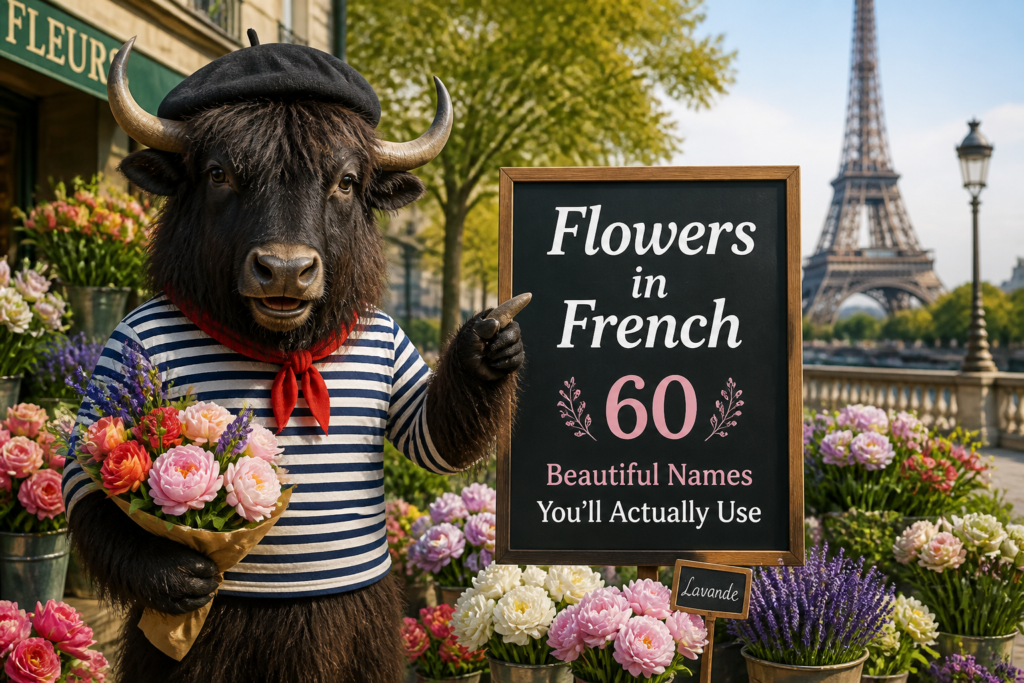
If you only know la fleur for “flower,” you can survive. Barely. But the second you want to buy a bouquet, compliment a garden, read a menu, understand perfume notes, or figure out what your French friend just planted on the balcony, you’ll want more than one floral word in your pocket.
The good news: a lot of flower names in French are lovely, memorable, and surprisingly useful in real life. The sneaky part is that some of them also show up in first names, colors, cosmetics, cooking, and everyday expressions. French really does like making plants work overtime.
Let’s make your vocabulary bloom without turning this into a botany exam nobody asked for.
If you want a broader path into everyday French, the main Learn French hub is a good place to keep going after this lesson.
How To Talk About Flowers In French
The basic word is une fleur (uhn flur) = “a flower.” The plural is des fleurs (day flur). The final s is silent, because of course it is.
A few quick real-life phrases before we dive into the big list:
- J’adore les fleurs. (zhah-dor lay flur) — I love flowers.
- Tu m’offres des fleurs ? (too maw-fr day flur) — Are you giving me flowers?
- Ce bouquet est magnifique. (suh boo-kay ay ma-nye-feek) — This bouquet is gorgeous.
- Quelles sont tes fleurs préférées ? (kel sohn tay flur pray-fay-ray) — What are your favorite flowers?
- Ça sent bon les fleurs. (sah sahn bon lay flur) — Flowers smell nice.
Useful note: in les fleurs, the s of les links into the next word. You’ll hear something like “lay-z flur.” That little sound connection is called a liaison, but you do not need to panic about the grammar label. Just know it happens.
60 Flower Names In French You’ll Actually Recognize Or Use
The table below gives you the French flower name, easy pronunciation help, the meaning in English, one example sentence in French, the English translation, and a quick learner note where useful.
| French | Pronunciation | Meaning | Example Sentence | Translation | Learner Note |
|---|---|---|---|---|---|
| la rose | lah rohz | rose | J’ai acheté une rose rouge. | I bought a red rose. | Rose is also the color pink in French. |
| la tulipe | lah too-leep | tulip | Les tulipes fleurissent au printemps. | Tulips bloom in spring. | Very common in home and garden talk. |
| le lys | luh lees | lily | Le lys blanc est très élégant. | The white lily is very elegant. | Final s is pronounced here. |
| l’orchidée | lor-kee-day | orchid | Mon orchidée est sur la table. | My orchid is on the table. | Feminine: une orchidée. |
| la marguerite | lah mar-guh-reet | daisy | Elle cueille une marguerite dans le jardin. | She picks a daisy in the garden. | Also linked to the “loves me, loves me not” game. |
| le tournesol | luh toor-nuh-sol | sunflower | Le tournesol suit la lumière. | The sunflower follows the light. | Literally “turns toward the sun.” |
| la pivoine | lah pee-vwan | peony | Les pivoines sont très populaires en mai. | Peonies are very popular in May. | A favorite in bouquets and weddings. |
| la violette | lah vee-oh-let | violet | La violette a un parfum délicat. | The violet has a delicate scent. | Also used for the color violet. |
| le coquelicot | luh kok-lee-koh | poppy | Les coquelicots rouges couvrent le champ. | Red poppies cover the field. | A very French-looking countryside word. |
| le jasmin | luh zhaz-man | jasmine | Le jasmin sent très bon le soir. | Jasmine smells wonderful in the evening. | Common in perfume vocabulary. |
| la lavande | lah lah-vahnd | lavender | La lavande pousse bien dans le sud de la France. | Lavender grows well in the south of France. | Very useful for travel and fragrance talk. |
| le muguet | luh moo-gay | lily of the valley | On offre du muguet le 1er mai. | People give lily of the valley on May 1st. | A classic French cultural reference. |
| le narcisse | luh nar-sees | daffodil / narcissus | Le narcisse annonce le printemps. | The daffodil announces spring. | Can refer to narcissus more generally. |
| la jonquille | lah zhon-kee | daffodil | J’aime les jonquilles jaunes. | I like yellow daffodils. | Often used for the common yellow daffodil. |
| l’iris | lee-rees | iris | L’iris bleu est magnifique. | The blue iris is magnificent. | Same spelling as English, different rhythm. |
| l’œillet | luh-yay | carnation | Elle a mis des œillets dans un vase. | She put carnations in a vase. | The spelling looks dramatic; pronunciation is calmer. |
| le camélia | luh ka-may-lya | camellia | Le camélia fleurit en hiver. | The camellia blooms in winter. | Elegant word, often seen in literature too. |
| le lilas | luh lee-lah | lilac | Le lilas embaume le jardin. | The lilac fills the garden with fragrance. | Can also refer to the lilac color. |
| le géranium | luh zhay-ray-nyom | geranium | Les géraniums décorent le balcon. | Geraniums decorate the balcony. | Very common in window boxes in Europe. |
| le chrysanthème | luh kree-zahn-tem | chrysanthemum | Le chrysanthème fleurit en automne. | The chrysanthemum blooms in autumn. | In France, often associated with remembrance. |
| French | Pronunciation | Meaning | Example Sentence | Translation | Learner Note |
|---|---|---|---|---|---|
| l’hortensia | lor-tahn-sya | hydrangea | L’hortensia aime l’ombre légère. | The hydrangea likes light shade. | The h is silent: l’hortensia. |
| le magnolia | luh mag-no-lya | magnolia | Le magnolia est déjà en fleurs. | The magnolia is already in bloom. | Useful in parks and neighborhood talk. |
| le bleuet | luh bluh-ay | cornflower | Le bleuet pousse dans les champs. | The cornflower grows in fields. | In Quebec, bleuet also means blueberry. |
| le souci | luh soo-see | marigold | Le souci apporte une belle couleur orange. | The marigold brings a lovely orange color. | Funny detail: souci also means “worry.” Context matters. |
| la primevère | lah preem-vair | primrose | La primevère apparaît très tôt au printemps. | The primrose appears very early in spring. | Common in garden centers. |
| le pavot | luh pa-voh | poppy | Le pavot a des pétales très fins. | The poppy has very thin petals. | More botanical than coquelicot in some contexts. |
| la pensée | lah pahn-say | pansy | Les pensées résistent bien au froid. | Pansies resist cold well. | Also means “thought” in other contexts. |
| le pétunia | luh pay-too-nya | petunia | Le pétunia est parfait pour les jardinières. | The petunia is perfect for flower boxes. | Very practical balcony vocabulary. |
| le bégonia | luh bay-go-nya | begonia | Le bégonia préfère la mi-ombre. | The begonia prefers partial shade. | Often seen in gardening labels. |
| le dahlia | luh da-lya | dahlia | Le dahlia a des couleurs étonnantes. | The dahlia has amazing colors. | Looks fancy, very useful in florists. |
| l’anémone | la-nay-mon | anemone | L’anémone est très populaire chez les fleuristes. | Anemones are very popular with florists. | Elision: la anémone becomes l’anémone. |
| la renoncule | lah ruh-nohn-kul | ranunculus | La renoncule ressemble parfois à une petite rose. | The ranunculus sometimes looks like a small rose. | A florist favorite. |
| le freesia | luh fray-zya | freesia | Le freesia a un parfum frais. | The freesia has a fresh scent. | Common in perfume and bouquet talk. |
| l’amaryllis | la-ma-ree-lees | amaryllis | L’amaryllis fleurit souvent en hiver à l’intérieur. | Amaryllis often blooms indoors in winter. | Another useful holiday-season flower word. |
| le glaïeul | luh gla-yul | gladiolus | Le glaïeul est une fleur très haute. | The gladiolus is a very tall flower. | The spelling is more annoying than the meaning. |
| la capucine | lah ka-pu-seen | nasturtium | La capucine a des fleurs comestibles. | The nasturtium has edible flowers. | Useful if you read menus or garden labels. |
| la jacinthe | lah zha-saint | hyacinth | La jacinthe parfume toute la pièce. | The hyacinth perfumes the whole room. | The final sound is nasal, not a hard “th.” |
| la clématite | lah clay-ma-teet | clematis | La clématite grimpe sur le mur. | The clematis climbs on the wall. | Useful for garden descriptions. |
| la glycine | lah glee-seen | wisteria | La glycine tombe en grappes violettes. | Wisteria falls in purple clusters. | A very picturesque French garden word. |
| le chèvrefeuille | luh shev-ruh-fuhy | honeysuckle | Le chèvrefeuille sent fort le soir. | Honeysuckle smells strong in the evening. | One of those words that looks harder than it is. |
| French | Pronunciation | Meaning | Example Sentence | Translation | Learner Note |
|---|---|---|---|---|---|
| la pâquerette | lah pah-kuh-ret | common daisy | Les enfants font une couronne de pâquerettes. | The children are making a daisy crown. | Different from marguerite, though both can be “daisy” in English. |
| la digitale | lah dee-zhee-tal | foxglove | La digitale est belle mais toxique. | Foxglove is beautiful but toxic. | Good word for garden warnings too. |
| la bruyère | lah brwee-air | heather | La bruyère pousse sur les landes. | Heather grows on moorland. | More common in landscape descriptions. |
| le bouton d’or | luh boo-tohn dor | buttercup | Le bouton d’or est très commun dans les prés. | The buttercup is very common in meadows. | Literally “gold button.” Very French, honestly. |
| le perce-neige | luh pehrs-nayzh | snowdrop | Le perce-neige fleurit à la fin de l’hiver. | The snowdrop blooms at the end of winter. | Literally “pierces the snow.” Nice image. |
| la camomille | lah ka-mo-meel | chamomile | La camomille a de petites fleurs blanches. | Chamomile has small white flowers. | Also useful for tea vocabulary. |
| la fleur d’oranger | lah flur dor-ahn-zhay | orange blossom | La fleur d’oranger est utilisée en pâtisserie. | Orange blossom is used in baking. | Great crossover word: flowers and food. |
| la fleur de cerisier | lah flur duh suh-ree-zyay | cherry blossom | Les fleurs de cerisier attirent beaucoup de monde. | Cherry blossoms attract many people. | Usually used in the plural too. |
| la fleur de lotus | lah flur duh lo-tus | lotus flower | La fleur de lotus symbolise souvent la pureté. | The lotus flower often symbolizes purity. | More cultural than everyday, but common enough. |
| la fleur de pommier | lah flur duh po-myay | apple blossom | La fleur de pommier apparaît avant les fruits. | The apple blossom appears before the fruit. | Handy in countryside or seasonal talk. |
| le cosmos | luh kos-mos | cosmos | Le cosmos apporte de la légèreté au jardin. | Cosmos adds lightness to the garden. | Yes, same word as in English. |
| la zinnia | lah zee-nya | zinnia | La zinnia fleurit longtemps en été. | The zinnia blooms for a long time in summer. | Often seen in seed catalogs. |
| la verveine | lah vair-ven | verbena | La verveine attire les papillons. | Verbena attracts butterflies. | Also useful in herbal tea contexts. |
| la sauge | lah sozh | sage flower / sage | La sauge a de jolies fleurs violettes. | Sage has pretty purple flowers. | Plant and herb vocabulary overlap here. |
| la menthe en fleur | lah mohnt ahn flur | mint in bloom | La menthe en fleur attire les abeilles. | Mint in bloom attracts bees. | Not a classic flower name, but useful in gardens. |
| la rose trémière | lah rohz tray-myair | hollyhock | La rose trémière pousse contre les murs. | Hollyhocks grow against walls. | A charming countryside word. |
| l’edelweiss | lay-del-vayss | edelweiss | L’edelweiss pousse en montagne. | Edelweiss grows in the mountains. | More alpine vocabulary, still worth knowing. |
| la fleur sauvage | lah flur soh-vazh | wildflower | J’aime les fleurs sauvages au bord de la route. | I like wildflowers by the roadside. | Very useful everyday phrase. |
| la fleur séchée | lah flur say-shay | dried flower | Elle décore la table avec des fleurs séchées. | She decorates the table with dried flowers. | Adjective agrees: séchée, séchées. |
| la fleur coupée | lah flur koo-pay | cut flower | Cette fleur coupée tient longtemps en vase. | This cut flower lasts a long time in a vase. | Useful in florists and garden shops. |
Useful Flower Vocabulary Around The Main Words
Knowing flower names is great. Knowing how to say what is happening to them is even better.
| French | Pronunciation | Meaning | Example Sentence | Translation | Learner Note |
|---|---|---|---|---|---|
| un bouquet | uhn boo-kay | bouquet | Il lui offre un bouquet de roses. | He gives her a bouquet of roses. | A very common real-life word. |
| un pétale | uhn pay-tal | petal | Les pétales tombent vite. | The petals fall quickly. | Masculine noun. |
| une tige | oon teezh | stem | La tige est trop longue pour ce vase. | The stem is too long for this vase. | Feminine noun. |
| une épine | oon ay-peen | thorn | Attention aux épines de cette rose. | Watch out for the thorns on that rose. | Very useful with roses. |
| une odeur | oon oh-dur | smell / scent | Cette fleur a une odeur légère. | This flower has a light scent. | Neutral everyday word. |
| un parfum | uhn par-fan | fragrance | Le jasmin a un parfum intense. | Jasmine has an intense fragrance. | Often a bit more elegant than odeur. |
| fleurir | fluh-reer | to bloom | Les tulipes vont bientôt fleurir. | The tulips are going to bloom soon. | Useful verb for seasons and gardens. |
| faner | fa-nay | to wilt | Les fleurs fanent sans eau. | Flowers wilt without water. | Good practical household word. |
| arroser | a-ro-zay | to water | N’oublie pas d’arroser les plantes. | Don’t forget to water the plants. | Every balcony owner needs this one. |
| en fleurs | ahn flur | in bloom | Le jardin est en fleurs. | The garden is in bloom. | A very natural phrase. |
What You’ll Actually Say In Real Life
Here are some ready-to-use phrases that sound natural and not like you swallowed a gardening catalog.
- Je cherche un bouquet de fleurs. — I’m looking for a bouquet of flowers.
- Vous avez des roses blanches ? — Do you have white roses?
- J’adore l’odeur du jasmin. — I love the smell of jasmine.
- La lavande me rappelle les vacances. — Lavender reminds me of vacation.
- Ces fleurs sont pour toi. — These flowers are for you.
- Le jardin est plein de tulipes. — The garden is full of tulips.
- Les pivoines sont mes fleurs préférées. — Peonies are my favorite flowers.
- Cette orchidée est facile à entretenir. — This orchid is easy to care for.
- Les fleurs ont déjà fané. — The flowers have already wilted.
- Tu peux arroser les géraniums ? — Can you water the geraniums?
If you want to describe flower colors, this pairs nicely with French colors. Because saying “a flower” is useful, but saying “a bright yellow sunflower” is where the fun starts.
Common Confusions And Sneaky Little Traps
- Rose can mean the flower rose or the color pink. Context saves the day.
- Violette can mean the flower violet or the color purple/violet.
- Pensée means pansy, but in many contexts it also means thought.
- Souci means marigold, but much more often in everyday French it means worry or problem.
- Marguerite and pâquerette can both be translated as daisy, but they are not exactly the same flower.
- Coquelicot and pavot can both relate to poppies; coquelicot often feels more visual and everyday, while pavot can sound more botanical.
When in doubt, use the flower name you know and add a color. French speakers will understand you just fine, and nobody is expecting you to become a florist by lunch.
Tiny Grammar Notes That Help A Lot
Flower names in French have gender, because French likes every noun to pick a side. Some common ones are feminine: la rose, la tulipe, la lavande, la pivoine. Some are masculine: le jasmin, le lilas, le tournesol, le géranium.
When the noun starts with a vowel or silent h, le or la becomes l’: l’orchidée, l’iris, l’hortensia. That’s called elision. Mostly, it just means French hates vowel pileups.
For plural forms, the article changes more than the noun sound usually does: la rose → les roses, le lys → les lys. In speech, the plural is often obvious from the article and the rest of the sentence, not from a big dramatic ending.
Flowers, Names, And Culture
A few flower words also appear as first names, especially Rose, Violette, Marguerite, Iris, and Jasmin or Yasmine. So if you hear one of these in conversation, context matters. Someone may be talking about a person, not admiring a shrub.
Also worth remembering: le muguet has a strong cultural association in France because people traditionally give it on May 1st. That little flower comes up way more often than you’d expect for such a tiny plant with such a big social calendar.
Quick Practice
Try these mini translations:
- “I love peonies.” → J’adore les pivoines.
- “This bouquet smells amazing.” → Ce bouquet sent très bon.
- “The roses have wilted.” → Les roses ont fané.
- “The garden is full of lavender.” → Le jardin est plein de lavande.
- “Do you have tulips?” → Vous avez des tulipes ?
If you want to check your overall level before learning more topic vocabulary, try the French placement test. If you want to see how many everyday words you already know, the French vocabulary test is a handy reality check.
And if you enjoy nature vocabulary, you can branch out from petals to feathers with bird names in French. Nature-themed French has a suspicious amount of charm.
For a quick revisit of this topic later, keep this page handy: flowers in French.
Quick Reference Summary
- une fleur = a flower
- des fleurs = flowers
- un bouquet = bouquet
- fleurir = to bloom
- faner = to wilt
- en fleurs = in bloom
- Top useful flower words: rose, tulipe, lys, orchidée, lavande, jasmin, pivoine, tournesol, muguet, marguerite
Yak takeaway: learn the flowers you’ll actually see, gift, smell, or accidentally kill on a windowsill. Start with rose, tulipe, lavande, jasmin, and pivoine, and suddenly your French sounds a lot more alive. Slightly floral. Maybe even classy.