


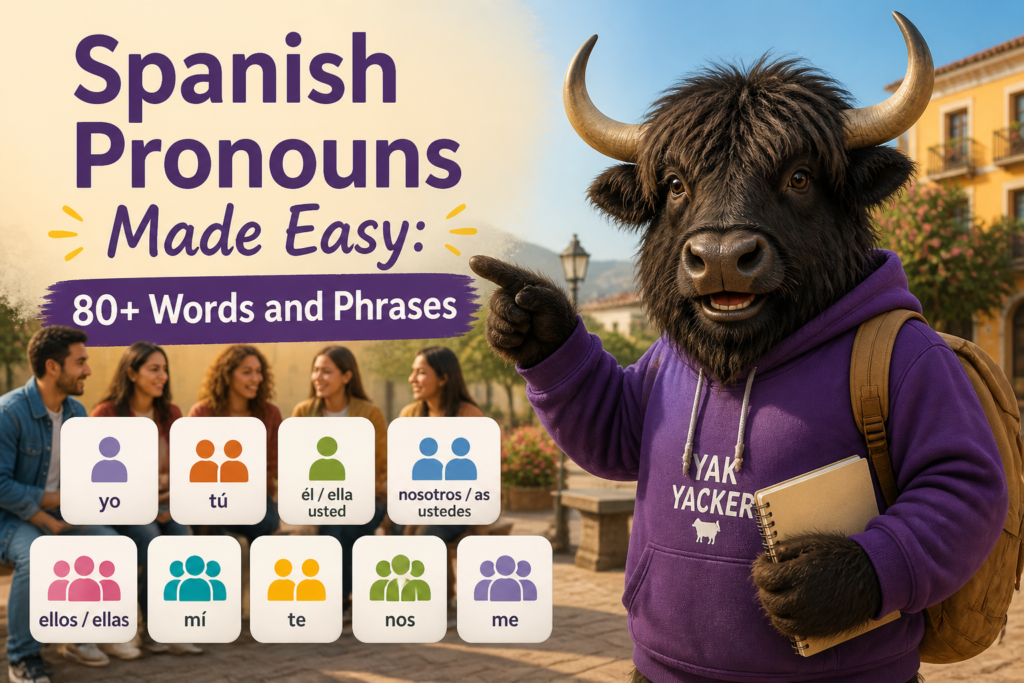
If you’ve ever been halfway through a Spanish sentence and thought, “Wait… who is he, who is she, and why am I now pointing like a confused tour guide?”, welcome. Pronouns are the little words that keep Spanish from becoming a full-body mime show.
For the broader learning path, visit our parent guide.
This guide makes Spanish pronouns easier in real life: subject pronouns, object pronouns, reflexive pronouns, possessives, demonstratives, and a few common extras. By the end, you’ll understand how to use them, when to leave them out, and how to sound a lot less like you’re translating word by word in your head.
For a broader vocabulary boost, you can also compare this with 100 Essential Spanish Words and Phrases. And if you want the tricky object-pronoun stuff in its own little box of chaos, save Spanish Direct and Indirect Object Pronouns for later.
Spanish often drops subject pronouns because the verb already tells you who is doing the action. English likes to announce everything. Spanish is more of a “you’ll figure it out” language. Rude? A little. Efficient? Absolutely.
What A Pronoun Does
A pronoun replaces a noun. Instead of repeating María, the book, or my friends over and over, Spanish uses short words like ella, lo, eso, or mío.
That sounds simple, and it mostly is. The catch is that Spanish pronouns change depending on grammar, gender, number, formality, and whether they are doing the action or receiving it. Fun, right?
Subject Pronouns
Subject pronouns tell you who is doing the action. In Spanish, they are often optional because the verb ending already gives the clue.
| Spanish | Pronunciation | Meaning | Example Sentence | Translation | Learner Note |
|---|---|---|---|---|---|
| yo | yoh | I | Yo estudio español. | I study Spanish. | Often dropped unless you want emphasis. |
| tú | too | you (informal, singular) | Tú hablas muy claro. | You speak very clearly. | Use with friends, family, and people your age in many places. |
| él | el | he | Él trabaja aquí. | He works here. | Accent mark matters: él = he, el = the. |
| ella | EH-yah | she | Ella vive en Lima. | She lives in Lima. | Use for people and sometimes animals or objects if personified. |
| usted | oos-TEHD | you (formal) | Usted necesita una cita. | You need an appointment. | Formal singular. Verb uses third-person form. |
| nosotros / nosotras | noh-SOH-trohs / noh-SOH-tras | we | Nosotros vamos al centro. | We’re going downtown. | Nosotras is used by an all-female group. |
| vosotros / vosotras | boh-SOH-trohs / boh-SOH-tras | you all | Vosotros estudiáis mucho. | You all study a lot. | Common in Spain, not standard in most of Latin America. |
| ellos / ellas | EH-yohs / EH-yahs | they | Ellos llegan tarde. | They arrive late. | Ellos can be a mixed group or all-male group; ellas is all-female. |
| ustedes | oos-TEH-des | you all (formal or neutral plural) | Ustedes pueden entrar. | You all may enter. | Standard plural “you” in Latin America; also formal in Spain. |
Rule: Spanish subject pronouns are often optional.
Example: Hablo español.
Translation: I speak Spanish.
You can say Yo hablo español, but usually the yo is only needed for emphasis. Example: Yo lo hice, no mi hermano. — I did it, not my brother.
Direct Object Pronouns
Direct object pronouns replace the thing or person directly affected by the verb. In plain English: they answer “what?” or “whom?”
| Spanish | Pronunciation | Meaning | Example Sentence | Translation | Learner Note |
|---|---|---|---|---|---|
| me | meh | me | Me llamaste anoche. | You called me last night. | Same form as the reflexive pronoun me. |
| te | teh | you | Te vi en la tienda. | I saw you in the store. | Same form in informal singular. |
| lo | loh | him / it (masculine) | Lo compré ayer. | I bought it yesterday. | Used for masculine nouns and male people. |
| la | lah | her / it (feminine) | La invité a cenar. | I invited her to dinner. | Used for feminine nouns and female people. |
| nos | nohs | us | Nos ayudaron mucho. | They helped us a lot. | Very common in everyday speech. |
| os | ohs | you all | Os vi en Madrid. | I saw you all in Madrid. | Mainly Spain. |
| los | lohs | them / you all (masc. or mixed) | Los conozco bien. | I know them well. | Also can mean “you all” in some contexts in Spain. |
| las | lahs | them / you all (fem.) | Las esperamos aquí. | We’re waiting for them here. | Feminine plural. |
Rule: Direct object pronouns usually go before the conjugated verb.
Example: La veo mañana.
Translation: I see her / it tomorrow.
If the verb is in the infinitive or gerund form, the pronoun can attach to the end: verla, viéndolo. Spanish loves glue. English, meanwhile, keeps things annoyingly separate.
Indirect Object Pronouns
Indirect object pronouns usually tell you to whom or for whom something is done.
| Spanish | Pronunciation | Meaning | Example Sentence | Translation | Learner Note |
|---|---|---|---|---|---|
| me | meh | to/for me | Me dieron un café. | They gave me a coffee. | Same form as direct object and reflexive. |
| te | teh | to/for you | Te escribí un mensaje. | I wrote you a message. | Informal singular. |
| le | leh | to/for him, her, you (formal) | Le expliqué la regla. | I explained the rule to him/her/you. | Very common. In many regions, le can replace direct forms in special usage, but don’t start there. |
| nos | nohs | to/for us | Nos prestaron su coche. | They lent us their car. | Same form as direct object. |
| os | ohs | to/for you all | Os traje café. | I brought you all coffee. | Mainly Spain. |
| les | lehs | to/for them, you all | Les mandé fotos. | I sent them photos. | Plural of le. |
Rule: Indirect object pronouns also go before the verb.
Example: Le di el libro.
Translation: I gave him/her/you the book.
For a deeper dive into this little monster, keep Spanish Direct and Indirect Object Pronouns handy. It’s the part where Spanish stops being cute and starts making you earn it.
Reflexive Pronouns
Reflexive pronouns show that the subject and object are the same person. In other words, the person does the action to themselves.
| Spanish | Pronunciation | Meaning | Example Sentence | Translation | Learner Note |
|---|---|---|---|---|---|
| me | meh | myself | Me baño temprano. | I bathe myself early / I take a shower early. | Very common with daily routines. |
| te | teh | yourself | Te despiertas tarde. | You wake up late. | Informal singular. |
| se | seh | himself, herself, yourself, themselves | Se prepara rápido. | He/she prepares quickly. | One form does a lot of work. Spanish is efficient like that. |
| nos | nohs | ourselves | Nos arreglamos para salir. | We get ready to go out. | Also used in expressions like nos vemos. |
| os | ohs | yourselves | Os sentís bien hoy. | You all feel well today. | Mainly Spain. |
| se | seh | themselves / yourselves | Se levantan temprano. | They get up early. | Used with third person plural and formal plural. |
Rule: Reflexive pronouns usually come before the conjugated verb.
Example: Me lavo las manos.
Translation: I wash my hands.
Some verbs are commonly reflexive in Spanish but not in English: sentarse (to sit down), levantarse (to get up), llamarse (to be called / to call oneself). If you forget the reflexive form, the sentence can still be understandable, but it may sound off. Like wearing one dress shoe and one sneaker.
Possessive Pronouns And Adjectives
Spanish uses possessive adjectives before nouns and possessive pronouns to replace the noun entirely. English says my book and mine. Spanish does the same thing, but with extra agreement rules, because why not.
| Spanish | Pronunciation | Meaning | Example Sentence | Translation | Learner Note |
|---|---|---|---|---|---|
| mi | mee | my | Mi casa es pequeña. | My house is small. | Does not change for gender or number. |
| mis | mees | my (plural) | Mis amigos vienen hoy. | My friends are coming today. | Plural form of mi. |
| tu | too | your | Tu hermana es simpática. | Your sister is nice. | No accent here. tú = you, tu = your. |
| tus | toos | your (plural) | Tus zapatos están aquí. | Your shoes are here. | Plural of tu. |
| su | soo | his, her, your (formal), their | Su oficina está cerrada. | His/her/your/their office is closed. | Very broad, so context matters. |
| sus | soos | his/her/your/their (plural) | Sus hijos estudian aquí. | His/her/your/their children study here. | Plural of su. |
| mío / mía / míos / mías | MEE-oh, MEE-ah | mine | Ese cuaderno es mío. | That notebook is mine. | Changes to match the thing owned. |
| tuyo / tuya / tuyos / tuyas | TOO-yoh, TOO-yah | yours | La mochila es tuya. | The backpack is yours. | Agree with the noun replaced. |
| suyo / suya / suyos / suyas | SOO-yoh, SOO-yah | his / hers / yours / theirs | El coche es suyo. | The car is his/hers/yours/theirs. | Can be ambiguous without context. |
| nuestro / nuestra / nuestros / nuestras | noo-ES-troh / noo-ES-trah | ours | Esta mesa es nuestra. | This table is ours. | Agrees with the noun. |
| vuestro / vuestra / vuestros / vuestras | BVWEH-stroh / BVWEH-strah | yours (plural, Spain) | Los boletos son vuestros. | The tickets are yours. | Mainly Spain. |
Rule: Possessive adjectives go before the noun.
Example: mi celular, su casa, nuestros amigos
Rule: Possessive pronouns replace the noun.
Example: Esa casa es mía.
Translation: That house is mine.
Demonstrative Pronouns
Demonstrative pronouns point to things: this one, that one, those ones. In Spanish, they also change by distance. No actual pointing finger required, though the language does enjoy the energy.
| Spanish | Pronunciation | Meaning | Example Sentence | Translation | Learner Note |
|---|---|---|---|---|---|
| este / esta / estos / estas | ES-teh / ES-tah | this / these | Esta taza es nueva. | This cup is new. | Very near the speaker. |
| ese / esa / esos / esas | EH-seh / EH-sah | that / those | Ese libro es interesante. | That book is interesting. | Near the listener or not far from either person. |
| aquel / aquella / aquellos / aquellas | ah-KEHL / ah-KEH-yah | that over there / those over there | Aquella montaña es muy alta. | That mountain over there is very high. | More distant, physical or mental. |
| esto | ES-toh | this thing / this | Esto no me gusta. | I don’t like this. | Neutral form for unknown or abstract things. |
| eso | EH-soh | that thing / that | Eso parece fácil. | That seems easy. | Very common in conversation. |
aquelloMore Spanish to explore How to Type Spanish Accents on Your Phone and Computer Best graded readers for Spanish The Boy and the Sheep: A1 Beginner Spanish Story with Audio Martina the Little Cockroach: A1 Beginner Spanish Story with Audio |