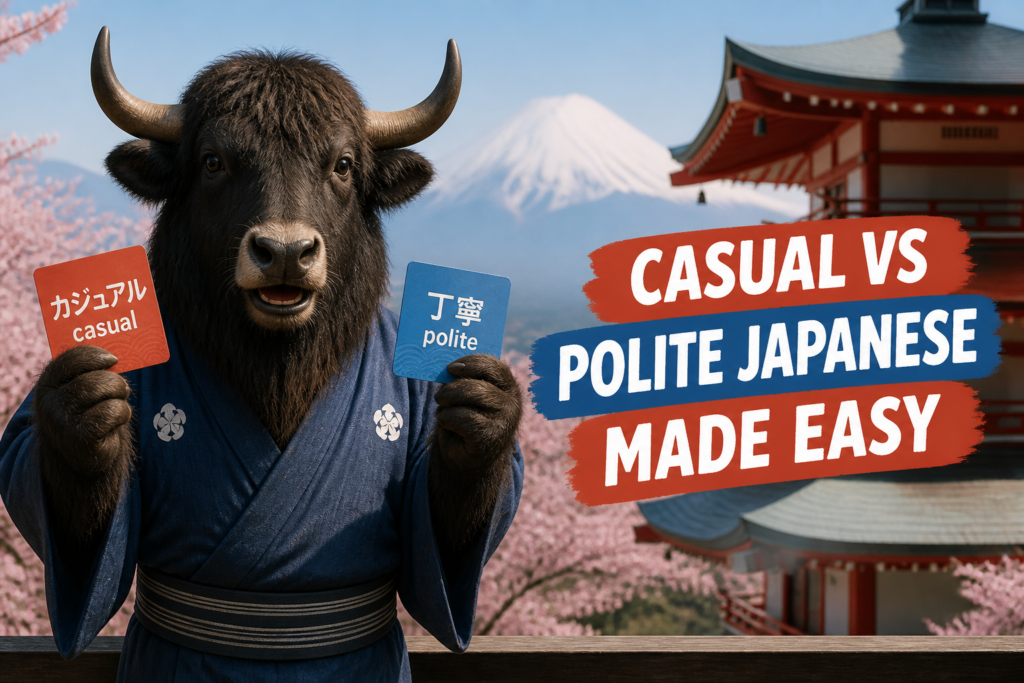
Japanese can feel like it has two personalities. One is friendly and relaxed. The other is careful, polished, and ready for company. Both are normal. Both are useful. And yes, choosing the wrong one can make a simple sentence feel a little awkward, like showing up to a dinner party in gym clothes.
The good news: once you understand the basic switch between casual and polite Japanese, everything gets easier. You do not need to memorize a giant mountain of rules. You just need to learn how Japanese changes depending on who you are speaking to, where you are, and how much distance you want to keep.
If you want a bigger study path, the main Japanese learning hub is a useful place to keep going after this lesson.
| Style | Japanese Name | Rōmaji | English Meaning |
|---|---|---|---|
| Casual speech | 普通形 | futsūkei | plain form; informal style |
| Polite speech | 丁寧形 | teineikei | polite form; respectful everyday style |
| Formal style | 敬語 | keigo | honorific language; extra respectful speech |
Here is the shortest version of the idea: casual Japanese is for friends, family, and people close to you. Polite Japanese is the safe default for strangers, teachers, coworkers, service situations, and basically any time you do not want to accidentally sound like you skipped manners class.
And one more thing: polite Japanese is not “weirdly formal” or stiff. It is just normal social glue. In Japan, using the right level of speech helps conversations feel smooth instead of messy.
The Core Difference
The main difference is the verb ending.
| Style | Verb Ending | Example | Meaning |
|---|---|---|---|
| Casual | plain form | 行く / iku | go |
| Polite | -ます / -です | 行きます / ikimasu | go |
That little ending does a lot of social work. It tells the listener how carefully you are speaking. It does not change the basic meaning of the sentence, but it changes the tone.
Casual speech sounds close. Polite speech sounds respectful. Same meaning, different social temperature.
Common Everyday Phrases
| Japanese | Rōmaji | English Meaning | Example Sentence | Example Rōmaji | English Translation |
|---|---|---|---|---|---|
| ありがとう | arigatō | thanks | ありがとう。 | Arigatō. | Thanks. |
| ありがとうございます | arigatō gozaimasu | thank you | ありがとうございます。 | Arigatō gozaimasu. | Thank you. |
| ごめん | gomen | sorry; my bad | ごめん、遅れた。 | Gomen, okureta. | Sorry, I was late. |
| すみません | sumimasen | excuse me; sorry; thank you | すみません、もう一度お願いします。 | Sumimasen, mō ichido onegaishimasu. | Excuse me, please say that one more time. |
| おはよう | ohayō | morning; good morning, casual | おはよう。 | Ohayō. | Good morning. |
| おはようございます | ohayō gozaimasu | good morning, polite | おはようございます。 | Ohayō gozaimasu. | Good morning. |
| そう | sō | yeah; that’s right | そう。 | Sō. | Yeah. |
| そうです | sō desu | that is right | そうです。 | Sō desu. | That’s right. |
| だめ | dame | no good; not allowed | それはだめ。 | Sore wa dame. | That is not okay. |
| だめです | dame desu | that is not okay, polite | ここはだめです。 | Koko wa dame desu. | This place is not allowed. |
| ある | aru | to exist; there is | 本がある。 | Hon ga aru. | There is a book. |
| あります | arimasu | there is, polite | 本があります。 | Hon ga arimasu. | There is a book. |
How Verbs Change
In casual Japanese, verbs usually use the dictionary form or plain form.
| Plain Form | Polite Form | Meaning |
|---|---|---|
| 食べる / taberu | 食べます / tabemasu | eat |
| 見る / miru | 見ます / mimasu | see; watch |
| 行く / iku | 行きます / ikimasu | go |
| 来る / kuru | 来ます / kimasu | come |
| する / suru | します / shimasu | do |
Example in casual Japanese:
映画を見る。
Eiga o miru.
I watch a movie.
Example in polite Japanese:
映画を見ます。
Eiga o mimasu.
I watch a movie.
The content is the same. The social packaging is different. Japanese loves packaging. It is practically a hobby.
Common Sentence Endings
| Casual Ending | Polite Ending | What It Feels Like |
|---|---|---|
| 〜だ | 〜です | is; am; are |
| 〜ない | 〜ません | negative |
| 〜た | 〜ました | past tense |
| 〜か | 〜か | question marker, often same in both styles |
Casual and polite Japanese often use the same grammar skeleton, but the endings change.
学生だ。
Gakusei da.
I am a student.
学生です。
Gakusei desu.
I am a student.
行かない。
Ikanai.
I am not going.
行きません。
Ikimasen.
I am not going.
食べた。
Tabeta.
I ate.
食べました。
Tabemashita.
I ate.
When To Use Casual Japanese
Use casual Japanese with people you know well: friends, siblings, close classmates, children, and sometimes colleagues after a relationship becomes very friendly. It is also common in texts, anime dialogue, manga, and everyday chatter between people who already share a comfortable bond.
| Situation | Casual? | Example |
|---|---|---|
| Talking to a close friend | Yes | 元気? / Genki? / How are you? |
| Talking to your little brother | Yes | 何してる? / Nani shiteru? / What are you doing? |
| Texting a classmate you know well | Yes | あとで会う? / Ato de au? / Meet later? |
| Talking in a casual group chat | Yes | 了解 / Ryōkai / Got it |
Casual Japanese is warm and efficient. But it has a catch: it can sound rude if you use it too early. That is why beginners often hear “just use polite Japanese” so much. It is not because casual Japanese is bad. It is because polite Japanese is safer.
When To Use Polite Japanese
Use polite Japanese with strangers, teachers, shop staff, customers, older people you do not know well, and in most first-time conversations. It is also the standard in school, work, and service settings.
| Situation | Polite? | Example |
|---|---|---|
| Buying something | Yes | これをください。 / Kore o kudasai. / I’ll take this, please. |
| Speaking to a teacher | Yes | わかりません。 / Wakarimasen. / I do not understand. |
| First meeting | Yes | はじめまして。 / Hajimemashite. / Nice to meet you. |
| Email or work message | Yes | よろしくお願いします。 / Yoroshiku onegaishimasu. / Please treat me well. |
Polite Japanese is not cold. It is respectful, and in many situations it is the kindest choice. Think of it as giving the conversation some breathing room.
Useful Phrase Swaps
| Casual | Polite | Meaning | Example Sentence | Rōmaji | English Translation |
|---|---|---|---|---|---|
| いい | いいです | good; okay | それでいい。 | Sore de ii. | That is fine. |
| いいです | 大丈夫です | it is okay; I am fine | 大丈夫です。 | Daijōbu desu. | I am fine. |
| わかる | わかります | understand | わかる。 | Wakaru. | I understand. |
| 知らない | 知りません | do not know | 知らない。 | Shiranai. | I do not know. |
| いる | います | to exist; be there for living things | 犬がいる。 | Inu ga iru. | There is a dog. |
| います | います | same form in polite speech | 犬がいます。 | Inu ga imasu. | There is a dog. |
| じゃない | ではありません | not; is not | それはちがうじゃない。 | Sore wa chigau janai. | That is not it. |
| じゃないです | ではありません | not polite; not | それはちがいではありません。 | Sore wa chigai de wa arimasen. | That is not a mistake. |
Casual And Polite Examples Side By Side
| Meaning | Casual | Polite |
|---|---|---|
| Hello | やあ。 / Yā. | こんにちは。 / Konnichiwa. |
| I am busy. | 忙しい。 / Isogashii. | 忙しいです。 / Isogashii desu. |
| I am going home. | 帰る。 / Kaeru. | 帰ります。 / Kaerimasu. |
| I do not know. | 知らない。 / Shiranai. | 知りません。 / Shirimasen. |
| It was fun. | 楽しかった。 / Tanoshikatta. | 楽しかったです。 / Tanoshikatta desu. |
| I will do it. | やる。 / Yaru. | やります。 / Yarimasu. |
| No need. | いらない。 / Iranai. | いりません。 / Irimasen. |
| I think so. | そう思う。 / Sō omou. | そう思います。 / Sō omoimasu. |
Quick Rule For Beginners
If you are unsure, start polite. That is the simplest and safest rule.
You can always become more casual later if the relationship supports it. But trying to become casual too quickly can sound sharp. Japanese is not dramatic about this every second of the day, but the social signals do matter.
Polite first, casual later. That tiny strategy saves a lot of awkwardness.
Small But Important Nuances
Some words are naturally casual, and some are naturally polite. You cannot always just swap endings and call it a day. Language, annoyingly, enjoys exceptions.
| Casual Word | Polite Word | Note |
|---|---|---|
| うん | はい | casual yes / polite yes |
| いや | いいえ | casual no / polite no |
| ちょっと | 少々 / しょうしょう | casual “a little”; polite/business style often uses shōshō |
| あのさ | あの | casual attention getter / soft polite attention getter |
Also, casual Japanese often drops things that polite Japanese keeps. Subjects disappear. Small words disappear. Pronouns disappear. Japanese is already pretty comfortable with leaving things unsaid, and casual speech takes that habit and stretches it a bit further.
Plain Form Versus Polite Form
This matters a lot because the plain form is not only for casual speech. It also appears inside grammar patterns, descriptions, and connected clauses. If you want a deeper look at plain form itself, see Plain Form Japanese.
Here is the basic shape:
| Function | Plain Form | Polite Form |
|---|---|---|
| Statement | 行く。 / Iku. | 行きます。 / Ikimasu. |
| Negative | 行かない。 / Ikanai. | 行きません。 / Ikimasen. |
| Past | 行った。 / Itta. | 行きました。 / Ikimashita. |
| State | 静かだ。 / Shizuka da. | 静かです。 / Shizuka desu. |
The plain form is the backbone of casual Japanese, but it also shows up in lots of grammar structures. So learning it is not optional if you want to read or speak comfortably.
Casual Endings You Will Hear A Lot
Some casual endings are so common they deserve their own spotlight. If you want extra practice, there is also a full guide on Casual Japanese Endings.
| Ending | Meaning | Example |
|---|---|---|
| 〜よ | adds emphasis or new information | 知ってるよ。 / Shitteru yo. / I do know, you know. |
| 〜ね | seeks agreement | いいね。 / Ii ne. / Nice, right? |
| 〜かな | I wonder; maybe | 行こうかな。 / Ikō kana. / Maybe I’ll go. |
| 〜さ | casual filler or emphasis | まあ、いいさ。 / Mā, ii sa. / Well, it is fine. |
These endings can make speech sound softer, friendlier, or more natural. Used well, they help you sound human. Used too much, they can make you sound like you are auditioning for a dramatic side role in your own sentence.
Common Mistakes And Fixes
| Mistake | Why It Feels Off | Better Choice |
|---|---|---|
| Using casual speech with a teacher | too familiar too early | わかりません。 / Wakarimasen. |
| Using polite speech with very close friends all the time | can sound distant or stiff | mix in casual forms when appropriate |
| Only learning one style | you will sound limited | learn both from the start |
| Thinking polite means “translated English politeness” | Japanese social cues are different | focus on relationship and situation |
| Dropping politeness in emails | can sound abrupt | use standard polite language |
A good habit is to listen for the speech style in every sentence you hear. Ask yourself: is this close and relaxed, or careful and respectful? That one question will train your ear fast.
Practice: Switch The Style
Try changing each sentence from casual to polite, or polite to casual. Do not overthink it. Your brain may act dramatic for five seconds, but this is how the skill sticks.
| Prompt | Your Task |
|---|---|
| 食べる。 / taberu. | Make it polite. |
| 行きます。 / ikimasu. | Make it casual. |
| きれいです。 / kirei desu. | Make it casual. |
| わからない。 / wakaranai. | Make it polite. |
| いいよ。 / ii yo. | Make it polite. |
Answers:
- 食べます。 / tabemasu. / I eat.
- 行く。 / iku. / I go.
- きれいだ。 / kirei da. / It is pretty; it is clean.
- わかりません。 / wakarimasen. / I do not understand.
- いいです。 / ii desu. / It is fine.
Quick Reference Summary
- Casual Japanese = close, relaxed, everyday speech with friends and family.
- Polite Japanese = safe, respectful speech for most unfamiliar or formal situations.
- Plain form is the base of casual Japanese and also appears in grammar patterns.
- -ます / -です make speech polite.
- If unsure, start polite.
- Learn both styles early so your Japanese does not sound stuck in one gear.
If you want to check your current level after this lesson, try the Japanese Placement Test JLPT or the Japanese Vocabulary Test. They are a useful reality check, which is always slightly rude but also very helpful.
One more small tip: if a sentence feels too blunt in English, it often needs more care in Japanese too. And if you want a slightly nerdy bonus lesson, the article on Japanese grammar can help connect the dots.
Casual vs polite Japanese is not about memorizing two separate languages. It is about learning how relationships shape speech. Once that clicks, Japanese starts feeling less mysterious and a lot more natural. Tiny ending changes, big social difference. Sneaky, really.