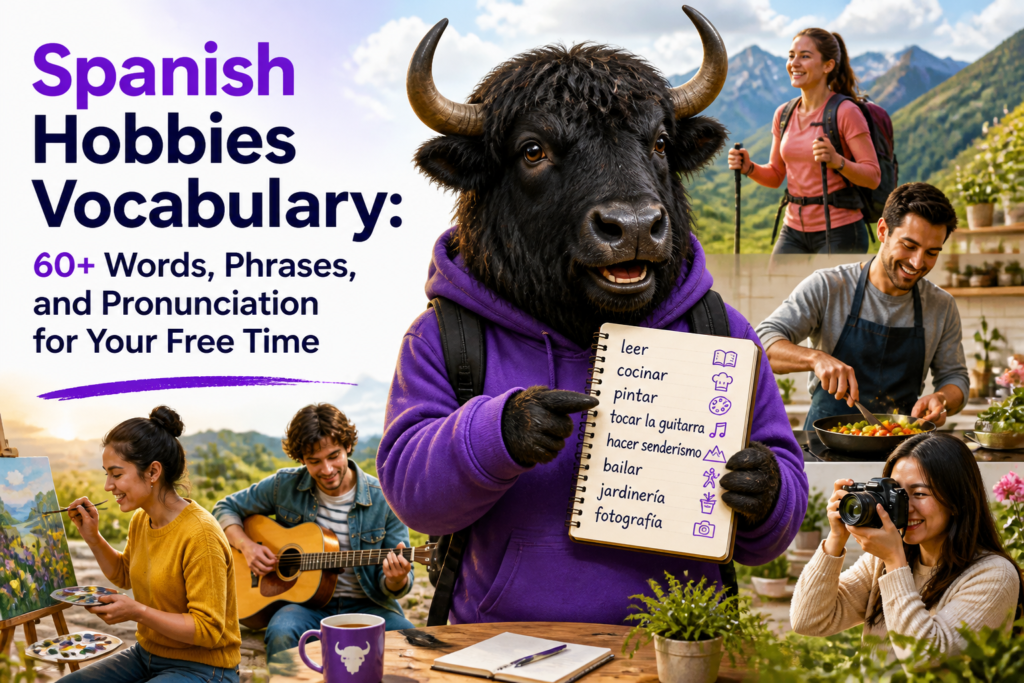
If your weekend has ever turned into “I guess I’ll just scroll my phone and call that a personality,” this article is for you. Spanish has a very handy set of words for talking about hobbies, free time, and the glorious art of not doing work for a few hours.
For the broader learning path, visit our parent guide.
By the end, you’ll be able to say what you like doing, what you’re into, what you do on weekends, and how to ask other people about their hobbies without sounding like a robot with a textbook.
For a bigger starter pack, you can also check 100 Essential Spanish Words & Phrases, and if you want more action words, the related guide on actions and gestures in Spanish is a nice companion.
Quick Idea: How Spanish Talks About Hobbies
Spanish often uses gustar for likes, plus verbs like hacer (to do), jugar (to play), leer (to read), and ver (to watch). A lot of hobby talk is built around “I like + activity,” which is great because it gives you a lot of mileage with a few common patterns. Language efficiency. Fancy.
One tiny pronunciation tip before we begin: Spanish vowels are usually clean and steady. If you can say a, e, i, o, u clearly, you’re already doing a lot right.
Useful Hobby Words and Phrases
Here are the most useful hobby words first, followed by extra phrases you’ll actually use in conversation. Standard Latin American Spanish is used by default, with notes when Spain Spanish differs.
| Spanish | Pronunciation | Meaning | Example Sentence | Translation | Learner Note |
|---|---|---|---|---|---|
| el pasatiempo | pah-sah-TYEHM-poh | hobby, pastime | Mi pasatiempo favorito es la fotografía. | My favorite hobby is photography. | Formal-ish and useful in writing or conversations. |
| el hobby / el hobbie | OH-bee | hobby | Tengo un hobby nuevo: aprender guitarra. | I have a new hobby: learning guitar. | Hobby is common too. Hobbie is a common spelling in Spanish, though many style guides prefer hobby. |
| el tiempo libre | TYEM-poh LEE-breh | free time | En mi tiempo libre, leo y cocino. | In my free time, I read and cook. | Super common phrase. |
| hacer ejercicio | ah-SEHR eh-hehr-SEE-syoh | to exercise | Hago ejercicio tres veces por semana. | I exercise three times a week. | Very natural. Not just for gym people. |
| ir al gimnasio | eer al him-NAH-syoh | to go to the gym | Voy al gimnasio los lunes. | I go to the gym on Mondays. | Gimnasio starts with a hard g sound like in English “get.” |
| leer | leh-EHR | to read | Me gusta leer antes de dormir. | I like to read before sleeping. | Common in hobbies, school, and daily life. |
| escribir | ehs-kree-BEER | to write | Escribo historias cortas por diversión. | I write short stories for fun. | Useful for journaling, blogging, and creative hobbies. |
| dibujar | dee-boo-HAHR | to draw | Le gusta dibujar caricaturas. | He/She likes to draw cartoons. | The j sounds like a strong English “h.” |
| pintar | peen-TAHR | to paint | Mi hermana pinta paisajes. | My sister paints landscapes. | Can mean painting art or painting walls, depending on context. |
| cocinar | koh-see-NAHR | to cook | Nos encanta cocinar en casa. | We love cooking at home. | Very practical for weekend talk. |
| hornear | or-neh-AHR | to bake | Mi abuela hornea pan los domingos. | My grandmother bakes bread on Sundays. | Great for food lovers. |
| escuchar música | ehs-koo-CHAHR MOO-see-kah | to listen to music | Escucho música cuando camino. | I listen to music when I walk. | Escuchar is “to listen”; oir means “to hear.” |
| ver series | behr SEH-ryes | to watch series | Veo series en la noche. | I watch series at night. | In Latin America, serie is very common for TV series. |
| ver películas | behr peh-LEE-koo-las | to watch movies | Vamos a ver una película el sábado. | We’re going to watch a movie on Saturday. | Note the feminine plural películas. |
| jugar videojuegos | hoo-GAHR bee-deh-oh-JWEH-gohs | to play video games | Mi primo juega videojuegos por la tarde. | My cousin plays video games in the afternoon. | Jugar is irregular and very common. |
| jugar al fútbol | hoo-GAHR al FOOT-bol | to play soccer | Jugamos al fútbol con amigos. | We play soccer with friends. | In Spain, fútbol means soccer; in some places people may say soccer in English, but not in Spanish, obviously. |
More Everyday Hobbies Vocabulary
| Spanish | Pronunciation | Meaning | Example Sentence | Translation | Learner Note |
|---|---|---|---|---|---|
| ir de compras | eer deh KOM-pras | to go shopping | Voy de compras con mi amiga. | I go shopping with my friend. | Very common and natural. |
| ir de paseo | eer deh pah-SEH-oh | to go for a walk / outing | Salimos de paseo al parque. | We went out for a walk to the park. | Can mean a relaxed outing, not just a walk. |
| caminar | kah-mee-NAHR | to walk | Camino veinte minutos al día. | I walk twenty minutes a day. | Simple and useful. |
| correr | koh-RREHR | to run | Corre en el parque los fines de semana. | He/She runs in the park on weekends. | The double rr is a strong rolled sound. |
| andar en bicicleta | an-DAHR ehn bee-see-KLEH-tah | to ride a bike | Ando en bicicleta por la ciudad. | I ride a bike around the city. | Very common; bicicleta is feminine. |
| nadar | nah-DAHR | to swim | Nos gusta nadar en verano. | We like swimming in summer. | Common leisure activity. |
| hacer senderismo | ah-SEHR sehn-deh-REES-moh | to hike | Hacemos senderismo en las montañas. | We go hiking in the mountains. | Very useful for outdoor hobbies. |
| acampar | ah-kam-PAHR | to camp | Nos gusta acampar cerca del lago. | We like camping near the lake. | Simple verb; no need to overthink it. |
| pescar | pehs-KAHR | to fish | Mi tío pesca los domingos. | My uncle fishes on Sundays. | Common hobby in many regions. |
| tocar un instrumento | toh-KAHR oon een-stroo-MEHN-toh | to play an instrument | Toca un instrumento desde niño. | He/She has played an instrument since childhood. | Use tocar for instruments, not jugar. |
| tocar la guitarra | toh-KAHR lah gee-TAH-rrah | to play guitar | Toco la guitarra por las noches. | I play guitar at night. | The g in guitarra is soft before u. |
| cantar | kan-TAHR | to sing | Mi amiga canta muy bien. | My friend sings very well. | Easy, common, and fun. |
| bailar | bye-LAHR | to dance | Nos encanta bailar salsa. | We love dancing salsa. | Very natural in social contexts. |
| tomar fotos | toh-MAHR FOH-tohs | to take photos | Tomo fotos cuando viajo. | I take photos when I travel. | In Latin America, tomar fotos is very common. In Spain, hacer fotos is also very common. |
| hacer fotos | ah-SEHR FOH-tohs | to take photos | Hacemos fotos en la playa. | We take photos at the beach. | Very common in Spain. Latin America also understands it perfectly. |
| viajar | bee-ah-HAHR | to travel | Le gusta viajar en tren. | He/She likes to travel by train. | Travel is basically a hobby for some people, and a therapy for others. |
Talking About What You Like
These phrases are the real engine of hobby conversation. Learn these, and suddenly Spanish people stop sounding like mysterious background characters and start sounding like people with actual preferences.
| Spanish | Pronunciation | Meaning | Example Sentence | Translation | Learner Note |
|---|---|---|---|---|---|
| Me gusta… | meh GOOS-tah | I like… | Me gusta leer novelas. | I like reading novels. | Very common. Literally, “It pleases me.” |
| Me encanta… | meh ehn-KAHN-tah | I love… | Me encanta cocinar. | I love cooking. | Stronger than me gusta. |
| No me gusta… | noh meh GOOS-tah | I don’t like… | No me gusta correr temprano. | I don’t like running early. | Put no before the phrase. |
| Me interesa… | meh een-teh-REH-sah | I’m interested in… | Me interesa la música clásica. | I’m interested in classical music. | Good for formal or thoughtful conversation. |
| Estoy aprendiendo a… | ehs-TOY ah-prehn-dyEHN-doh ah | I’m learning to… | Estoy aprendiendo a tocar el piano. | I’m learning to play the piano. | Useful for new hobbies. |
| Suelo… | SWEH-loh | I usually… | Suelo leer los fines de semana. | I usually read on weekends. | Helpful for routine hobby talk. |
| Normalmente… | nor-mal-MEN-teh | normally, usually | Normalmente juego videojuegos por la noche. | I usually play video games at night. | Neutral and easy. |
| En mi tiempo libre… | ehn mee TYEM-poh LEE-breh | in my free time… | En mi tiempo libre, camino y leo. | In my free time, I walk and read. | Excellent for introducing hobbies. |
| Los fines de semana… | lohs FEEN-ehs deh seh-MAH-nah | on weekends… | Los fines de semana descanso mucho. | On weekends, I rest a lot. | Plural, because weekends happen more than once. Very smug of them. |
| Después del trabajo… | dehs-PWEHS dehl trah-BAH-hoh | after work… | Después del trabajo, hago ejercicio. | After work, I exercise. | Useful in daily conversation. |
| Con amigos… | kohn ah-MEE-gohs | with friends… | Veo películas con amigos. | I watch movies with friends. | Simple preposition phrase. |
| Por diversión | pohr dee-behr-SYOHN | for fun | Aprendo francés por diversión. | I learn French for fun. | Natural and useful. No need to be serious all the time. |
Handy Sentence Patterns for Hobby Talk
Spanish hobby sentences are often built from a few very reusable patterns. Here’s the good stuff in plain English.
| Pattern | Meaning | Spanish Example | English Translation | Learner Note |
|---|---|---|---|---|
| Me gusta + infinitive | I like to do something | Me gusta bailar. | I like to dance. | Infinitive = base verb form: bailar, leer, cocinar. |
| Me gusta + noun | I like something | Me gusta la música. | I like music. | Use the article: la música, el fútbol. |
| Me encanta + infinitive | I love to do something | Me encanta viajar. | I love to travel. | More enthusiastic than me gusta. |
| Quiero aprender a + infinitive | I want to learn to do something | Quiero aprender a cocinar. | I want to learn to cook. | Great for talking about new hobbies. |
| Suelo + infinitive | I usually do something | Suelo leer por la noche. | I usually read at night. | Useful for habits. |
| Estoy aprendiendo a + infinitive | I’m learning to do something | Estoy aprendiendo a nadar. | I’m learning to swim. | Very natural and practical. |
Common Hobby Phrases You’ll Actually Hear
- ¿Qué te gusta hacer en tu tiempo libre? — keh teh GOOS-tah ah-SEHR ehn tooh TYEM-poh LEE-breh? — What do you like to do in your free time? Example: ¿Qué te gusta hacer en tu tiempo libre? — What do you like to do in your free time?
- ¿Cuál es tu pasatiempo favorito? — kwahl ehs too pah-sah-TYEHM-poh fah-boh-REE-toh? — What is your favorite hobby? Example: ¿Cuál es tu pasatiempo favorito? — What is your favorite hobby?
- En mi tiempo libre, yo… — ehn mee TYEM-poh LEE-breh yoh… — In my free time, I… Example: En mi tiempo libre, yo leo mucho. — In my free time, I read a lot.
- Los fines de semana me gusta… — lohs FEEN-ehs deh seh-MAH-nah meh GOOS-tah… — On weekends I like to… Example: Los fines de semana me gusta descansar. — On weekends I like to rest.
- Estoy practicando… — ehs-TOY prak-tee-KAHN-doh… — I’m practicing… Example: Estoy practicando la guitarra. — I’m practicing guitar.
- Me estoy aficionando a… — meh ehs-TOY ah-fee-syoh-NAHN-doh ah… — I’m getting into… Example: Me estoy aficionando a la fotografía. — I’m getting into photography.
- Voy a… — boy ah… — I’m going to… Example: Voy a correr esta tarde. — I’m going to run this afternoon.
- Hago… — AH-goh — I do / I make Example: Hago yoga los martes. — I do yoga on Tuesdays.
- Paso el rato… — PAH-soh ehl RAH-toh… — I spend time / hang out doing something Example: Paso el rato con amigos. — I hang out with friends.
- Me relaja… — meh reh-LAH-hah… — It relaxes me / I find it relaxing Example: Me relaja escuchar música. — Listening to music relaxes me.
Quick note: in Spanish, you often use the infinitive after phrases like me gusta and quiero. So instead of forcing a weird English-style structure, just go with the flow: Me gusta leer, not “me gusta to read.” Spanish is not here for that.
Hobbies With Useful Verbs: A Mini Reference
| Spanish Verb | Pronunciation | Meaning | Example Sentence | Translation | Learner Note |
|---|---|---|---|---|---|
| practicar | prahk-tee-KAHR | to practice | Practico piano todos los días. | I practice piano every day. | Very common with hobbies, sports, and skills. |
| aprender | ah-prehn-DEHR | to learn | Aprendo español por hobby. | I learn Spanish as a hobby. | Use a when needed: aprender a cocinar. |
| disfrutar | dees-froo-TAHR | to enjoy | Disfruto caminar por el parque. | I enjoy walking in the park. | Very nice for a slightly more elegant sentence. |
| descansar | dehs-kan-SAHR | to rest | Los domingos descanso y leo. | On Sundays I rest and read. | Rest counts as a hobby sometimes. We don’t judge. |
| coleccionar | koh-lek-syoh-NAHR | to collect | Colecciono monedas antiguas. | I collect old coins. | Great for talking about collections. |
| juntar | hoon-TAHR | to gather, collect, put together | Junta las piezas del rompecabezas. | Put the puzzle pieces together. | Useful in some hobby contexts. |
| explorar | eks-ploh-RAHR | to explore | Me gusta explorar nuevos cafés. | I like exploring new cafés. | Good for adventurous free time. |
| salir | sah-LEER | to go out | Salgo con amigos los viernes. | I go out with friends on Fridays. | Very common in social plans. |
| quedarse en casa | keh-DAHR-seh ehn KAH-sah | to stay home | Me quedo en casa y veo una serie. | I stay home and watch a series. | Super natural for quiet weekends. |
| hacer manualidades | ah-SEHR mah-noo-ah-lee-DAH-dehs | to do crafts | Hace manualidades con papel y cartón. | She does crafts with paper and cardboard. | Great hobby vocabulary for kids and adults. |
Latin American Spanish vs Spain Spanish: A Few Hobby Notes
Most hobby vocabulary is the same across the Spanish-speaking world, which is lovely because languages do occasionally decide to cooperate.
- Tomar fotos is very common in Latin America; hacer fotos is especially common in Spain.
- Ordenador is more common in Spain, while computadora is more common in Latin America when talking about computer-related hobbies.
- Coger means “to take” in Spain, but in Latin America it can sound awkward or rude in some contexts, so avoid it unless you know the local usage well.
- Fútbol means soccer everywhere in the Spanish-speaking world, even if your brain keeps trying to be clever.
Pronunciation Tips That Help With Hobby Words
- j sounds like a strong English h: jugar, dibujar, viajar.
- rr is a rolled or trilled sound: correr, guitarra, aburrido.
- ll often sounds like y in many regions: llamar, lluvia, calle. In some places it can sound different, but y-like is a safe default.
- h is usually silent: hacer, hora, hobby in many loanword spellings.
- Spanish vowels are pure and short: leer is roughly “leh-EHR,” not “lee-er” with extra English wobble.
Extra Note: Gustar Is a Bit Backwards
English says “I like music.” Spanish often says literally “Music is pleasing to me”: Me gusta la música. That’s why the verb form changes depending on whether the thing is singular or plural:
Me gusta el fútbol. — I like soccer.
Me gustan los deportes. — I like sports.
Learner note: gusta goes with singular nouns or one activity; gustan goes with plural nouns.
Mini Practice: Build Your Own Hobby Sentences
Try swapping in your own words. Don’t panic if it feels slow at first. That’s normal. Languages are rude like that.
- Me gusta… → Me gusta leer.
- Me encanta… → Me encanta bailar.
- En mi tiempo libre… → En mi tiempo libre, dibujo y cocino.
- Los fines de semana… → Los fines de semana juego videojuegos.
- Estoy aprendiendo a… → Estoy aprendiendo a tocar la guitarra.
- Suelo… → Suelo caminar por la mañana.
- No me gusta… → No me gusta correr temprano.
- Me interesa… → Me interesa la fotografía.
Common Mistakes and Easy Fixes
| Mistake | Better Version | Why |
|---|---|---|
| Me gusta leer libroses. | Me gusta leer libros. | Libroses is not a word. Spanish plural endings are usually much calmer than that. |
| Me gusta to play guitar. | Me gusta tocar la guitarra. | Keep the sentence in Spanish once you start. Mixing languages is a mood, but not a sentence pattern. |
| Me gustan la música. | Me gusta la música. | Música is singular, so use gusta, not gustan. |
| Jugar la guitarra. | Tocar la guitarra. | Use tocar for instruments; jugar is for games and sports. |
| Hacer fotos in Latin America when you mean “take photos” | Tomar fotos | Hacer fotos is understandable, but tomar fotos is usually more natural in Latin America. |
| Estoy gusta… | Me gusta… | Gustar uses indirect object pronouns like me, te, le. |
If you want to strengthen the grammar around actions and everyday expressions, the related page on actions and gestures in Spanish is a good next stop. And if you want more vocabulary in the same practical style, emotions in Spanish pairs nicely with hobby talk because people love to say how things make them feel. Conveniently dramatic, as always.
Quick Reference Summary
- Me gusta = I like
- Me encanta = I love
- En mi tiempo libre = in my free time
- Pasatiempo = hobby
- Hacer ejercicio = to exercise
- Leer = to read
- Cocinar = to cook
- Escuchar música = to listen to music
- Ver películas / series = to watch movies / series
- Jugar videojuegos = to play video games
- Tocar un instrumento = to play an instrument
- Hacer senderismo = to hike
- Tomar fotos / hacer fotos = to take photos
For official word-checking and spelling rabbit holes, a boring-but-useful source is the Real Academia Española. It will not entertain you, but it will absolutely keep you honest.
Yak takeaway: if you can say Me gusta…, En mi tiempo libre…, and Estoy aprendiendo a…, you can already talk about hobbies in Spanish like a real human and not a vocabulary card that escaped from a binder.