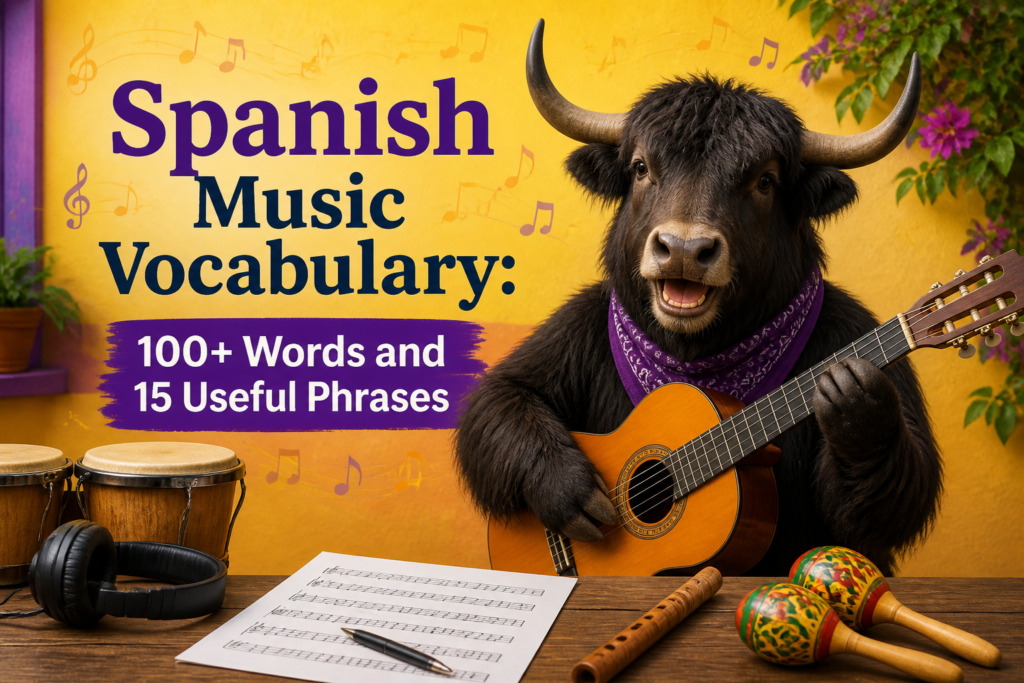
If you like music, Spanish is basically handing you a backstage pass. You get words for genres, instruments, concerts, playlists, lyrics, rhythm, and all the little things people say when they are talking about a song they cannot stop replaying for the 47th time.
For the broader learning path, visit our parent guide.
And yes, music vocabulary is one of the easiest ways to sound natural fast. You can talk about your favorite band, complain about loud speakers, or ask for the lyrics without sounding like you swallowed a dictionary. Lovely.
This guide gives you practical Spanish music vocabulary, real-life phrases, pronunciation help, and examples you can actually use. By the end, you should be able to talk about songs, instruments, concerts, and musical tastes in clear, everyday Spanish.
For a quick language nerd moment, the word música already carries the accent mark that keeps it from becoming a spelling gremlin. If you want a boring but reliable reference for Spanish spelling and usage, the Real Academia Española is always there, doing the paperwork.
Useful Music Words In Spanish
Here are the most useful words first: things you will hear in songs, concerts, music apps, and everyday conversations.
| Spanish | Pronunciation | Meaning | Example Sentence | Translation | Learner Note |
|---|---|---|---|---|---|
| la música | MOO-see-kah | music | La música me relaja. | Music relaxes me. | Feminine noun: la música. |
| la canción | kan-SYON | song | ¿Conoces esta canción? | Do you know this song? | Very common in daily speech. |
| el cantante | kan-TAHN-teh | singer | Mi cantante favorito es de Colombia. | My favorite singer is from Colombia. | Can refer to male singer; la cantante for female. |
| la cantante | kan-TAHN-teh | female singer | Esa cantante tiene una voz increíble. | That singer has an incredible voice. | Gender changes only in the article and sometimes adjective agreement. |
| la banda | BAHN-dah | band | La banda toca en vivo esta noche. | The band is playing live tonight. | Can also mean “group” in some contexts. |
| el grupo | GROO-po | group, band | Ese grupo suena muy bien. | That band sounds very good. | Common for musical groups too. |
| la letra | LEH-trah | lyrics, text | No entiendo la letra de esta canción. | I don’t understand the lyrics of this song. | Important false friend: not “letter” here. |
| el ritmo | REET-mo | rhythm, beat | El ritmo es pegajoso. | The rhythm is catchy. | Very useful for describing songs. |
| la melodía | meh-loh-DEE-ah | melody | La melodía se queda en la cabeza. | The melody gets stuck in your head. | Common in music reviews. |
| la voz | BOHS | voice | Su voz es muy suave. | Her voice is very soft. | z sounds like an English s in Latin American Spanish. |
| el volumen | boh-LOO-men | volume | Baja el volumen, por favor. | Turn down the volume, please. | Useful at home, in cars, and at parties. |
| el sonido | soh-NEE-doh | sound | El sonido está muy bajo. | The sound is very low. | Common for speakers and concerts. |
| el concierto | kon-SYER-toh | concert | Vamos al concierto mañana. | We’re going to the concert tomorrow. | One of the most useful music words. |
| el espectáculo | eh-spehk-TAH-koo-loh | show, performance | El espectáculo fue fantástico. | The show was fantastic. | Broader than just music. |
| el festival | fehs-tee-BAHL | festival | Ese festival dura tres días. | That festival lasts three days. | Same spelling in English, different pronunciation. |
| el escenario | ehs-seh-NAH-ryoh | stage | La cantante salió al escenario. | The singer went on stage. | Good word for concerts and theater. |
| el público | POO-blee-koh | the audience | El público cantó con ella. | The audience sang with her. | Can refer to concertgoers or any audience. |
| el aplauso | ah-PLOW-soh | applause, clap | El aplauso fue enorme. | The applause was huge. | Singular often used collectively. |
| el micrófono | mee-KROH-foh-noh | microphone | El micrófono no funciona. | The microphone doesn’t work. | Accent mark matters: micrófono. |
| los audífonos | ow-DEE-foh-nohs | headphones | Me puse los audífonos para escuchar la canción. | I put on my headphones to listen to the song. | Latin America. In Spain, people often say los auriculares. |
| los auriculares | ow-ree-koo-LAH-res | headphones, earbuds | Mis auriculares están conectados al teléfono. | My headphones are connected to the phone. | More common in Spain. |
| el altavoz | ahl-tah-BOHS | speaker | El altavoz suena fuerte. | The speaker sounds loud. | Useful for phones, laptops, and systems. |
| la guitarra | gee-TAH-rrah | guitar | Toca la guitarra muy bien. | He plays the guitar very well. | The double rr is a strong rolled sound. |
| el piano | pee-AH-noh | piano | Aprendí piano cuando era niño. | I learned piano when I was a child. | Also used as “piano” without article in some contexts. |
| la batería | bah-teh-REE-ah | drums, drum set | La batería tiene mucho ritmo. | The drums have a lot of rhythm. | Can mean the instrument or drum kit. |
| el bajo | BAH-hoh | bass | El bajo suena profundo. | The bass sounds deep. | Also means “low”; context decides. |
| el violín | byoh-LEEN | violin | Mi hermana toca el violín. | My sister plays the violin. | Accent on the last syllable. |
| la flauta | FLOW-tah | flute | La flauta tiene un sonido suave. | The flute has a soft sound. | Common in orchestras and schools. |
More Music Words You’ll Hear A Lot
This next group adds more depth: style, production, performance, and all the things people mention when they are being extremely serious about a playlist.
| Spanish | Pronunciation | Meaning | Example Sentence | Translation | Learner Note |
|---|---|---|---|---|---|
| la pista | PEES-tah | track, song track | La pista tres es mi favorita. | Track three is my favorite. | Also “dance floor” in some contexts. |
| el álbum | AHL-boom | album | El álbum salió en mayo. | The album came out in May. | Pronounce the m lightly, not like “al-boom.” |
| la portada | por-TAH-dah | cover art | La portada del álbum es preciosa. | The album cover is beautiful. | Also “front page” in other contexts. |
| la discografía | dees-koh-grah-FEE-ah | discography | Su discografía es enorme. | His discography is huge. | More advanced but useful for fans. |
| el sencillo | sen-SEE-yoh | single | El sencillo fue un éxito. | The single was a hit. | Also means “simple/easy.” |
| el éxito | EHK-see-toh | hit, success | La canción fue un éxito mundial. | The song was a worldwide hit. | Great word for charts and popularity. |
| popular | poh-poo-LAHR | popular | Es un artista muy popular. | He is a very popular artist. | Looks like English, but pronounce every vowel clearly. |
| famoso / famosa | fah-MOH-soh / fah-MOH-sah | famous | Es una cantante famosa. | She is a famous singer. | Adjective agrees with gender. |
| en vivo | en BEE-boh | live, live performance | La banda toca en vivo esta noche. | The band is playing live tonight. | Very common on posters and ads. |
| el ensayo | en-SAH-yoh | rehearsal | Tenemos ensayo a las seis. | We have rehearsal at six. | Also means “essay” in school contexts. |
| la gira | HEE-rah | tour | La gira empieza en verano. | The tour starts in summer. | Useful for concerts and artists. |
| la entrada | en-TRAH-dah | ticket, entry | Compré la entrada para el concierto. | I bought the ticket for the concert. | Can also mean “entrance.” |
| el boleto | boh-LEH-toh | ticket | Necesito dos boletos para el show. | I need two tickets for the show. | Very common in Latin America. In Spain, entrada is often used too. |
| la taquilla | tah-KEE-yah | ticket office, box office | Las entradas se venden en la taquilla. | The tickets are sold at the box office. | Useful at theaters and venues. |
| el repertorio | reh-per-TOH-ryoh | repertoire | El repertorio incluye canciones nuevas. | The repertoire includes new songs. | More advanced, but handy. |
| la coreografía | koh-reh-oh-grah-FEE-ah | choreography | La coreografía es difícil. | The choreography is difficult. | Useful for pop, dance, and stage shows. |
| el baile | BYE-leh | dance | El baile empezó rápido. | The dance started quickly. | Great for salsa, bachata, and parties. |
| bailar | bye-LAHR | to dance | Me gusta bailar con música latina. | I like to dance to Latin music. | Very common verb. |
| cantar | kan-TAHR | to sing | Todos comenzaron a cantar. | Everyone started to sing. | Simple, essential verb. |
| tocar | toh-KAHR | to play an instrument | Mi primo toca el piano. | My cousin plays the piano. | Use tocar for instruments, not jugar. |
| componer | kom-poh-NER | to compose | Ella compone sus propias canciones. | She composes her own songs. | Great verb for songwriters. |
| ensayar | en-sah-YAHR | to rehearse | La banda ensaya todos los miércoles. | The band rehearses every Wednesday. | Common in music and theater. |
| grabar | grah-BAHR | to record | Van a grabar una nueva canción. | They are going to record a new song. | Also “to film” in some contexts. |
| escuchar | ehs-koo-CHAR | to listen to | Escucho música mientras camino. | I listen to music while I walk. | Very useful everyday verb. |
| sonar | soh-NAHR | to sound | La canción suena genial. | The song sounds great. | Also “to ring” for alarms, phones, etc. |
| seguir el ritmo | seh-GEER el REET-mo | to keep the beat | No puedo seguir el ritmo. | I can’t keep the beat. | Useful in dance and music classes. |
Genres Of Music In Spanish
Music genres are great conversation fuel. People have Opinions with a capital O here, because apparently liking a playlist is a personality test now.
| Spanish | Pronunciation | Meaning | Example Sentence | Translation | Learner Note |
|---|---|---|---|---|---|
| el pop | pohp | pop | Escucho mucho pop. | I listen to a lot of pop. | Looks like English and works the same. |
| el rock | rohk | rock | Me gusta el rock clásico. | I like classic rock. | Very common and easy. |
| el reguetón | reh-geh-TOHN | reggaeton | El reguetón suena en todas partes. | Reggaeton plays everywhere. | Standard spelling in Spanish. |
| la salsa | SAHL-sah | salsa | Bailamos salsa los viernes. | We dance salsa on Fridays. | Can refer to the music or the dance. |
| la bachata | bah-CHAH-tah | bachata | La bachata es muy romántica. | Bachata is very romantic. | Popular in Latin America and beyond. |
| el vallenato | bah-yeh-NAH-toh | vallenato | Mi familia escucha vallenato. | My family listens to vallenato. | Very important in Colombia. |
| el mariachi | mah-ree-AH-chee | mariachi | Hay un grupo de mariachi en la plaza. | There is a mariachi group in the square. | Music style and ensemble; strongly associated with Mexico. |
| el jazz | yas | jazz | Le encanta el jazz. | She loves jazz. | The j is softer in Spanish than in English. |
| el hip-hop | eep-hop | hip-hop | Escucha hip-hop todos los días. | He listens to hip-hop every day. | Often used as in English. |
| la música clásica | MOO-see-kah KLAH-see-kah | classical music | La música clásica me ayuda a estudiar. | Classical music helps me study. | Good phrase for preferences and study habits. |
| la música latina | MOO-see-kah lah-TEE-nah | Latin music | La música latina es muy variada. | Latin music is very varied. | Very broad category. |
| la música folklórica | fowk-LOH-REE-kah | folk music | La música folklórica refleja la cultura local. | Folk music reflects local culture. | Spelling can also appear as folklórica. |
| la electrónica | eh-lek-troh-NEE-kah | electronic music | Prefiere la electrónica por la noche. | He prefers electronic music at night. | Often shortened in casual talk to electrónica. |
| el indie | EEN-dee | indie | Le gusta el indie alternativo. | She likes alternative indie. | Used a lot in playlists and festivals. |
| la ópera | OH-peh-rah | opera | Nunca he ido a la ópera. | I have never been to the opera. | Accent mark on the first syllable. |
| el rap | rahp | rap | Es fan del rap español. | He is a fan of Spanish rap. | Easy cognate. |
| la balada | bah-LAH-dah | ballad | Es una balada triste. | It’s a sad ballad. | Useful for slower emotional songs. |
15 Useful Music Phrases In Spanish
These are the phrases people actually say in conversations, in comments, before concerts, and while pretending they know the lyrics perfectly.
| Spanish | Pronunciation | Meaning | Example Sentence | Translation | Learner Note |
|---|---|---|---|---|---|
| Me gusta esta canción. | meh GOO-stah ehs-tah kan-SYON | I like this song. | Me gusta esta canción muchísimo. | I like this song a lot. | Very useful basic opinion phrase. |
| La canción está pegajosa. | lah kan-SYON ehs-TAH peh-gah-HOH-sah | The song is catchy. | La canción está pegajosa y no la puedo sacar de la cabeza. | The song is catchy and I can’t get it out of my head. | Pegajosa literally means “sticky,” but here it means catchy. |
| ¿Quién canta esta canción? | kyen KAHN-tah ehs-tah kan-SYON | Who sings this song? | ¿Quién canta esta canción? Suena familiar. | Who sings this song? It sounds familiar. | canta = sings; very practical question. |
| ¿Puedes subir el volumen? | PWEH-des soo-BEER el boh-LOO-men | Can you turn up the volume? | ¿Puedes subir el volumen un poco? | Can you turn the volume up a little? | Polite and everyday. Use puedes with friends; puede with usted. |
| Baja el volumen, por favor. | BAH-hah el boh-LOO-men por fah-BOR | Turn down the volume, please. | Baja el volumen, por favor, que ya es tarde. | Turn down the volume, please, because it’s already late. | Great for home, car, or headphones. |
| ¿Tienes la letra? | TYEH-nes lah LEH-trah | Do you have the lyrics? | ¿Tienes la letra? Quiero seguir la canción. | Do you have the lyrics? I want to follow the song. | Useful for karaoke and learning songs. |
| Estoy escuchando música. | ehs-TOY ehs-koo-CHAN-doh MOO-see-kah | I’m listening to music. | Estoy escuchando música mientras limpio. | I’m listening to music while I clean. | Present progressive: estar + gerund. |
| Me encanta el ritmo. | meh en-KAN-tah el REET-mo | I love the rhythm/beat. | Me encanta el ritmo de esta canción. | I love the rhythm of this song. | Great for expressing strong liking. |
| Su voz es increíble. | soo BOHS ehs een-kreh-EE-bleh | Her/his voice is incredible. | Su voz es increíble en vivo. | Her voice is incredible live. | su can mean his, her, your, or their depending on context. |
| Vamos al concierto. | BAH-mos al kon-SYER-toh | Let’s go to the concert. | Vamos al concierto esta noche. | Let’s go to the concert tonight. | Simple invitation phrase. |
| La banda toca en vivo. | lah BAHN-dah TOH-kah en BEE-boh | The band is playing live. | La banda toca en vivo los viernes. | The band plays live on Fridays. | Use tocar for performing instruments or playing live. |
| Está muy bien producida. | ehs-TAH MOOY byen proh-doo-SEE-dah | It is very well produced. | La canción está muy bien producida. | The song is very well produced. | Good phrase for modern music reviews. |
| Me sé la canción de memoria. | meh seh lah kan-SYON deh meh-MOH-ryah | I know the song by heart. | Me sé la canción de memoria, pero no la pronuncio bien. | I know the song by heart, but I don’t pronounce it well. | saberse = to know by heart. |
| ¿De qué trata la canción? | deh keh TRAH-tah lah kan-SYON | What is the song about? | ¿De qué trata la canción? No entendí la historia. | What is the song about? I didn’t understand the story. | Great for lyrics and meaning. |
| La puse en mi lista. | lah POO-seh en mee LEES-tah | I put it on my playlist/list. | La puse en mi lista para después. | I put it on my list for later. | Puse is from poner; very common in everyday Spanish. |
Words For Sound, Feel, And Music Taste
People rarely stop at “good” or “bad” when talking about music. They go for words like suave, fuerte, alegre, and nostálgico because apparently one adjective is never enough when describing a chorus that wrecks you emotionally.
| Spanish | Pronunciation | Meaning | Example Sentence | Translation | Learner Note |
|---|---|---|---|---|---|
| suave | SWAH-beh | soft, gentle | La canción tiene un sonido suave. | The song has a soft sound. | Useful for voice, music, and fabrics. |
| fuerte | FWEHR-teh | strong, loud | La música está muy fuerte. | The music is very loud. | Very common in complaints and requests. |
| alegre | ah-LEH-greh | happy, lively | Es una canción alegre. | It’s a cheerful song. | Good for upbeat songs. |
| triste | TREES-teh | sad | Es una balada triste. | It’s a sad ballad. | Same form for masculine and feminine. |
| romántico / romántica | roh-MAHN-tee-koh / roh-MAHN-tee-kah | romantic | La canción es romántica. | The song is romantic. | Adjective agrees with the noun. |
| pegajoso / pegajosa | peh-gah-HOH-soh / peh-gah-HOH-sah | catchy | El coro es muy pegajoso. | The chorus is very catchy. | Very useful slang-adjacent compliment. |
| movido / movida | moh-BEE-doh / moh-BEE-dah | lively, energetic | La canción está muy movida. | The song is very lively. | Common for dance music. |
| tranquilo / tranquila | trahn-KEE-loh / trahn-KEE-lah | calm, relaxed | Prefiero música tranquila para estudiar. | I prefer calm music for studying. | Great for background music. |
| moderno / moderna | moh-DEHR-noh / moh-DEHR-nah | modern | La producción suena muy moderna. | The production sounds very modern. | Useful in reviews. |
| clásico / clásica | KLAH-see-koh / KLAH-see-kah | classic, classical | Me gusta el rock clásico. | I like classic rock. | Context tells you if it means “classical.” |
| delicioso | deh-lee-SYOH-soh | delightful, lovely | La canción suena deliciosa. | The song sounds delightful. | Used more metaphorically in music talk. |
Grammar You Need With Music Words
Music vocabulary comes with a few grammar habits that show up all the time. Nothing dramatic. Just the usual Spanish rules quietly waiting to trip people up when they get too confident.
| Pattern | Meaning | Spanish Example | English Translation | Learner Note |
|---|---|---|---|---|
| Me gusta + singular noun | I like + one thing | Me gusta la música. | I like music. | Gusta stays singular because música is singular. |
| Me gustan + plural noun | I like + plural things | Me gustan las canciones lentas. | I like slow songs. | Use gustan with plural nouns. |
| Tocar + instrument | to play an instrument | Él toca la guitarra. | He plays the guitar. | Use tocar, not jugar. |
| Cantar + song/lyric | to sing | Ella canta muy bien. | She sings very well. | Also works for karaoke and parties. |
| Escuchar + music | to listen to | Escucho jazz por las noches. | I listen to jazz at night. | Use with a only if needed for emphasis: escuchar a alguien. |
| Estar + adjective | temporary state/description | La canción está genial. | The song is great. | Very common with opinions about songs. |
| Ser + adjective | permanent characteristic | La cantante es famosa. | The singer is famous. | Use ser for identity and lasting traits. |
| En vivo | live, not recorded | La banda toca en vivo. | The band plays live. | Common concert phrase. |
| De memoria | by heart | Me sé la letra de memoria. | I know the lyrics by heart. | Very handy in music and school contexts. |
| ¿Quién…? | who? | ¿Quién canta? | Who is singing? | Use for asking about singers or performers. |
Pronunciation Tips For Music Words
Spanish pronunciation is usually friendly to learners, which is rare and suspicious. Most music words are easy once you remember a few sounds.
- rr in guitarra, canción? No. But in words like perro it is a strong rolled sound. Double r matters.
- j sounds like a strong breath, not the English j. So jazz is closer to “hass” than “jazz” in English.
- v and b are very similar in Spanish. voz does not sound like “boats,” sadly.
- Spanish vowels stay clean and clear: a, e, i, o, u. No drifting into vowel soup.
- The h is silent in standard Spanish, so hombre and hora do not start with an English h sound.
- Accent marks matter: canción, micrófono, álbum, música, ritmo. If the accent is there, respect it. The word has feelings.
For pronunciation and spelling questions, a plain reference like WordReference can be helpful, especially when you want examples and community notes without drama.
Latin American Spanish Vs Spain Spanish
Most music vocabulary is the same across the Spanish-speaking world, but a few everyday words change depending on the region.
| Latin American Spanish | Spain Spanish | Meaning | Example Note |
|---|---|---|---|
| audífonos | auriculares | headphones | Both are correct; regional preference changes. |
| boleto | entrada | ticket | Both can be used, but entrada is very common in Spain. |
| reguetón | reguetón | reggaeton | Usually the same word, same meaning. |
| música en vivo | música en directo | live music | En directo is especially common in Spain. |
If you want to keep building your Spanish vocabulary beyond music, the related guides on 100 Essential Spanish Words & Phrases and Hobbies In Spanish fit nicely with this topic. Music and hobbies love a good crossover episode.
Quick Practice
Try these short drills. No pressure. Just enough practice to stop the words from floating away like confetti.
| Task | Answer | English |
|---|---|---|
| Translate: “I like this song.” | Me gusta esta canción. | Me gusta esta canción. |
| Translate: “The band plays live.” | La banda toca en vivo. | The band plays live. |
| Choose the correct verb: Yo ___ la guitarra. (cantar / tocar) | toco | I play the guitar. |
| Choose the correct form: Me ___ las canciones lentas. (gusta / gustan) | gustan | I like slow songs. |
| Fill in the blank: ¿Quién ___ esta canción? | canta | Who sings this song? |
| Translate: “Turn down the volume, please.” | Baja el volumen, por favor. | Turn down the volume, please. |
Mini challenge: say these aloud without rushing the vowels.
- música
- canción
- concierto
- guitarra
- reguetón
- micrófono
- audífonos
Common Mistakes And Fixes
| Common Mistake | Better Spanish | Why |
|---|---|---|
| Yo gusto la canción. | Me gusta la canción. | gustar works differently from English “to like.” |
| Yo juego la guitarra. | Yo toco la guitarra. | jugar is for games and sports; instruments use tocar. |
| La música está bonito. | La música está bonita. | música is feminine, so the adjective must agree. |
| Quien canta esta canción? | ¿Quién canta esta canción? | Questions need the opening question mark in Spanish, and quién has an accent. |
| Escucho a música. | Escucho música. | Do not add unnecessary a before a direct object like música. |
| La letra de la canción es muy larga. when meaning “lyrics” | La letra de la canción es muy bonita. | letra can mean lyrics or text, but context matters. If you mean the full lyric sheet, say la letra or las letras if plural in some contexts. |
One more thing: canción is feminine, but el cantante is masculine and la cantante is feminine. Spanish enjoys making you pay attention, which is fair enough.
More Useful Music Phrases
Here are a few extra phrases that round out the topic nicely and make your Spanish sound more complete.
- ¿Te gusta este cantante? — Do you like this singer?
- Esta canción me recuerda a mi infancia. — This song reminds me of my childhood.
- La melodía es muy bonita. — The melody is very pretty.
- El coro es lo mejor. — The chorus is the best part.
- La producción suena profesional. — The production sounds professional.
- La batería entra fuerte. — The drums come in strongly.
- Hay un solo de guitarra increíble. — There is an incredible guitar solo.
- Voy a poner esta canción otra vez. — I’m going to play this song again.
- No me sé la letra. — I don’t know the lyrics by heart.
- ¿Tienes más música de este estilo? — Do you have more music of this style?
- Me encanta bailar esta canción. — I love dancing to this song.
- La voz principal es muy potente. — The lead voice is very powerful.
- Ese ritmo está brutal. — That beat is amazing.
- La canción tiene mucho sentimiento. — The song has a lot of feeling.
- Vamos a escuchar el nuevo álbum. — Let’s listen to the new album.
Want a quick, funny reward for reaching this far? Check out Jokes To Learn Spanish after this. Your brain deserves a snack, and humor helps vocabulary stick like that one chorus you were trying so hard to forget.
Quick Reference Summary
- Música = music
- Canción = song
- Letra = lyrics / text
- Concierto = concert
- Tocar = to play an instrument
- Cantar = to sing
- Escuchar = to listen to
- Reguetón, salsa, bachata, rock, pop = common genres
- Me gusta… = I like…
- ¿Quién canta? = Who sings?
- Baja el volumen = Turn down the volume
- En vivo = live
Yak takeaway: if you know música, canción, tocar, cantar, and concierto, you can already survive a lot of real Spanish music conversations. Add a few genre words, and suddenly you are not just listening anymore — you are talking like you belong there.