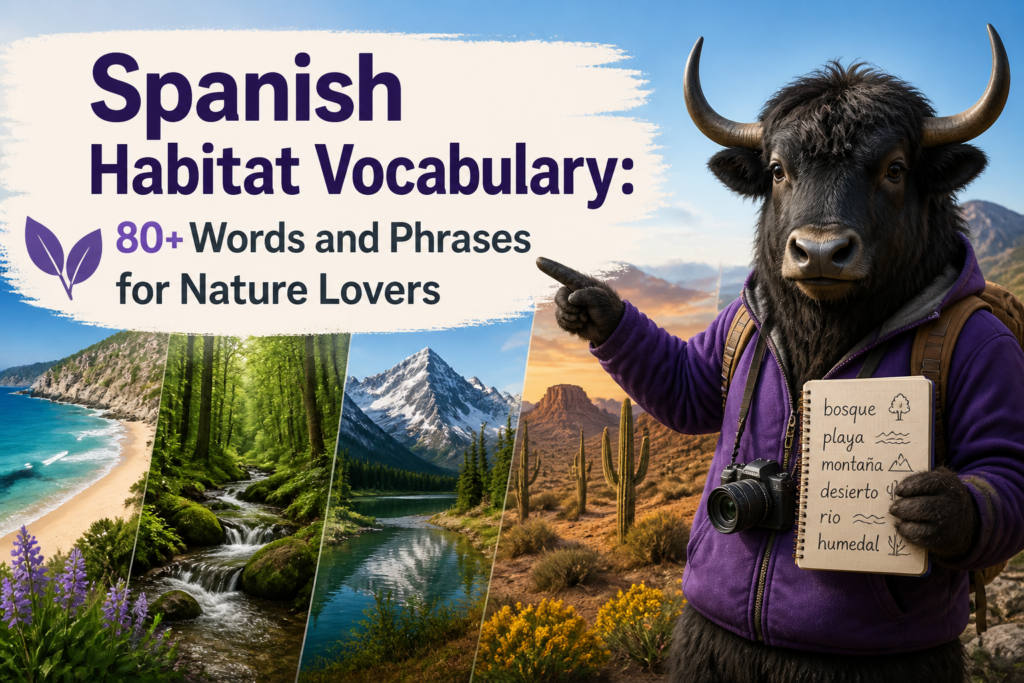
Habitats Vocabulary in Spanish: 80+ Nature Words & Phrases (So You Can Stop Saying “That Place”)
If you’ve ever pointed at a forest, a wetland, or some mysterious patch of green and said, “that place,” this lesson is here to rescue you from linguistic underachievement. Spanish has plenty of useful words for habitats, ecosystems, landscapes, and the living things that belong there.
This guide uses natural Latin American Spanish by default, with a few notes when Spain Spanish differs. By the end, you’ll be able to name common habitats, describe what grows or lives there, and sound much less like someone touring nature with a vague hand gesture.
For a wider Spanish-learning path, you can also check the main hub at Learn Spanish.
Quick Starter: The Most Useful Habitat Words
| Spanish | Pronunciation | Meaning | Example Sentence | Translation | Learner Note |
|---|---|---|---|---|---|
| el bosque | el BOHS-keh | forest, woods | El bosque está lleno de vida. | The forest is full of life. | Very common. Use for general forest/woodland. |
| la selva | lah SEL-vah | jungle, rainforest | La selva amazónica es enorme. | The Amazon rainforest is huge. | Often means tropical jungle or rainforest. |
| el desierto | el deh-SYEHR-toh | desert | El desierto tiene noches frías. | The desert has cold nights. | Classic habitat word. No surprises, thankfully. |
| la montaña | lah mohn-TAH-nyah | mountain | Vivimos cerca de la montaña. | We live near the mountain. | Also used for mountainous areas. |
| el río | el REE-oh | river | El río atraviesa el valle. | The river crosses the valley. | Accent mark matters: río = river. |
| el lago | el LAH-goh | lake | Hay un lago cerca del pueblo. | There is a lake near the town. | Useful for travel, geography, and nature talk. |
| la playa | lah PLYAH-yah | beach | La playa está tranquila hoy. | The beach is quiet today. | Common in both Latin America and Spain. |
| el pantano | el pahn-TAH-noh | swamp, marsh | El pantano tiene mucha vegetación. | The swamp has a lot of vegetation. | Can sound negative in some contexts. |
Small note, because Spanish loves being just slightly annoying: selva is not the same as bosque. A bosque is a forest or woods in general, while selva usually suggests dense tropical rainforest or jungle.
Yak wisdom: If a habitat has too many vines, humidity, and things trying to bite you, selva is probably the word you want.
Habitats And Landscapes: Core Vocabulary
These are the words you’ll use when talking about ecosystems, geography, travel, documentaries, or that one hiking friend who uses the word “pristine” a little too often.
| Spanish | Pronunciation | Meaning | Example Sentence | Translation | Learner Note |
|---|---|---|---|---|---|
| el bosque | el BOHS-keh | forest | Hay ciervos en el bosque. | There are deer in the forest. | General and very flexible. |
| la selva | lah SEL-vah | jungle, rainforest | La selva tropical recibe mucha lluvia. | The tropical rainforest gets a lot of rain. | Use for tropical regions. |
| la pradera | lah prah-DEH-rah | meadow, prairie | Las flores crecen en la pradera. | The flowers grow in the meadow. | Can also mean prairie depending on context. |
| la sabana | lah sah-BAH-nah | savanna | Los elefantes viven en la sabana. | Elephants live in the savanna. | Also used in geography and ecology. |
| el desierto | el deh-SYEHR-toh | desert | El desierto puede ser muy caluroso. | The desert can be very hot. | Good for climate and habitat descriptions. |
| la tundra | lah TOON-drah | tundra | La tundra tiene vegetación baja. | The tundra has low vegetation. | Usually used in science or geography contexts. |
| la costa | lah KOH-stah | coast | Vivimos en la costa del Pacífico. | We live on the Pacific coast. | Great for places near the sea. |
| la orilla | lah oh-REE-yah | shore, bank, edge | Hay plantas en la orilla del río. | There are plants on the riverbank. | Useful for rivers, lakes, and seas. |
| el arrecife | el ah-rreh-SEE-feh | reef | El arrecife protege a muchas especies. | The reef protects many species. | r is rolled lightly in arrecife. |
| el manglar | el mahn-GLAHR | mangrove | El manglar es un hábitat muy importante. | The mangrove is a very important habitat. | Common in environmental topics. |
| el humedal | el oo-meh-DAHL | wetland | El humedal alberga muchas aves. | The wetland shelters many birds. | Very useful in ecology writing. |
| el pantano | el pahn-TAH-noh | swamp, marsh | El pantano está cubierto de plantas. | The swamp is covered with plants. | Often more “swampy” than humedal. |
| la montaña | lah mohn-TAH-nyah | mountain | La montaña está nevada. | The mountain is snowy. | Good for altitude and landscape talk. |
| el valle | el BAH-yeh | valley | El valle es fértil. | The valley is fertile. | ll sounds like “y” in most Latin American accents. |
| la llanura | lah yah-NOO-rah | plain, flatland | La llanura se extiende por kilómetros. | The plain stretches for kilometers. | The double ll can sound like “y.” |
Water Habitats And Coastal Words
Water habitats show up everywhere in Spanish descriptions: rivers, lakes, wetlands, coasts, and marine ecosystems. If you like nature documentaries, you’ll see these constantly.
| Spanish | Pronunciation | Meaning | Example Sentence | Translation | Learner Note |
|---|---|---|---|---|---|
| el río | el REE-oh | river | El río desemboca en el mar. | The river flows into the sea. | Useful verb: desembocar = to flow into. |
| el lago | el LAH-goh | lake | Nadamos en el lago por la tarde. | We swam in the lake in the afternoon. | Simple and common. |
| la laguna | lah lah-GOO-nah | lagoon, small lake | La laguna está rodeada de árboles. | The lagoon is surrounded by trees. | Can mean lagoon or a small lake/pond in some places. |
| el arroyo | el ah-RROH-yoh | stream, creek | El arroyo baja de la montaña. | The stream comes down from the mountain. | rr is rolled more strongly. |
| la cascada | lah kahs-KAH-dah | waterfall | La cascada es un lugar turístico. | The waterfall is a tourist spot. | Common in travel and nature descriptions. |
| la costa | lah KOH-stah | coast | La costa tiene muchas playas. | The coast has many beaches. | Very practical. Use it a lot. |
| la orilla | lah oh-REE-yah | shore, bank, edge | Hay piedras en la orilla del lago. | There are stones on the lake shore. | More specific than costa. |
| el mar | el mahr | sea | El mar está tranquilo hoy. | The sea is calm today. | In many places, people say mar and océano differently. |
| el océano | el oh-SEH-ah-noh | ocean | El océano cubre gran parte del planeta. | The ocean covers much of the planet. | More scientific and global. |
| el arrecife | el ah-rreh-SEE-feh | reef | Los corales viven en el arrecife. | Corals live on the reef. | Great for marine biology vocabulary. |
| el estuario | el es-too-AH-ryoh | estuary | El estuario mezcla agua dulce y salada. | The estuary mixes fresh and salt water. | More academic, but very useful. |
| el manglar | el mahn-GLAHR | mangrove | El manglar protege la costa. | The mangrove protects the coast. | Important environmental word. |
Forest And Plant Habitat Words
This section is especially helpful if you want to describe what grows in a habitat. Spoiler: Spanish does not require you to say “thingy” every time you forget the word for shrub.
| Spanish | Pronunciation | Meaning | Example Sentence | Translation | Learner Note |
|---|---|---|---|---|---|
| el árbol | el AHR-bol | tree | Ese árbol es muy alto. | That tree is very tall. | Accent mark on á; stress is not on the second syllable. |
| el tronco | el TRON-koh | trunk, tree trunk | El tronco está cubierto de musgo. | The trunk is covered in moss. | Also means “log” or “torso” in other contexts. |
| la rama | lah RAH-mah | branch | Un pájaro se posó en la rama. | A bird landed on the branch. | Very useful in nature descriptions. |
| la hoja | lah OH-hah | leaf | La hoja es verde y grande. | The leaf is green and big. | Silent h; start with a breathy “o.” |
| la corteza | lah kohr-TEH-sah | bark | La corteza del árbol es rugosa. | The tree bark is rough. | Good for plant descriptions. |
| el arbusto | el ahr-BOOS-toh | shrub, bush | El arbusto crece junto al sendero. | The shrub grows next to the path. | Useful in gardens and wild areas. |
| la hierba | lah YER-bah | grass, herb | La hierba está húmeda por la mañana. | The grass is wet in the morning. | Also means “herb” depending on context. |
| el musgo | el MOOS-goh | moss | Hay musgo sobre las piedras. | There is moss on the stones. | Common in damp forest areas. |
| la flor | lah flor | flower | La flor abre por la mañana. | The flower opens in the morning. | Simple and versatile. |
| la raíz | lah rah-EES | root | La raíz absorbe agua. | The root absorbs water. | Accent mark changes stress: raíz. |
| la semilla | lah seh-MEE-yah | seed | La semilla necesita agua para crecer. | The seed needs water to grow. | ll often sounds like “y.” |
| el pasto | el PAHS-toh | grass, pasture | El pasto está seco. | The grass is dry. | Common in Latin America. In Spain, césped is more common for lawn. |
| el césped | el SEHS-ped | lawn, grass | No pises el césped. | Don’t step on the grass. | Very common in Spain; also understood in Latin America. |
| el cactus | el KAK-toos | cactus | El cactus guarda agua en sus tejidos. | The cactus stores water in its tissues. | Plural: los cactus or los cactos. |
Animal Habitat Words You’ll Actually Use
Habitats and animals go together like lluvia and paraguas: one tends to make you need the other. If you want animal vocabulary too, there’s a related guide on animal names in Spanish.
| Spanish | Pronunciation | Meaning | Example Sentence | Translation | Learner Note |
|---|---|---|---|---|---|
| el hábitat | el AH-bee-tat | habitat | Ese animal perdió su hábitat. | That animal lost its habitat. | Accent mark keeps stress on the first syllable. |
| la especie | lah ES-peh-syeh | species | Esta especie vive en la selva. | This species lives in the jungle. | Very common in science and nature articles. |
| la fauna | lah FOW-nah | animal life, fauna | La fauna de la región es muy variada. | The fauna of the region is very varied. | Formal or academic, but very useful. |
| la flora | lah FLOH-rah | plant life, flora | La flora local cambia con la altitud. | The local flora changes with altitude. | Pairs naturally with fauna. |
| la biodiversidad | lah bee-oh-dee-bohr-see-DAHD | biodiversity | La biodiversidad es muy alta en esta zona. | Biodiversity is very high in this area. | Common in environmental and conservation writing. |
| la población | lah poh-blah-SYOHN | population | La población de aves ha bajado. | The bird population has decreased. | Useful for wildlife counts and ecology. |
| el nido | el NEE-doh | nest | El nido está en el árbol. | The nest is in the tree. | Great for bird-related sentences. |
| la madriguera | lah mah-dree-GWEH-rah | burrow, den | El conejo vive en una madriguera. | The rabbit lives in a burrow. | Less common, but very useful in animal contexts. |
| el refugio | el reh-FOO-hyoh | shelter, refuge | El refugio protege a los animales. | The shelter protects the animals. | Can be literal shelter or protected area. |
| la manada | lah mah-NAH-dah | herd, pack | La manada cruza el campo. | The herd crosses the field. | Used for groups of animals. |
| la colonia | lah koh-LOH-nyah | colony | La colonia de pingüinos vive cerca del mar. | The colony of penguins lives near the sea. | Useful for birds, insects, and marine animals. |
| el ecosistema | el eh-koh-SEE-steh-mah | ecosystem | El ecosistema necesita equilibrio. | The ecosystem needs balance. | Very common in educational and environmental talk. |
Describing Nature: Handy Adjectives And Verbs
Once you know the habitat word, you’ll want to say what it’s like. Spanish adjectives usually agree in gender and number, so bosque húmedo and selva húmeda both work, but the adjective changes with the noun.
| Spanish | Pronunciation | Meaning | Example Sentence | Translation | Learner Note |
|---|---|---|---|---|---|
| húmedo / húmeda | OO-meh-doh / OO-meh-dah | humid, damp | La selva es húmeda todo el año. | The jungle is humid all year. | The h is silent. |
| seco / seca | SEH-koh / SEH-kah | dry | El clima está seco. | The climate is dry. | Very common for deserts and droughts. |
| verde | BEHR-deh | green | La zona es muy verde. | The area is very green. | Same form for masculine and feminine. |
| fértil | FEHR-til | fertile | El suelo es fértil. | The soil is fertile. | Often used for valleys and farmland. |
| rocoso / rocosa | roh-KOH-soh / roh-KOH-sah | rocky | La costa es rocosa. | The coast is rocky. | From roca = rock. |
| arenoso / arenosa | ah-reh-NOH-soh / ah-reh-NOH-sah | sandy | La playa tiene suelo arenoso. | The beach has sandy ground. | Useful for beaches and deserts. |
| denso / densa | DEHN-soh / DEHN-sah | dense | La vegetación es densa. | The vegetation is dense. | Very common in habitat descriptions. |
| salado / salada | sah-LAH-doh / sah-LAH-dah | salty | El agua es salada. | The water is salty. | Useful in marine contexts. |
| dulce | DOOL-seh | fresh, freshwater | El río tiene agua dulce. | The river has fresh water. | Not “sweet” here; context matters. |
| frondoso / frondosa | fron-DOH-soh / fron-DOH-sah | leafy, lush | Es un bosque frondoso. | It is a lush forest. | Lovely word. Very nature-documentary-ish. |
| proteger | proh-teh-HEHR | to protect | Debemos proteger los humedales. | We must protect wetlands. | Infinitive form; common in public messages. |
| crecer | kreh-SEHR | to grow | Las plantas crecen rápido aquí. | The plants grow quickly here. | Useful in all habitat contexts. |
| albergar | ahl-behr-GAHR | to shelter, to house | El bosque alberga muchas especies. | The forest shelters many species. | More formal, great for writing. |
| habitar | ah-bee-TAHR | to inhabit, live in | Muchas aves habitan esta zona. | Many birds inhabit this area. | More academic than vivir en. |
Common Phrases For Talking About Habitats
These are the phrases that help you build real sentences instead of just naming random nature stuff like a very enthusiastic museum label.
| Spanish | Pronunciation | Meaning | Example Sentence | Translation | Learner Note |
|---|---|---|---|---|---|
| viven en | BEE-ven en | they live in/on | Los monos viven en la selva. | The monkeys live in the jungle. | Use with people, animals, and groups. |
| crecen en | KREH-sen en | they grow in | Las flores crecen en la pradera. | The flowers grow in the meadow. | Good for plants and crops. |
| se encuentra | seh ehn-KWEN-trah | is found | Este animal se encuentra en zonas húmedas. | This animal is found in humid areas. | Very useful in formal descriptions. |
| es hogar de | es oh-GAHR deh | is home to | El arrecife es hogar de muchos peces. | The reef is home to many fish. | Beautiful and natural in Spanish. |
| está cubierto de | es-TAH koo-BYEHR-toh deh | is covered with | El suelo está cubierto de hojas. | The ground is covered with leaves. | Great for describing habitats visually. |
| depende de | deh-PEN-deh deh | depends on | La fauna depende del agua. | The fauna depends on water. | Useful in ecology and science. |
| está protegido | es-TAH proh-teh-HEE-doh | is protected | El humedal está protegido. | The wetland is protected. | Good for conservation vocabulary. |
| tiene mucha vegetación | TYEH-neh MOO-chah beh-heh-tah-SYOHN | has a lot of vegetation | La selva tiene mucha vegetación. | The jungle has a lot of vegetation. | Very common phrase. Keep it handy. |
| es una zona seca | es OO-nah SOH-nah SEH-kah | it is a dry area | Es una zona seca y caliente. | It is a dry and hot area. | Useful for climate and habitat talk. |
| es una zona húmeda | es OO-nah SOH-nah OO-meh-dah | it is a humid area | Es una zona húmeda con mucha lluvia. | It is a humid area with a lot of rain. | Remember the silent h. |
| hay mucha biodiversidad | ay MOO-chah bee-oh-dee-bohr-see-DAHD | there is a lot of biodiversity | En esta región hay mucha biodiversidad. | There is a lot of biodiversity in this region. | Great phrase for eco-travel and science. |
| es un ecosistema frágil | es oon eh-koh-SEE-steh-mah FRAH-hil | it is a fragile ecosystem | El arrecife es un ecosistema frágil. | The reef is a fragile ecosystem. | g before i sounds like a soft English “h.” |
Regional Note: Latin America Vs Spain
Most of these habitat words are shared across the Spanish-speaking world. Still, a few details are worth knowing so you don’t get blindsided by vocabulary variety, which is a very Spanish thing to do, apparently.
| Word | Latin American Spanish | Spain Spanish | Note |
|---|---|---|---|
| césped | understood, but less common in some countries | very common for lawn/grass | Use pasto more often in Latin America. |
| pasto | very common | understood, but less common | Often means grass or pasture. |
| selva | common for jungle/rainforest | also common | Very widely understood. |
| bosque | common for forest/woods | common for forest/woods | Safe, standard choice everywhere. |
| comarca | rare in everyday speech | more common in some regional/geographic contexts | Usually means district or region, not a habitat word you need early on. |
Common Mistakes And Easy Fixes
- Mixing up bosque and selva → Bosque is forest/woods. Selva is jungle or rainforest.
- Forgetting gender → el bosque, la selva, la montaña. The article matters.
- Using English word order too much → In Spanish, adjectives often come after the noun: bosque húmedo, agua dulce.
- Pronouncing silent h → hábitat and húmedo start with a breath, not a hard sound.
- Confusing río and rio → río means river. rio is “I laugh.” Tiny accent, huge difference. Charming, really.
- Using mar for every body of water → Choose río, lago, laguna, océano, or costa depending on context.
- Overusing hay → Hay is very useful, but mix in se encuentra, vive, and crece for variety.
If you want a more formal definition of habitat vocabulary, a safe boring reference is the Real Academia Española entry for hábitat. It’s not glamorous, but it does the job.
Mini Practice
Try these quick exercises. No pressure. Just enough pressure to keep your brain awake.
| Task | Prompt | Answer |
|---|---|---|
| 1 | Translate: “The forest is full of life.” | El bosque está lleno de vida. |
| 2 | Translate: “The wetlands are protected.” | Los humedales están protegidos. |
| 3 | Choose the better word: forest or jungle? “La selva amazónica” = ____ | jungle / rainforest |
| 4 | Fill in the blank: La ___ es muy húmeda. | selva |
| 5 | Fill in the blank: El río tiene agua ____. | dulce |
| 6 | Translate: “Many birds live in the mangrove.” | Muchas aves viven en el manglar. |
| 7 | Correct the sentence: El hábitat estan protegido. | El hábitat está protegido. |
Quick Reference Summary
- Forest: el bosque
- Jungle/rainforest: la selva
- Wetland: el humedal
- Swamp/marsh: el pantano
- River: el río
- Lake: el lago
- Coast: la costa
- Ocean: el océano
- Habitat: el hábitat
- Fauna / flora: animal life / plant life
- Protected area: área protegida
- Biodiversity: biodiversidad
- Is home to: es hogar de
- Is found in: se encuentra en
- Grows in: crece en
Need a broader nature vocabulary boost? The related lessons on weather in Spanish and vegetables in Spanish pair nicely with habitat words, because nature rarely shows up alone and politely introduces itself.
Yak takeaway: Once you know words like bosque, selva, humedal, and hábitat, you can talk about nature in Spanish with actual precision instead of waving at the landscape and hoping for the best.