Playgrounds are basically tiny diplomacy summits with slides. One minute someone is asking for a turn, the next minute somebody is dramatically claiming the swing as their birthright. If you can talk about playground actions in Spanish, you can help kids play, share, wait, and make friends without needing a translation app doing cartwheels in the dirt.
For the broader learning path, visit our parent guide.
In this guide, you’ll learn practical Spanish playground vocabulary for real-life use with kids: equipment, actions, safety phrases, and a few useful commands and social expressions. The Spanish here is standard and widely understood across Latin America, with a couple of notes where Spain Spanish differs.
By the end, you’ll be able to talk about playground equipment, give simple instructions, and handle the classic kid situations: “My turn,” “Be careful,” and “No pushing, please.” Tiny vocabulary, big survival energy.
Quick Playground Starter Phrases
Here are the most useful phrases first. These are the ones that actually get used in parks, schoolyards, and after-school chaos. If you only learn a few today, start here.
| Spanish | Pronunciation | Meaning | Example Sentence | Translation | Learner Note |
|---|---|---|---|---|---|
| el parque | el PAR-keh | the park / playground | Vamos al parque después de la escuela. | We’re going to the park after school. | In many places, parque can mean both “park” and “playground area.” |
| el patio de juegos | el PA-tyoh deh HWEH-gos | the playground | Los niños están en el patio de juegos. | The children are at the playground. | Very clear and common. A safe, literal term. |
| jugar | hoo-GAR | to play | Vamos a jugar afuera. | Let’s play outside. | Infinitive form. Great for commands and plans. |
| sube | SOO-beh | climb up / get on | Sube con cuidado. | Climb up carefully. | Used for ladders, slides, and climbing frames. |
| baja | BAH-hah | go down / get off | Baja despacio, por favor. | Come down slowly, please. | Useful for slides and steps. |
| es tu turno | es too TOOR-noh | it’s your turn | Es tu turno en el columpio. | It’s your turn on the swing. | Very common with games and sharing equipment. |
| mi turno | mee TOOR-noh | my turn | ¡Mi turno ahora! | My turn now! | Kids will say this a lot. Brace yourself. |
| espera | es-PEH-rah | wait | Espera un momento. | Wait a moment. | Simple and very useful. From esperar. |
| con cuidado | kohn kwee-DAH-doh | carefully | Camina con cuidado. | Walk carefully. | Great safety phrase with almost any verb. |
| no empujes | noh em-POO-hes | don’t push | No empujes a tu hermano. | Don’t push your brother. | Empujar means “to push.” Useful on busy playgrounds. |
| ten cuidado | ten kwee-DAH-doh | be careful | Ten cuidado en las escaleras. | Be careful on the stairs. | Common, neutral, and practical. |
| ¡bien hecho! | byen E-choh | well done! | ¡Bien hecho, subiste solo! | Well done, you climbed up by yourself! | Praise is powerful. Annoyingly so. Use it freely. |
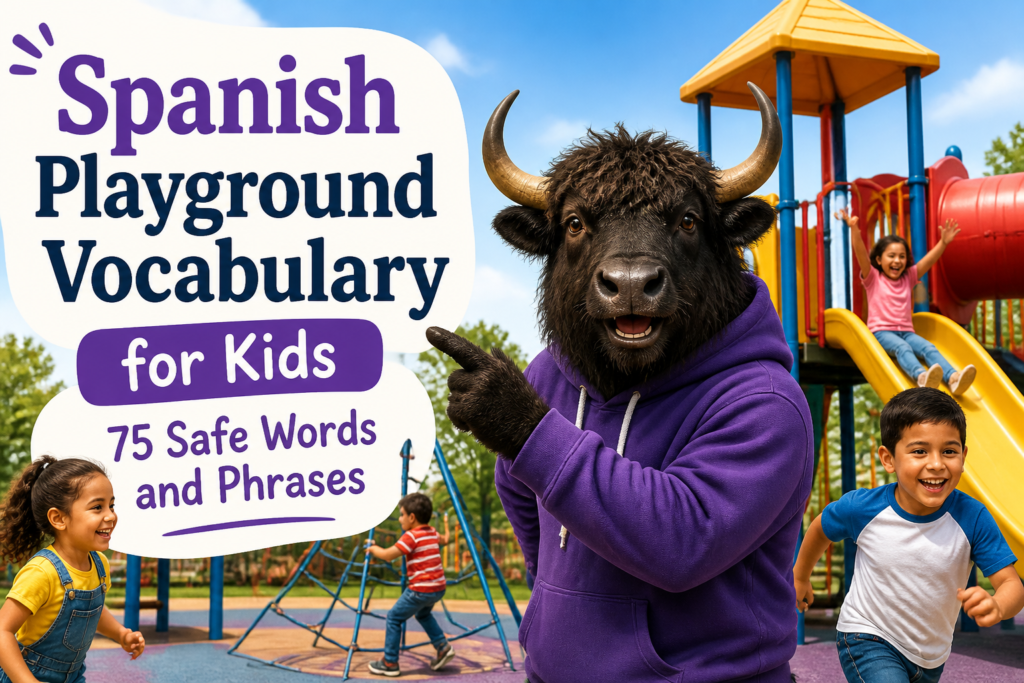
75 Kid-Safe Playground Words And Phrases
Below you’ll find the full set of kid-safe playground vocabulary. The words are grouped so they’re easier to remember, because one giant list is just a fast track to brain fog.
1) Playground Places And Equipment
| Spanish | Pronunciation | Meaning | Example Sentence | Translation | Learner Note |
|---|---|---|---|---|---|
| el parque | el PAR-keh | park / playground | El parque está lleno de niños. | The park is full of children. | Very common general word. |
| el patio de juegos | el PA-tyoh deh HWEH-gos | playground | El patio de juegos tiene muchas cosas. | The playground has many things. | Clear and neutral. |
| el columpio | el koh-LOOM-pyoh | swing | El columpio está ocupado. | The swing is occupied. | One of the first playground words kids learn. |
| el tobogán | el toh-boh-GAN | slide | Quiero bajar por el tobogán. | I want to go down the slide. | Ojo: stress is on the last syllable. |
| el sube y baja | el SOO-beh ee BAH-hah | seesaw | Los niños juegan en el sube y baja. | The children play on the seesaw. | Literal, easy, and descriptive. |
| la resbaladilla | lah res-bah-lah-DEE-yah | slide | La resbaladilla está mojada. | The slide is wet. | More common in Mexico and some parts of Latin America. |
| la escalera | lah es-kah-LEH-rah | stairs / ladder | Sube por la escalera despacio. | Go up the ladder slowly. | Context tells you if it’s stairs or a ladder. |
| las barras | lahs BAH-rahs | bars / monkey bars | Las barras son altas. | The monkey bars are high. | Often used for playground climbing bars. |
| la cuerda | lah KWEHR-dah | rope | Agárrate de la cuerda. | Hold on to the rope. | Good for climbing or swing sets. |
| el balancín | el bah-lahn-SEEN | teeter-totter / seesaw | El balancín se mueve rápido. | The seesaw moves fast. | Less common than sube y baja in everyday speech. |
| el aro | el AH-roh | ring / hoop | El niño saltó dentro del aro. | The child jumped inside the hoop. | Meaning depends on context. |
| el túnel | el TOO-nehl | tunnel | Hay un túnel pequeño en el parque. | There is a small tunnel at the park. | The accent mark matters: túnel. |
2) Playground Actions And Movement
| Spanish | Pronunciation | Meaning | Example Sentence | Translation | Learner Note |
|---|---|---|---|---|---|
| jugar | hoo-GAR | to play | Vamos a jugar con la pelota. | Let’s play with the ball. | Basic verb you’ll use constantly. |
| correr | koh-RER | to run | No corras cerca de los columpios. | Don’t run near the swings. | Use for movement and safety instructions. |
| saltar | sal-TAR | to jump | Los niños saltan en el césped. | The children jump on the grass. | Easy verb, very common in playground talk. |
| subir | soo-BEER | to go up / climb up | Ella puede subir sola. | She can climb up by herself. | Often used with stairs, slides, and climbing frames. |
| bajar | bah-HAR | to go down | Vamos a bajar por aquí. | Let’s go down this way. | Useful in directions and safety. |
| colgarse | kohl-GAR-seh | to hang on | Se colgó de las barras. | He hung from the bars. | Reflexive verb. Great for monkey bars. |
| agarrar | ah-gah-RAR | to grab / hold | Agárrate fuerte. | Hold on tight. | Very useful with children. |
| trepar | treh-PAR | to climb | Le gusta trepar al árbol. | He likes to climb the tree. | Common for climbing trees and structures. |
| deslizarse | des-lee-SAR-seh | to slide down | Se deslizó rápido por el tobogán. | She slid down the slide quickly. | More descriptive than bajar. |
| esperar | es-peh-RAR | to wait | Espera tu turno, por favor. | Wait your turn, please. | Polite and useful in almost any situation. |
| tomar turnos | toh-MAR TOOR-nos | to take turns | Los niños toman turnos en el columpio. | The children take turns on the swing. | Great social phrase for sharing equipment. |
| andar | ahn-DAR | to walk / go around | Anda con cuidado. | Walk carefully. | Very common in everyday Latin American Spanish. |
3) Safety And Careful Warnings
| Spanish | Pronunciation | Meaning | Example Sentence | Translation | Learner Note |
|---|---|---|---|---|---|
| ten cuidado | ten kwee-DAH-doh | be careful | Ten cuidado en las escaleras. | Be careful on the stairs. | Neutral and very common. |
| con cuidado | kohn kwee-DAH-doh | carefully | Camina con cuidado. | Walk carefully. | Often added to commands. |
| no corras | noh KOH-rahs | don’t run | No corras cerca de la calle. | Don’t run near the street. | Simple and direct. |
| no empujes | noh em-POO-hes | don’t push | No empujes a nadie. | Don’t push anyone. | Good for social rules. |
| no te caigas | noh teh KAI-gahs | don’t fall | Ten cuidado y no te caigas. | Be careful and don’t fall. | Common in real life, especially with little kids. |
| espera aquí | es-PEH-rah ah-KEE | wait here | Espera aquí mientras hablo. | Wait here while I talk. | Useful at parks, bathrooms, and school pick-up. |
| agárrate fuerte | ah-GAH-rah-teh FWEHR-teh | hold on tight | Agárrate fuerte del columpio. | Hold on tight to the swing. | Great for climbing and swings. |
| despacio | des-PAH-syoh | slowly | Baja despacio. | Come down slowly. | Very handy with children. Very handy with adults too, honestly. |
| cuidado con… | kwee-DAH-doh kohn | watch out for… | Cuidado con el piso mojado. | Watch out for the wet floor. | Very flexible warning phrase. |
| no toques | noh TOH-kes | don’t touch | No toques esa parte. | Don’t touch that part. | Useful for rules and safety. |
| sal con cuidado | sahl kohn kwee-DAH-doh | come out carefully | Sal con cuidado del túnel. | Come out carefully from the tunnel. | Handy for play structures. |
| mira | MEE-rah | look | Mira por dónde vas. | Watch where you’re going. | Can be a warning or a friendly instruction. |
4) Sharing, Turns, And Friendly Social Phrases
| Spanish | Pronunciation | Meaning | Example Sentence | Translation | Learner Note |
|---|---|---|---|---|---|
| es tu turno | es too TOOR-noh | it’s your turn | Es tu turno de subir. | It’s your turn to climb. | Very common and useful. |
| mi turno | mee TOOR-noh | my turn | ¡Mi turno después! | My turn after that! | Useful in games and playground rotation. |
| te toca | teh TOH-kah | it’s your turn / your go | Te toca en el columpio. | It’s your turn on the swing. | Very natural in Latin America. |
| me toca | meh TOH-kah | it’s my turn / my go | Ahora me toca a mí. | Now it’s my turn. | Super common in everyday conversation. |
| espera un momento | es-PEH-rah oon moh-MEN-toh | wait a moment | Espera un momento, por favor. | Wait a moment, please. | Polite and calm. |
| ¿me dejas? | meh DEH-hahs | will you let me? | ¿Me dejas usar el columpio? | Will you let me use the swing? | Gentle way to ask for a turn. |
| ¿me prestas? | meh PRES-tahs | can I borrow / can you lend me? | ¿Me prestas la pelota? | Can I borrow the ball? | Useful with toys and balls. |
| por favor | por fah-VOR | please | Espera, por favor. | Wait, please. | Always useful. Never boring. Barely. |
| gracias | GRAH-syahs | thank you | Gracias por compartir. | Thank you for sharing. | Basic politeness is a superpower. |
| de nada | deh NAH-dah | you’re welcome | —Gracias. —De nada. | —Thank you. —You’re welcome. | Simple response to thanks. |
| ¿jugamos? | hoo-GAH-mos | shall we play? | ¿Jugamos en la arena? | Shall we play in the sand? | Friendly invitation using nosotros form. |
| vamos juntos | BAH-mos HOON-tos | let’s go together | Vamos juntos al tobogán. | Let’s go to the slide together. | Warm and friendly phrasing. |
5) People And Playground Words For Kids
| Spanish | Pronunciation | Meaning | Example Sentence | Translation | Learner Note |
|---|---|---|---|---|---|
| el niño | el NEE-nyoh | the boy / the child | El niño está jugando. | The boy is playing. | niño can mean “boy” or “child” in many contexts. |
| la niña | lah NEE-nyah | the girl | La niña quiere subir. | The girl wants to climb. | Feminine form of niño. |
| los niños | lohs NEE-nyohs | the children / boys | Los niños están corriendo. | The children are running. | Plural masculine or mixed group. |
| las niñas | lahs NEE-nyahs | the girls | Las niñas están en el columpio. | The girls are on the swing. | Plural feminine form. |
| amigo | ah-MEE-goh | friend | Mi amigo juega conmigo. | My friend plays with me. | Very common. Amiga is the feminine form. |
| amiga | ah-MEE-gah | friend (female) | Mi amiga me espera. | My friend waits for me. | Use when the friend is a girl or woman. |
| papá | pah-PAH | dad | Mi papá está aquí. | My dad is here. | Accent mark is important. |
| mamá | mah-MAH | mom | Mamá me llama. | Mom calls me. | Accent mark is important. |
| maestra | mah-ES-trah | female teacher | La maestra nos ayuda. | The teacher helps us. | Common in school and playground settings. |
| maestro | mah-ES-troh | male teacher | El maestro está mirando. | The teacher is watching. | Male teacher form. |
| adulto | ah-DOOL-toh | adult | Un adulto está cerca. | An adult is nearby. | Useful for safety phrases. |
| compañero | kom-pah-NYEH-roh | classmate / companion | Mi compañero comparte el juego. | My classmate shares the game. | Common in school settings. |
6) Playground Objects, Weather, And Extras
| Spanish | Pronunciation | Meaning | Example Sentence | Translation | Learner Note |
|---|---|---|---|---|---|
| la pelota | lah peh-LOH-tah | ball | La pelota rueda lejos. | The ball rolls far away. | Very common and kid-friendly. |
| la arena | lah ah-REH-nah | sand | Jugamos con arena. | We play with sand. | Common in sandbox play. |
| el balde | el BAL-deh | bucket | El balde está lleno de arena. | The bucket is full of sand. | Often used in Latin America. |
| la pala | lah PAH-lah | shovel / spade | La pala es pequeña. | The shovel is small. | Very useful for sand play. |
| la mochila | lah moh-CHEE-lah | backpack | Dejé la mochila en el banco. | I left the backpack on the bench. | Very common school word too. |
| el banco | el BAHN-koh | bench | Nos sentamos en el banco. | We sit on the bench. | Easy noun with lots of uses. |
| el árbol | el AHR-bol | tree | Hay sombra debajo del árbol. | There is shade under the tree. | The r is light, not rolled. |
| la sombra | lah SOM-brah | shade / shadow | Vamos a la sombra. | Let’s go to the shade. | Very useful in hot weather. |
| el sol | el sol | sun | El sol está fuerte hoy. | The sun is strong today. | Common in weather warnings. |
| el agua | el AH-gwah | water | Necesitamos agua. | We need water. | Feminine noun, but takes el in singular for sound reasons. |
| la cuerda para saltar | lah KWEHR-dah PAH-rah sahl-TAR | jump rope | Traje la cuerda para saltar. | I brought the jump rope. | Helpful if the playground includes rope games. |
| el balón | el bah-LOHN | ball | Jugamos con el balón. | We play with the ball. | Very common in Spain; in Latin America, pelota is often more general. |
Useful Notes On Pronunciation And Usage
Spanish is refreshingly honest about vowels: they stay pretty much the same every time. That helps a lot with kid vocabulary, because parque, niña, and pelota all sound clean and predictable once you get used to them.
Here are a few pronunciation details worth knowing for playground words:
- ñ sounds like the ny in “canyon”: niño, niña.
- ll can sound like “y” in most of Latin America: columpio has no ll, but words like llamar may show up in phrases like mamá me llama.
- j sounds like a strong breathy “h”: jugar, juegos.
- rr is rolled or trilled in words like correr.
- h is silent: hoy sounds like “oy,” not “hoi.”
- Spanish stress matters: tobogán, mamá, and papá all need that accent mark.
For a boring-but-useful reference on word meanings and spelling, you can check the Real Academia Española. Delightfully unexciting. Very trustworthy.
Common Mistakes And Easy Fixes
English speakers often make the same small mistakes with playground Spanish. Good news: they’re easy to fix, and the playground does not care about your perfectionism.
| Common Mistake | Better Spanish | Why It Matters |
|---|---|---|
| el parqueo for playground | el parque or el patio de juegos | parqueo usually means parking in some places. Not the same job at all. |
| la pelota for every ball in Spain | el balón for some sports contexts in Spain | In Latin America, pelota is often the safest general word. |
| Using yo jugar instead of yo juego | yo juego | Spanish verbs change form. English likes to keep things simple and then make them annoying in other ways. |
| Forgetting that niño changes to niños | niño / niños | Plural nouns usually end in -s or -es. |
| Using cuidado alone in all situations | ten cuidado, con cuidado, cuidado con… | The full phrase sounds more natural. |
| Translating “my turn” as mi vez | mi turno or me toca | Turno is the normal word for turns in games and lines. |
| Using sube like a noun | el columpio, el tobogán, sube as a command | Sube means “climb up” or “get on,” not “the climby thing.” |
| Dropping the accent in mamá and papá | mamá, papá | The accent shows the stress and keeps the word clear. |
Mini Practice: Say It The Playground Way
Try these quick practice rounds. No need to overthink them. Spanish likes repetition more than perfection.
Change The Sentence
Swap the English idea into Spanish using the word bank above.
- It’s your turn. → Es tu turno.
- Be careful. → Ten cuidado.
- Don’t push. → No empujes.
- Let’s play. → Vamos a jugar.
- Wait a moment. → Espera un momento.
Fill In The Missing Word
- ___ cuidado → Ten cuidado
- ___ turno → Mi turno
- Es tu ___ → turno
- No ___ → corras
- Vamos al ___ → parque
Say It Out Loud
Practice these slowly. Clear Spanish vowels help a lot:
- el columpio — el koh-LOOM-pyoh
- la resbaladilla — lah res-bah-lah-DEE-yah
- ten cuidado — ten kwee-DAH-doh
- es tu turno — es too TOOR-noh
- no corras — noh KOH-rahs
Latin American Spanish Vs Spain Spanish
Most of the words above work across the Spanish-speaking world, but a few labels vary by region. Here are the main ones to watch.
| Concept | Latin America | Spain | Note |
|---|---|---|---|
| playground | el patio de juegos, el parque | el parque, el parque infantil | parque infantil is very common in Spain. |
| slide | el tobogán, la resbaladilla in some places | el tobogán | resbaladilla is especially common in Mexico. |
| ball | la pelota | el balón in sports contexts | Pelota is still understood in Spain. |
| take turns | tomar turnos, me toca | turnarse, me toca | Both are natural; me toca is very common everywhere. |
| kid | niño / niña | niño / niña | No drama here. Spanish occasionally allows itself to be cooperative. |
If you want to build more kid-friendly Spanish fast, the next good stops are Toys and Games in Spanish, Animal Names in Spanish, and 100 Essential Spanish Words and Phrases. They fit together nicely, like words in a very well-behaved backpack.
Yak takeaway: when you know playground Spanish, you can handle the essentials: play, wait, share, climb, and be careful. That’s not just vocabulary. That’s peacekeeping with slides.