


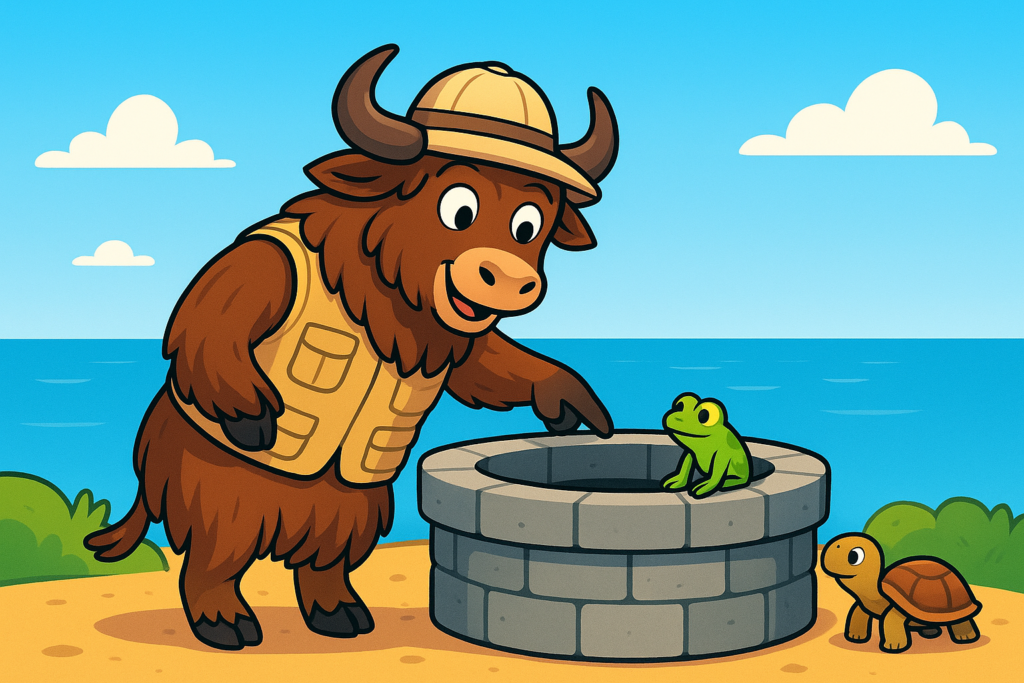
Welcome to this gentle retelling of a wise old fable! Our story follows a little frog who lives at the bottom of a well. He is very proud of his home and believes there is no place better or bigger in the whole world. One day, a sea turtle comes to visit, and the frog discovers that his tiny, watery world is just a small part of something far greater.
This A1 beginner-level Chinese graded reader is designed for learners who are just starting their journey. You'll meet friendly characters, read simple sentences, and pick up useful words like 'frog,' 'well,' and 'sea.' Every word is clickable for instant help, and you can listen to the story audio as many times as you like. Look inside for short lesson notes and a free, no-pressure reading experience.
一口井里住着一只。
青蛙很。他:"这是我的井!井很大!"
一天,。乌龟说:"你好!"
青蛙说:"你看!我天。天很。"
乌龟说:"我海。海很很大。"
青蛙很。他:"海很大,我的井很小。"
青蛙说:"我海!"
A frog lives in a well.
The frog is very happy. He says, "This is my well! The well is big!"
One day, a turtle comes to the well. The turtle says, "Hello!"
The frog says, "Look! I see the sky. The sky is small."
The turtle says, "I see the sea. The sea is very, very big."
The frog is surprised. He thinks, "The sea is big, my well is small."
The frog says, "I want to see the sea!"
Our story introduced a few simple Chinese words for places and animals. These are great for describing the world around you, and you'll hear them often in everyday talk.
- 井 (jǐng) - well
- 海 (hǎi) - sea
- 天 (tiān) - sky
- 青蛙 (qīngwā) - frog
- 乌龟 (wūguī) - turtle
In Chinese, adjectives are often joined with 很 (hěn), even when you just mean "is big" rather than "is very big." For example, the frog says 天很小 (tiān hěn xiǎo) - "the sky is small." The turtle replies 海很大很大 (hǎi hěn dà hěn dà) - "the sea is very, very big." Repeating the adjective makes it even stronger.
- 很大 (hěn dà) - big / very big
- 很小 (hěn xiǎo) - small / very small
- Repeating an adjective doubles the intensity
The frog proudly declares 这是我的井 (zhè shì wǒ de jǐng) - "This is my well!" Here, 这 (zhè) means "this," 是 (shì) is "is," and 我的 (wǒ de) means "my." The particle 的 (de) shows possession, and you can use it with other pronouns too.
- 这是我的___ (zhè shì wǒ de ___) - This is my ___
- 你的 (nǐ de) - your
- Try: 这是我的家 (zhè shì wǒ de jiā) - This is my home
Now you can describe your own space! Look around and make sentences with 这, 很, and 的. Just like the frog discovered the vast sea, every new word opens a bigger world. Take a small hop beyond your "well" and keep exploring.
- Challenge: Describe your room in Chinese!
The Frog at the Bottom of the Well comes from the Chinese / idiom story tradition and is best known as a idiom/fable. This Yak Yacker article is an original learner retelling based on Ancient Chinese idiom story; public domain, so the wording here is simplified for modern learners rather than copied from one old edition.
Older printings, translations, and retellings of this story can vary quite a bit. The original audience was usually kids/general, but this version is adapted for A1 Beginner learners studying Simplified Chinese. Very clear moral; good for place/size vocabulary.
If you want to look into the source tradition, start with Wikisource.
If you want to keep going, browse more in our Simplified Chinese section and review the HSK 1 Vocabulary List. After that, try Essential Chinese Grammar Words for another useful next step.