Japanese counters look scary at first. A tiny word changes depending on whether you are counting people, books, flat things, long thin things, animals, or cups of tea. Very polite of Japanese to make counting feel like a quiz show.
But here is the good news: you do not need to memorize every counter on day one. You only need a small starter set, a smart way to notice patterns, and enough practice to stop freezing when a number appears. This article shows you how to survive counters without turning your brain into a flashcard factory.
For a bigger picture on Japanese learning, you can also visit the Japanese learning hub. And yes, counters are one of those topics that suddenly make Japanese feel “real.” Once you start noticing them, you see them everywhere.
What A Counter Actually Is
A counter is a word that tells you what kind of thing you are counting. In English, we usually just say “three books” or “two people.” In Japanese, the counter often changes the number form too.
That means you do not just learn numbers. You learn numbers plus the type of thing. Annoying? A little. Logical? Also yes.
| Kanji | Rōmaji | English Meaning | Example (Kanji) | Example (Rōmaji) | Translation (EN) |
|---|---|---|---|---|---|
| 一つ | hitotsu | one thing; general counter for small simple items | りんごを一つください。 | Ringo o hitotsu kudasai. | Please give me one apple. |
| 二人 | futari | two people | 二人で行きます。 | Futari de ikimasu. | We will go as two people. |
| 三冊 | sansatsu | three books; magazine-like bound items | 本を三冊買いました。 | Hon o sansatsu kaimashita. | I bought three books. |
| 四本 | yon-hon | four long, thin items | 鉛筆を四本ください。 | Enpitsu o yon-hon kudasai. | Please give me four pencils. |
If you want a simple reference later, the guide on common Japanese counters is a solid companion. No dramatic lore. Just useful counter survival gear.
The Smart Way To Learn Counters
Do not try to learn every counter at once. That is how learners end up knowing 十本 and panicking when they need to count socks. Instead, group counters by how often you will use them.
- People → 一人 (hitori), 二人 (futari), then the regular pattern for 3 and up
- Small objects → 一つ (hitotsu), 二つ (futatsu)
- Books and magazines → 一冊 (issatsu), 二冊 (nisatsu)
- Long thin things → 一本 (ippon), 二本 (nihon)
- Flat things → 一枚 (ichimai), 二枚 (nimai)
- Machines and devices → 一台 (ichidai), 二台 (nidai)
That list is already enough to do a lot of real-life Japanese. You do not need every special form today. You need the ones that appear every day while you are alive and buying things.
Start With The Most Useful Counters
Here are the counters worth learning first. These cover a huge amount of daily Japanese. If you can use these, you can already speak in a more natural way.
| Kanji | Rōmaji | Meaning | Example (Kanji) | Example (Rōmaji) | Translation (EN) |
|---|---|---|---|---|---|
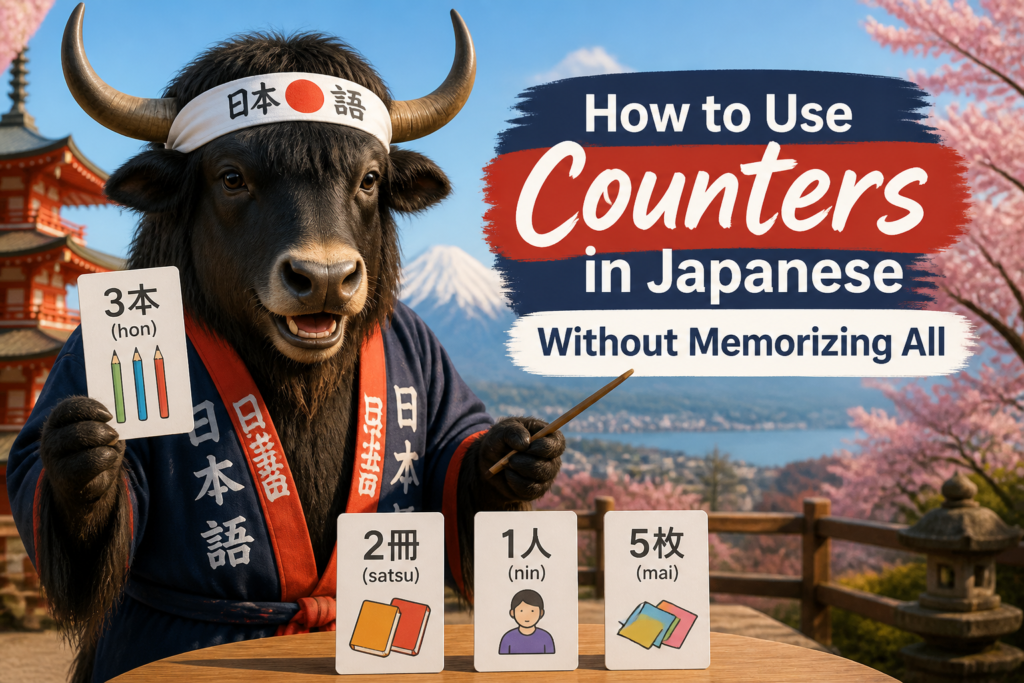
| 人 | -nin | people | 学生が三人います。 | Gakusei ga san-nin imasu. | There are three students. |
| 本 | -hon | long, thin things | ペンを一本買いました。 | Pen o ippon kaimashita. | I bought one pen. |
| 枚 | -mai | flat things | 紙を二枚ください。 | Kami o nimai kudasai. | Please give me two sheets of paper. |
| 冊 | -satsu | books, notebooks, bound items | 辞書を一冊持っています。 | Jisho o issatsu motte imasu. | I have one dictionary. |
| 個 | -ko | small round or general objects | 卵を六個買いました。 | Tamago o rokkko kaimashita. | I bought six eggs. |
| 台 | -dai | machines, vehicles | 車が一台あります。 | Kuruma ga ichidai arimasu. | There is one car. |
| 杯 | -hai | cups of drink | ビールを二杯お願いします。 | Bīru o nihai onegaishimasu. | Two beers, please. |
| 匹 | -hiki | small animals | 猫が三匹います。 | Neko ga san-biki imasu. | There are three cats. |
| 着 | -chaku | clothes | Tシャツを二着買いました。 | T-shatsu o ni-chaku kaimashita. | I bought two T-shirts. |
| 足 | -soku | pairs of shoes and socks | 靴を一足持っています。 | Kutsu o issoku motte imasu. | I have one pair of shoes. |
Useful Phrases You Can Use Right Away
Below are real phrases that help you sound natural. Notice how the counter comes after the number. Japanese loves putting the important little detail at the end, just to keep you alert.
| Kanji | Rōmaji | English Meaning | Example (Kanji) | Example (Rōmaji) | Translation (EN) |
|---|---|---|---|---|---|
| いくつですか | ikutsu desu ka | How many? / How old? for objects or children | りんごはいくつですか。 | Ringo wa ikutsu desu ka. | How many apples are there? |
| 一つください | hitotsu kudasai | Please give me one. | これを一つください。 | Kore o hitotsu kudasai. | Please give me one of these. |
| 二人います | futari imasu | There are two people. | 店に二人います。 | Mise ni futari imasu. | There are two people in the store. |
| 三冊買います | sansatsu kaimasu | I will buy three books. | 本を三冊買います。 | Hon o sansatsu kaimasu. | I will buy three books. |
| 四枚あります | yonmai arimasu | There are four flat items. | 写真が四枚あります。 | Shashin ga yonmai arimasu. | There are four photos. |
| 五本あります | gohon arimasu | There are five long items. | 鉛筆が五本あります。 | Enpitsu ga gohon arimasu. | There are five pencils. |
| 六個ください | rokko kudasai | Please give me six small items. | 卵を六個ください。 | Tamago o rokko kudasai. | Please give me six eggs. |
| 七匹います | shichihiki imasu | There are seven small animals. | 犬が七匹います。 | Inu ga shichihiki imasu. | There are seven dogs. |
| 八台あります | hachidai arimasu | There are eight machines or vehicles. | 車が八台あります。 | Kuruma ga hachidai arimasu. | There are eight cars. |
| 九杯お願いします | kyūhai onegaishimasu | Nine cups, please. | お茶を九杯お願いします。 | Ocha o kyūhai onegaishimasu. | Nine cups of tea, please. |
| 十着あります | jutchaku arimasu | There are ten items of clothing. | 服が十着あります。 | Fuku ga jutchaku arimasu. | There are ten pieces of clothing. |
| 一足買いました | issoku kaimashita | I bought one pair of shoes. | 靴を一足買いました。 | Kutsu o issoku kaimashita. | I bought one pair of shoes. |
If you want to test whether these forms are starting to stick, try the Japanese vocabulary test. Not because tests are magic, but because your brain likes to pretend it knows things until it has to perform.
The Counter Pattern That Saves You
Most counter phrases follow a simple shape:
- Number + Counter + Verb
- 三人います — san-nin imasu — There are three people
- 二冊買います — nisatsu kaimasu — I will buy two books
- 四枚あります — yonmai arimasu — There are four flat things
Once you know the counter, the sentence becomes easy. The hard part is choosing the right counter, not building the sentence.
Learn the shape first. Then learn the exceptions. That way, counters stop being a swamp and start being a system.
Common Counter Changes You Should Notice
Some counters change sound because Japanese likes smooth pronunciation. It is not trying to torment you personally. It just enjoys sound rules.
| Base Form | Rōmaji | Used For | Changed Form | Rōmaji | Example |
|---|---|---|---|---|---|
| 一匹 | ippiki | small animals | 三匹 | san-biki | 猫が三匹います。 / Neko ga san-biki imasu. / There are three cats. |
| 一本 | ippon | long thin things | 三本 | san-bon | ペンを三本買いました。 / Pen o san-bon kaimashita. / I bought three pens. |
| 一冊 | issatsu | books | 三冊 | san-satsu | 本を三冊読みます。 / Hon o san-satsu yomimasu. / I will read three books. |
| 一枚 | ichimai | flat things | 三枚 | sanmai | 紙を三枚ください。 / Kami o sanmai kudasai. / Please give me three sheets of paper. |
The trick is to learn the first number carefully. After that, the pattern usually behaves. Usually. Japanese does enjoy a little mischief now and then.
How To Guess The Right Counter
When you do not know the exact counter, use this backup plan:
- Ask yourself: is it a person, animal, object, book, flat thing, or machine?
- Use the most common counter if it fits.
- If you still do not know, use a general phrase like 一つ (hitotsu) for small things.
- Listen for context. Japanese speakers often make the category obvious.
- Do not freeze. A rough correct answer is better than silence.
For example, if you are unsure whether something uses a special counter, you can often survive with 一つ for a while. Not perfect, but perfectly useful. Language learners call that progress. Humans call it not collapsing in public.
Important Groups Of Counters
Learning counters in groups is easier than learning them like random trivia. Here are the main clusters that matter most.
| Group | Common Counter | Meaning | Example (Kanji) | Example (Rōmaji) | Translation (EN) |
|---|---|---|---|---|---|
| People | 人 | human beings | 先生が一人います。 | Sensei ga hitori imasu. | There is one teacher. |
| Small animals | 匹 | cats, dogs, fish, and similar small animals | 魚が二匹います。 | Sakana ga ni-hiki imasu. | There are two fish. |
| Books / bound items | 冊 | books, notebooks, magazines | 雑誌を五冊読みました。 | Zasshi o gosatsu yomimashita. | I read five magazines. |
| Flat things | 枚 | paper, tickets, photos, plates | 切符を三枚買いました。 | Kippu o sanmai kaimashita. | I bought three tickets. |
| Long thin things | 本 | pencils, bottles, umbrellas, sticks | 傘を一本持っています。 | Kasa o ippon motte imasu. | I have one umbrella. |
| Machines / vehicles | 台 | cars, computers, appliances | パソコンが二台あります。 | Pasokon ga nidai arimasu. | There are two computers. |
| Cups / bowls | 杯 | drinks, portions of liquid | 水を一杯飲みました。 | Mizu o ippai nomimashita. | I drank one cup of water. |
| Clothes | 着 | shirts, coats, outfits | コートを一着買いました。 | Kōto o ichaku kaimashita. | I bought one coat. |
| Pairs | 足 | shoes, socks | 靴下を二足買いました。 | Kutsushita o nisoku kaimashita. | I bought two pairs of socks. |
Examples You Can Copy
Try these out loud. The more you say them, the less mysterious counters feel.
- りんごを二つください。 — Ringo o futatsu kudasai. — Please give me two apples.
- 友達が三人います。 — Tomodachi ga san-nin imasu. — I have three friends.
- 本を一冊読みます。 — Hon o issatsu yomimasu. — I will read one book.
- 紙を四枚ください。 — Kami o yonmai kudasai. — Please give me four sheets of paper.
- ペンを五本買いました。 — Pen o gohon kaimashita. — I bought five pens.
- 犬が六匹います。 — Inu ga roppiki imasu. — There are six dogs.
- 車が七台あります。 — Kuruma ga nanadai arimasu. — There are seven cars.
- 水を八杯飲みました。 — Mizu o hachi-hai nomimashita. — I drank eight cups of water.
- Tシャツを九着持っています。 — T-shatsu o kyūchaku motte imasu. — I have nine T-shirts.
- 靴を十足買いました。 — Kutsu o jussoku kaimashita. — I bought ten pairs of shoes.
Practice Without Memorizing Everything
Here is the secret: do not study counters as a giant list. Study them as situations.
| Situation | Question To Ask | Likely Counter | Example |
|---|---|---|---|
| Talking about people | Is it a human? | 人 | 三人います。 — san-nin imasu — There are three people. |
| Buying books | Is it a book or notebook? | 冊 | 二冊ください。 — nisatsu kudasai — Please give me two books. |
| Ordering drinks | Is it liquid in cups? | 杯 | 一杯お願いします。 — ippai onegaishimasu — One cup, please. |
| Counting photos or sheets | Is it flat? | 枚 | 五枚あります。 — gomanai arimasu — There are five sheets/photos. |
| Counting pencils or bottles | Is it long and thin? | 本 | 四本あります。 — yonhon arimasu — There are four long items. |
After a while, your brain stops asking “what counter is this?” and starts asking “what kind of thing is this?” That is the real upgrade.
If you want a quick diagnostic check before or during your study, try the Japanese placement test JLPT. It is useful for seeing how comfortable you are with basic grammar and vocabulary, including the kinds of forms that show up around counters.
Common Mistakes And Easy Fixes
- Mistake: trying to memorize every counter first. Fix: learn the most common 8 to 10 counters and use them often.
- Mistake: forgetting that pronunciation changes. Fix: learn the sound as part of the phrase, not as a naked rule.
- Mistake: using the wrong counter and stopping the sentence. Fix: keep speaking; context often saves you.
- Mistake: confusing 一つ with a special counter. Fix: use 一つ as a general backup for many small things.
- Mistake: thinking counters are only for advanced learners. Fix: start early; they show up in beginner conversation all the time.
One of the easiest ways to strengthen this skill is to learn more kanji at the same time. That sounds like extra work, and yes, it is. But it pays off fast because counters often use kanji that tell you the category. A good next step is learn kanji Japanese.
Mini Reference: Counter Meanings At A Glance
| Kanji | Rōmaji | Use It For |
|---|---|---|
| 人 | -nin | people |
| 匹 | -hiki | small animals |
| 冊 | -satsu | books, magazines, notebooks |
| 枚 | -mai | flat things |
| 本 | -hon | long thin things |
| 台 | -dai | machines, vehicles |
| 杯 | -hai | cups of drinks |
| 個 | -ko | small objects |
| 着 | -chaku | clothes |
| 足 | -soku | pairs of shoes or socks |
Final Takeaway
You do not need to memorize all Japanese counters at once. Start with the common ones, learn them in useful groups, and practice them in real sentences. That is the whole game. Not glamorous, but effective.
When you meet a new counter, do not treat it like a disaster. Treat it like a new tool. Japanese has a lot of these little tools, and once you know how to look at them, the language becomes much less scary and much more interesting.
If you want to keep going, review Japanese counters and then compare them with common Japanese counters. That little bit of repetition is exactly how counters stop feeling random and start feeling normal.