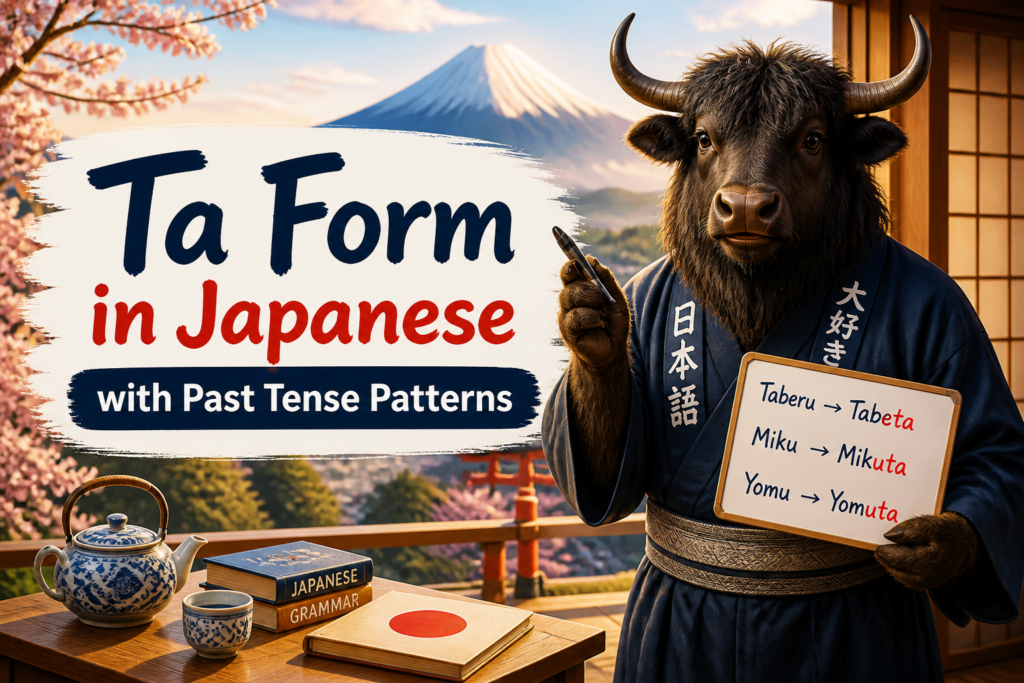
Ta form is one of those Japanese grammar points that shows up everywhere, then quietly pretends to be simple. It is often used for the past tense, but that is only the start. It also appears in requests, discoveries, completed actions, and a bunch of everyday patterns that make Japanese sound natural instead of textbook-stiff.
If you have ever heard someone say 食べた tabeta or 行った itta, you already met the ta form. The good news: once you learn the pattern, it starts behaving nicely. Mostly. Japanese grammar does enjoy a small dramatic entrance before settling down.
This guide explains Ta Form Explained with Past Tense and Common Patterns in a simple way, with examples you can actually use. For a bigger picture, it helps to compare this lesson with Japanese tenses, te-form patterns, and masu form.
What Ta Form Means
Ta form is the plain, casual form used for actions that happened in the past. In many sentences, it works like “did” or “was/were” in English. But Japanese does not always map neatly onto English, because of course it doesn’t. That would be too convenient.
The basic idea is simple:
- 食べる taberu = to eat
- 食べた tabeta = ate / ate and finished
- 行く iku = to go
- 行った itta = went
Ta form is informal. If you want polite speech, you usually use ました -mashita instead. So 食べました tabemashita is the polite version of 食べた tabeta.
Core Ta Form Patterns
Before the examples, here is the main pattern in plain English:
- Verb dictionary form → change to ta form
- Noun + だった datta → “was / were” in casual speech
- Adjective + かった katta → past form of i-adjectives
Let’s make each one easier to see.
1. Verb Ta Form For Past Actions
This is the most common use. It tells you an action happened, often already finished.
| Kanji | Rōmaji | Meaning | Example |
|---|---|---|---|
| 食べた | tabeta | ate | 朝ご飯を食べた。 Asa-gohan o tabeta. I ate breakfast. |
| 見た | mita | saw / watched | 映画を見た。 Eiga o mita. I watched a movie. |
| 読んだ | yonda | read | 本を読んだ。 Hon o yonda. I read a book. |
| 行った | itta | went | 昨日、駅に行った。 Kinō, eki ni itta. I went to the station yesterday. |
Notice that Japanese often leaves out obvious words like “I.” If the context is clear, Japanese just calmly moves on. Very efficient. Slightly smug.
2. Polite Past With Masu Form
If you want to sound polite, use ました -mashita. This is the past tense version of the polite ます -masu form.
| Kanji | Rōmaji | Meaning | Example |
|---|---|---|---|
| 食べました | tabemashita | ate | 昼ご飯を食べました。 Hirugohan o tabemashita. I ate lunch. |
| 見ました | mimashita | saw / watched | 映画を見ました。 Eiga o mimashita. I watched a movie. |
| 行きました | ikimashita | went | 学校に行きました。 Gakkō ni ikimashita. I went to school. |
For deeper form comparison, it helps to keep masu form in mind. Ta form is casual; mashita form is polite. Same idea, different tone.
3. Adjective Past Forms
i-adjectives use かった -katta for the past tense.
| Kanji | Rōmaji | Meaning | Example |
|---|---|---|---|
| 高かった | takakatta | was expensive / was high | この本は高かった。 Kono hon wa takakatta. This book was expensive. |
| 忙しかった | isogashikatta | was busy | 昨日は忙しかった。 Kinō wa isogashikatta. I was busy yesterday. |
| 面白かった | omoshirokatta | was interesting / fun | その映画は面白かった。 Sono eiga wa omoshirokatta. That movie was interesting. |
For na-adjectives and nouns, the past is usually だった datta.
| Kanji | Rōmaji | Meaning | Example |
|---|---|---|---|
| 静かだった | shizuka datta | was quiet | 図書館は静かだった。 Toshokan wa shizuka datta. The library was quiet. |
| 学生だった | gakusei datta | was a student | あの時は学生だった。 Ano toki wa gakusei datta. I was a student then. |
How To Make Ta Form From Verbs
Japanese verbs do not all change the same way. That would be wonderfully boring, and Japanese prefers a little shape-shifting.
Here are the basic groups.
Group 1: U-Verbs
Many common verbs belong here. The final sound changes before た ta or だ da.
| Dictionary Form | Ta Form | Meaning |
|---|---|---|
| 書く kaku | 書いた kaita | wrote |
| 話す hanasu | 話した hanashita | spoke |
| 待つ matsu | 待った matta | waited |
| 泳ぐ oyogu | 泳いだ oyoida | swam |
| 飲む nomu | 飲んだ nonda | drank |
Yes, 行く iku is the famous troublemaker. Its ta form is 行った itta, not what you might expect. Language loves one or two exceptions just to keep learners humble.
Group 2: Ru-Verbs
These are easier. Drop る ru and add た ta.
| Dictionary Form | Ta Form | Meaning |
|---|---|---|
| 食べる taberu | 食べた tabeta | ate |
| 見る miru | 見た mita | saw |
| 寝る neru | 寝た neta | slept |
Group 3: Irregular Verbs
Only a few verbs are irregular, which is merciful.
| Dictionary Form | Ta Form | Meaning |
|---|---|---|
| する suru | した shita | did |
| くる kuru | きた kita | came |
These show up all the time in daily Japanese:
- 勉強した benkyō shita = studied
- 来た kita = came
- 練習した renshū shita = practiced
Useful Ta Form Phrases And Real-Life Sentences
Here are common ta form patterns you will hear in real life. Some are plain past tense, and some are useful sentence endings or expressions built from the same form.
| Kanji | Rōmaji | English Meaning | Example Sentence | Rōmaji | English Translation |
|---|---|---|---|---|---|
| 食べた | tabeta | ate | もう食べた。 | Mō tabeta. | I already ate. |
| 行った | itta | went | 友達と映画館に行った。 | Tomodachi to eigakan ni itta. | I went to the cinema with a friend. |
| 見た | mita | saw / watched | そのニュースを見た。 | Sono nyūsu o mita. | I saw that news. |
| 聞いた | kiita | heard / asked | 先生に聞いた。 | Sensei ni kiita. | I asked the teacher. |
| 買った | katta | bought | 新しい靴を買った。 | Atarashii kutsu o katta. | I bought new shoes. |
| 書いた | kaita | wrote | 手紙を書いた。 | Tegami o kaita. | I wrote a letter. |
| 読んだ | yonda | read | 本を読んだ。 | Hon o yonda. | I read a book. |
| 話した | hanashita | spoke | 昨日、友達と話した。 | Kinō, tomodachi to hanashita. | Yesterday, I talked with a friend. |
| 飲んだ | nonda | drank | 水を飲んだ。 | Mizu o nonda. | I drank water. |
| 使った | tsukatta | used | このアプリを使った。 | Kono apuri o tsukatta. | I used this app. |
| 終わった | owatta | finished | 宿題が終わった。 | Shukudai ga owatta. | The homework is finished. |
| 分かった | wakatta | understood | やっと分かった。 | Yatto wakatta. | I finally understood. |
| 思った | omotta | thought | そう思った。 | Sō omotta. | I thought so. |
| 会った | atta | met | 昨日、駅で会った。 | Kinō, eki de atta. | I met at the station yesterday. |
| 帰った | kaetta | went home / returned | 早く帰った。 | Hayaku kaetta. | I went home early. |
Common Patterns Built With Ta Form
Ta form is not only for “past tense.” It also appears in a few very common grammar patterns that learners hear all the time.
Ta Form + ことがある
This means “have done something before” or “sometimes do something”, depending on context.
| Pattern | Meaning | Example | Rōmaji | English |
|---|---|---|---|---|
| 食べたことがある | have eaten before | 日本料理を食べたことがある。 | Nihon ryōri o tabeta koto ga aru. | I have eaten Japanese food before. |
| 行ったことがある | have been to | 京都に行ったことがある。 | Kyōto ni itta koto ga aru. | I have been to Kyoto. |
Ta Form + ら,
This can show a condition like “when” or “after.”
| Kanji | Rōmaji | Meaning |
|---|---|---|
| 食べたら、寝る。 | Tabetara, neru. | After I eat, I sleep. |
| 家に帰ったら、電話して。 | Ie ni kaettara, denwa shite. | When you get home, call me. |
In real life, this pattern is everywhere. It is a tiny grammar tool that does a lot of work.
Ta Form + ほうがいい
This pattern gives advice: “It is better to…” or “You should…”
| Kanji | Rōmaji | Meaning |
|---|---|---|
| 早く寝たほうがいい。 | Hayaku neta hō ga ii. | You should sleep early. |
| 医者に行ったほうがいい。 | Isha ni itta hō ga ii. | You should go to a doctor. |
Ta Form + ばかり
This often means “just did something” or “only did something.”
| Kanji | Rōmaji | Meaning |
|---|---|---|
| 食べたばかり | tabeta bakari | just ate |
| 来たばかり | kita bakari | just came |
Short Practice
Try changing these into ta form. No cheating. Well, at least not too much.
- 飲む nomu → ______
- 書く kaku → ______
- 見る miru → ______
- する suru → ______
- 行く iku → ______
Answers:
- 飲む nomu → 飲んだ nonda
- 書く kaku → 書いた kaita
- 見る miru → 見た mita
- する suru → した shita
- 行く iku → 行った itta
Common Mistakes And Fixes
These are the mistakes that show up often enough to deserve a polite side-eye.
- Mixing up ta form and polite past
食べた tabeta is casual. 食べました tabemashita is polite. - Forgetting irregular verbs
する suru becomes した shita, and くる kuru becomes きた kita. - Missing the special verb 行く
行く iku becomes 行った itta, not いくた or anything adventurous. - Using the wrong form with adjectives
i-adjectives use かった -katta; nouns and na-adjectives use だった -datta.
Quick Reference Summary
| Type | Pattern | Example | Meaning |
|---|---|---|---|
| Verb | Dictionary form → ta form | 食べる → 食べた | eat → ate |
| Polite past | ます → ました | 食べます → 食べました | eat → ate politely |
| i-Adjective past | い → かった | 高い → 高かった | expensive → was expensive |
| Na-adjective / noun past | だ → だった | 静かだ → 静かだった | quiet → was quiet |
For a broader study plan, the Japanese grammar path at learn Japanese can help connect ta form with other essentials like polite speech, verb groups, and sentence endings. If you want to test what you already know, try the Japanese Placement Test or the Japanese Vocabulary Test.
Ta form is one of the most useful forms in Japanese, because it keeps showing up in daily speech, stories, advice, and casual conversation. Once you can spot it, a lot more Japanese starts making sense. Not instantly, sadly, but noticeably.