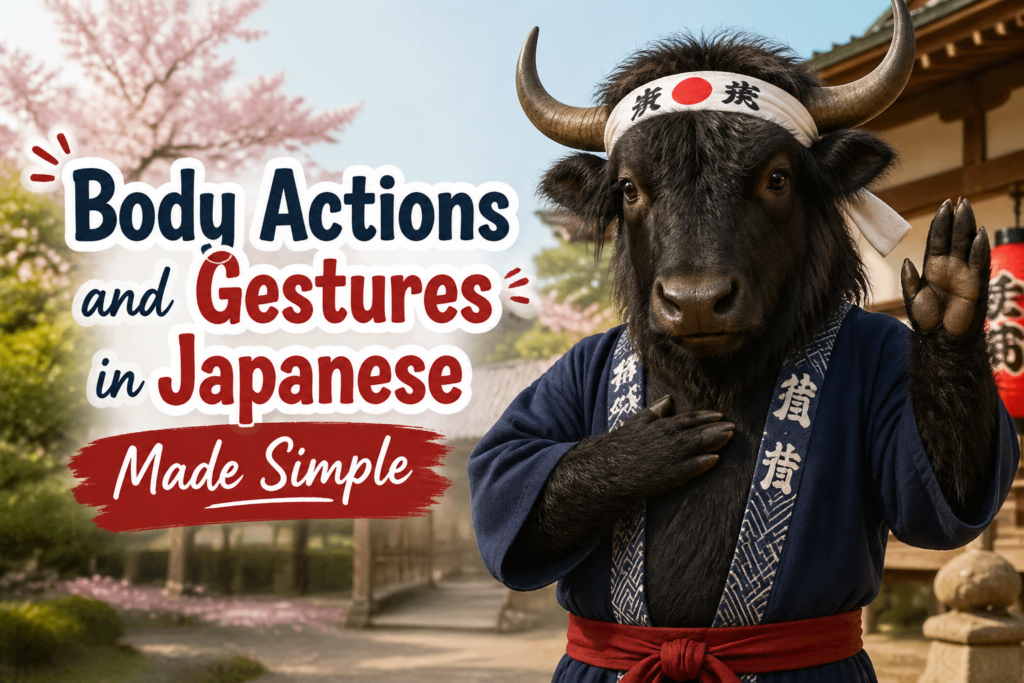
Body Actions and Gestures in Japanese can make your speech feel natural fast. Not because you suddenly become mysterious and elegant, but because Japanese conversation often leans on small physical cues: a nod, a bow, a hand wave, a little shrug. In other words, your face and hands do part of the talking. Convenient, right?
If you have ever watched Japanese people talk, you may have noticed that a tiny gesture can carry a lot of meaning. A simple うなずく (Unazuku)—to nod—can mean “I’m listening,” “I understand,” or “please keep going.” That is a lot of work for one small head movement.
This guide keeps things simple and useful. You will learn common body actions, gestures, and real-life phrases with kanji, rōmaji, meanings, and example sentences. For a broader overview of learning Japanese, you can also check the Learn Japanese page.
Common Body Actions And Gestures
| Kanji | Rōmaji | English Meaning | Example Sentence | Rōmaji | English Translation |
|---|---|---|---|---|---|
| うなずく | Unazuku | to nod | 彼は何度もうなずいた。 | Kare wa nando mo unazuita. | He nodded many times. |
| おじぎする | Ojigi suru | to bow | 店員は丁寧におじぎした。 | Tenin wa teinei ni ojigi shita. | The staff member bowed politely. |
| 手を振る | Te o furu | to wave a hand | 駅で友達に手を振った。 | Eki de tomodachi ni te o futta. | I waved to my friend at the station. |
| 指さす | Yubisasu | to point | 彼女は地図を指さした。 | Kanojo wa chizu o yubisashita. | She pointed at the map. |
| 手をたたく | Te o tataku | to clap | みんなで手をたたいた。 | Minna de te o tataita. | Everyone clapped together. |
| 腕を組む | Ude o kumu | to cross one’s arms | 彼は腕を組んで考えた。 | Kare wa ude o kunde kangaeta. | He crossed his arms and thought. |
| 頭を下げる | Atama o sageru | to lower one’s head; to bow deeply | 彼は深く頭を下げた。 | Kare wa fukaku atama o sageta. | He bowed deeply. |
| 肩をすくめる | Kata o sukumeru | to shrug | 彼女は肩をすくめた。 | Kanojo wa kata o sukumeta. | She shrugged. |
| 目を合わせる | Me o awaseru | to make eye contact | 先生と目を合わせた。 | Sensei to me o awaseta. | I made eye contact with the teacher. |
| 手を上げる | Te o ageru | to raise a hand | 質問があるので手を上げた。 | Shitsumon ga aru node te o ageta. | I raised my hand because I had a question. |
These are the kind of actions that show up in real conversation all the time. Japanese is not only about words. It is also about timing, posture, and little signals that say, “Yes, I am with you.”
Useful Phrases For Everyday Gestures
| Kanji | Rōmaji | English Meaning | Example Sentence | Rōmaji | English Translation |
|---|---|---|---|---|---|
| ちょっと待って | Chotto matte | Wait a moment | ちょっと待って、今行く。 | Chotto matte, ima iku. | Wait a moment, I’m coming now. |
| こちらへどうぞ | Kochira e dōzo | This way, please | こちらへどうぞと案内された。 | Kochira e dōzo to annai sareta. | I was guided and told, “This way, please.” |
| どうぞお座りください | Dōzo osuwari kudasai | Please have a seat | 先生がどうぞお座りくださいと言った。 | Sensei ga dōzo osuwari kudasai to itta. | The teacher said, “Please have a seat.” |
| ありがとうございます | Arigatō gozaimasu | Thank you very much | 店員にありがとうございますと伝えた。 | Tenin ni arigatō gozaimasu to tsutaeta. | I said thank you very much to the staff member. |
| すみません | Sumimasen | Excuse me / sorry | すみません、道をたずねた。 | Sumimasen, michi o tazuneta. | Excuse me, I asked for directions. |
| お願いします | Onegai shimasu | Please | これをお願いします。 | Kore o onegai shimasu. | This, please. |
| わかりました | Wakarimashita | I understood | 先生の話がわかりました。 | Sensei no hanashi ga wakarimashita. | I understood the teacher’s explanation. |
| 大丈夫です | Daijōbu desu | It is okay / I’m fine | 手伝いは大丈夫です。 | Tetsudai wa daijōbu desu. | Help is not needed. |
| もう一度お願いします | Mō ichido onegai shimasu | One more time, please | もう一度お願いしますと聞いた。 | Mō ichido onegai shimasu to kiita. | I asked, “One more time, please.” |
Gesture Words You Will Hear In Real Life
| Kanji | Rōmaji | English Meaning | Example Sentence | Rōmaji | English Translation |
|---|---|---|---|---|---|
| 身振り | Miburi | gesture; body movement | 身振りで説明した。 | Miburi de setsumei shita. | I explained with gestures. |
| 手振り | Teburi | hand gesture | 彼の手振りは大きい。 | Kare no teburi wa ōkii. | His hand gestures are big. |
| 表情 | Hyōjō | facial expression | 表情で気持ちがわかる。 | Hyōjō de kimochi ga wakaru. | You can understand feelings from facial expressions. |
| 姿勢 | Shisei | posture | 姿勢を正した。 | Shisei o tadashita. | I straightened my posture. |
| 態度 | Taido | attitude; manner | 彼の態度は丁寧だ。 | Kare no taido wa teinei da. | His manner is polite. |
| 合図 | Aizu | signal; cue | 合図で歩き始めた。 | Aizu de aruki hajimeta. | We started walking at the signal. |
| 拍手 | Hakushu | applause; clapping | 拍手が大きくなった。 | Hakushu ga ōkiku natta. | The applause got louder. |
| 会釈 | Eshaku | a slight bow; nod of acknowledgement | 会釈だけでも礼儀になる。 | Eshaku dake demo reigi ni naru. | Even a slight bow counts as politeness. |
| 深々と | Fukabukato | deeply; profoundly | 深々とおじぎした。 | Fukabukato ojigi shita. | I bowed deeply. |
| うつむく | Utsumuku | to look down | 悲しくてうつむいた。 | Kanashikute utsumuita. | I looked down because I was sad. |
How Bowing Works
Japanese bowing is more than a habit. It is a social tool. A light 会釈 (Eshaku) is often used for quick greetings, while a deeper bow shows stronger respect, apology, or gratitude. You do not need to become a bowing expert overnight. Nobody is handing out medals for perfect angle control.
Simple rule: the more formal the situation, the more careful the bow. In casual life, a small nod may be enough. In business or when apologizing seriously, people usually bow more deeply.
| Pattern | Meaning | Example Sentence | Rōmaji | English Translation |
|---|---|---|---|---|
| 軽く会釈する | to bow slightly | 会ったときに軽く会釈する。 | Atta toki ni karuku eshaku suru. | We bow slightly when we meet. |
| 深くおじぎする | to bow deeply | 謝って深くおじぎした。 | Ayamatte fukaku ojigi shita. | I apologized and bowed deeply. |
| 頭を下げる | to lower one’s head | 彼は何度も頭を下げた。 | Kare wa nando mo atama o sageta. | He lowered his head many times. |
Hand Gestures And What They Suggest
Japanese hand gestures can be practical, polite, and sometimes very specific. 手を振る (Te o furu) means waving, usually hello or goodbye. 指さす (Yubisasu) means pointing, but direct pointing can feel a little sharp in some situations, so people often use an open hand instead. Little details, big social impact. Japanese conversation loves those tiny invisible rules.
| Kanji | Rōmaji | Meaning | Example Sentence | Rōmaji | English Translation |
|---|---|---|---|---|---|
| 手を振る | Te o furu | to wave | 子どもが遠くから手を振った。 | Kodomo ga tōku kara te o futta. | The child waved from far away. |
| 指さす | Yubisasu | to point | 彼は看板を指さした。 | Kare wa kanban o yubisashita. | He pointed at the sign. |
| 手招きする | Temaneki suru | to beckon | 先生が学生を手招きした。 | Sensei ga gakusei o temaneki shita. | The teacher beckoned the student. |
| 拍手する | Hakushu suru | to clap | みんなで拍手した。 | Minna de hakushu shita. | Everyone clapped. |
| 手をたたく | Te o tataku | to clap hands | 子どもが喜んで手をたたいた。 | Kodomo ga yorokonde te o tataita. | The child clapped with joy. |
| 腕を広げる | Ude o hirogeru | to spread one’s arms | 彼は大きく腕を広げた。 | Kare wa ōkiku ude o hirogeta. | He spread his arms wide. |
| 手を合わせる | Te o awaseru | to press hands together; to pray or ask | 食べる前に手を合わせた。 | Taberu mae ni te o awaseta. | I put my hands together before eating. |
| 肩をたたく | Kata o tataku | to pat someone on the shoulder | 友達の肩をたたいた。 | Tomodachi no kata o tataita. | I patted my friend on the shoulder. |
| 顔を上げる | Kao o ageru | to raise one’s face | 顔を上げて話してください。 | Kao o agete hanashite kudasai. | Please raise your face and speak. |
| 体を向ける | Karada o mukeru | to turn one’s body toward someone/something | 彼女は私の方へ体を向けた。 | Kanojo wa watashi no hō e karada o muketa. | She turned her body toward me. |
Face And Eye Movements Matter Too
Japanese communication often depends on subtle facial cues. A nod can mean “yes,” but also “I am listening.” A small smile can soften a sentence. Looking away at the right time can show respect, while staring too much can feel intense.
| Kanji | Rōmaji | Meaning | Example Sentence | Rōmaji | English Translation |
|---|---|---|---|---|---|
| 目をそらす | Me o sorasu | to look away | 彼は少し目をそらした。 | Kare wa sukoshi me o sorashita. | He looked away a little. |
| 目を閉じる | Me o tojiru | to close one’s eyes | 静かに目を閉じた。 | Shizuka ni me o tojita. | I quietly closed my eyes. |
| 目を見開く | Me o mihiraku | to open one’s eyes wide | 驚いて目を見開いた。 | Odoroite me o mihiraita. | I opened my eyes wide in surprise. |
| 微笑む | Hohoemu | to smile gently | 彼女は静かに微笑んだ。 | Kanojo wa shizuka ni hohoenda. | She smiled gently. |
| しかめる | Shikameru | to frown | 彼は眉をしかめた。 | Kare wa mayu o shikameta. | He frowned. |
| 眉を上げる | Mayu o ageru | to raise one’s eyebrows | 驚いて眉を上げた。 | Odoroite mayu o ageta. | I raised my eyebrows in surprise. |
| うなずく | Unazuku | to nod | 話を聞きながらうなずいた。 | Hanashi o kiki nagara unazuita. | I nodded while listening. |
| 顔をしかめる | Kao o shikameru | to make a grimace | 苦くて顔をしかめた。 | Nigakute kao o shikameta. | I grimaced because it was bitter. |
| 首をかしげる | Kubi o kashigeru | to tilt one’s head in confusion | 彼は首をかしげた。 | Kare wa kubi o kashigeta. | He tilted his head in confusion. |
| 涙を流す | Namida o nagasu | to shed tears | 彼女は涙を流した。 | Kanojo wa namida o nagashita. | She shed tears. |
Body Language In Polite Conversation
Politeness is not only in the words. It is in the way you stand, bow, listen, and pause. A calm posture, a slight nod, and careful eye contact can make you sound more natural even if your Japanese is still under construction. Which, let’s be honest, it probably is. That is normal.
| Kanji | Rōmaji | Meaning | Example Sentence | Rōmaji | English Translation |
|---|---|---|---|---|---|
| 礼儀正しい | Reigi tadashii | polite; well-mannered | 彼女はとても礼儀正しい。 | Kanojo wa totemo reigi tadashii. | She is very polite. |
| 遠慮する | Enryo suru | to hold back; to refrain | 彼は遠慮して手を出さなかった。 | Kare wa enryo shite te o dasanakatta. | He held back and did not reach out. |
| 丁寧に | Teinei ni | politely; carefully | 丁寧におじぎした。 | Teinei ni ojigi shita. | I bowed politely. |
| 静かに | Shizuka ni | quietly | 静かに話してください。 | Shizuka ni hanashite kudasai. | Please speak quietly. |
| 落ち着く | Ochitsuku | to calm down; to settle | 深呼吸して落ち着いた。 | Shinkokyū shite ochitsuita. | I took a deep breath and calmed down. |
| 姿勢を正す | Shisei o tadasu | to straighten one’s posture | 姿勢を正して座った。 | Shisei o tadashite suwatta. | I sat with straight posture. |
| 気をつける | Ki o tsukeru | to be careful | 相手の反応に気をつけた。 | Aite no hannō ni ki o tsuketa. | I paid attention to the other person’s reaction. |
| 敬礼する | Keirei suru | to salute; to make a respectful gesture | 警備員が敬礼した。 | Keibiin ga keirei shita. | The guard saluted. |
| 反応する | Hannō suru | to react | 相手の反応を見た。 | Aite no hannō o mita. | I watched the other person’s reaction. |
| 受け止める | Uketomeru | to receive; to take in | 彼の言葉を静かに受け止めた。 | Kare no kotoba o shizuka ni uketometa. | I calmly took in his words. |
Small Nuance That Saves Embarrassment
In Japanese, some gestures are more neutral than in English-speaking cultures. For example, nodding often means “I’m listening,” not always “I fully agree.” Also, pointing with a finger can feel a bit direct, so an open hand is often softer. Tiny habit, big difference.
うなずく (Unazuku) can mean “yes,” but it can also mean “I hear you.” That is why listening carefully matters as much as speaking carefully.
If you want a more formal, dictionary-style look at gesture-related terms, a plain reference like Wikipedia’s bowing overview can help with background reading. Not glamorous, but useful. Like a reliable umbrella.
Quick Practice
- Say this in Japanese: “I nodded.” → うなずいた (Unazuita)
- Say this in Japanese: “She bowed politely.” → 彼女は丁寧におじぎした (Kanojo wa teinei ni ojigi shita)
- Say this in Japanese: “He waved to his friend.” → 彼は友達に手を振った (Kare wa tomodachi ni te o futta)
- Say this in Japanese: “Please wait a moment.” → ちょっと待って (Chotto matte)
- Say this in Japanese: “I understood.” → わかりました (Wakarimashita)
- Say this in Japanese: “I made eye contact.” → 目を合わせた (Me o awaseta)
- Say this in Japanese: “She shrugged.” → 彼女は肩をすくめた (Kanojo wa kata o sukumeta)
- Say this in Japanese: “He pointed at the map.” → 彼は地図を指さした (Kare wa chizu o yubisashita)
Common Mistakes And Fixes
| Common Mistake | Better Choice | Why |
|---|---|---|
| Using only words and ignoring body language | Use うなずく, おじぎする, and a calm posture | These actions help your speech feel natural |
| Pointing too much with one finger | Use an open hand when possible | It can feel softer and more polite |
| Thinking a nod always means full agreement | Read the full context | Nodding may simply show listening |
| Forgetting to bow in formal situations | Use 会釈 or a deeper bow | Bowing is a basic sign of respect |
| Staring too directly for too long | Use natural, gentle eye contact | It feels less intense and more comfortable |
Quick Reference Summary
- うなずく (Unazuku) = nod
- おじぎする (Ojigi suru) = bow
- 手を振る (Te o furu) = wave
- 指さす (Yubisasu) = point
- 手をたたく (Te o tataku) = clap
- 表情 (Hyōjō) = facial expression
- 姿勢 (Shisei) = posture
- 会釈 (Eshaku) = slight bow
- 目を合わせる (Me o awaseru) = make eye contact
- 肩をすくめる (Kata o sukumeru) = shrug
Body language in Japanese is not a secret code. It is more like a set of small social hints. Learn the basic gestures, match them to the situation, and your Japanese will feel smoother, warmer, and a lot less robotic. That is the good stuff.
If you keep practicing these phrases and gestures together, you will start noticing them everywhere in conversation, anime, dramas, and real life. And once you see them, you cannot unsee them. Welcome to the club.