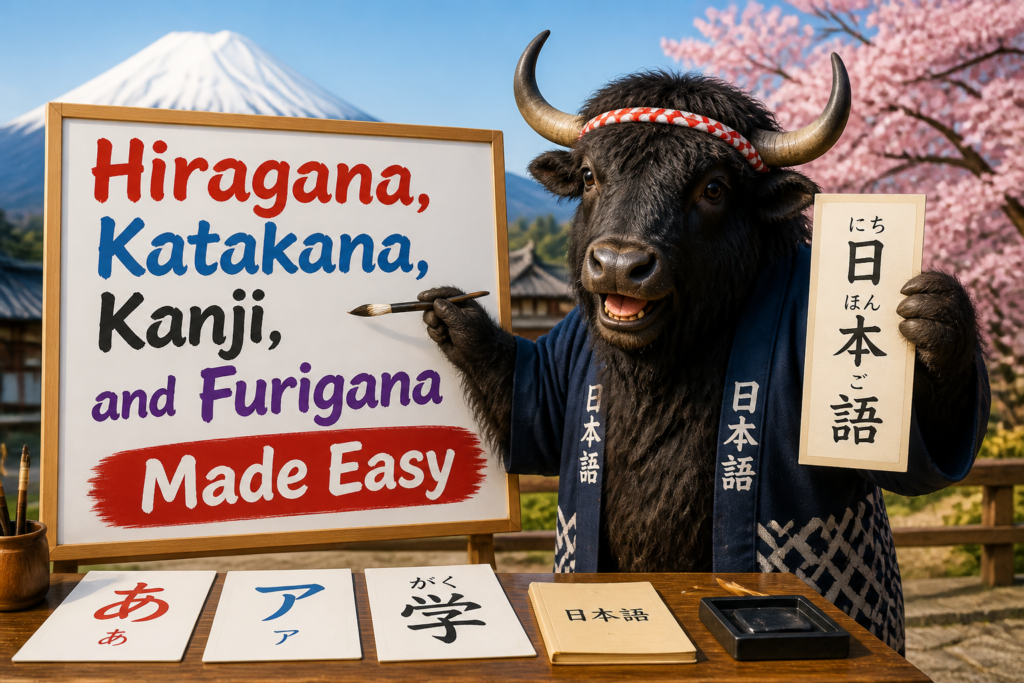
ひらがな Hiragana, カタカナ Katakana, 漢字 Kanji, and ふりがな Furigana are the four little troublemakers that run Japanese writing. Each one has a job, and yes, they do enjoy making beginners stare at a page like it owes them money.
For the broader learning path, visit our parent guide.
The good news is that Japanese is not random chaos. Once you see how these scripts work together, real Japanese starts feeling much less mysterious. A sentence can be mostly Kanji, softened by Hiragana, decorated by Katakana, and explained by Furigana. It is a system with layers, not a pile of symbols thrown together for fun.
If you want the big picture first, the overview on Japanese learning basics is a good companion, and if you want to test where you stand later, the Japanese Placement Test JLPT and the Japanese Vocabulary Test are handy checkpoints.
The Four Scripts At A Glance
| Script | Rōmaji | English Meaning | What It Does |
|---|---|---|---|
| ひらがな | Hiragana | Basic Japanese phonetic script | Shows grammar, endings, and native Japanese words |
| カタカナ | Katakana | Phonetic script for foreign words and emphasis | Shows loanwords, names, sounds, and stylistic emphasis |
| 漢字 | Kanji | Chinese characters used in Japanese | Shows meaning, roots, and content words |
| ふりがな | Furigana | Reading guide text | Shows pronunciation above or beside Kanji |
Here is the simple version: Hiragana is the glue, Katakana is the costume, Kanji is the meaning-heavy core, and Furigana is the helpful little label that stops readers from getting lost. Japanese uses all four in real life, often in the same sentence. Because apparently one alphabet would have been too convenient.
How Hiragana Works
ひらがな Hiragana is the soft, rounded script you learn first. It represents sounds, not meanings. It is used for grammar bits like verb endings, particles, and native words that are often written without Kanji.
日本語 nihongo means Japanese language. In real writing, you often see it mixed with Hiragana like this:
日本語を勉強します。 Nihongo o benkyō shimasu. I study Japanese.
Notice the mix: 日本語 nihongo is Kanji, while を o and ます masu are Hiragana. That is normal. In fact, it is the standard pattern.
Useful Hiragana Words And Phrases
| Kanji / Kana | Rōmaji | Meaning | Example | Rōmaji | Translation |
|---|---|---|---|---|---|
| ひらがな | hiragana | basic Japanese phonetic script | ひらがなを読みます。 | Hiragana o yomimasu. | I read hiragana. |
| あさ | asa | morning | あさごはんを食べます。 | Asa gohan o tabemasu. | I eat breakfast. |
| いえ | ie | house | いえに帰ります。 | Ie ni kaerimasu. | I go home. |
| みず | mizu | water | みずを飲みます。 | Mizu o nomimasu. | I drink water. |
| たべる | taberu | to eat | パンをたべる。 | Pan o taberu. | To eat bread. |
| のむ | nomu | to drink | おちゃをのむ。 | Ocha o nomu. | To drink tea. |
| みる | miru | to see, to watch | テレビをみます。 | Terebi o mimasu. | I watch TV. |
| きく | kiku | to hear, to listen | 音楽をききます。 | Ongaku o kikimasu. | I listen to music. |
| たかい | takai | expensive; high | この本はたかいです。 | Kono hon wa takai desu. | This book is expensive. |
| やさしい | yasashii | easy; kind | この文はやさしいです。 | Kono bun wa yasashii desu. | This sentence is easy. |
Hiragana is also what makes Japanese grammar readable. Without it, sentence endings, particles, and verb forms would look like a stubborn wall of Kanji. Nobody asked for that kind of drama.
How Katakana Works
カタカナ Katakana is another sound-based script, but it has a sharper, straighter look. It is mainly used for foreign loanwords, imported names, sound effects, scientific terms, and emphasis. Think of it as the “look here” script.
コーヒー kōhī means coffee. Japanese borrowed the word, adjusted it to Japanese sounds, and wrote it in Katakana.
コーヒーを飲みます。 Kōhī o nomimasu. I drink coffee.
Useful Katakana Words And Phrases
| Kanji / Kana | Rōmaji | Meaning | Example | Rōmaji | Translation |
|---|---|---|---|---|---|
| カタカナ | katakana | phonetic script for loanwords and emphasis | カタカナで書きます。 | Katakana de kakimasu. | I write in katakana. |
| コーヒー | kōhī | coffee | コーヒーを飲みます。 | Kōhī o nomimasu. | I drink coffee. |
| テレビ | terebi | television | テレビを見ます。 | Terebi o mimasu. | I watch TV. |
| コンピューター | konpyūtā | computer | コンピューターを使います。 | Konpyūtā o tsukaimasu. | I use a computer. |
| ホテル | hoteru | hotel | ホテルに泊まります。 | Hoteru ni tomarimasu. | I stay at a hotel. |
| メール | mēru | メールを送ります。 | Mēru o okurimasu. | I send an email. | |
| アメリカ | Amerika | America | アメリカへ行きます。 | Amerika e ikimasu. | I go to America. |
| サンドイッチ | sandoicchi | sandwich | サンドイッチを食べます。 | Sandoicchi o tabemasu. | I eat a sandwich. |
| バス | basu | bus | バスで行きます。 | Basu de ikimasu. | I go by bus. |
| チェック | chekku | check | 答えをチェックします。 | Kotae o chekku shimasu. | I check the answers. |
Katakana can also add flavor. A sign, advertisement, or product name may switch into Katakana to stand out. It does not always mean “foreign.” Sometimes it just means “please notice me.” Very mature. Very subtle. Absolutely not subtle.
How Kanji Works
漢字 Kanji are characters borrowed from Chinese and adapted for Japanese. They carry meaning, and often more than one reading. This is where Japanese gets powerful, dense, and slightly mischievous.
Kanji often represent the core ideas in a word, while Hiragana carries the grammar. That is why a sentence like this is normal:
学校へ行きます。 Gakkō e ikimasu. I go to school.
学校 gakkō is Kanji for “school,” while へ e and 行きます ikimasu help the sentence move properly.
Useful Kanji Words And Phrases
| Kanji | Rōmaji | Meaning | Example | Rōmaji | Translation |
|---|---|---|---|---|---|
| 日本 | Nihon | Japan | 日本へ行きます。 | Nihon e ikimasu. | I go to Japan. |
| 学校 | gakkō | school | 学校で勉強します。 | Gakkō de benkyō shimasu. | I study at school. |
| 先生 | sensei | teacher | 先生に聞きます。 | Sensei ni kikimasu. | I ask the teacher. |
| 学生 | gakusei | student | 学生です。 | Gakusei desu. | I am a student. |
| 時間 | jikan | time | 時間がありません。 | Jikan ga arimasen. | There is no time. |
| 名前 | namae | name | 名前を書きます。 | Namae o kakimasu. | I write my name. |
| 大人 | otona | adult | 大人です。 | Otona desu. | I am an adult. |
| 友達 | tomodachi | friend | 友達と会います。 | Tomodachi to aimasu. | I meet a friend. |
| 天気 | tenki | weather | 天気がいいです。 | Tenki ga ii desu. | The weather is good. |
| 本 | hon | book | 本を読みます。 | Hon o yomimasu. | I read a book. |
Kanji can be efficient. One character can carry a whole chunk of meaning. That is why native Japanese writing often feels compact compared with writing only in Kana. It is also why Kanji is the part that makes learners sigh, then continue anyway. Respect.
How Furigana Works
ふりがな Furigana are small pronunciation guides placed next to or above Kanji. They help readers know how to say a word, especially when the Kanji is new, difficult, or used for children, learners, or special names.
For example, a book might print 漢字 kanji with Furigana above it so the reader can see the reading immediately. In plain text online, people often show it like this:
漢字 kanji
Furigana do not change the meaning. They only help with reading. That is a very kind job, and a very important one.
Useful Furigana And Reading Support Words
| Kanji / Kana | Rōmaji | Meaning | Example | Rōmaji | Translation |
|---|---|---|---|---|---|
| ふりがな | furigana | reading aid for Kanji | ふりがなをつけます。 | Furigana o tsukemasu. | I add furigana. |
| 読み方 | yomikata | reading method; pronunciation | 読み方を教えてください。 | Yomikata o oshiete kudasai. | Please tell me the reading. |
| 難しい | muzukashii | difficult | この漢字は難しいです。 | Kono kanji wa muzukashii desu. | This Kanji is difficult. |
| 子ども | kodomo | child | 子ども向けの本です。 | Kodomo-muke no hon desu. | This is a book for children. |
| 名前 | namae | name | 名前にふりがながあります。 | Namae ni furigana ga arimasu. | There is furigana for the name. |
| 辞書 | jisho | dictionary | 辞書で読みを調べます。 | Jisho de yomi o shirabemasu. | I check the reading in a dictionary. |
How They Work Together In Real Japanese
This is the part that makes everything click. Real Japanese writing usually mixes scripts in a predictable way:
- Kanji kanji show the main meaning of nouns, verb roots, and adjective roots.
- Hiragana hiragana shows particles, endings, and grammar.
- Katakana katakana shows loanwords, foreign names, and emphasis.
- Furigana furigana shows the reading of difficult Kanji.
Let us break a sentence into pieces:
私は図書館で本を読みます。 Watashi wa toshokan de hon o yomimasu. I read books at the library.
- 私 watashi = I
- は wa = topic particle, Hiragana
- 図書館 toshokan = library, Kanji
- で de = location particle, Hiragana
- 本 hon = book, Kanji
- を o = object particle, Hiragana
- 読みます yomimasu = read, Kanji root plus Hiragana ending
That mix is the heart of Japanese. It is not just decorative. Each script is doing real work.
Here is another one:
コンビニでお茶を買います。 Konbini de ocha o kaimasu. I buy tea at the convenience store.
- コンビニ konbini = convenience store, Katakana
- で de = at, Hiragana
- お茶 ocha = tea, Kanji with polite prefix Hiragana
- を o = object particle, Hiragana
- 買います kaimasu = buy, Kanji root plus Hiragana ending
And yes, Japanese writers choose scripts on purpose. If a word is native Japanese, Hiragana may be used. If it is a Chinese-origin word, Kanji often appears. If it is a borrowed foreign word, Katakana is the usual choice. The system is surprisingly tidy once you stop expecting it to behave like English.
Pattern Guide: What Each Script Usually Does
| Pattern | Meaning | Example | Rōmaji | English |
|---|---|---|---|---|
| Kanji + Hiragana ending | main word plus grammar | 読みます | yomimasu | read |
| Kanji + Kanji | compound noun | 図書館 | toshokan | library |
| Katakana only | loanword or emphasis | ゲーム | gēmu | game |
| Hiragana only | grammar, particles, or simple native words | これ | kore | this |
| Kanji with Furigana | Kanji plus reading help | 漢字 kanji | kanji | Chinese character(s) |
Common Sentence Pieces You Will See Everywhere
If you are learning to read real Japanese, these tiny pieces matter a lot. They are the boring-looking bits that make every sentence work. And boring is often where the magic hides.
| Kanji / Kana | Rōmaji | Meaning | Example | Rōmaji | Translation |
|---|---|---|---|---|---|
| は | wa | topic marker | 私は学生です。 | Watashi wa gakusei desu. | I am a student. |
| が | ga | subject marker | 雨が降ります。 | Ame ga furimasu. | It rains. |
| を | o | object marker | 本を読みます。 | Hon o yomimasu. | I read a book. |
| で | de | place of action | 学校で勉強します。 | Gakkō de benkyō shimasu. | I study at school. |
| に | ni | direction, time, target | 駅に行きます。 | Eki ni ikimasu. | I go to the station. |
| と | to | and; with | 友達と話します。 | Tomodachi to hanashimasu. | I talk with a friend. |
| の | no | possessive link | 日本の本です。 | Nihon no hon desu. | It is a Japanese book. |
| ます | masu | polite verb ending | 食べます。 | Tabemasu. | I eat. |
Why Kanji Needs Hiragana Around It
Kanji gives you meaning, but Japanese grammar still needs to be shown. Hiragana carries verb changes, adjective endings, and particles. That is why a word like 食べます tabemasu is not just one Kanji block. The Kanji root 食 ta carries the core idea of eating, and Hiragana shows the polite form.
Another useful example:
見ました。 mimashita. I saw / watched.
- 見 mi = see, watch
- ました mashita = polite past ending
Without Hiragana, you would lose the grammar. Without Kanji, you would lose a lot of meaning. Together, they keep the sentence both readable and precise.
Where Furigana Shows Up Most Often
- Children’s books
- Language textbooks
- News articles for learners
- Manga and novels with difficult words
- Rare names and place names
- Educational signs and study materials
Some texts use Furigana heavily, while others barely use it at all. In adult writing, readers are usually expected to know many common Kanji already. In learner materials, Furigana is much more generous. Thank goodness for small mercies.
Common Reading Types You Should Know
Japanese words can have more than one reading. That is one of the big reasons Kanji looks intimidating at first. The character tells you the meaning, but the reading depends on the word and context.
| Kanji | Rōmaji | Meaning | Example Word | Reading | English |
|---|---|---|---|---|---|
| 山 | yama / san | mountain | 山 | yama | mountain |
| 山 | yama / san | mountain | 富士山 | Fujisan | Mount Fuji |
| 人 | hito / jin / nin | person | 人 | hito | person |
| 人 | hito / jin / nin | person | 日本人 | Nihon-jin | Japanese person |
| 学 | manabu / gaku | study, learning | 学生 | gakusei | student |
This is why Furigana matters. It tells you which reading is being used right now. So if you see 人 hito in one place and 人 nin in another, both can be correct. Japanese is not being inconsistent. It is being Japanese.
Practice: Spot The Script
Look at each word and decide which script is doing the main job.
- 日本語 nihongo = Kanji
- コンビニ konbini = Katakana
- たべます tabemasu = Hiragana
- 学校 gakkō = Kanji
- ふりがな furigana = Hiragana
Now try these sentence parts:
- 本を読む Hon o yomu = Kanji + Hiragana
- メールを送る Mēru o okuru = Katakana + Hiragana + Kanji
- 子どもが来ます Kodomo ga kimasu = Kanji + Hiragana
- 富士山 Fujisan = Kanji compound
When you read Japanese, try not to translate every character in isolation. Instead, look for the script pattern. That is where the sentence starts making sense faster.
Common Mistakes And Quick Fixes
- Mistake: Thinking Kanji always replaces whole words. Fix: Many words are Kanji plus Hiragana endings.
- Mistake: Using Katakana for every foreign-looking idea. Fix: Katakana is mainly for loanwords, names, and emphasis.
- Mistake: Ignoring Furigana in study texts. Fix: Use it to learn readings fast, then gradually cover it up.
- Mistake: Trying to read Japanese as if it were English. Fix: Read by chunks, not by isolated symbols.
- Mistake: Forgetting that Hiragana carries grammar. Fix: Watch particles and verb endings closely.
Japanese writing is not three alphabets fighting in a hallway. It is one system where each script has a job, and the sentence works best when they cooperate.
Quick Reference Summary
- Hiragana hiragana = grammar, particles, endings, and native words
- Katakana katakana = loanwords, names, sound effects, emphasis
- Kanji kanji = meaning, roots, and content words
- Furigana furigana = reading help for Kanji
- Real Japanese often mixes all four in one sentence
- Kanji carries meaning; Hiragana carries grammar
- Katakana makes borrowed words easy to spot
- Furigana is your backup reader when Kanji gets rude
If you want to go deeper, the individual guides on Hiragana, Katakana, and Kanji Radicals will help each piece feel less like a puzzle and more like a system. A very efficient, mildly annoying, but ultimately sensible system.
Once you start noticing the script pattern, Japanese text becomes easier to scan, easier to guess, and easier to learn from. That is the real trick: not memorizing everything at once, but recognizing how the pieces cooperate in everyday writing. And honestly, cooperation is a refreshing change.