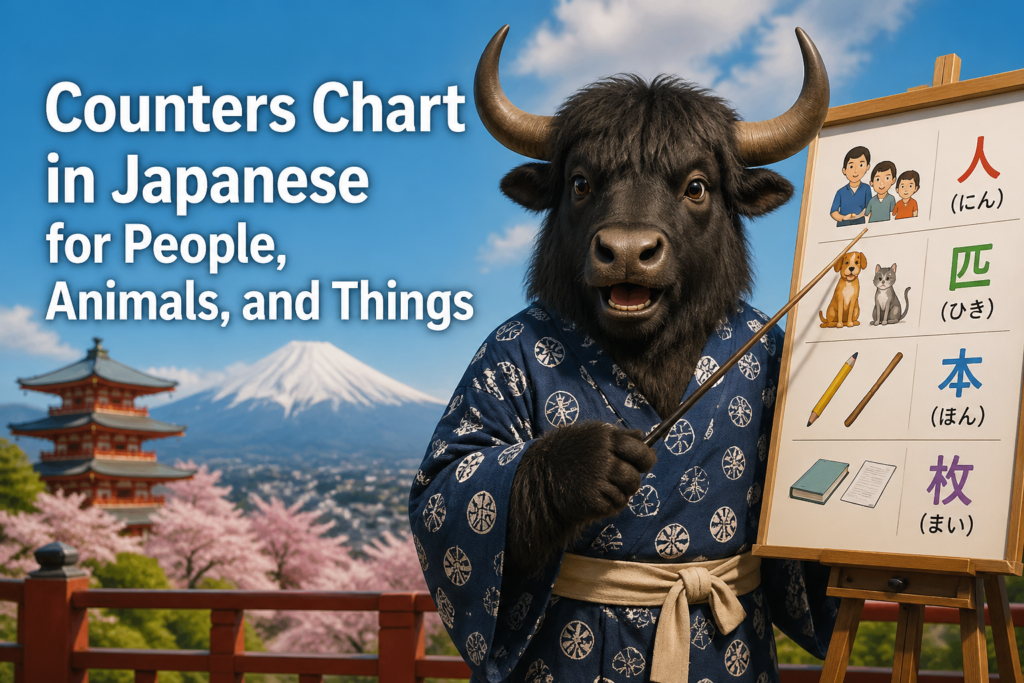
Japanese counters are one of those topics that look simple for about twelve seconds, and then suddenly your brain is doing math in another language. Lovely. The good news is that once you learn a few core counters, you can count people, long objects, flat objects, and animals with real confidence.
This guide gives you a practical Japanese Counters Chart with People, Long Objects, Flat Objects, and Animals. You will see the Japanese words, the Rōmaji, the English meaning, and example sentences you can actually use. For a broader Japanese learning path, the main hub is here: Learn Japanese.
If you have ever heard someone say ひとり or いっぽん and thought, “That cannot possibly be the whole system,” you are right. It is not. But it is also not chaos. It is a pattern-rich little system that becomes much friendlier once you see the categories.
The Big Idea: Counters Match The Thing
In Japanese, you usually do not just say a number by itself. You attach a counter that fits the thing you are counting. People use one counter. Long objects use another. Flat objects use another. Animals often use another. Easy, right? Slightly annoying, yes. Useful, absolutely.
Here is the basic formula:
Number + Counter + noun
For example, “three books” is not just “three book.” Japanese cares about shape, category, and sometimes species, because apparently nouns need supervision.
Quick Counters Chart
| Use | Counter | Rōmaji | Meaning | Example | Rōmaji Example | English Translation |
|---|---|---|---|---|---|---|
| People | 人 | nin | counter for people | 三人 | san-nin | three people |
| Long objects | 本 | hon | counter for long, cylindrical things | 二本 | ni-hon | two long objects |
| Flat objects | 枚 | mai | counter for flat things | 五枚 | go-mai | five flat objects |
| Animals | 匹 | hiki | counter for small animals | 四匹 | yon-hiki | four small animals |
People Counter: 人
The counter for people is 人, read as nin in most numbers. The first two numbers are special and worth memorizing right away.
| Japanese | Rōmaji | English Meaning | Example Sentence | Rōmaji Sentence | English Translation |
|---|---|---|---|---|---|
| 一人 | hitori | one person | 一人です。 | Hitori desu. | It is one person. / I am alone. |
| 二人 | futari | two people | 二人います。 | Futari imasu. | There are two people. |
| 三人 | san-nin | three people | 三人います。 | San-nin imasu. | There are three people. |
| 四人 | yon-nin | four people | 四人です。 | Yon-nin desu. | They are four people. |
| 五人 | go-nin | five people | 五人来ます。 | Go-nin kimasu. | Five people are coming. |
Important nuance: 一人 is hitori, and 二人 is futari. After that, the pattern becomes more regular. Japanese gives you a little reward for surviving the exceptions.
More examples:
- 三人家族 — san-nin kazoku — a family of three
- 四人です — yon-nin desu — there are four people
- 六人います — roku-nin imasu — there are six people
- 十人来ます — jū-nin kimasu — ten people are coming
Long Objects Counter: 本
The counter 本 is used for long objects like pens, bottles, umbrellas, trees, and rolls. The reading is hon, but it changes a little depending on the number. That is normal. Japanese enjoys sound changes just enough to keep you alert.
| Japanese | Rōmaji | English Meaning | Example Sentence | Rōmaji Sentence | English Translation |
|---|---|---|---|---|---|
| 一本 | ippon | one long object | 一本あります。 | Ippon arimasu. | There is one long object. |
| 二本 | ni-hon | two long objects | 二本ください。 | Ni-hon kudasai. | Two, please. |
| 三本 | san-bon | three long objects | 三本買いました。 | San-bon kaimashita. | I bought three. |
| 四本 | yon-hon | four long objects | 四本あります。 | Yon-hon arimasu. | There are four long objects. |
| 五本 | go-hon | five long objects | 五本必要です。 | Go-hon hitsuyō desu. | Five are necessary. |
Common long-object words:
- ペン一本 — pen ippon — one pen
- 傘二本 — kasa ni-hon — two umbrellas
- ビール三本 — bīru san-bon — three beers
- 木四本 — ki yon-hon — four trees
Useful rule: 本 often becomes pon or bon in actual speech. So ippon, san-bon, and roppon are all normal patterns. Yes, the sound changes. No, it is not trying to ruin your day.
Flat Objects Counter: 枚
The counter 枚 is used for flat things: paper, plates, shirts, tickets, postcards, and photos. The reading is mai, and this one is refreshingly consistent.
| Japanese | Rōmaji | English Meaning | Example Sentence | Rōmaji Sentence | English Translation |
|---|---|---|---|---|---|
| 一枚 | ichimai | one flat object | 一枚あります。 | Ichimai arimasu. | There is one flat object. |
| 二枚 | ni-mai | two flat objects | 二枚ください。 | Ni-mai kudasai. | Two, please. |
| 三枚 | san-mai | three flat objects | 三枚あります。 | San-mai arimasu. | There are three flat objects. |
| 四枚 | yon-mai | four flat objects | 四枚持っています。 | Yon-mai motte imasu. | I have four. |
| 五枚 | go-mai | five flat objects | 五枚必要です。 | Go-mai hitsuyō desu. | Five are needed. |
Flat-object examples:
- 紙一枚 — kami ichimai — one sheet of paper
- 皿二枚 — sara ni-mai — two plates
- 写真三枚 — shashin san-mai — three photos
- 切符四枚 — kippu yon-mai — four tickets
Handy note: 枚 is very common and polite enough for daily life. When in doubt about something flat, this is often the safest guess.
Animals Counter: 匹
The counter 匹 is used for small animals like cats, dogs, fish, mice, and insects. The reading is hiki, but it changes sound depending on the number. You already know the drill: Japanese likes a little phonetic drama.
| Japanese | Rōmaji | English Meaning | Example Sentence | Rōmaji Sentence | English Translation |
|---|---|---|---|---|---|
| 一匹 | ippiki | one small animal | 一匹います。 | Ippiki imasu. | There is one small animal. |
| 二匹 | ni-hiki | two small animals | 二匹います。 | Ni-hiki imasu. | There are two small animals. |
| 三匹 | san-biki | three small animals | 三匹見ました。 | San-biki mimashita. | I saw three small animals. |
| 四匹 | yon-hiki | four small animals | 四匹飼っています。 | Yon-hiki katte imasu. | I have four as pets. |
| 五匹 | go-hiki | five small animals | 五匹います。 | Go-hiki imasu. | There are five small animals. |
Animal examples:
- 猫一匹 — neko ippiki — one cat
- 犬二匹 — inu ni-hiki — two dogs
- 魚三匹 — sakana san-biki — three fish
- 虫四匹 — mushi yon-hiki — four insects
Note: bigger animals can use different counters in some situations, but 匹 is the main one for small animals and is the one learners should start with.
More Common Counters You Will Meet Soon
Once you know the main four, other counters start showing up everywhere. Sneaky, but manageable.
| Japanese | Rōmaji | Meaning | Example | Rōmaji Example | English Translation |
|---|---|---|---|---|---|
| 冊 | satsu | counter for books, magazines | 本を二冊買いました。 | Hon o ni-satsu kaimashita. | I bought two books. |
| 個 | ko | counter for small objects | 卵を三個ください。 | Tamago o san-ko kudasai. | Three eggs, please. |
| 台 | dai | counter for machines, vehicles | 車が一台あります。 | Kuruma ga ichi-dai arimasu. | There is one car. |
| 杯 | hai | counter for cups, glasses of drink | お酒を二杯飲みました。 | Osake o ni-hai nomimashita. | I drank two cups of alcohol. |
Simple Pattern Guide
Use these patterns as your starting point:
- 一人 — hitori — one person
- 二人 — futari — two people
- 三人 — san-nin — three people
- 一本 — ippon — one long object
- 二本 — ni-hon — two long objects
- 一枚 — ichimai — one flat object
- 二枚 — ni-mai — two flat objects
- 一匹 — ippiki — one small animal
- 二匹 — ni-hiki — two small animals
Think of the counter as the “shape helper.” If the thing is a person, long, flat, or furry and small, the counter tells you how Japanese wants to count it.
Common Mistakes And Easy Fixes
| Common Mistake | Better Choice | Why |
|---|---|---|
| Using one generic counter for everything | Match the thing to the counter | Japanese usually wants a category-based counter |
| Saying 一人 as ichinin | ひとり — hitori | One person is irregular |
| Saying 二人 as nihunin | ふたり — futari | Two people is also irregular |
| Forgetting sound changes in 本 and 匹 | Listen for ippon, san-bon, ippiki, san-biki | The pronunciation shifts are normal |
| Using 枚 for anything | Use 枚 only for flat things | It is not a universal counter |
If you do make a mistake, people usually still understand. Context does a lot of heavy lifting in Japanese. Still, learning the right counter makes your Japanese sound much more natural, which is always nice when language tries to behave itself.
Practice: Swap The Counter
Try changing the English idea into the correct Japanese counter:
- one person → 一人 — hitori
- two people → 二人 — futari
- three people → 三人 — san-nin
- one pen → 一本 — ippon
- two pens → 二本 — ni-hon
- three sheets of paper → 三枚 — san-mai
- four photos → 四枚 — yon-mai
- one cat → 一匹 — ippiki
- two dogs → 二匹 — ni-hiki
- three fish → 三匹 — san-biki
Now try making your own sentences:
- 一人います。 — Hitori imasu. — There is one person.
- 本を二本買います。 — Hon o ni-hon kaimasu. — I will buy two long objects.
- 写真を三枚見ました。 — Shashin o san-mai mimashita. — I saw three photos.
- 犬が四匹います。 — Inu ga yon-hiki imasu. — There are four dogs.
Quick Reference Summary
Here is the shortest useful version of this chart:
| Category | Counter | Reading | Use It For |
|---|---|---|---|
| People | 人 | nin | people |
| Long objects | 本 | hon | pens, bottles, umbrellas, sticks |
| Flat objects | 枚 | mai | paper, shirts, tickets, photos |
| Small animals | 匹 | hiki | cats, dogs, fish, insects |
And the must-know irregulars:
- 一人 — hitori
- 二人 — futari
- 一本 — ippon
- 一匹 — ippiki
Japanese counters are not random chaos. They are a system with a few tricky exceptions, and once those are familiar, the rest starts to feel oddly logical. Annoying, yes. Logical, also yes.
Keep this counters chart close while you study, and you will start spotting the patterns everywhere. That is the moment Japanese counting stops feeling like a puzzle and starts feeling like a tool. A slightly fussy tool, sure, but a useful one.