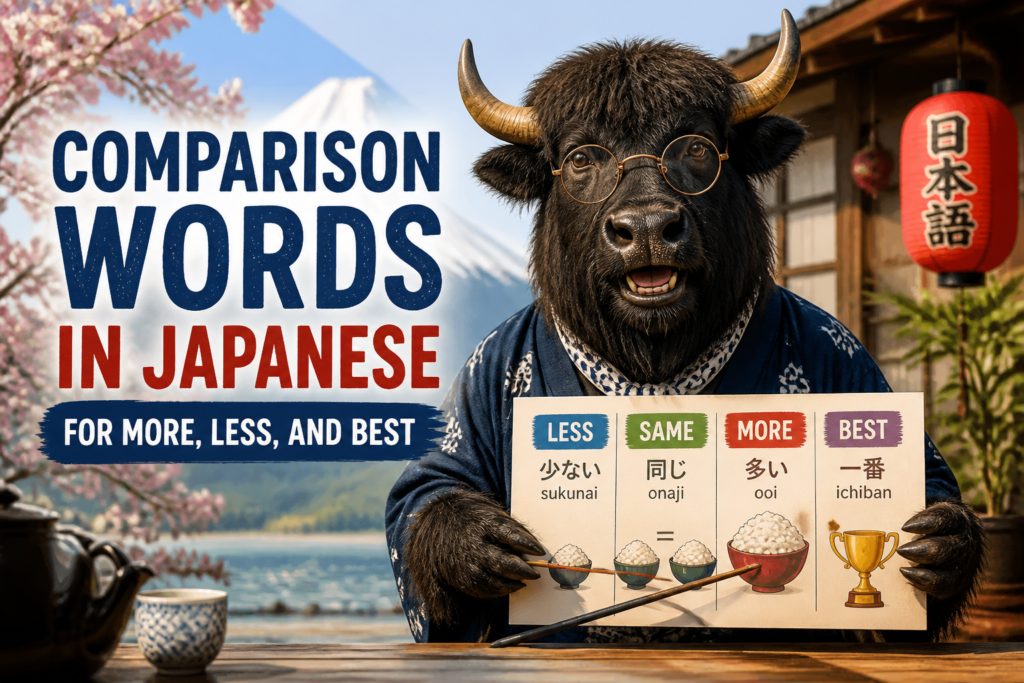
Japanese Comparison Words Chart for More, Less, Same, and Best sounds technical, but the actual language is refreshingly practical. If you can say “more,” “less,” “same,” and “best,” you can compare food, prices, skills, plans, and probably a friend’s suspiciously confident karaoke score.
Japanese usually keeps comparison simple. No dramatic grammar monster lurking in the shadows. A few key words do most of the work, and once you know them, you can start making real-life comparisons right away.
For a broader study path, the main Japanese learning hub is here, and if you want to check your level before diving deeper, try the Japanese placement test.
The Core Comparison Words
| Japanese | Rōmaji | English Meaning | Example |
|---|---|---|---|
| より | yori | than; compared to | このケーキはあのケーキより甘い。 C no kēki wa ano kēki yori amai. This cake is sweeter than that cake. |
| もっと | motto | more; even more | 私はもっと水がほしい。 Watashi wa motto mizu ga hoshii. I want more water. |
| 少ない | sukunai | few; little; less | 今日の宿題は少ない。 Kyou no shukudai wa sukunai. Today’s homework is less. |
| 多い | ooi | many; much; more in quantity | この店は客が多い。 Kono mise wa kyaku ga ooi. This store has many customers. |
| 同じ | onaji | same | その二つは同じです。 Sono futatsu wa onaji desu. Those two are the same. |
| 一番 | ichiban | the most; number one; best | このラーメンが一番おいしい。 Kono rāmen ga ichiban oishii. This ramen is the best. |
How Japanese Comparison Works
Japanese comparison is usually built with より (yori), which means “than.” It attaches the thing being compared to the standard you are comparing against. In other words, Japanese politely points at the other thing and says, “Yes, that one.”
Basic structure:
A は B より adjective.
A wa B yori adjective.
A is more adjective than B.
Example:
この車はあの車より速い。
Kono kuruma wa ano kuruma yori hayai.
This car is faster than that car.
Notice the pattern. Japanese does not need a separate “more” in many cases. The adjective itself already does the job. Convenient. Almost rude how simple it is.
| Pattern | Meaning | Example | Rōmaji | Translation |
|---|---|---|---|---|
| A は B より adjective | A is more adjective than B | 東京は大阪より大きい。 | Toukyou wa Oosaka yori ookii. | Tokyo is bigger than Osaka. |
| A は B より adjective | A is less adjective than B | この部屋はあの部屋より広くない。 | Kono heya wa ano heya yori hirokunai. | This room is not as spacious as that room. |
| A は B と同じです | A is the same as B | この本はあの本と同じです。 | Kono hon wa ano hon to onaji desu. | This book is the same as that book. |
| A が一番 adjective | A is the most / best | この店が一番安い。 | Kono mise ga ichiban yasui. | This store is the cheapest. |
Useful Words And Real-Life Sentences
Here are common comparison words and phrases you will actually use, not just admire in a grammar book and then ignore for six months.
| Kanji | Rōmaji | Meaning | Example Sentence | Translation |
|---|---|---|---|---|
| より | yori | than | この店はあの店より安い。 Kono mise wa ano mise yori yasui. | This store is cheaper than that store. |
| もっと | motto | more | もっと早く来てください。 Motto hayaku kite kudasai. | Please come earlier. |
| 少ない | sukunai | less; few | 今日は人が少ない。 Kyou wa hito ga sukunai. | There are fewer people today. |
| 多い | ooi | many; much | この駅は人が多い。 Kono eki wa hito ga ooi. | This station is crowded. |
| 同じ | onaji | same | 私たちは同じ意見です。 Watashitachi wa onaji iken desu. | We have the same opinion. |
| 一番 | ichiban | the most; best | この映画が一番好きです。 Kono eiga ga ichiban suki desu. | This is my favorite movie. |
| 最も | mottomo | most; most of all | 彼は最も有名な作家です。 Kare wa mottomo yuumei na sakka desu. | He is the most famous writer. |
| 一層 | issou | even more | この結果で一層安心しました。 Kono kekka de issou anshin shimashita. | I felt even more relieved because of this result. |
| ずっと | zutto | much; far more | 昨日よりずっと寒い。 Kinoo yori zutto samui. | It is much colder than yesterday. |
| 半分 | hanbun | half | このケーキは前の半分しかない。 Kono kēki wa mae no hanbun shika nai. | This cake is only half of the previous one. |
| 倍 | bai | double; times | このパソコンは前の二倍速い。 Kono pasokon wa mae no nibai hayai. | This computer is twice as fast as the old one. |
| 以上 | ijou | more than; at least | 十人以上来ました。 Juu nin ijou kimashita. | More than ten people came. |
| 以下 | ika | less than; under | 十八歳以下は入れません。 Juu hachi sai ika wa hairemasen. | People under 18 cannot enter. |
More, Less, Same, And Best In Easy Patterns
Japanese comparison often uses a small set of reliable patterns. If you learn these, you can build a lot of sentences without panic-searching the internet in the middle of class.
1. More / Better Than
A は B より adjective。
A wa B yori adjective.
A is more adjective than B.
Example:
この映画はあの映画より面白い。
Kono eiga wa ano eiga yori omoshiroi.
This movie is more interesting than that movie.
2. More Of Something
もっと + noun / verb
Motto + noun / verb
More; even more
Example:
もっと野菜を食べてください。
Motto yasai o tabete kudasai.
Please eat more vegetables.
3. Less / Fewer
Japanese often says the negative form of an adjective or uses words like 少ない (sukunai). Context does the heavy lifting, because apparently Japanese enjoys keeping learners humble.
Example:
この町は雨が少ない。
Kono machi wa ame ga sukunai.
This town gets less rain.
4. Same As
A は B と同じです。
A wa B to onaji desu.
A is the same as B.
Example:
このサイズはあのサイズと同じです。
Kono saizu wa ano saizu to onaji desu.
This size is the same as that size.
5. Best / Most
A が一番 adjective。
A ga ichiban adjective.
A is the most adjective / the best.
Example:
この駅が一番便利です。
Kono eki ga ichiban benri desu.
This station is the most convenient.
Common Comparison Words By Type
| Type | Japanese | Rōmaji | English | Example |
|---|---|---|---|---|
| Quantity | 多い | ooi | many; much | 人が多い。 Hito ga ooi. There are many people. |
| Quantity | 少ない | sukunai | few; little | 時間が少ない。 Jikan ga sukunai. There is little time. |
| Degree | もっと | motto | more | もっと勉強します。 Motto benkyou shimasu. I will study more. |
| Degree | ずっと | zutto | much; far more | 前よりずっといい。 Mae yori zutto ii. It is much better than before. |
| Equality | 同じ | onaji | same | 私の答えは同じです。 Watashi no kotae wa onaji desu. My answer is the same. |
| Superlative | 一番 | ichiban | most; best | 一番高い山 ichiban takai yama the highest mountain |
| Superlative | 最も | mottomo | most | 最も重要です。 Mottomo juuyou desu. It is the most important. |
| Scale | 以上 | ijou | more than; at least | 三人以上必要です。 San nin ijou hitsuyou desu. At least three people are needed. |
| Scale | 以下 | ika | less than; under | 十五歳以下 Juu go sai ika under 15 years old |
| Ratio | 倍 | bai | double; times | 二倍の速さ Nibai no hayasa double speed |
Curious Bit: “Best” Is Not Always 一番
In casual English, “best” can sound like personal preference. Japanese often uses 一番 (ichiban), which means “number one” or “the most,” but it can also feel slightly more factual than emotional.
Compare these:
このラーメンが一番おいしい。
Kono rāmen ga ichiban oishii.
This ramen is the most delicious / the best.
私はこのラーメンが一番好きです。
Watashi wa kono rāmen ga ichiban suki desu.
I like this ramen best.
If you want the English-style idea of “my favorite,” Japanese often prefers 一番好き or a direct preference statement. Simple, clean, and very Japanese: less drama, more precision.
Practice Drills
Try swapping the words. Small changes, big payoff.
- この本はあの本より面白い。
Kono hon wa ano hon yori omoshiroi.
This book is more interesting than that book. - この本はあの本より安い。
Kono hon wa ano hon yori yasui.
This book is cheaper than that book. - 私たちは同じクラスです。
Watashitachi wa onaji kurasu desu.
We are in the same class. - この道が一番近い。
Kono michi ga ichiban chikai.
This road is the nearest. - もっとゆっくり話してください。
Motto yukkuri hanashite kudasai.
Please speak more slowly. - 今日は昨日より寒い。
Kyou wa kinou yori samui.
Today is colder than yesterday. - この店は人が少ない。
Kono mise wa hito ga sukunai.
This store has fewer people. - この問題は前より簡単です。
Kono mondai wa mae yori kantan desu.
This problem is easier than before.
Common Mistakes And Fixes
1. Using “more” with every adjective
Wrong idea: “more big,” “more cold,” “more fast.” English does this sometimes with “more beautiful,” but Japanese does not always need a separate “more.”
Better:
この車はあの車より大きい。
Kono kuruma wa ano kuruma yori ookii.
This car is bigger than that car.
2. Forgetting より
If you compare two things, より is often the key word. Leave it out and the sentence may feel incomplete.
この町はあの町より静かです。
Kono machi wa ano machi yori shizuka desu.
This town is quieter than that town.
3. Mixing Up 同じ With 一番
同じ means “same.” 一番 means “the most” or “best.” They are not cousins. They are not even at the same party.
この二つは同じです。
Kono futatsu wa onaji desu.
These two are the same.
この二つの中でこれが一番好きです。
Kono futatsu no naka de kore ga ichiban suki desu.
Among these two, I like this one best.
4. Confusing 少ない And 小さい
少ない (sukunai) means “few” or “little.” 小さい (chīsai) means “small.” One is about amount, the other is about size.
この箱は小さい。
Kono hako wa chiisai.
This box is small.
この箱の中身は少ない。
Kono hako no nakami wa sukunai.
There is little inside this box.
Quick Reference Summary
More / Than
より (yori) = than
More
もっと (motto) = more, even more
Less / Fewer
少ない (sukunai) = few, little, less
Same
同じ (onaji) = same
Best / Most
一番 (ichiban) = the best, the most
Extra Formal “Most”
最も (mottomo) = most
Under / More Than
以下 (ika) = under, less than
以上 (ijou) = more than, at least
Japanese comparison is a lot less scary than it looks. Once you know より, 同じ, and 一番, you can compare almost anything without sweating through your notebook.
That’s the nice thing about this part of Japanese: the patterns are stable, useful, and easy to recycle. Learn the core words, then start building with real objects around you—food, movies, trains, weather, and all the other things people love to compare like it’s a national sport.