


Example: Aさんは来ませんでした。 A-san wa kimasen deshita. A did not come.
でも、連絡はありました。 Demo, renraku wa arimashita. But there was contact.
How しかし Shikashi Works
しかし Shikashi is the formal cousin in the contrast family. It means “however” or “nevertheless,” and it is more common in writing, reports, speeches, and serious explanations than in casual conversation.
Rule: Use しかし when you want a formal, polished contrast.
Example: 計画は順調です。しかし、油断はできません。 Keikaku wa junchō desu. Shikashi, yudan wa dekimasen. The plan is going well. However, we cannot be careless.
Example: 値段は高い。しかし、買う価値がある。 Nedan wa takai. Shikashi, kau kachi ga aru. The price is high. However, it is worth buying.
If けど is a friendly tap on the shoulder, しかし is a neat suit and a clipboard. Both are useful. One just wears better shoes.
Direct Comparison: Which One Should You Use?
| Word | Rōmaji | Style | Best Use | Example |
|---|---|---|---|---|
| けど | Kedo | Casual, soft | Everyday conversation, gentle contrast, unfinished sentences | 行くけど、遅れるかも。 Iku kedo, okureru kamo. I’ll go, but I may be late. |
| が | Ga | Polite, formal | Business speech, polite requests, written Japanese | 行きますが、少し遅れます。 Ikimasu ga, sukoshi okuremasu. I will go, but I will be a little late. |
| でも | Demo | Flexible, conversational | Starting a new sentence, pushing back, correcting | 行きたい。でも、無理。 Ikitai. Demo, muri. I want to go. But it’s impossible. |
| しかし | Shikashi | Formal, written | Reports, essays, speeches, serious explanations | 必要です。しかし、時間が足りません。 Hitsuyō desu. Shikashi, jikan ga tarimasen. It is necessary. However, there is not enough time. |
Sentence Patterns You Will Actually Use
These patterns are worth memorizing because they show up everywhere. Not glamorous, maybe, but neither is brushing your teeth and yet here we are.
- [A] けど [B] — [A] kedo [B] — [A], but [B]
- [A] が [B] — [A] ga [B] — [A], but [B] in formal/polite style
- [Sentence]. でも、[Sentence]. — Demo, [Sentence]. — “But…” at the start of a new sentence
- [Sentence]. しかし、[Sentence]. — Shikashi, [Sentence]. — formal “however”
- 〜たいけど — ~tai kedo — “I want to…, but…”
- 〜ですが — ~desu ga — very polite “but…”
- 〜ても — ~te mo — “even if / even though” in a different contrast pattern
That last one, 〜ても ~te mo, is related but not the same as “but.” It often means “even if” or “even though.” If that sounds useful, the article on reasons in Japanese helps explain why Japanese often connects ideas very carefully instead of just throwing “but” at every problem.
Common Confusion: けど And が
These two are the main troublemakers because both can mean “but.” The difference is mostly style.
- けど = more casual, common in spoken Japanese.
- が = more formal, polite, and sometimes a little distant.
Casual: 今日は休みだけど、出かける。 Kyō wa yasumi da kedo, dekakeru. It’s my day off, but I’m going out.
Polite: 今日は休みですが、出かけます。 Kyō wa yasumi desu ga, dekakemasu. It’s my day off, but I will go out.
Notice how both sentences say almost the same thing, but one sounds like a chat and the other sounds like a tidy public statement.
Common Confusion: でも And しかし
These two often appear at the start of a sentence. The main difference is formality.
- でも = everyday, flexible, conversational.
- しかし = formal, written, deliberate.
Conversation: でも、今日は無理。 Demo, kyō wa muri. But today is impossible.
Writing: しかし、本日の実施は困難です。 Shikashi, honjitsu no jisshi wa konnan desu. However, carrying it out today is difficult.
That second one sounds like it belongs in an email, a notice, or a report. Because it does.
Mini Reference Table: Tone And Situation
| Word | Rōmaji | Meaning | Typical Situation |
|---|---|---|---|
| けど | Kedo | But, though, yet | Casual speech, everyday conversation |
| が | Ga | But, however | Polite speech, formal writing |
| でも | Demo | But, however, even so | Start of sentence, contrast, correction |
| しかし | Shikashi | However, nevertheless | Written Japanese, formal speech |
Useful Vocabulary For Contrast And Explanation
Here are extra words that often appear near these contrast expressions. They are not identical, but they like to hang out together.
| Kanji | Rōmaji | Meaning | Example (Kanji) | Example (Rōmaji) | Translation (EN) |
|---|---|---|---|---|---|
| 反対 | Hantai | Opposition, opposite | 私はこの案に反対です。 | Watashi wa kono an ni hantai desu. | I am against this plan. |
| 対比 | Taihi | Contrast | 二つの意見を対比します。 | Futatsu no iken o taihi shimasu. | I will compare the two opinions. |
| 理由 | Riyū | Reason | 理由はありますが、今は言えません。 | Riyū wa arimasu ga, ima wa iemasen. | I have a reason, but I can’t say it now. |
| 一方 | Ippō | On the other hand | 日本は冬が寒い。一方、沖縄は暖かい。 | Nihon wa fuyu ga samui. Ippō, Okinawa wa atatakai. | Japan is cold in winter. On the other hand, Okinawa is warm. |
| 問題 | Mondai | Problem, issue | 問題はありますが、解決できます。 | Mondai wa arimasu ga, kaiketsu dekimasu. | There are problems, but we can solve them. |
| 必要 | Hitsuyō | Necessary | 練習は必要ですが、毎日少しで大丈夫です。 | Renshū wa hitsuyō desu ga, mainichi sukoshi de daijōbu desu. | Practice is necessary, but a little every day is fine. |
For more contrast-adjacent grammar like sentence endings and softening expressions, see Japanese Ending Particles. That topic pairs nicely with this one, because Japanese loves using tiny words to do giant emotional jobs.
Practice: Choose The Best One
Pick the best option: けど, が, でも, or しかし. Then check the answer in the example below it.
- 1. 今日は忙しい___、行けます。 Kyō wa isogashii ___, ikemasu.
- 2. 申し訳ありません___、少し待ってください。 Mōshiwake arimasen ___, sukoshi matte kudasai.
- 3. 行きたい。___、お金がない。 Ikitai. ___, okane ga nai.
- 4. この方法は簡単です。___、時間がかかります。 Kono hōhō wa kantan desu. ___, jikan ga kakarimasu.
Answers:
- 1. けど — Kedo — casual, natural.
- 2. が — Ga — polite.
- 3. でも — Demo — sentence starter.
- 4. しかし — Shikashi — formal written contrast.
If you got them mixed up, good. That means your brain is paying attention. Japanese contrast words are less about “one correct translation” and more about “which tone fits the room.”
Common Mistakes And Easy Fixes
| Mistake | Why It Sounds Off | Better Choice |
|---|---|---|
| Using しかし in casual conversation all the time | It can sound stiff or overly formal | Use けど or でも in everyday speech |
| Using けど in a formal email when you need politeness | Too casual for the situation | Use が or しかし |
| Translating every “but” as でも | でも often starts a new sentence; it is not always the best fit inside one clause | Use けど or が for clause connection |
| Forgetting that けど can trail off | The sentence may sound unfinished, but that is often intentional | Leave the ending open when softening is the goal |
One more useful note: Japanese contrast is often softer than English “but.” So if you use a contrast word and the sentence still feels gentle, that is normal. Japanese is not being vague. It is being itself.
Quick Reference Summary
- けど Kedo — casual “but,” very common in speech.
- が Ga — polite “but,” common in formal contexts.
- でも Demo — “but/however,” often starts a sentence.
- しかし Shikashi — formal “however,” common in writing.
- Choose based on tone, not just translation.
- When unsure in conversation, けど is often the safest default.
- When writing politely, が is a strong option.
- When making a clear contrast in formal writing, しかし works well.
If you want to keep testing yourself, you can also use the Japanese Placement Test JLPT and the Japanese Vocabulary Test for extra practice. Tiny words like these are easy to overlook, and then suddenly they are everywhere. Classic Japanese behavior.
Yak Takeaway: In Japanese, “but” is not one word with one job. けど is casual, が is polite, でも is flexible, and しかし is formal. Learn the tone, and the grammar starts behaving like it actually wants to help.
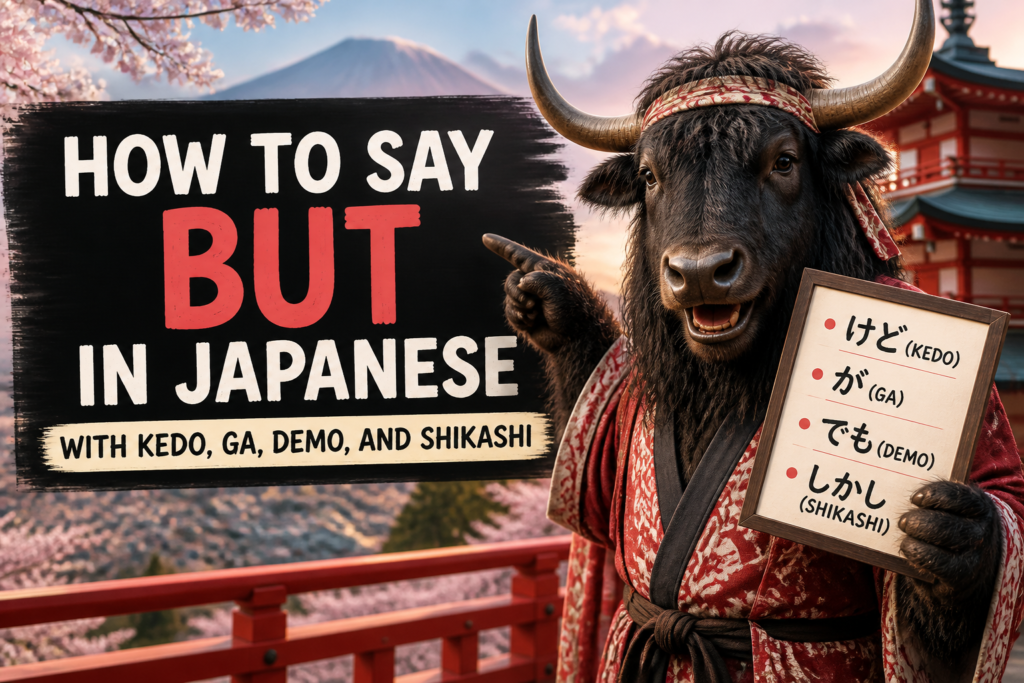
けど Kedo, が Ga, でも Demo, and しかし Shikashi all help you show contrast in Japanese. In other words: “but,” “however,” “though,” “still,” “even so.” Japanese, naturally, refuses to give you just one neat little button for a simple idea. Rude? Maybe. Useful? Absolutely.
If you’ve ever wondered why one person says けど in a casual chat while another suddenly switches to しかし in a formal speech, you are not alone. These words are similar, but they do not feel the same. That tiny difference can make a sentence sound friendly, stiff, soft, apologetic, or a bit more literary.
For a broader look at Japanese learning, the main hub is here: Learn Japanese. And if you want to check where your level sits, try the Japanese Placement Test JLPT or the Japanese Vocabulary Test.
The Big Idea: Contrast In Japanese
In English, “but” can do a lot of work. In Japanese, the job gets split up. Sometimes you need a soft connection between two ideas. Sometimes you need a stronger “however.” Sometimes you need a sentence that sounds polite and not too sharp. That is why learners run into けど, が, でも, and しかし so often.
Here is the simplest way to think about them:
- けど Kedo — casual, soft, and very common.
- が Ga — polite, formal, and often a little reserved.
- でも Demo — “but,” “however,” or “even so,” often at the start of a sentence.
- しかし Shikashi — formal “however,” often used in writing, speeches, and serious explanations.
They overlap, but not perfectly. That is the fun part. Or the annoying part. Same difference, really.
Useful Contrast Phrases And Real-Life Sentences
Each phrase below includes the Japanese, Rōmaji, and a clear English meaning. The examples show how the contrast feels in real life, not just in grammar textbooks that sound like they were written by a very polite robot.
| Japanese | Rōmaji | English Meaning |
|---|---|---|
| 高いけど、買いたい。 Takai kedo, kaitai. | Takai kedo, kaitai. | It’s expensive, but I want to buy it. |
| 雨だけど、行きます。 Ame da kedo, ikimasu. | Ame da kedo, ikimasu. | It’s raining, but I’m going. |
| 忙しいけど、手伝います。 Isogashii kedo, tetsudaimasu. | Isogashii kedo, tetsudaimasu. | I’m busy, but I’ll help. |
| 時間がないけど、大丈夫です。 Jikan ga nai kedo, daijōbu desu. | Jikan ga nai kedo, daijōbu desu. | I don’t have time, but it’s okay. |
| 行きたいんですけど…… Ikitain desu kedo… | Ikitain desu kedo… | I want to go, but… |
| が、 Ga — polite contrast | Ga | But / however, often softer or more formal than “kedo.” |
| お電話しましたが、ご不在でした。 O-denwa shimashita ga, go-fuzai deshita. | O-denwa shimashita ga, go-fuzai deshita. | I called, but you were not available. |
| 申し訳ありませんが、今日は無理です。 Mōshiwake arimasen ga, kyō wa muri desu. | Mōshiwake arimasen ga, kyō wa muri desu. | I’m sorry, but today is impossible. |
| 少々お待ちくださいが、 Shōshō omachi kudasai ga, | Shōshō omachi kudasai ga, | Please wait a moment, but… |
| でも、 Demo — starting contrast | Demo | But / however / even so. |
| 行きたい。でも、時間がない。 Ikitai. Demo, jikan ga nai. | Ikitai. Demo, jikan ga nai. | I want to go. But I don’t have time. |
| 寒い。でも、窓を開けたい。 Samui. Demo, mado o aketai. | Samui. Demo, mado o aketai. | It’s cold. But I want to open the window. |
| 高かった。でも、良かった。 Takakatta. Demo, yokatta. | Takakatta. Demo, yokatta. | It was expensive. But it was good. |
| しかし、 Shikashi — formal contrast | Shikashi | However / nevertheless. |
| この方法は簡単です。しかし、時間がかかります。 Kono hōhō wa kantan desu. Shikashi, jikan ga kakarimasu. | Kono hōhō wa kantan desu. Shikashi, jikan ga kakarimasu. | This method is easy. However, it takes time. |
| 値段は高い。しかし、品質は良い。 Nedan wa takai. Shikashi, hinshitsu wa yoi. | Nedan wa takai. Shikashi, hinshitsu wa yoi. | The price is high. However, the quality is good. |
| 簡単そうに見える。しかし、実際は難しい。 Kantan sō ni mieru. Shikashi, jissai wa muzukashii. | Kantan sō ni mieru. Shikashi, jissai wa muzukashii. | It looks easy. However, in reality, it is difficult. |
How けど Kedo Works
けど Kedo is the most common “but” in everyday Japanese. It feels soft and natural. It can connect two clauses, or it can trail off politely when the speaker does not want to sound too direct. Japanese loves a gentle exit ramp.
Rule: Use けど when you want a casual or neutral contrast. It often sounds less blunt than English “but.”
Example: 今日は行きたいけど、忙しい。 Kyō wa ikitai kedo, isogashii. I want to go today, but I’m busy.
Example: この店は安いけど、おいしい。 Kono mise wa yasui kedo, oishii. This shop is cheap, but delicious.
In conversation, けど can also mean “well…” or “so…” depending on the situation.
Example: ちょっと相談があるんだけど。 Chotto sōdan ga aru n da kedo. I have something I want to ask you about…
How が Ga Works
が Ga also means “but,” but it usually sounds more formal, softer, or more careful than けど. It is very common in polite speech, business Japanese, and written language. It can sound slightly reserved, which is useful when you want to be polite without sounding overly chatty.
Rule: Use が when the sentence should feel polite, formal, or a little restrained.
Example: 試験は難しかったが、合格しました。 Shiken wa muzukashikatta ga, gōkaku shimashita. The exam was difficult, but I passed.
Example: 質問がありますが、少しよろしいですか。 Shitsumon ga arimasu ga, sukoshi yoroshii desu ka. I have a question, but would you have a moment?
When が appears at the end of a sentence, it can also soften the unfinished feeling of what you are saying.
Example: お願いしたいことがあるのですが…… Onegai shitai koto ga aru no desu ga… I have something I’d like to ask, but…
How でも Demo Works
でも Demo is very flexible. It often begins a sentence and introduces a contrast, a correction, or a counterpoint. It can mean “but,” “however,” or “even so,” depending on context.
Rule: Use でも when you want to start a new sentence with contrast or push back against the previous idea.
Example: おいしい。でも、高い。 Oishii. Demo, takai. It’s delicious. But it’s expensive.
Example: 行きたい。でも、雨がひどい。 Ikitai. Demo, ame ga hidoi. I want to go. But the rain is terrible.
Example: 疲れた。でも、まだ仕事がある。 Tsumuketa. Demo, mada shigoto ga aru. I’m tired. But I still have work.
でも can also be used for a gentle correction.
Example: Aさんは来ませんでした。 A-san wa kimasen deshita. A did not come.
でも、連絡はありました。 Demo, renraku wa arimashita. But there was contact.
How しかし Shikashi Works
しかし Shikashi is the formal cousin in the contrast family. It means “however” or “nevertheless,” and it is more common in writing, reports, speeches, and serious explanations than in casual conversation.
Rule: Use しかし when you want a formal, polished contrast.
Example: 計画は順調です。しかし、油断はできません。 Keikaku wa junchō desu. Shikashi, yudan wa dekimasen. The plan is going well. However, we cannot be careless.
Example: 値段は高い。しかし、買う価値がある。 Nedan wa takai. Shikashi, kau kachi ga aru. The price is high. However, it is worth buying.
If けど is a friendly tap on the shoulder, しかし is a neat suit and a clipboard. Both are useful. One just wears better shoes.
Direct Comparison: Which One Should You Use?
| Word | Rōmaji | Style | Best Use | Example |
|---|---|---|---|---|
| けど | Kedo | Casual, soft | Everyday conversation, gentle contrast, unfinished sentences | 行くけど、遅れるかも。 Iku kedo, okureru kamo. I’ll go, but I may be late. |
| が | Ga | Polite, formal | Business speech, polite requests, written Japanese | 行きますが、少し遅れます。 Ikimasu ga, sukoshi okuremasu. I will go, but I will be a little late. |
| でも | Demo | Flexible, conversational | Starting a new sentence, pushing back, correcting | 行きたい。でも、無理。 Ikitai. Demo, muri. I want to go. But it’s impossible. |
| しかし | Shikashi | Formal, written | Reports, essays, speeches, serious explanations | 必要です。しかし、時間が足りません。 Hitsuyō desu. Shikashi, jikan ga tarimasen. It is necessary. However, there is not enough time. |
Sentence Patterns You Will Actually Use
These patterns are worth memorizing because they show up everywhere. Not glamorous, maybe, but neither is brushing your teeth and yet here we are.
- [A] けど [B] — [A] kedo [B] — [A], but [B]
- [A] が [B] — [A] ga [B] — [A], but [B] in formal/polite style
- [Sentence]. でも、[Sentence]. — Demo, [Sentence]. — “But…” at the start of a new sentence
- [Sentence]. しかし、[Sentence]. — Shikashi, [Sentence]. — formal “however”
- 〜たいけど — ~tai kedo — “I want to…, but…”
- 〜ですが — ~desu ga — very polite “but…”
- 〜ても — ~te mo — “even if / even though” in a different contrast pattern
That last one, 〜ても ~te mo, is related but not the same as “but.” It often means “even if” or “even though.” If that sounds useful, the article on reasons in Japanese helps explain why Japanese often connects ideas very carefully instead of just throwing “but” at every problem.
Common Confusion: けど And が
These two are the main troublemakers because both can mean “but.” The difference is mostly style.
- けど = more casual, common in spoken Japanese.
- が = more formal, polite, and sometimes a little distant.
Casual: 今日は休みだけど、出かける。 Kyō wa yasumi da kedo, dekakeru. It’s my day off, but I’m going out.
Polite: 今日は休みですが、出かけます。 Kyō wa yasumi desu ga, dekakemasu. It’s my day off, but I will go out.
Notice how both sentences say almost the same thing, but one sounds like a chat and the other sounds like a tidy public statement.
Common Confusion: でも And しかし
These two often appear at the start of a sentence. The main difference is formality.
- でも = everyday, flexible, conversational.
- しかし = formal, written, deliberate.
Conversation: でも、今日は無理。 Demo, kyō wa muri. But today is impossible.
Writing: しかし、本日の実施は困難です。 Shikashi, honjitsu no jisshi wa konnan desu. However, carrying it out today is difficult.
That second one sounds like it belongs in an email, a notice, or a report. Because it does.
Mini Reference Table: Tone And Situation
| Word | Rōmaji | Meaning | Typical Situation |
|---|---|---|---|
| けど | Kedo | But, though, yet | Casual speech, everyday conversation |
| が | Ga | But, however | Polite speech, formal writing |
| でも | Demo | But, however, even so | Start of sentence, contrast, correction |
| しかし | Shikashi | However, nevertheless | Written Japanese, formal speech |
Useful Vocabulary For Contrast And Explanation
Here are extra words that often appear near these contrast expressions. They are not identical, but they like to hang out together.
| Kanji | Rōmaji | Meaning | Example (Kanji) | Example (Rōmaji) | Translation (EN) |
|---|---|---|---|---|---|
| 反対 | Hantai | Opposition, opposite | 私はこの案に反対です。 | Watashi wa kono an ni hantai desu. | I am against this plan. |
| 対比 | Taihi | Contrast | 二つの意見を対比します。 | Futatsu no iken o taihi shimasu. | I will compare the two opinions. |
| 理由 | Riyū | Reason | 理由はありますが、今は言えません。 | Riyū wa arimasu ga, ima wa iemasen. | I have a reason, but I can’t say it now. |
| 一方 | Ippō | On the other hand | 日本は冬が寒い。一方、沖縄は暖かい。 | Nihon wa fuyu ga samui. Ippō, Okinawa wa atatakai. | Japan is cold in winter. On the other hand, Okinawa is warm. |
| 問題 | Mondai | Problem, issue | 問題はありますが、解決できます。 | Mondai wa arimasu ga, kaiketsu dekimasu. | There are problems, but we can solve them. |
| 必要 | Hitsuyō | Necessary | 練習は必要ですが、毎日少しで大丈夫です。 | Renshū wa hitsuyō desu ga, mainichi sukoshi de daijōbu desu. | Practice is necessary, but a little every day is fine. |
For more contrast-adjacent grammar like sentence endings and softening expressions, see Japanese Ending Particles. That topic pairs nicely with this one, because Japanese loves using tiny words to do giant emotional jobs.
Practice: Choose The Best One
Pick the best option: けど, が, でも, or しかし. Then check the answer in the example below it.
- 1. 今日は忙しい___、行けます。 Kyō wa isogashii ___, ikemasu.
- 2. 申し訳ありません___、少し待ってください。 Mōshiwake arimasen ___, sukoshi matte kudasai.
- 3. 行きたい。___、お金がない。 Ikitai. ___, okane ga nai.
- 4. この方法は簡単です。___、時間がかかります。 Kono hōhō wa kantan desu. ___, jikan ga kakarimasu.
Answers:
- 1. けど — Kedo — casual, natural.
- 2. が — Ga — polite.
- 3. でも — Demo — sentence starter.
- 4. しかし — Shikashi — formal written contrast.
If you got them mixed up, good. That means your brain is paying attention. Japanese contrast words are less about “one correct translation” and more about “which tone fits the room.”
Common Mistakes And Easy Fixes
| Mistake | Why It Sounds Off | Better Choice |
|---|---|---|
| Using しかし in casual conversation all the time | It can sound stiff or overly formal | Use けど or でも in everyday speech |
| Using けど in a formal email when you need politeness | Too casual for the situation | Use が or しかし |
| Translating every “but” as でも | でも often starts a new sentence; it is not always the best fit inside one clause | Use けど or が for clause connection |
| Forgetting that けど can trail off | The sentence may sound unfinished, but that is often intentional | Leave the ending open when softening is the goal |
One more useful note: Japanese contrast is often softer than English “but.” So if you use a contrast word and the sentence still feels gentle, that is normal. Japanese is not being vague. It is being itself.
Quick Reference Summary
- けど Kedo — casual “but,” very common in speech.
- が Ga — polite “but,” common in formal contexts.
- でも Demo — “but/however,” often starts a sentence.
- しかし Shikashi — formal “however,” common in writing.
- Choose based on tone, not just translation.
- When unsure in conversation, けど is often the safest default.
- When writing politely, が is a strong option.
- When making a clear contrast in formal writing, しかし works well.
If you want to keep testing yourself, you can also use the Japanese Placement Test JLPT and the Japanese Vocabulary Test for extra practice. Tiny words like these are easy to overlook, and then suddenly they are everywhere. Classic Japanese behavior.
Yak Takeaway: In Japanese, “but” is not one word with one job. けど is casual, が is polite, でも is flexible, and しかし is formal. Learn the tone, and the grammar starts behaving like it actually wants to help.