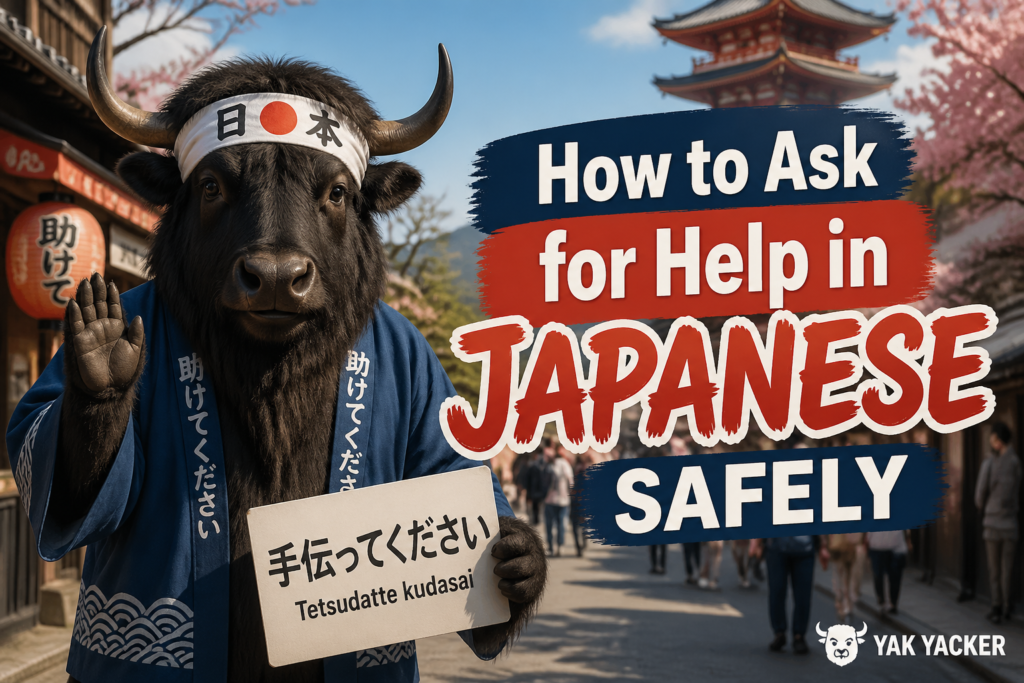
Needing help in another language can make even calm people forget every useful word they have ever learned. Funny how the brain remembers anime theme songs just fine, but suddenly hides “please help me” in a dusty corner.
The good news is that Japanese gives you a few clear, practical phrases that work in daily life and in real emergencies. This guide teaches the most useful ones, when to use them, and how to sound polite without freezing up. If you want a broader foundation first, the main Learn Japanese guide is a good place to keep your basics tidy.
We will start with everyday help, then move into urgent situations. Some phrases are soft and polite. Some are direct because, well, emergencies are not the time for elegant small talk.
The Fastest Everyday Help Phrases
These are the phrases you will use most often in shops, stations, hotels, restaurants, and random moments of mild confusion.
| Kanji | Rōmaji | Meaning | Example (JP) | Example (Rōmaji) | Translation (EN) |
|---|---|---|---|---|---|
| 手伝ってください | tetsudatte kudasai | Please help me | すみません、手伝ってください。 | sumimasen, tetsudatte kudasai. | Excuse me, please help me. |
| 助けてください | tasukete kudasai | Please help me / Please save me | 道に迷いました。助けてください。 | michi ni mayoimashita. tasukete kudasai. | I am lost. Please help me. |
| お願いします | onegai shimasu | Please | もう一度お願いします。 | mou ichido onegai shimasu. | Please say it one more time. |
| すみません | sumimasen | Excuse me / Sorry | すみません、駅はどこですか。 | sumimasen, eki wa doko desu ka. | Excuse me, where is the station? |
| ちょっと困っています | chotto komatte imasu | I am having a little trouble | 携帯がなくて、ちょっと困っています。 | keitai ga nakute, chotto komatte imasu. | I do not have my phone, so I am in a bit of trouble. |
| わかりません | wakarimasen | I do not understand | 日本語がわかりません。 | nihongo ga wakarimasen. | I do not understand Japanese. |
手伝ってください
tetsudatte kudasai
Use this when you need practical assistance, like carrying something, finding a place, or working out a machine that seems personally offended by your existence.
助けてください
tasukete kudasai
This can also mean “help me,” but it sounds stronger and more urgent. It is perfectly fine in daily trouble, but it becomes especially useful when something is actually wrong.
お願いします
onegai shimasu
This is your all-purpose softener. If you already know the thing you need, adding this makes the request polite and natural. For more on polite requesting, this guide to saying please in Japanese helps a lot.
How To Get Someone’s Attention First
Before asking for help, you often need a clean opener. In Japanese, that opener is usually すみません. It is incredibly useful, and yes, it does half the social work for you.
| Kanji | Rōmaji | Meaning | Example (JP) | Example (Rōmaji) | Translation (EN) |
|---|---|---|---|---|---|
| すみません | sumimasen | Excuse me / Sorry | すみません、手伝ってください。 | sumimasen, tetsudatte kudasai. | Excuse me, please help me. |
| あのう | anou | Um / Excuse me | あのう、病院はどこですか。 | anou, byouin wa doko desu ka. | Um, where is the hospital? |
| ちょっといいですか | chotto ii desu ka | Do you have a moment? | ちょっといいですか。道を教えてください。 | chotto ii desu ka. michi o oshiete kudasai. | Do you have a moment? Please tell me the way. |
| 聞いてもいいですか | kiite mo ii desu ka | May I ask? | 聞いてもいいですか。トイレはどこですか。 | kiite mo ii desu ka. toire wa doko desu ka. | May I ask? Where is the toilet? |
すみません
sumimasen
This is the safest default. Use it with strangers, staff, drivers, station workers, basically anyone.
すみません
sumimasen
If you learn only one help-opening phrase, make it this one. It is doing a lot of heavy lifting.
Useful Phrases For Being Lost, Confused, Or Stuck
A lot of “help” situations are not dramatic. You are just lost, confused, late, or staring at a ticket machine like it has challenged you to a duel. These phrases handle that kind of trouble well.
| Kanji | Rōmaji | Meaning | Example (JP) | Example (Rōmaji) | Translation (EN) |
|---|---|---|---|---|---|
| 道に迷いました | michi ni mayoimashita | I am lost | すみません、道に迷いました。 | sumimasen, michi ni mayoimashita. | Excuse me, I am lost. |
| 教えてください | oshiete kudasai | Please tell me / Please show me | 駅までの道を教えてください。 | eki made no michi o oshiete kudasai. | Please tell me the way to the station. |
| 案内してください | annai shite kudasai | Please guide me | ホテルまで案内してください。 | hoteru made annai shite kudasai. | Please guide me to the hotel. |
| これを使うのを手伝ってください | kore o tsukau no o tetsudatte kudasai | Please help me use this | この機械がわかりません。これを使うのを手伝ってください。 | kono kikai ga wakarimasen. kore o tsukau no o tetsudatte kudasai. | I do not understand this machine. Please help me use this. |
| ゆっくり話してください | yukkuri hanashite kudasai | Please speak slowly | すみません、ゆっくり話してください。 | sumimasen, yukkuri hanashite kudasai. | Excuse me, please speak slowly. |
| もう一度言ってください | mou ichido itte kudasai | Please say it again | すみません、もう一度言ってください。 | sumimasen, mou ichido itte kudasai. | Excuse me, please say it again. |
道に迷いました
michi ni mayoimashita
One of the most useful travel phrases ever. Short, clear, effective.
ゆっくり話してください
yukkuri hanashite kudasai
If someone is helping you but speaking at lightning speed, this phrase saves the day. Pair it with 日本語があまりわかりません
nihongo ga amari wakarimasen
I do not understand much Japanese.
If not understanding is your bigger problem, this guide to saying “I don’t know” and “I don’t understand” in Japanese fits perfectly with the help phrases here.
Emergency Help Phrases You Should Know
Now for the serious part. In an emergency, being polite still matters, but clarity matters more. Short and direct is good. Dramatic? Maybe. Useful? Absolutely.
| Kanji | Rōmaji | Meaning | Example (JP) | Example (Rōmaji) | Translation (EN) |
|---|---|---|---|---|---|
| 助けて! | tasukete! | Help! | 誰か、助けて! | dareka, tasukete! | Somebody, help! |
| 救急車を呼んでください | kyuukyuusha o yonde kudasai | Please call an ambulance | 倒れた人がいます。救急車を呼んでください。 | taoreta hito ga imasu. kyuukyuusha o yonde kudasai. | Someone has collapsed. Please call an ambulance. |
| 警察を呼んでください | keisatsu o yonde kudasai | Please call the police | 危ないです。警察を呼んでください。 | abunai desu. keisatsu o yonde kudasai. | It is dangerous. Please call the police. |
| 危ないです | abunai desu | It is dangerous | そこは危ないです。 | soko wa abunai desu. | That place is dangerous. |
| 気分が悪いです | kibun ga warui desu | I feel sick | すみません、気分が悪いです。 | sumimasen, kibun ga warui desu. | Excuse me, I feel sick. |
| 病院へ行きたいです | byouin e ikitai desu | I want to go to the hospital | けがをしました。病院へ行きたいです。 | kega o shimashita. byouin e ikitai desu. | I was injured. I want to go to the hospital. |
助けて!
tasukete!
This is a real emergency cry for help. It is not for “I dropped my shopping bag” levels of inconvenience. Use it when you actually need urgent help.
救急車を呼んでください
kyuukyuusha o yonde kudasai
If someone needs immediate medical help, this is the phrase. It is long, yes, but worth memorizing.
警察を呼んでください
keisatsu o yonde kudasai
Use this if there is danger, theft, assault, or another situation where police are needed.
Medical And Physical Trouble Phrases
Sometimes the problem is not danger around you. It is your body deciding now is a great time to stop cooperating. Very rude, but here we are.
| Kanji | Rōmaji | Meaning | Example (JP) | Example (Rōmaji) | Translation (EN) |
|---|---|---|---|---|---|
| けがをしました | kega o shimashita | I am injured | 転んで、けがをしました。 | koronde, kega o shimashita. | I fell and got injured. |
| 痛いです | itai desu | It hurts | 足が痛いです。 | ashi ga itai desu. | My leg hurts. |
| 息ができません | iki ga dekimasen | I cannot breathe | 息ができません。助けてください。 | iki ga dekimasen. tasukete kudasai. | I cannot breathe. Please help me. |
| 水をください | mizu o kudasai | Please give me water | 気分が悪いです。水をください。 | kibun ga warui desu. mizu o kudasai. | I feel sick. Please give me water. |
| 薬局はどこですか | yakkyoku wa doko desu ka | Where is the pharmacy? | すみません、薬局はどこですか。 | sumimasen, yakkyoku wa doko desu ka. | Excuse me, where is the pharmacy? |
| 医者が必要です | isha ga hitsuyou desu | I need a doctor | 医者が必要です。助けてください。 | isha ga hitsuyou desu. tasukete kudasai. | I need a doctor. Please help me. |
How To Ask Specific People For Help
Japanese often sounds more natural when you say who you need help from, especially in public places.
| Kanji | Rōmaji | Meaning | Example (JP) | Example (Rōmaji) | Translation (EN) |
|---|---|---|---|---|---|
| 駅員さん、手伝ってください | ekiin-san, tetsudatte kudasai | Station staff, please help me | 駅員さん、切符をなくしました。手伝ってください。 | ekiin-san, kippu o nakushimashita. tetsudatte kudasai. | Station staff, I lost my ticket. Please help me. |
| 店員さん、お願いします | tenin-san, onegai shimasu | Store staff, please | 店員さん、これを開けてください。お願いします。 | tenin-san, kore o akete kudasai. onegai shimasu. | Store staff, please open this. Please. |
| お医者さんを呼んでください | oishasan o yonde kudasai | Please call a doctor | 祖父の気分が悪いです。お医者さんを呼んでください。 | sofu no kibun ga warui desu. oishasan o yonde kudasai. | My grandfather feels sick. Please call a doctor. |
| 誰か来てください | dareka kite kudasai | Someone, please come here | 誰か来てください。友だちが倒れました。 | dareka kite kudasai. tomodachi ga taoremashita. | Someone, please come here. My friend collapsed. |
Polite Vs Urgent: What Changes?
Here is the basic idea:
- すみません
sumimasen
Use this to open politely. - ~してください
~shite kudasai
Use this for clear requests. - 助けて!
tasukete!
Use this when it is urgent and immediate. - 呼んでください
yonde kudasai
Use this when you need someone to call help.
So:
- すみません、手伝ってください。
sumimasen, tetsudatte kudasai.
Excuse me, please help me. → everyday polite help - 助けて!
tasukete!
Help! → urgent emergency help - 救急車を呼んでください!
kyuukyuusha o yonde kudasai!
Please call an ambulance! → emergency action
Polite Japanese is great. Clear Japanese is better when something is wrong.
Common Mistakes And Better Choices
Some phrases are easy to mix up. Here are a few quick fixes.
| Common Issue | Better Japanese | Rōmaji | Why It Works |
|---|---|---|---|
| Saying only お願いします with no context | 手伝ってください、お願いします | tetsudatte kudasai, onegai shimasu | Now the request is clear. |
| Using 助けて! for tiny problems | 手伝ってください | tetsudatte kudasai | This sounds less like a crisis movie scene. |
| Saying a long explanation first | すみません、道に迷いました | sumimasen, michi ni mayoimashita | Start with the problem clearly. |
| Not saying you do not understand | 日本語がわかりません | nihongo ga wakarimasen | This helps the other person adjust quickly. |
Quick Survival Sentences To Memorize
If you only memorize a small set, make it these.
| Kanji | Rōmaji | Meaning |
|---|---|---|
| すみません | sumimasen | Excuse me |
| 手伝ってください | tetsudatte kudasai | Please help me |
| 助けてください | tasukete kudasai | Please help me |
| 道に迷いました | michi ni mayoimashita | I am lost |
| わかりません | wakarimasen | I do not understand |
| ゆっくり話してください | yukkuri hanashite kudasai | Please speak slowly |
| 気分が悪いです | kibun ga warui desu | I feel sick |
| 救急車を呼んでください | kyuukyuusha o yonde kudasai | Please call an ambulance |
| 警察を呼んでください | keisatsu o yonde kudasai | Please call the police |
| 助けて! | tasukete! | Help! |
A Mini Practice Set
Try matching the situation with the best phrase.
- You are lost near a station.
すみません、道に迷いました。
sumimasen, michi ni mayoimashita.
Excuse me, I am lost. - You feel sick on a train.
すみません、気分が悪いです。
sumimasen, kibun ga warui desu.
Excuse me, I feel sick. - You need urgent medical help for someone.
救急車を呼んでください!
kyuukyuusha o yonde kudasai!
Please call an ambulance! - You cannot understand fast Japanese directions.
わかりません。ゆっくり話してください。
wakarimasen. yukkuri hanashite kudasai.
I do not understand. Please speak slowly.
Useful Related Words
| Kanji | Rōmaji | Meaning | Example (JP) | Example (Rōmaji) | Translation (EN) |
|---|---|---|---|---|---|
| 駅 | eki | station | 駅はどこですか。 | eki wa doko desu ka. | Where is the station? |
| 病院 | byouin | hospital | 病院へ行きたいです。 | byouin e ikitai desu. | I want to go to the hospital. |
| 警察 | keisatsu | police | 警察を呼んでください。 | keisatsu o yonde kudasai. | Please call the police. |
| 救急車 | kyuukyuusha | ambulance | 救急車を呼んでください。 | kyuukyuusha o yonde kudasai. | Please call an ambulance. |
| 薬局 | yakkyoku | pharmacy | 薬局はどこですか。 | yakkyoku wa doko desu ka. | Where is the pharmacy? |
| 道 | michi | road / way | 駅までの道を教えてください。 | eki made no michi o oshiete kudasai. | Please tell me the way to the station. |
Yak Takeaway
If you remember nothing else, remember this small chain: すみません
sumimasen
to get attention, 手伝ってください
tetsudatte kudasai
for normal help, and 助けて!
tasukete!
for real emergencies. Add 救急車を呼んでください
kyuukyuusha o yonde kudasai
and you already have a very solid safety toolkit.
That is not perfect Japanese. It does not need to be. In stressful moments, clear beats fancy every single time. If you want to keep building practical everyday Japanese, this related lesson is a smart next step.