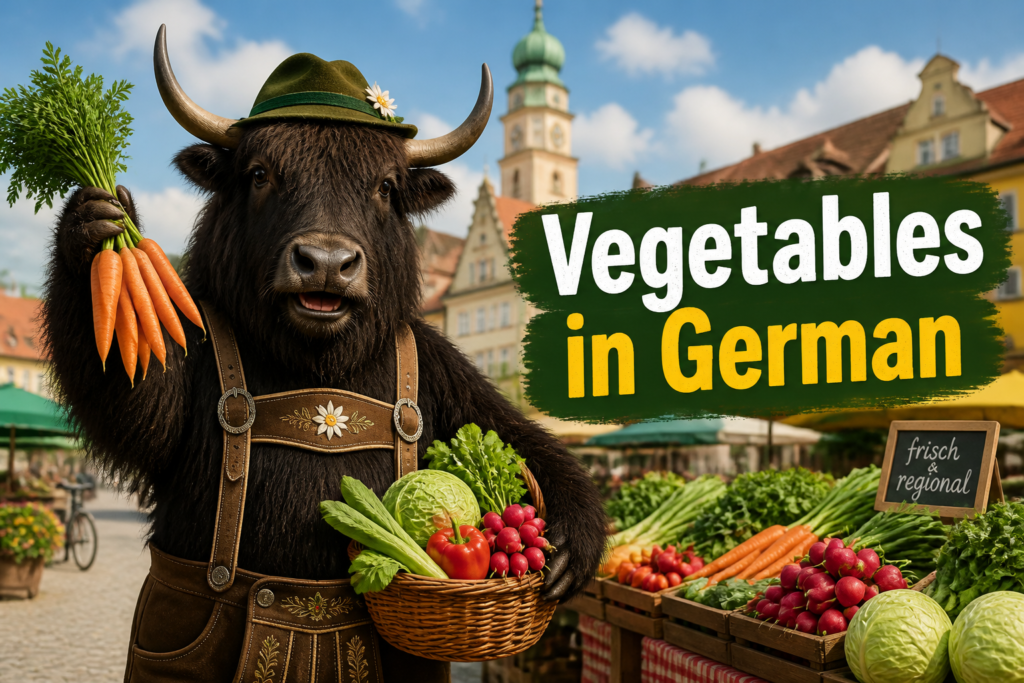
If you want to order food, shop at the market, or survive a German recipe without staring at the word list like it owes you money, vegetables are a very useful place to start. “Vegetables in German” sounds simple enough, but the real win is learning the everyday words people actually use: die Karotte, die Tomate, der Salat, and the not-so-glamorous but very common das Gemüse.
For the broader learning path, visit our parent guide.
German is wonderfully practical here. Many vegetable names look a bit familiar, some are borrowed from Latin or other European languages, and a few are sneaky little troublemakers with articles and plurals. Because of course they are.
You will also see that Germans often talk about vegetables in the singular with Gemüse, which is a group noun. That’s one of those small grammar things that makes a big difference when you want to sound natural instead of like you just escaped a dictionary.
For a broader starter list of useful basics, it also helps to keep Essential German Words & Phrases nearby. Vocabulary loves company.
Core Vegetable Words You Will Hear Often
Here are the most useful vegetable words first. This is the kind of vocabulary you will see in shops, recipes, menus, and friendly “Should we buy something green?” conversations.
| German | Pronunciation | Meaning | Example Sentence | Translation | Learner Note |
|---|---|---|---|---|---|
| das Gemüse | gah-MYOO-zuh | vegetables, veg | Ich kaufe frisches Gemüse auf dem Markt. | I buy fresh vegetables at the market. | Usually used as a mass noun. No plural in normal use. |
| die Karotte | kah-ROH-tuh | carrot | Die Karotte ist schon weich. | The carrot is already soft. | Very common in Germany. In Austria, people often say die Möhre less often for the orange one? Actually the common regional variation is the other way around: Karotte is especially common in Austria. |
| die Möhre | MEW-ruh | carrot | Ich esse gern Möhren roh. | I like eating carrots raw. | Common in Germany too, especially in some regions. Same vegetable as Karotte. |
| die Tomate | toh-MAH-tuh | tomato | Die Tomate ist sehr reif. | The tomato is very ripe. | Plural: die Tomaten. |
| die Gurke | GOOR-kuh | cucumber | Ich nehme eine Gurke für den Salat. | I’ll take a cucumber for the salad. | Very useful in supermarkets and sandwich shops. |
| die Kartoffel | kar-TOFF-el | potato | Die Kartoffeln sind fast fertig. | The potatoes are almost ready. | Plural: Kartoffeln. One of the most important German food words, honestly. |
| die Zwiebel | TSVEE-bel | onion | Bitte ohne Zwiebeln. | Please, without onions. | Very common in restaurants. Singling out onions is a noble act. |
| der Knoblauch | KNOHB-lowkh | garlic | Ich mag Knoblauch sehr gern. | I like garlic very much. | Uncountable in normal use. No plural in everyday speech. |
| der Salat | zah-LAHT | salad, lettuce | Der Salat ist heute teuer. | The salad is expensive today. | Can mean salad in general or lettuce depending on context. |
| der Spinat | shpee-NAHT | spinach | Ich koche Spinat mit Kartoffeln. | I cook spinach with potatoes. | Often used without an article when talking about the food in general. |
| die Paprika | PAHP-ree-kah | bell pepper, sweet pepper | Die Paprika ist rot. | The pepper is red. | In German, Paprika can be feminine singular or plural in usage. Context matters. |
| der Mais | myss | corn | Mais ist in diesem Gericht drin. | Corn is in this dish. | Often treated as a mass noun. |
Learner note: In German, nouns are always capitalized. So it is die Tomate, not die tomate. Tiny rule, huge habit.
More Common Vegetables And Kitchen Words
Once you know the basics, you can keep expanding your vocabulary with vegetables that appear in recipes, soups, side dishes, and market stalls.
| German | Pronunciation | Meaning | Example Sentence | Translation | Learner Note |
|---|---|---|---|---|---|
| der Brokkoli | BROK-koh-lee | broccoli | Brokkoli passt gut zu Pasta. | Broccoli goes well with pasta. | Borrowed word. Easy to recognize. |
| der Blumenkohl | BLOO-men-kohl | cauliflower | Ich mache Blumenkohlsuppe. | I’m making cauliflower soup. | Literally “flower cabbage.” German does love a compound noun. |
| der Rosenkohl | ROH-zen-kohl | Brussels sprouts | Rosenkohl schmeckt besser mit Butter. | Brussels sprouts taste better with butter. | Often polarizing. People feel things about this one. |
| die Erbse | ERB-suh | pea | Die Erbsen sind tiefgekühlt. | The peas are frozen. | Plural: Erbsen. Common in side dishes and soups. |
| die Bohne | BOH-nuh | bean | Ich esse grüne Bohnen gern. | I like eating green beans. | Plural: Bohnen. Green beans are usually grüne Bohnen. |
| die grüne Bohne | GROO-nuh BOH-nuh | green bean | Die grünen Bohnen sind noch knackig. | The green beans are still crisp. | Adjective ending changes in plural: grünen. |
| die Lauch | ??? | leek | Leek isn’t this? |