In this A2 German retelling of the classic fairy tale, a humble fisherman catches a magical flounder that grants wishes. His wife, however, is never satisfied, demanding a cottage, a castle, and even to become king and emperor. As her greed grows, the fisherman returns to the flounder again and again, until the sea itself grows stormy with anger. Discover how far the wife's ambition will go and what happens when she asks for the impossible.
This interactive graded reader makes reading in German easy and enjoyable. Simply tap any word to see its meaning instantly, and listen to the full story audio for natural pronunciation. You'll also find grammar insights and vocabulary tips woven throughout, helping you build skills while enjoying a timeless tale. Best of all, it's completely free to read and learn.
Es war einmal ein . Er lebte mit seiner Frau in einer am Meer. Jeden Tag ging er .
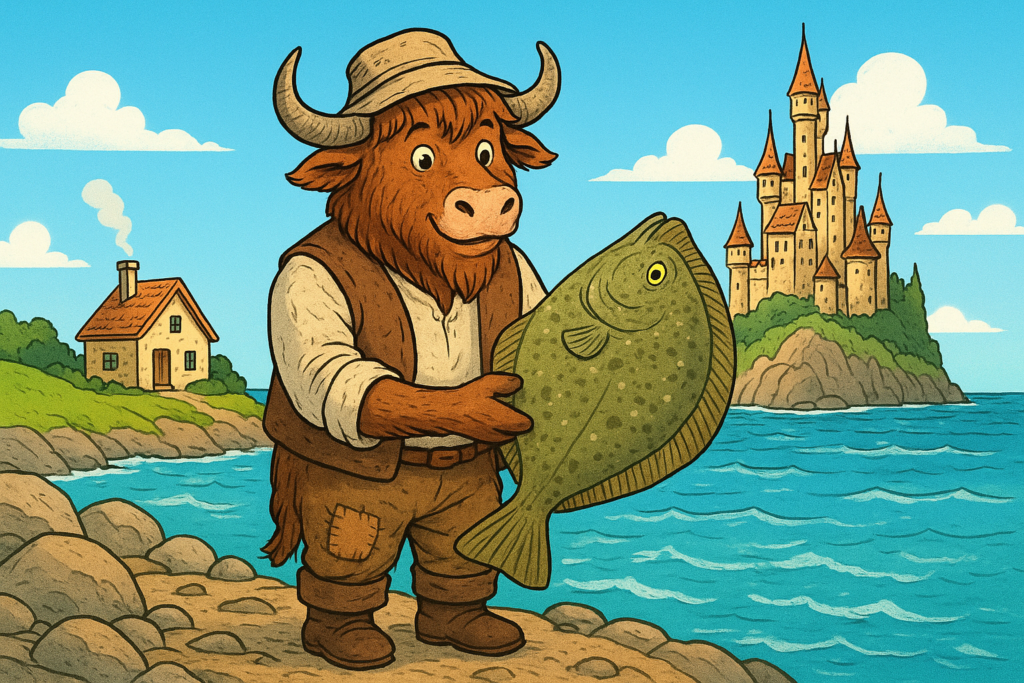
Eines Tages er einen . Der Fisch war eine Flunder. Sie sagte: „Bitte lass mich frei. Ich bin ein Prinz." Der Fischer war und ließ sie frei.
Zu Hause erzählte er alles seiner Frau. Sie war : „Ein Zauberfisch? Geh zurück! eine !" Der Fischer ging zum Meer.
Das Meer war nicht mehr . Der Fischer rief: „O Flunder, Flunder in der See, meine Frau möchte eine schönere Hütte!" Die Flunder und sagte: „Geh heim. Sie hat sie schon."
Zu Hause stand eine mit Garten. Die Frau war – aber nur kurz. Sie sagte: „Ich möchte ein . Ein Schloss!" Der Fischer und ging wieder ans Meer.
Das Meer war nun . Er rief: „O Flunder, Flunder in der See, meine Frau möchte ein !" Die Flunder sagte: „Geh heim. Sie sitzt schon in einem Schloss."
Bald wollte die Frau sein. Das Meer wurde . Sie wurde Königin. Dann wollte sie sein. Das Meer tobte. Sie wurde Kaiserin.
Danach rief sie: „Ich möchte sein!" Das Meer war . Trotzdem die Flunder den Wunsch. Am nächsten Morgen sagte die Frau: „Ich möchte Gott sein!"
Der Fischer und ging zum Meer. Es war ein . Er schrie: „O Flunder, Flunder in der See, meine Frau möchte Gott sein!" Eine Stimme antwortete: „Geh heim. Sie sitzt wieder in eurer alten Hütte." Und so war es. .
Once upon a time there was a fisherman. He lived with his wife in a small hut by the sea. Every day he went fishing.
One day he caught a big fish. The fish was an enchanted flounder. It said, "Please let me go. I am a prince." The fisherman was amazed and let it go.
At home he told his wife everything. She was furious: "A magic fish? Go back! Wish for a nicer hut!" The fisherman reluctantly went to the sea.
The sea was no longer clear. The fisherman called: "O flounder, flounder in the sea, my wife wants a nicer hut!" The flounder came and said, "Go home. She has it already."
At home stood a pretty hut with a garden. The wife was happy - but only briefly. She said, "I want a bigger house. A castle!" The fisherman sighed and went back to the sea.
The sea was now gray. He called: "O flounder, flounder in the sea, my wife wants a bigger castle!" The flounder said, "Go home. She is already sitting in a castle."
Soon the wife wanted to be queen. The sea became stormy. She became queen. Then she wanted to be empress. The sea raged. She became empress.
After that she cried, "I want to be Pope!" The sea was pitch black. Nevertheless, the flounder granted the wish. The next morning the wife said, "I want to be God!"
The fisherman wept and went to the sea. There was a terrible storm. He shouted: "O flounder, flounder in the sea, my wife wants to be God!" A voice answered, "Go home. She is sitting again in your old hut." And so it was. Nothing was left.
In 'The Fisherman and His Wife', we meet a few central characters. Their roles give us useful vocabulary for talking about family and jobs at the A2 level.
Notice how the story uses these words naturally. The fisherman (der Fischer) goes fishing every day, and his wife (die Frau) stays at home – until her wishes start changing everything!
- der Fischer (fisherman), die Fischerin (fisherwoman; less common, but often just der Fischer)
- die Frau (wife / woman), der Mann (husband / man)
- die Hütte (hut / cottage) – a small, simple home
- das Schloss (castle) – a much grander place to live
The wife constantly wants more: first a prettier cottage, then a house, a castle, and so on. She uses two key verbs to express her desires: "wünschen" and "möchten".
"Wünschen" means to wish for something, often used for bigger or more magical wishes. In the story, she commands: "Wünsch dir eine schönere Hütte!" (Wish for a prettier cottage!).
"Möchten" is the polite way to say "would like". The wife also says: "Ich möchte ein größeres Haus" (I would like a bigger house). At A2, "möchten" is your go‑to verb for everyday requests.
- Ich möchte ein Eis. (I would like an ice cream.)
- Er wünscht sich ein Fahrrad. (He wishes for a bike.)
- Wir möchten gern reservieren. (We would like to make a reservation, polite.)
- Was wünschst du dir zum Geburtstag? (What do you wish for your birthday?)
The wife’s demands become more and more extreme – everything has to be bigger or more impressive. In German, we form comparatives by adding -er to the adjective. For example, "schön" (beautiful) becomes "schöner" (more beautiful).
When we compare two things, we often use "als" (than). The wife doesn’t compare directly, but we can imagine: "Ein Schloss ist größer als eine Hütte." (A castle is bigger than a cottage.)
Keep an eye on vowel changes: some adjectives add an umlaut in the comparative, like "groß" → "größer" (big → bigger).
- klein → kleiner (small → smaller)
- wütend → wütender (angry → angrier) – note: long adjectives just add -er
- gut → besser (good → better) – irregular!
- viel → mehr (much → more) – also irregular
Now you have the tools to talk about your own wishes and the people around you. Imagine a magical fish offers you one wish – what would it be?
Try using "Ich möchte …" or "Ich wünsche mir …" with some comparatives. For example: "Ich möchte ein gemütlicheres Zimmer" (I would like a cozier room). Practise with a partner or write down three wishes – keeping them a little more modest than the fisherman’s wife’s!
The Fisherman and His Wife comes from an older public-domain story tradition and is best known as a public_domain_fairy_tale_retelling. This Yak Yacker article is an original learner retelling based on public-domain source material, so the wording here is simplified for modern learners rather than copied from one old edition.
Older printings, translations, and retellings of this story can vary quite a bit. This version is adapted for A2 Elementary learners studying German.
If you want to keep going, browse more in our German section and review the Goethe A2 German Vocabulary. After that, try German Comparative and Superlative Forms for another useful next step.